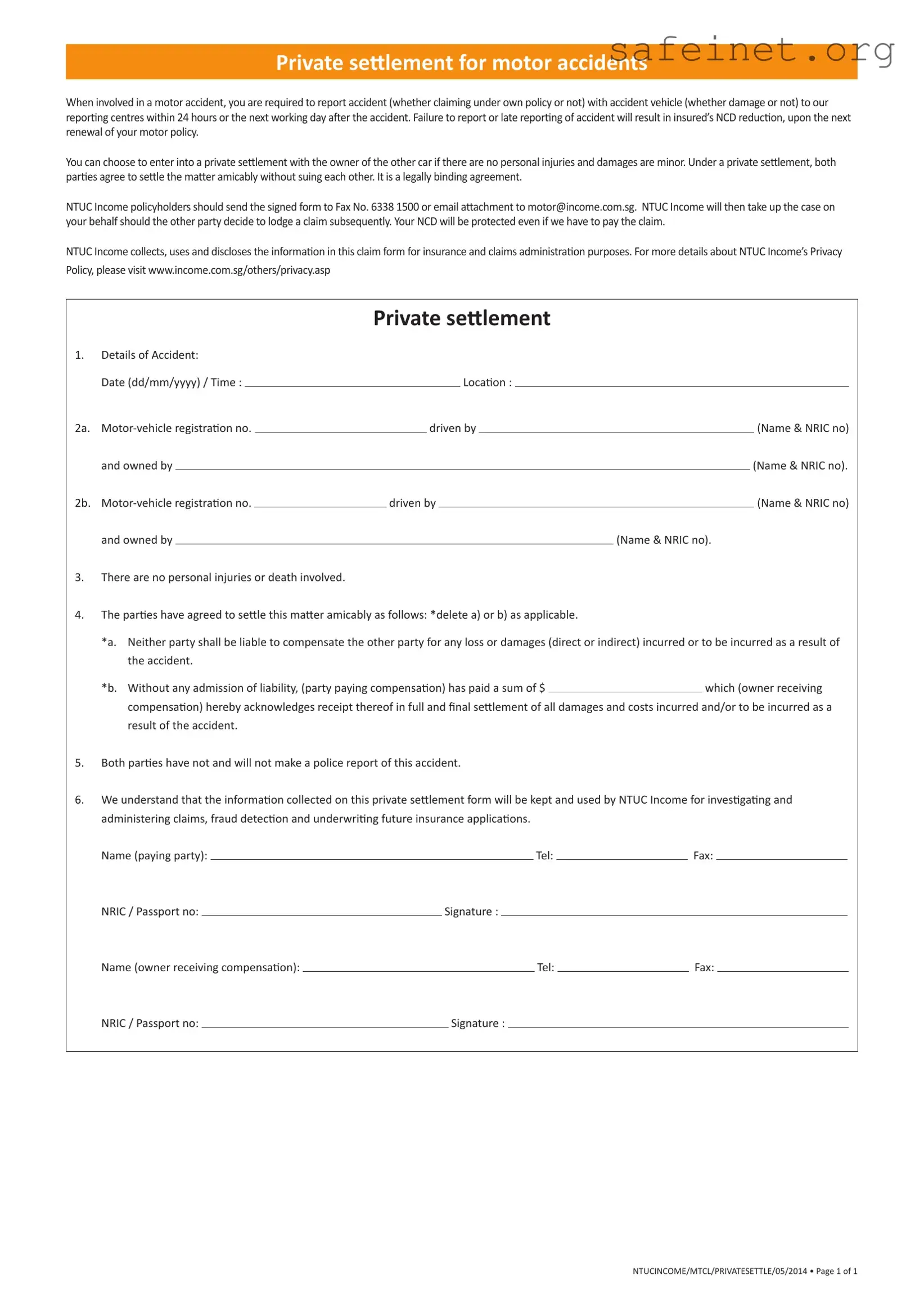
When a motor accident occurs, navigating the aftermath can be overwhelming. The Settlement Motor Accident form provides a structured way for parties involved to address the situation without escalating it to legal disputes. This form is particularly useful when there are no personal injuries and damages are minor, allowing both parties to agree on a private settlement. Key details must be recorded, including the date, time, and location of the accident, as well as the registration numbers and identities of the vehicles and their owners. Importantly, both parties must confirm that they are not pursuing police involvement. The agreement reached is legally binding, ensuring that neither party will seek further compensation for losses or damages related to the accident. Furthermore, NTUC Income policyholders are guided on how to submit the completed form, ensuring that their no-claim discount (NCD) is protected even if a claim arises later. The form also emphasizes the responsible handling of personal information, reassuring users that their data will be utilized solely for insurance and claims administration purposes. Understanding the components of this form is essential for anyone involved in a motor accident, as it can streamline the resolution process and provide peace of mind.

PRIVATE SEtLEMENT FOR MOTOR ACCIDENTS
When involved in a motor accident, you are required to report accident (whether claiming under own policy or not) with accident vehicle (whether damage or not) to our reporing centres within 24 hours or the next working day ater the accident. Failure to report or late reporing of accident will result in insured’s NCD reducion, upon the next renewal of your motor policy.
You can choose to enter into a private setlement with the owner of the other car if there are no personal injuries and damages are minor. Under a private setlement, both paries agree to setle the mater amicably without suing each other. It is a legally binding agreement.
NTUC Income policyholders should send the signed form to Fax No. 6338 1500 or email atachment to [email protected]. NTUC Income will then take up the case on your behalf should the other party decide to lodge a claim subsequently. Your NCD will be protected even if we have to pay the claim.
NTUC Income collects, uses and discloses the informaion in this claim form for insurance and claims administraion purposes. For more details about NTUC Income’s Privacy
Policy, please visit www.income.com.sg/others/privacy.asp
PRIVATE SEtLEMENT
1.Details of Accident:
|
Date (dd/mm/yyyy) / Time : |
|
|
|
|
|
|
Locaion : |
|
|
|
|
|
||
2a. |
|
|
driven by |
|
|
|
|
|
(Name & NRIC no) |
||||||
|
and owned by |
|
|
|
|
|
|
|
|
|
|
(Name & NRIC no). |
|||
2b. |
|
|
driven by |
|
|
|
|
|
(Name & NRIC no) |
||||||
|
and owned by |
|
|
|
|
|
|
|
|
(Name & NRIC no). |
|||||
3.There are no personal injuries or death involved.
4.The paries have agreed to setle this mater amicably as follows: *delete a) or b) as applicable.
*a. Neither party shall be liable to compensate the other party for any loss or damages (direct or indirect) incurred or to be incurred as a result of the accident.
*b. Without any admission of liability, (party paying compensaion) has paid a sum of $ |
|
which (owner receiving |
compensaion) hereby acknowledges receipt thereof in full and final setlement of all damages and costs incurred and/or to be incurred as a
result of the accident.
5.Both paries have not and will not make a police report of this accident.
6.We understand that the informaion collected on this private setlement form will be kept and used by NTUC Income for invesigaing and administering claims, fraud detecion and underwriing future insurance applicaions.
Name (paying party): |
|
|
|
|
|
|
|
Tel: |
|
|
Fax: |
|
||
NRIC / Passport no: |
|
|
Signature : |
|
|
|
|
|
|
|
|
|||
Name (owner receiving compensaion): |
|
|
|
|
|
|
Tel: |
|
|
Fax: |
|
|||
NRIC / Passport no: |
|
|
Signature : |
|
|
|
|
|
|
|||||
NTUCINCOME/MTCL/PRIVATESETTLE/05/2014 • Page 1 of 1
| Fact Name | Description |
|---|---|
| Reporting Requirement | Accidents must be reported to the insurance provider within 24 hours or the next working day, regardless of the claim status. |
| Impact of Late Reporting | Failing to report an accident on time may lead to a reduction in the insured's No Claim Discount (NCD) during the next policy renewal. |
| Private Settlement Option | Parties can choose to settle privately if there are no personal injuries and damages are minor, allowing for an amicable resolution. |
| Legally Binding Agreement | A private settlement is a legally binding agreement between the involved parties, ensuring that both agree not to sue each other. |
| Submission Instructions | NTUC Income policyholders must send the signed form via fax or email to initiate the claims process. |
| NCD Protection | The insured's No Claim Discount will be protected even if the insurance provider has to pay a claim on behalf of the other party. |
| Information Usage | Information collected through the form is used for claims administration, fraud detection, and underwriting future insurance applications. |
| Privacy Policy | For details on how personal information is handled, refer to NTUC Income’s Privacy Policy available on their website. |
Filling out the Settlement Motor Accident form is an important step in resolving a motor vehicle accident amicably. Once completed, this form serves as a record of the agreement between the parties involved, ensuring that both sides are clear on the terms of the settlement.
What is the purpose of the Settlement Motor Accident form?
The Settlement Motor Accident form is designed for parties involved in a motor accident to document the details of the incident and agree on a private settlement. This form is particularly useful when there are no personal injuries and the damages are minor, allowing both parties to resolve the matter amicably without legal action.
What are the reporting requirements after a motor accident?
It is mandatory to report the accident to the relevant reporting centers within 24 hours or by the next working day, regardless of whether you intend to claim under your own policy. Failing to report the accident on time may result in a reduction of your No Claims Discount (NCD) during the next renewal of your motor policy.
Can I choose to settle privately after an accident?
Yes, if there are no personal injuries and the damages are minor, both parties can agree to a private settlement. This agreement is legally binding, meaning that both parties must adhere to the terms outlined in the Settlement Motor Accident form.
What should I do if the other party decides to lodge a claim later?
If the other party decides to file a claim after you have completed the private settlement, you should submit the signed Settlement Motor Accident form to NTUC Income. They will handle the case on your behalf, ensuring that your NCD is protected even if a claim is made.
What information is collected in the Settlement Motor Accident form?
The form collects essential details such as the date and time of the accident, the location, vehicle registration numbers, and the names and identification numbers of both parties involved. Additionally, it includes the agreement terms regarding compensation and the acknowledgment of receipt of any payments made.
What happens if there are personal injuries involved?
If personal injuries or fatalities are involved in the accident, it is advisable to report the incident to the police and not to proceed with a private settlement. Legal advice may be necessary in such cases to ensure that all parties' rights are protected.
How does NTUC Income use the information from the form?
NTUC Income collects and uses the information provided in the Settlement Motor Accident form for purposes related to insurance and claims administration. This includes investigating claims, detecting fraud, and underwriting future insurance applications. For more information, you can refer to NTUC Income’s Privacy Policy on their website.
What should I do if I have questions about the form?
If you have any questions or need assistance with the Settlement Motor Accident form, it is recommended to contact NTUC Income directly. They can provide guidance and clarification on the form and the settlement process.
How do I submit the completed form?
Once you have completed and signed the Settlement Motor Accident form, you can submit it by fax to 6338 1500 or via email to [email protected]. Ensure that all required information is accurately filled out to avoid any delays in processing your case.
Not reporting the accident in time. You must report the accident within 24 hours or by the next working day. Delays can affect your insurance.
Failing to provide complete details. Ensure all required information, like the date, time, and location of the accident, is filled out accurately.
Incorrect vehicle registration numbers. Double-check the registration numbers for both vehicles. Mistakes here can lead to complications later.
Overlooking personal injury declarations. If there are no personal injuries, make sure to clearly state that. This is crucial for the settlement process.
Not agreeing on settlement terms. Both parties must agree on the terms of the settlement. Clearly state whether compensation is being paid or if neither party is liable.
Missing signatures. Ensure that both parties sign the form. Without signatures, the agreement may not be valid.
Not keeping copies of the form. Always keep a copy of the filled-out form for your records. This can be helpful in case of future disputes.
Neglecting to include contact information. Both parties should provide accurate contact details, including phone numbers and email addresses, for future communication.
Not understanding the privacy policy. Familiarize yourself with how your information will be used. Read NTUC Income's privacy policy to know your rights.
When dealing with motor accidents, several important forms and documents may accompany the Settlement Motor Accident form. Each of these documents plays a vital role in ensuring that all parties involved have their interests protected and that the process is handled smoothly. Below is a list of commonly used forms and documents related to motor accident settlements.
Having these documents prepared and organized can streamline the process of settling a motor accident claim. It is essential to ensure that all necessary paperwork is completed accurately to protect your rights and interests. By understanding the purpose of each document, you can navigate the aftermath of a motor accident with greater confidence.
The first document that bears similarity to the Settlement Motor Accident form is the Release of Liability form. This document is often used in various contexts, such as personal injury cases or recreational activities. Like the Settlement Motor Accident form, it serves to protect one party from future claims by another party. Both documents require the parties involved to agree on the terms of the settlement, ensuring that no further legal action will be taken regarding the incident. This mutual agreement creates a binding contract that outlines the responsibilities and rights of each party, fostering a sense of closure and resolution.
Another document that parallels the Settlement Motor Accident form is the Non-Disclosure Agreement (NDA). While NDAs are typically used to protect sensitive information, they share a commonality in that both documents aim to establish clear boundaries and expectations between parties. In the context of a motor accident, the NDA may be used to ensure that any details regarding the private settlement remain confidential. Just as with the Settlement Motor Accident form, the NDA requires both parties to consent to the terms, thereby creating a legally binding arrangement that protects the interests of all involved.
The Mediation Agreement is also similar in purpose and function to the Settlement Motor Accident form. Mediation is often employed as a means of resolving disputes without resorting to litigation. In both cases, the parties agree to settle their differences amicably, often with the assistance of a neutral third party. The Mediation Agreement outlines the terms of the settlement, similar to how the Settlement Motor Accident form specifies the conditions under which the parties will resolve their issues. Both documents emphasize cooperation and understanding, aiming to reach a resolution that is satisfactory for all parties involved.
A further document that shares characteristics with the Settlement Motor Accident form is the Settlement Agreement. This document is typically used in various legal disputes to outline the terms of a settlement between parties. Like the Settlement Motor Accident form, it is a legally binding agreement that details the rights and responsibilities of each party. Both documents require the parties to agree on the settlement terms, including any compensation that may be exchanged. The Settlement Agreement provides a framework for resolving disputes, allowing parties to move forward without the burden of ongoing legal conflict.
The Affidavit of Settlement is another document that exhibits similarities to the Settlement Motor Accident form. An affidavit is a written statement confirmed by oath or affirmation, often used in legal proceedings. In the context of a motor accident, an Affidavit of Settlement may serve to formally document the agreement reached between the parties. Like the Settlement Motor Accident form, it requires both parties to affirm their understanding and acceptance of the settlement terms. This document provides an additional layer of assurance that the agreement is recognized and can be referenced in the future if necessary.
Lastly, the Claim Waiver form is akin to the Settlement Motor Accident form in that it releases one party from future claims related to a specific incident. This document is often utilized in insurance contexts, where one party agrees to waive their right to pursue further claims after receiving compensation. Both the Claim Waiver form and the Settlement Motor Accident form emphasize the importance of mutual consent and understanding, ensuring that both parties are aware of the implications of their agreement. By signing either document, individuals acknowledge their acceptance of the terms and the resolution of the matter at hand.
When filling out the Settlement Motor Accident form, attention to detail is crucial. Here are some important guidelines to follow:
There are several misconceptions surrounding the Settlement Motor Accident form that can lead to confusion and potential issues. Here are six common misunderstandings:
In fact, you are required to report any motor accident to the designated reporting centers within 24 hours, regardless of whether injuries occurred. Failing to do so can affect your No Claim Discount (NCD).
While a private settlement allows both parties to resolve the matter without suing, it does not absolve you from informing your insurance provider. They must be notified to protect your interests.
Your NCD will remain protected even if a claim is made later by the other party. The insurance company will handle the situation on your behalf.
On the contrary, a private settlement is a legally binding agreement. Both parties must adhere to the terms outlined in the form.
Once you agree to a private settlement, both parties must confirm that they will not make a police report regarding the accident. This is a critical part of the agreement.
The information provided in the claim form is used for various purposes, including fraud detection and underwriting future insurance applications. Understanding how your data is used is essential.
Here are key takeaways about filling out and using the Settlement Motor Accident form: