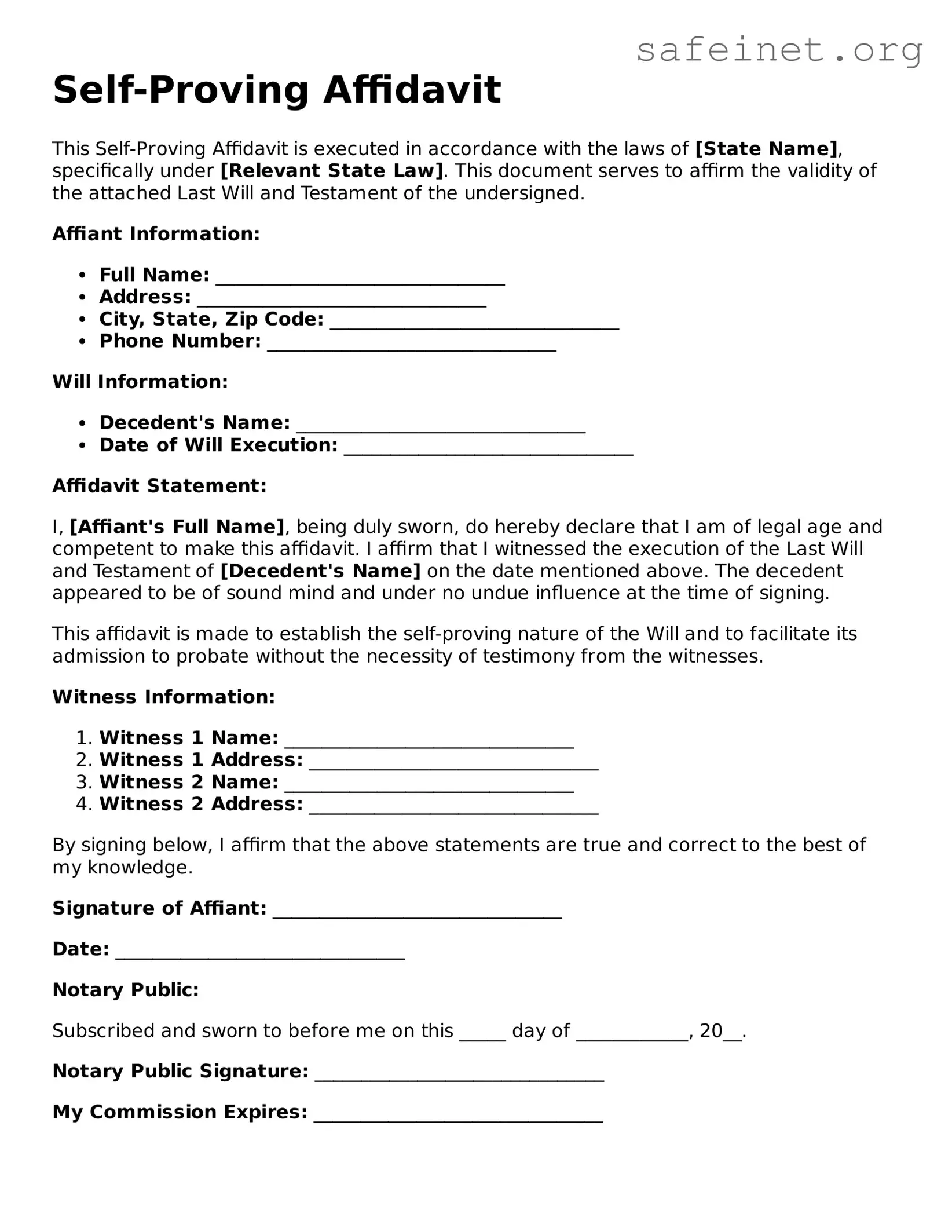
The Self-Proving Affidavit form plays a crucial role in the estate planning process, providing a streamlined way to validate a will without the need for witnesses to testify in court. This form is typically attached to a last will and testament, allowing the testator and witnesses to affirm their signatures in a sworn statement. By including a Self-Proving Affidavit, individuals can help ensure that their wishes are honored and that the probate process is expedited. It serves as a safeguard against potential disputes, as it establishes the authenticity of the will at the outset. The form generally requires the signatures of the testator and at least two witnesses, along with a notary public’s acknowledgment, making it a powerful tool in avoiding legal complications. Understanding how to properly complete and file this affidavit can significantly ease the burden on loved ones during a difficult time, ensuring that the estate is managed according to the deceased’s wishes with minimal hassle.
Self-Proving Affidavit
This Self-Proving Affidavit is executed in accordance with the laws of [State Name], specifically under [Relevant State Law]. This document serves to affirm the validity of the attached Last Will and Testament of the undersigned.
Affiant Information:
Will Information:
Affidavit Statement:
I, [Affiant's Full Name], being duly sworn, do hereby declare that I am of legal age and competent to make this affidavit. I affirm that I witnessed the execution of the Last Will and Testament of [Decedent's Name] on the date mentioned above. The decedent appeared to be of sound mind and under no undue influence at the time of signing.
This affidavit is made to establish the self-proving nature of the Will and to facilitate its admission to probate without the necessity of testimony from the witnesses.
Witness Information:
By signing below, I affirm that the above statements are true and correct to the best of my knowledge.
Signature of Affiant: _______________________________
Date: _______________________________
Notary Public:
Subscribed and sworn to before me on this _____ day of ____________, 20__.
Notary Public Signature: _______________________________
My Commission Expires: _______________________________
| Fact Name | Description |
|---|---|
| Definition | A Self-Proving Affidavit is a legal document that verifies the authenticity of a will, allowing it to be accepted in probate court without further proof. |
| Purpose | This affidavit simplifies the probate process by eliminating the need for witnesses to testify about the will's validity. |
| Requirements | Typically, the testator and witnesses must sign the affidavit in the presence of a notary public. |
| State-Specific Forms | Each state has its own version of the Self-Proving Affidavit, often included in the will itself. |
| Governing Laws | In many states, the governing law for Self-Proving Affidavits is found in the probate code, such as the Uniform Probate Code. |
| Benefits | Using a Self-Proving Affidavit can expedite the probate process and reduce legal disputes among heirs. |
| Limitations | Not all states recognize Self-Proving Affidavits, so it’s essential to check local laws. |
| Revocation | A Self-Proving Affidavit can be revoked if the will is modified or replaced, requiring a new affidavit to be executed. |
After obtaining the Self-Proving Affidavit form, you will need to fill it out accurately. This document will require specific information about the testator and the witnesses. Ensure you have all necessary details at hand before starting.
Once the form is completed and notarized, it should be kept with the will. This ensures that it is easily accessible when needed.
What is a Self-Proving Affidavit?
A Self-Proving Affidavit is a legal document that confirms the validity of a will. It is typically attached to a will and serves to simplify the probate process. This affidavit allows the will to be accepted by the court without requiring the witnesses to testify about the will's authenticity. In essence, it provides a layer of assurance regarding the will’s legitimacy.
Who can create a Self-Proving Affidavit?
Generally, the testator (the person who made the will) and the witnesses must sign the Self-Proving Affidavit. The testator must be of sound mind and at least 18 years old. The witnesses should also be competent adults. It’s crucial that everyone involved understands the contents of the will and the affidavit before signing.
What are the benefits of using a Self-Proving Affidavit?
The primary benefit is that it streamlines the probate process. By having a Self-Proving Affidavit, you can avoid the need for witnesses to appear in court. This can save time and reduce the complexity of the probate proceedings. Additionally, it can help prevent disputes regarding the will’s validity, as the affidavit acts as evidence of the will’s proper execution.
Is a Self-Proving Affidavit required?
No, a Self-Proving Affidavit is not legally required. However, it is highly recommended. Without it, witnesses may need to be located and called to testify, which can complicate and prolong the probate process. Including this affidavit can provide peace of mind and ensure a smoother transition of assets according to the deceased’s wishes.
How do I execute a Self-Proving Affidavit?
To execute a Self-Proving Affidavit, the testator and witnesses must sign the affidavit in the presence of a notary public. The notary will then notarize the document, confirming the identities of those who signed it. This process ensures that the affidavit is legally binding and can be presented in court without further witness testimony.
Can a Self-Proving Affidavit be revoked?
A Self-Proving Affidavit can be revoked if the underlying will is revoked. If the testator decides to create a new will, the previous will and its associated Self-Proving Affidavit become invalid. It’s important to ensure that any new documents are properly executed to avoid confusion during probate.
Not Including All Required Information: One common mistake is failing to fill in all the necessary details. Each section of the form must be completed accurately. Missing information can lead to complications later on.
Incorrect Signatures: Signatures are crucial on a Self-Proving Affidavit. People often forget to have witnesses sign or may not have the notary public sign the document properly. This oversight can invalidate the affidavit.
Using Outdated Forms: Laws and forms can change. Some individuals mistakenly use an outdated version of the Self-Proving Affidavit. Always ensure you are using the most current form to avoid legal issues.
Not Understanding the Purpose: Many people fill out the affidavit without fully grasping its purpose. This document serves to simplify the probate process by confirming the validity of a will. A lack of understanding can lead to improper completion.
A Self-Proving Affidavit is a legal document that enhances the validity of a will by confirming the authenticity of the signatures of the testator and witnesses. This affidavit is often accompanied by other forms and documents that play significant roles in the estate planning and probate processes. Below is a list of related documents that are frequently used alongside the Self-Proving Affidavit.
Understanding these documents can provide clarity in the estate planning process. Each plays a distinct role, ensuring that an individual's wishes are respected and followed after their passing.
The Self-Proving Affidavit is similar to the Last Will and Testament, which is a legal document outlining how a person's assets should be distributed after their death. Both documents serve to clarify the intentions of the individual regarding their estate. While the Last Will specifies beneficiaries and guardians, the Self-Proving Affidavit acts as a verification tool, confirming that the will was executed properly and witnessed. This can streamline the probate process, as it reduces the need for witnesses to testify about the will’s validity.
Another document that shares similarities with the Self-Proving Affidavit is the Durable Power of Attorney. This document allows a person to appoint someone else to manage their financial or medical decisions if they become incapacitated. Like the Self-Proving Affidavit, it requires signatures and can be notarized to enhance its legal standing. Both documents are designed to ensure that a person's wishes are respected and followed, even when they are unable to communicate those wishes themselves.
The Living Will is also comparable to the Self-Proving Affidavit. A Living Will outlines a person's preferences for medical treatment in situations where they cannot express their wishes. While the Self-Proving Affidavit confirms the authenticity of a will, the Living Will ensures that healthcare providers understand the individual's desires regarding life-sustaining treatments. Both documents emphasize the importance of clarity and intention in critical life decisions.
Similarly, the Revocable Trust shares key features with the Self-Proving Affidavit. A Revocable Trust allows individuals to manage their assets during their lifetime and dictate how those assets should be distributed after death. Like the Self-Proving Affidavit, this trust can help avoid probate and provides a clear framework for asset distribution. Both documents aim to protect the individual’s wishes and streamline the process for their heirs.
Finally, the Codicil is another document that resembles the Self-Proving Affidavit. A Codicil serves as an amendment to an existing will, allowing individuals to make changes without drafting an entirely new document. Just like the Self-Proving Affidavit, it requires proper execution and can include witness signatures. This ensures that any modifications to the will are legally binding and reflect the true intentions of the individual, similar to how a Self-Proving Affidavit verifies the original will's authenticity.
When filling out a Self-Proving Affidavit form, it’s important to follow certain guidelines to ensure that the document is valid and effective. Here are eight things to keep in mind:
The Self-Proving Affidavit is an important legal document often misunderstood. Here are ten common misconceptions about it:
Understanding these misconceptions can help individuals make informed decisions regarding their estate planning. A Self-Proving Affidavit can be a beneficial component of ensuring that your wishes are honored after your passing.
When filling out and using the Self-Proving Affidavit form, consider the following key takeaways: