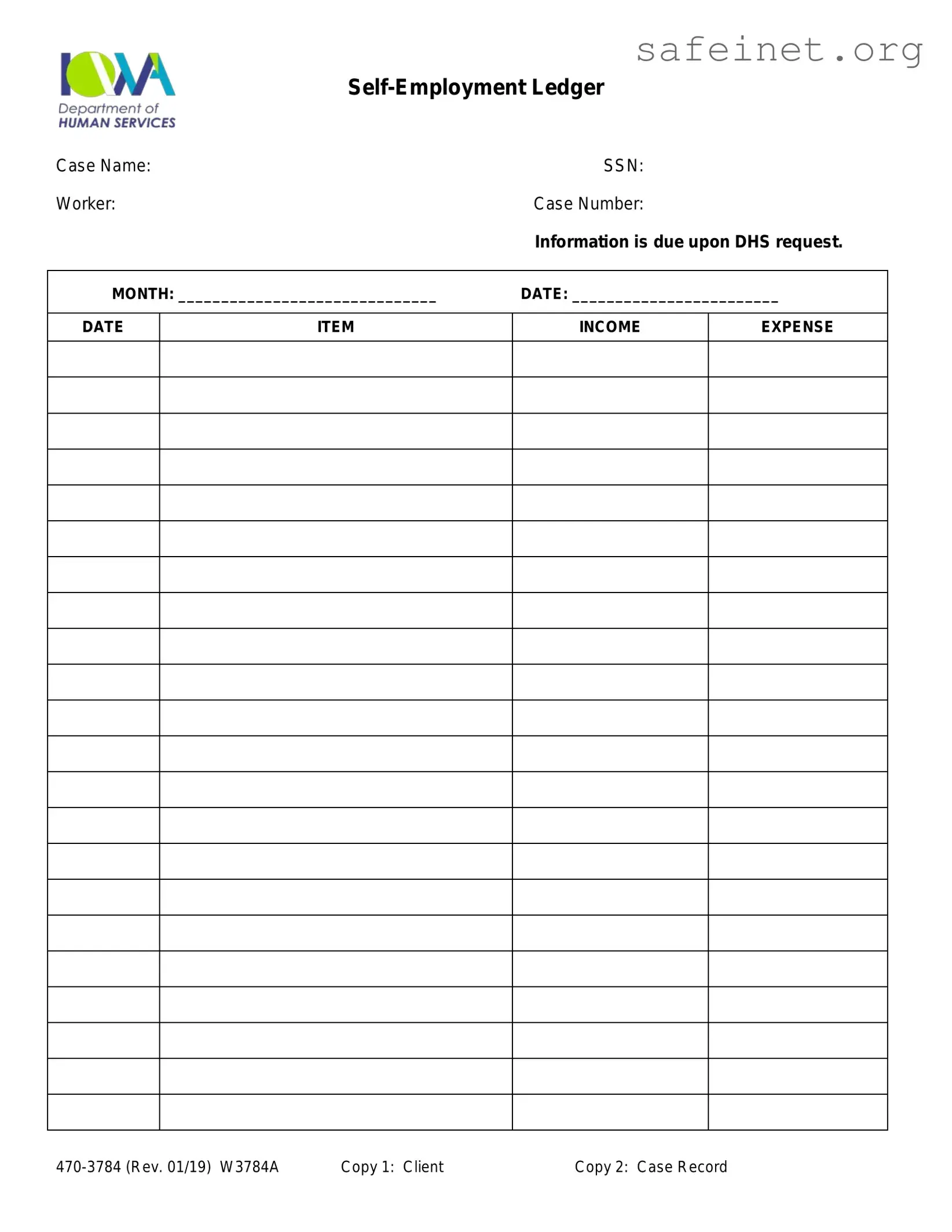
For individuals navigating the complexities of self-employment, the Self Employment Ledger form serves as a crucial tool in tracking income and expenses. This form, provided by the Iowa Department of Human Services, is essential for those who wish to maintain accurate records for their case. It requires specific details such as the case name, Social Security number, worker identification, and case number, ensuring that all information is organized and easily accessible. Each month, users must diligently record their income and expenses, as this data is vital for financial assessments and eligibility determinations. The form prompts users to fill in the date and item specifics, allowing for a clear overview of financial activity. Remember, timely submission of this information is necessary upon request from the Department of Human Services, making it imperative for self-employed individuals to stay on top of their records.
Case Name: |
|
SSN: |
|
Worker: |
|
Case Number: |
|
|
|
Information is due upon DHS request. |
|
|
|
|
|
MONTH: ______________________________ |
DATE: ________________________ |
||
|
|
|
|
DATE |
ITEM |
INCOME |
EXPENSE |
|
|
|
|
|
|
|
|
|
|
|
|
|
|
|
|
|
|
|
|
|
|
|
|
|
|
|
|
|
|
|
|
|
|
|
|
|
|
|
|
|
|
|
|
|
|
|
|
|
|
|
|
|
|
|
|
|
|
|
|
|
|
|
|
|
|
|
|
|
|
|
|
|
|
|
|
|
|
|
|
|
|
|
|
|
|
|
|
|
|
|
|
Copy 1: Client |
Copy 2: Case Record |
| Fact Name | Details |
|---|---|
| Governing Law | The Self Employment Ledger form is governed by Iowa Code Chapter 239B, which pertains to public assistance programs. |
| Purpose | This form is used to report income and expenses for self-employed individuals receiving assistance from the Iowa Department of Human Services. |
| Submission Requirement | Information must be provided upon request from the Department of Human Services to ensure compliance and accurate assistance calculations. |
| Form Version | The current version of the form is 470-3784, revised in March 2012. |
Filling out the Self Employment Ledger form is an important task for tracking your income and expenses as a self-employed individual. This form helps ensure that you provide the necessary information to the relevant authorities when requested. Below are the steps to guide you through the process of completing the form.
What is the purpose of the Self Employment Ledger form?
The Self Employment Ledger form is designed to help individuals track their income and expenses related to self-employment. This documentation is essential for the Iowa Department of Human Services (DHS) to assess eligibility for various assistance programs. By maintaining accurate records, individuals can ensure they provide the necessary information when requested by DHS.
Who needs to fill out the Self Employment Ledger form?
Any individual who is self-employed and receiving assistance or applying for assistance from the Iowa Department of Human Services should complete this form. This includes freelancers, independent contractors, and small business owners. Keeping track of income and expenses is crucial for those who want to maintain their eligibility for benefits.
How often should I update the Self Employment Ledger?
It is advisable to update the Self Employment Ledger regularly, ideally on a monthly basis. Frequent updates ensure that you have accurate and up-to-date information when DHS requests it. This practice not only helps in maintaining compliance but also simplifies your financial management.
What information do I need to provide on the form?
The Self Employment Ledger requires you to fill in details such as your case name, Social Security Number (SSN), worker's name, and case number. Additionally, you will need to record your income and expenses for each month. Accurate entries will help DHS evaluate your financial situation effectively.
What happens if I do not submit the Self Employment Ledger when requested?
Failure to submit the Self Employment Ledger when requested by DHS can lead to delays in processing your case or, in some instances, loss of benefits. It is important to respond promptly to any requests for documentation to avoid complications with your assistance status.
Can I use the Self Employment Ledger for tax purposes?
While the Self Employment Ledger is primarily intended for DHS requirements, it can also serve as a useful tool for tax purposes. Keeping detailed records of income and expenses can help you accurately report your earnings when filing taxes. However, ensure that you follow IRS guidelines for tax documentation as well.
Is there a specific format I need to follow for documenting income and expenses?
The Self Employment Ledger form provides a structured format for documenting your income and expenses. You should enter the date of each transaction, along with the corresponding income or expense amount. Adhering to this format will facilitate easier review by DHS and help you maintain organized records.
Where can I obtain a copy of the Self Employment Ledger form?
You can obtain a copy of the Self Employment Ledger form from the Iowa Department of Human Services website or by visiting your local DHS office. The form is also available in various community resource centers. Ensure you have the most recent version to comply with current requirements.
Failing to include the case name can lead to confusion and delays in processing.
Omitting the Social Security Number (SSN) may result in your form being rejected.
Not providing the worker's name can complicate communication with the Department of Human Services.
Forgetting to enter the case number can hinder the tracking of your submission.
Neglecting to fill in the month and date can lead to processing errors.
Inaccurate reporting of income or expenses can create discrepancies in your financial records.
Using illegible handwriting may cause misunderstandings or misinterpretations of your information.
Not keeping copies of the submitted form can leave you without proof of your submission.
Failing to update the ledger regularly can lead to outdated information being submitted.
Ignoring the due date for submission can result in penalties or loss of benefits.
The Self Employment Ledger form is an essential tool for documenting income and expenses related to self-employment. However, it is often used in conjunction with other important documents that help provide a complete financial picture. Here are four commonly associated forms and documents:
Using these documents alongside the Self Employment Ledger form can enhance the accuracy and completeness of financial reporting. This comprehensive approach supports better financial management and compliance with regulatory requirements.
The Self Employment Ledger form serves as a vital tool for tracking income and expenses for individuals who are self-employed. One document that shares similarities with this ledger is the Profit and Loss Statement. Like the Self Employment Ledger, a Profit and Loss Statement provides a detailed overview of income and expenses over a specific period. This document helps business owners understand their financial performance, making it easier to assess profitability and make informed decisions about their ventures.
Another comparable document is the Business Expense Report. This report focuses specifically on expenses incurred during business operations. Similar to the Self Employment Ledger, it itemizes costs such as supplies, travel, and utilities. By keeping a detailed record of expenses, business owners can ensure they are accurately reporting their financial situation, which is crucial for tax purposes and financial planning.
The Income Statement, also known as the Statement of Earnings, is yet another document that aligns with the Self Employment Ledger. This statement summarizes revenues and expenses over a certain period, ultimately revealing the net income or loss. Both documents aim to provide a clear picture of financial health, helping self-employed individuals understand their earnings and manage their finances more effectively.
A Cash Flow Statement is also similar in purpose. This document tracks the flow of cash in and out of a business. While the Self Employment Ledger focuses on income and expenses, the Cash Flow Statement emphasizes liquidity. Understanding cash flow is essential for self-employed individuals, as it helps them ensure they have enough funds to cover their ongoing expenses and invest in growth opportunities.
Lastly, the Schedule C form, used for reporting income or loss from a business, bears resemblance to the Self Employment Ledger. Both documents require detailed reporting of income and expenses. The Schedule C is specifically designed for tax reporting purposes, allowing self-employed individuals to calculate their taxable income. By accurately completing this form, individuals can leverage their Self Employment Ledger to ensure all financial information aligns with their tax obligations.
When filling out the Self Employment Ledger form, there are important guidelines to follow. Here’s a list of things you should and shouldn’t do:
Following these guidelines will help ensure that your form is filled out correctly and processed smoothly.
The Self Employment Ledger form is an important document for individuals who are self-employed and receiving assistance from the Iowa Department of Human Services. However, several misconceptions surround its use and requirements. Below are ten common misunderstandings about the Self Employment Ledger form, along with clarifications.
In reality, anyone who earns income from self-employment, regardless of the hours worked, should complete this form. Part-time self-employed individuals must also report their income and expenses.
This is incorrect. The form must be updated and submitted whenever there is a change in income or expenses, or upon request by the Department of Human Services.
The form is mandatory for reporting income and expenses. Failing to submit it can affect your eligibility for assistance.
It is essential to report actual income and expenses. Estimates can lead to inaccuracies that may impact benefits.
This form is applicable to all types of self-employment, whether it’s freelance work, a small business, or gig economy jobs.
Keeping detailed records is crucial. The ledger serves as a summary, but accurate records support the information reported.
Expenses must be legitimate and documented. Receipts or invoices should be kept to substantiate claims made on the form.
The Department may request the form at any time to verify ongoing eligibility for benefits, not just during annual reviews.
The Self Employment Ledger form must be completed using the official format provided by the Iowa Department of Human Services.
While submitting the form is necessary, it does not guarantee benefits. Eligibility is determined based on various factors, including income levels.
Understanding these misconceptions can help ensure that self-employed individuals comply with reporting requirements and maintain their eligibility for assistance. Always refer to official guidelines or consult with a professional for specific questions regarding your situation.
When filling out the Self Employment Ledger form, keep these key points in mind:
By following these guidelines, you can ensure that your Self Employment Ledger is filled out correctly and serves its purpose effectively.