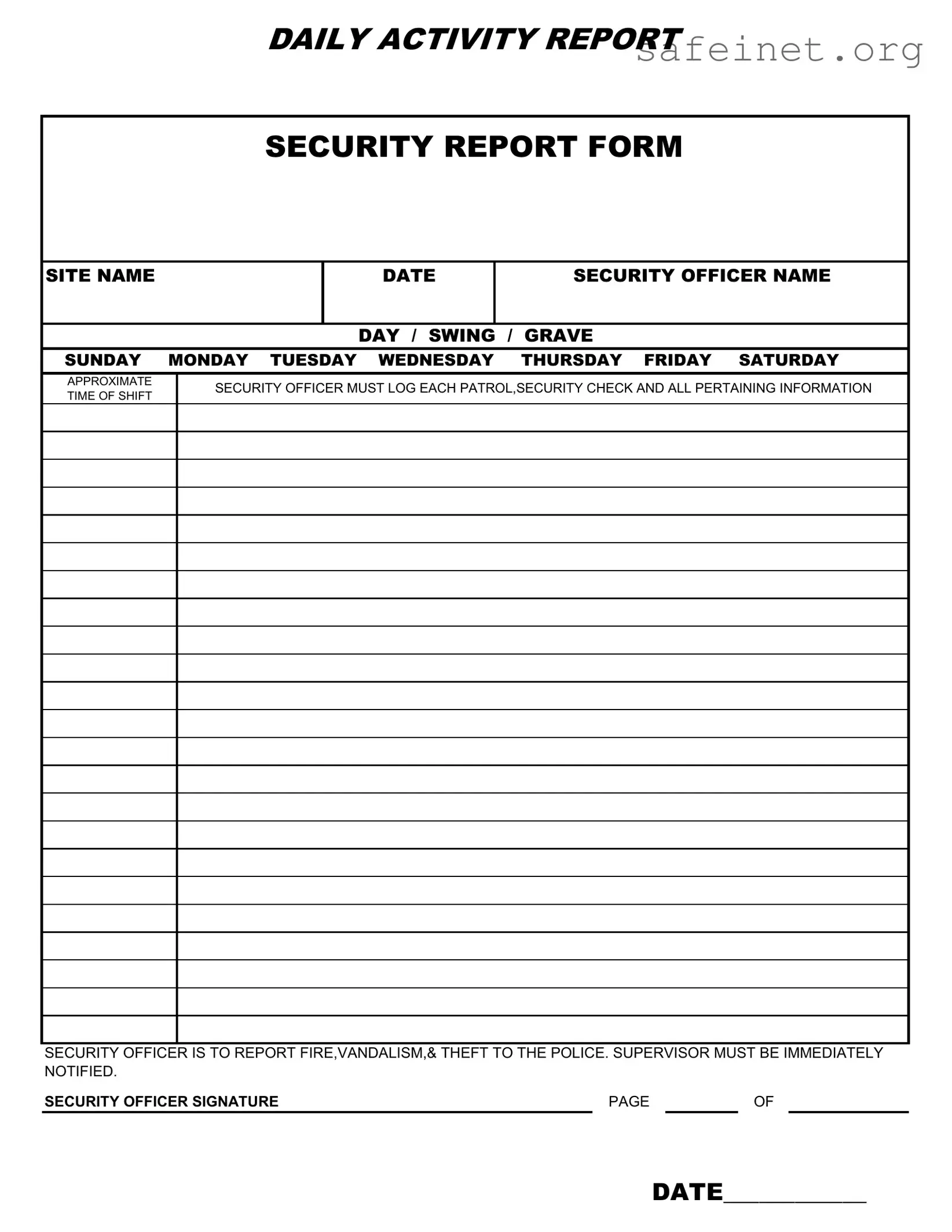
The Security Guard Daily Report Sample form serves as a crucial tool for maintaining safety and security at various sites. It includes essential fields such as the site name, date, and the name of the security officer on duty, along with their specific shift designation—whether day, swing, or grave. This form requires the officer to log each patrol and security check, ensuring that all relevant information is documented accurately. In cases of emergencies, such as fire, vandalism, or theft, the form mandates that the security officer notifies the police and informs a supervisor immediately. This structure not only promotes accountability but also enhances communication within the security team. Finally, the officer's signature is required to validate the report, emphasizing the importance of accurate record-keeping in the security profession.
DAILY ACTIVITY REPORT
SECURITY REPORT FORM
SITE NAME
DATE
SECURITY OFFICER NAME
DAY / SWING / GRAVE
SUNDAY MONDAY TUESDAY WEDNESDAY THURSDAY FRIDAY SATURDAY
APPROXIMATE TIME OF SHIFT
SECURITY OFFICER MUST LOG EACH PATROL,SECURITY CHECK AND ALL PERTAINING INFORMATION
SECURITY OFFICER IS TO REPORT FIRE,VANDALISM,& THEFT TO THE POLICE. SUPERVISOR MUST BE IMMEDIATELY NOTIFIED.
SECURITY OFFICER SIGNATURE |
PAGE |
|
OF |
DATE____________
| Fact Name | Description |
|---|---|
| Form Purpose | The Security Guard Daily Report Sample form is designed for security officers to log their daily activities and incidents. |
| Required Information | Security officers must record site name, date, their name, shift time, and details of each patrol or security check. |
| Incident Reporting | Officers are required to report incidents like fire, vandalism, and theft to the police and notify their supervisor immediately. |
| Signature Requirement | The form must be signed by the security officer to verify the accuracy of the reported information. |
Filling out the Security Guard Daily Report Sample form is an important task that helps maintain accurate records of daily activities. This ensures that all incidents and observations are documented properly. Below are the steps to complete the form effectively.
What is the purpose of the Security Guard Daily Report Sample form?
The Security Guard Daily Report Sample form is designed to help security officers document their daily activities. This form serves as a record of patrols, security checks, and any incidents that may occur during a shift. By maintaining a detailed account, it ensures accountability and provides valuable information for supervisors and law enforcement if necessary.
What information should be included in the report?
Each report should include essential details such as the site name, date, and the name of the security officer on duty. Additionally, it should capture the type of shift (day, swing, or grave) and the approximate time of the shift. The officer must log every patrol and security check, along with any relevant observations or incidents, such as fire, vandalism, or theft.
How should incidents like fire or theft be reported?
If a security officer encounters an incident such as a fire, vandalism, or theft, they are required to report it to the police immediately. Furthermore, the officer must notify their supervisor without delay. This ensures that appropriate actions can be taken swiftly to address the situation and mitigate any potential harm.
What is the significance of the security officer's signature on the report?
The signature of the security officer on the report serves as a confirmation that the information recorded is accurate and complete to the best of their knowledge. It also signifies that the officer has fulfilled their duty to document their activities and any incidents that occurred during their shift.
How does the report help supervisors?
Supervisors rely on these reports to monitor the activities of their security personnel and assess the security of the site. By reviewing daily reports, supervisors can identify patterns, address any recurring issues, and ensure that all protocols are being followed. This oversight is crucial for maintaining a safe environment.
Can the form be customized for different sites?
Yes, the Security Guard Daily Report Sample form can be customized to meet the specific needs of different sites. While the core information remains consistent, additional fields or sections can be added to address unique security concerns or requirements specific to a location. This flexibility allows for a more tailored approach to security reporting.
Incomplete Information: Failing to fill out all required fields, such as site name, date, or security officer name, can lead to confusion and miscommunication.
Incorrect Shift Designation: Not specifying whether the shift is day, swing, or grave can result in inaccurate record-keeping.
Omitting Patrol Logs: Neglecting to log each patrol or security check can create gaps in documentation, which may hinder incident investigations.
Failure to Report Incidents: Not reporting incidents like fire, vandalism, or theft can jeopardize safety and security protocols.
Delayed Notifications: Failing to notify the supervisor immediately after an incident occurs can lead to inadequate responses and increased risks.
Inaccurate Time Entries: Providing approximate times that are not precise can lead to misunderstandings about when incidents occurred.
Neglecting Signature: Forgetting to sign the report can render it unofficial and may raise questions about accountability.
Misunderstanding Report Purpose: Not recognizing that the report serves as a formal record can lead to incomplete or inaccurate entries.
Ignoring Clarity and Detail: Using vague language or abbreviations that are not universally understood can cause confusion for those reviewing the report.
When managing security operations, various forms and documents complement the Security Guard Daily Report. Each of these documents plays a crucial role in ensuring safety and accountability. Understanding their purpose can enhance the effectiveness of security measures.
Utilizing these documents alongside the Security Guard Daily Report can significantly enhance the overall security framework. Each form serves a specific purpose, contributing to a well-organized and effective security operation.
The Incident Report Form shares similarities with the Security Guard Daily Report. Both documents serve to record specific events or activities that occur during a given time frame. The Incident Report focuses on detailing any unusual occurrences, such as accidents or security breaches, while the Daily Report provides a broader overview of daily activities, including routine patrols and checks. Both forms require the signature of the reporting officer, ensuring accountability and accuracy in the documentation process.
The Patrol Log is another document that resembles the Security Guard Daily Report. This log specifically tracks the movements and actions taken by security personnel during their shifts. Like the Daily Report, the Patrol Log emphasizes the importance of recording times and locations of patrols. However, it may not include additional details about incidents or interactions with the public, making the Daily Report more comprehensive in nature.
The Shift Summary Report also aligns closely with the Security Guard Daily Report. This summary provides an overview of the entire shift, highlighting key activities, incidents, and any notable observations. While the Daily Report may focus on individual patrols and checks, the Shift Summary condenses that information into a concise format, making it easier for supervisors to review the overall security situation at a glance.
The Activity Log is another document that parallels the Security Guard Daily Report. This log tracks specific activities performed by security personnel throughout their shift. Similar to the Daily Report, it requires detailed entries, including times and descriptions of actions taken. The Activity Log may be more focused on routine tasks, while the Daily Report incorporates a wider range of events and incidents, providing a fuller picture of the day's security operations.
Lastly, the Security Incident Log shares characteristics with the Security Guard Daily Report. This log is used to document any security-related incidents that occur on-site, such as thefts, vandalism, or disturbances. Like the Daily Report, it emphasizes the importance of timely reporting and documentation. However, the Security Incident Log is more focused on specific incidents rather than the overall daily activities, allowing for detailed analysis of security breaches and responses.
When filling out the Security Guard Daily Report Sample form, it's important to keep a few key points in mind. Here are some things you should and shouldn't do:
By following these guidelines, you can help ensure that the report is thorough and useful for everyone involved.
Misconceptions about the Security Guard Daily Report Sample form can lead to misunderstandings regarding its purpose and use. Below are six common misconceptions, along with clarifications.
Understanding these misconceptions can help ensure that the Security Guard Daily Report is used effectively and serves its intended purpose.
When filling out the Security Guard Daily Report Sample form, consider the following key takeaways: