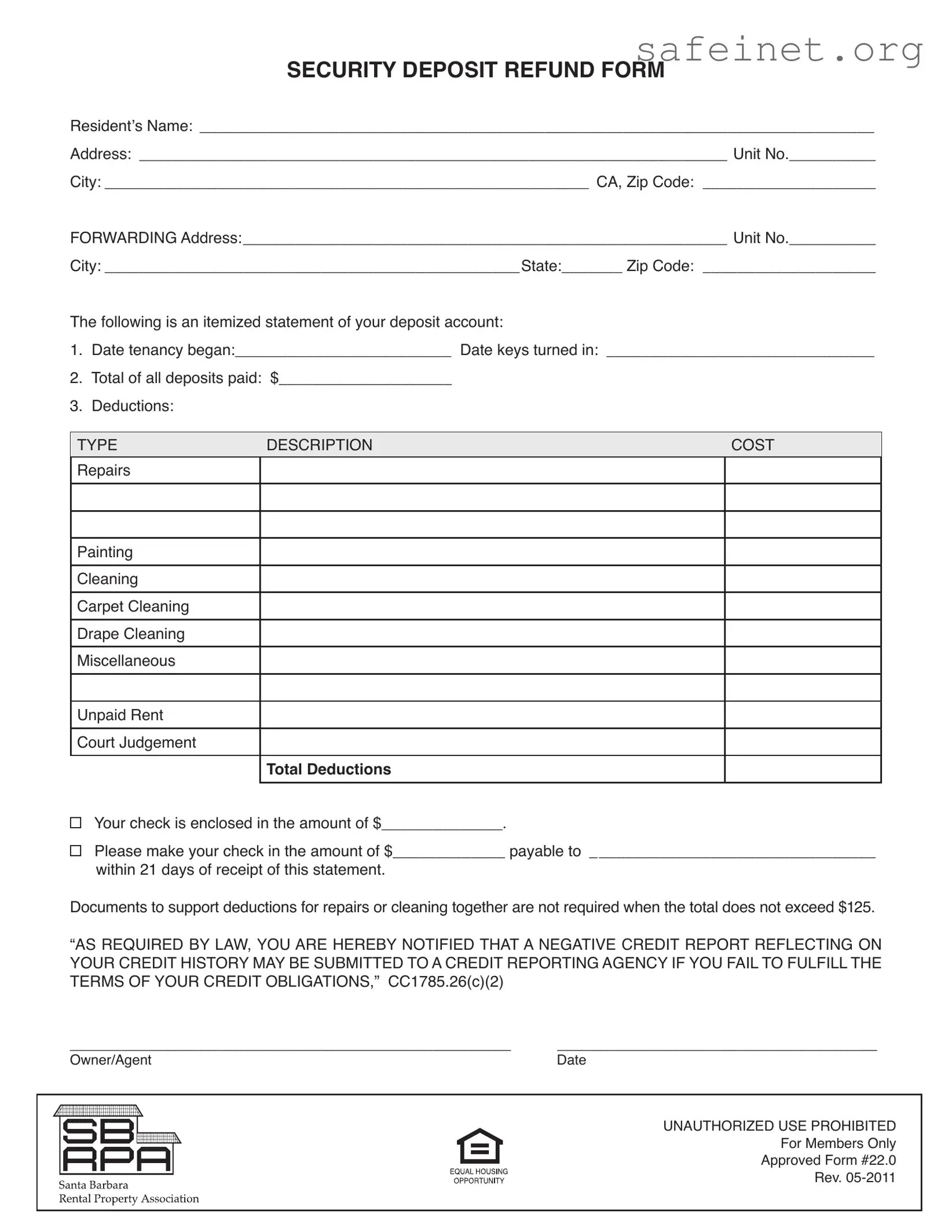
The Security Deposit Deductions form serves as a crucial document in the rental process, particularly when it comes to the return of security deposits. This form is designed to provide tenants with a clear breakdown of any deductions made from their security deposits after they vacate a rental unit. Key components include the resident's name and address, the unit number, and a forwarding address for the return of funds. It also requires important dates, such as when the tenancy began and when the keys were returned. A detailed itemized statement outlines the total deposits paid, along with specific deductions for repairs, cleaning, and any unpaid rent. Tenants will find that the form specifies the total amount being refunded and includes a reminder that supporting documents for deductions are not necessary if the total does not exceed $125. Furthermore, it highlights legal obligations regarding credit reporting, ensuring that tenants are aware of the potential consequences of unpaid dues. This structured approach aims to foster transparency and accountability between landlords and tenants, making the process smoother for all parties involved.
SECURITY DEPOSIT REFUND FORM
Resident’s Name: ______________________________________________________________________________
Address: ____________________________________________________________________ Unit No.__________
City: ________________________________________________________ CA, Zip Code: ____________________
FORWARDING Address:________________________________________________________ Unit No.__________
City: ________________________________________________State:_______ Zip Code: ____________________
The following is an itemized statement of your deposit account:
1.Date tenancy began:_________________________ Date keys turned in: _______________________________
2.Total of all deposits paid: $____________________
3.Deductions:
TYPE |
DESCRIPTION |
COST |
|
|
|
Repairs
Painting
Cleaning
Carpet Cleaning
Drape Cleaning
Miscellaneous
Unpaid Rent
Court Judgement
TOTAL DEDUCTIONS
Your check is enclosed in the amount of $______________.
Please make your check in the amount of $_____________ payable to _________________________________
within 21 days of receipt of this statement.
Documents to support deductions for repairs or cleaning together are not required when the total does not exceed $125.
“AS REQUIRED BY LAW, YOU ARE HEREBY NOTIFIED THAT A NEGATIVE CREDIT REPORT REFLECTING ON YOUR CREDIT HISTORY MAY BE SUBMITTED TO A CREDIT REPORTING AGENCY IF YOU FAIL TO FULFILL THE TERMS OF YOUR CREDIT OBLIGATIONS,” CC1785.26(c)(2)
___________________________________________________ |
_____________________________________ |
Owner/Agent |
Date |
UNAUTHORIZED USE PROHIBITED
For Members Only
Approved Form #22.0
Rev.
| Fact Name | Description |
|---|---|
| Purpose | The Security Deposit Refund Form is used to itemize deductions from a tenant's security deposit and to facilitate the refund process. |
| Tenancy Dates | The form requires the dates the tenancy began and when the keys were returned to ensure proper accounting of the rental period. |
| Itemized Deductions | Landlords must provide a breakdown of deductions for repairs, cleaning, and other costs incurred, ensuring transparency in the refund process. |
| Legal Requirement | California law mandates that a security deposit refund must be processed within 21 days of the tenant vacating the property. |
| Credit Reporting Notification | The form includes a legal notification regarding potential negative credit reporting if obligations are not fulfilled, as per California Civil Code § 1785.26(c)(2). |
After you receive the Security Deposit Deductions form, it’s important to fill it out accurately. This ensures that you provide all necessary information for the processing of your deductions. Follow these steps to complete the form correctly.
What is the purpose of the Security Deposit Deductions form?
The Security Deposit Deductions form is used to itemize any deductions taken from a tenant's security deposit after they move out. It provides a detailed account of the total deposits paid, deductions for repairs, cleaning, and any unpaid rent, ensuring transparency in the refund process.
How do I fill out the Security Deposit Deductions form?
To fill out the form, start by entering your name, address, and unit number. Then, note the dates your tenancy began and when you returned the keys. Next, list the total amount of deposits you paid. Finally, detail any deductions, including descriptions and costs for repairs, cleaning, or unpaid rent.
What types of deductions can be included?
Deductions may include costs for repairs, painting, cleaning, carpet cleaning, drape cleaning, and any unpaid rent. Each type of deduction should be clearly described and listed with its corresponding cost.
What is the maximum amount for which I do not need to provide supporting documents?
If the total deductions do not exceed $125, supporting documents for repairs or cleaning are not required. This allows for a more streamlined process for smaller deductions.
When will I receive my security deposit refund?
You should receive your security deposit refund within 21 days of receiving the itemized statement. The amount will be specified in the form, and a check will be issued accordingly.
To whom should the refund check be made payable?
The check should be made payable to the name specified in the form. Ensure that the correct name is entered to avoid any delays in processing your refund.
What happens if I fail to fulfill my credit obligations?
If you do not fulfill the terms of your credit obligations, a negative credit report may be submitted to a credit reporting agency. This can impact your credit history and score.
Can I dispute any deductions listed on the form?
If you believe any deductions are unfair or incorrect, you can dispute them. It’s advisable to communicate directly with your landlord or property management to address any concerns regarding the deductions.
Is there a specific format for the itemized statement of deductions?
The itemized statement should clearly list each deduction type, description, and cost. This format helps ensure clarity and allows you to understand how your security deposit was calculated.
What should I do if I have not received the form?
If you have not received the Security Deposit Deductions form after moving out, contact your landlord or property management. They are responsible for providing you with this information in a timely manner.
Missing Information: One common mistake is not filling in all the required fields. Residents often forget to include their forwarding address or the dates related to their tenancy. This can delay processing.
Incorrect Deductions: Sometimes, people list deductions that are not valid. For example, claiming costs for repairs that were not agreed upon or documented can lead to complications.
Calculation Errors: Double-checking the math is essential. Adding up the total deductions incorrectly can result in a lower refund than expected.
Not Providing Supporting Documents: While documents for repairs under $125 are not required, many forget to attach necessary evidence for larger deductions. This can create issues if the deductions are questioned.
The Security Deposit Deductions form is often used in conjunction with several other documents to ensure a comprehensive understanding of tenant obligations and rights. Below is a list of related forms and documents that may be relevant in the context of security deposits.
Understanding these documents can enhance clarity and transparency in the security deposit process. Each form plays a significant role in protecting the rights of both tenants and landlords, ensuring that all parties are informed and accountable.
The Security Deposit Deductions form shares similarities with a Lease Agreement. A Lease Agreement outlines the terms and conditions under which a tenant occupies a rental property. Both documents establish the financial obligations of the tenant, including the payment of a security deposit and any potential deductions. Just as the Security Deposit Deductions form specifies the reasons for deductions, a Lease Agreement often includes clauses about what constitutes acceptable wear and tear versus damage, guiding both parties in their expectations.
Another document that resembles the Security Deposit Deductions form is the Move-In Inspection Checklist. This checklist is typically completed at the beginning of a tenancy and documents the condition of the rental unit. Both forms serve to protect the interests of landlords and tenants by providing a record of the property's state. By comparing the move-in condition with the deductions listed on the Security Deposit Deductions form, disputes over damages can be minimized.
The Tenant's Notice of Intent to Vacate is also similar. This document is submitted by a tenant to inform the landlord of their intention to leave the rental property. Both the notice and the deductions form are essential in the transition process. The notice allows landlords to prepare for the upcoming vacancy, while the deductions form details any financial implications related to the tenant's departure.
The Rent Payment History is another related document. This record details all rent payments made by the tenant during their tenancy. Both the Rent Payment History and the Security Deposit Deductions form can be used to assess a tenant's financial behavior. If a tenant has unpaid rent, it may lead to deductions from their security deposit, which is documented in the deductions form.
Similarly, the Landlord's Statement of Account serves as a financial summary for the tenant. This document outlines all transactions between the landlord and tenant, including rent payments and any deductions. Both documents aim to provide transparency in financial dealings. The Landlord's Statement of Account can support or contradict the deductions listed on the Security Deposit Deductions form, depending on the circumstances.
The Final Walk-Through Checklist is also akin to the Security Deposit Deductions form. Conducted before a tenant vacates, this checklist assesses the condition of the rental unit. Both documents aim to ensure that the property is returned in an acceptable condition. They help establish accountability, as any discrepancies noted during the final walk-through may lead to deductions from the security deposit.
Another comparable document is the Pet Agreement. This agreement outlines the terms under which a tenant may keep pets in the rental unit. Both the Pet Agreement and the Security Deposit Deductions form can include financial implications related to damages caused by pets. If a tenant has pets, any additional cleaning or repairs needed may be itemized in the deductions form, similar to how the Pet Agreement stipulates pet-related responsibilities.
Lastly, the Eviction Notice shares some characteristics with the Security Deposit Deductions form. An Eviction Notice informs a tenant of their lease violations and the potential consequences. Both documents serve as formal communications regarding a tenant's obligations. While the Security Deposit Deductions form focuses on the return of the security deposit, the Eviction Notice addresses the consequences of failing to meet lease terms, highlighting the importance of adhering to agreed-upon conditions.
When filling out the Security Deposit Deductions form, it's important to be thorough and accurate. Here are some guidelines to help you navigate the process effectively.
By following these steps, you can help ensure that your Security Deposit Deductions form is processed smoothly and accurately.
Misconceptions about the Security Deposit Deductions form can lead to confusion for tenants and landlords alike. Here are seven common misconceptions:
Understanding these misconceptions can help both tenants and landlords navigate the security deposit process more effectively.
When filling out and using the Security Deposit Deductions form, it is important to understand the following key points: