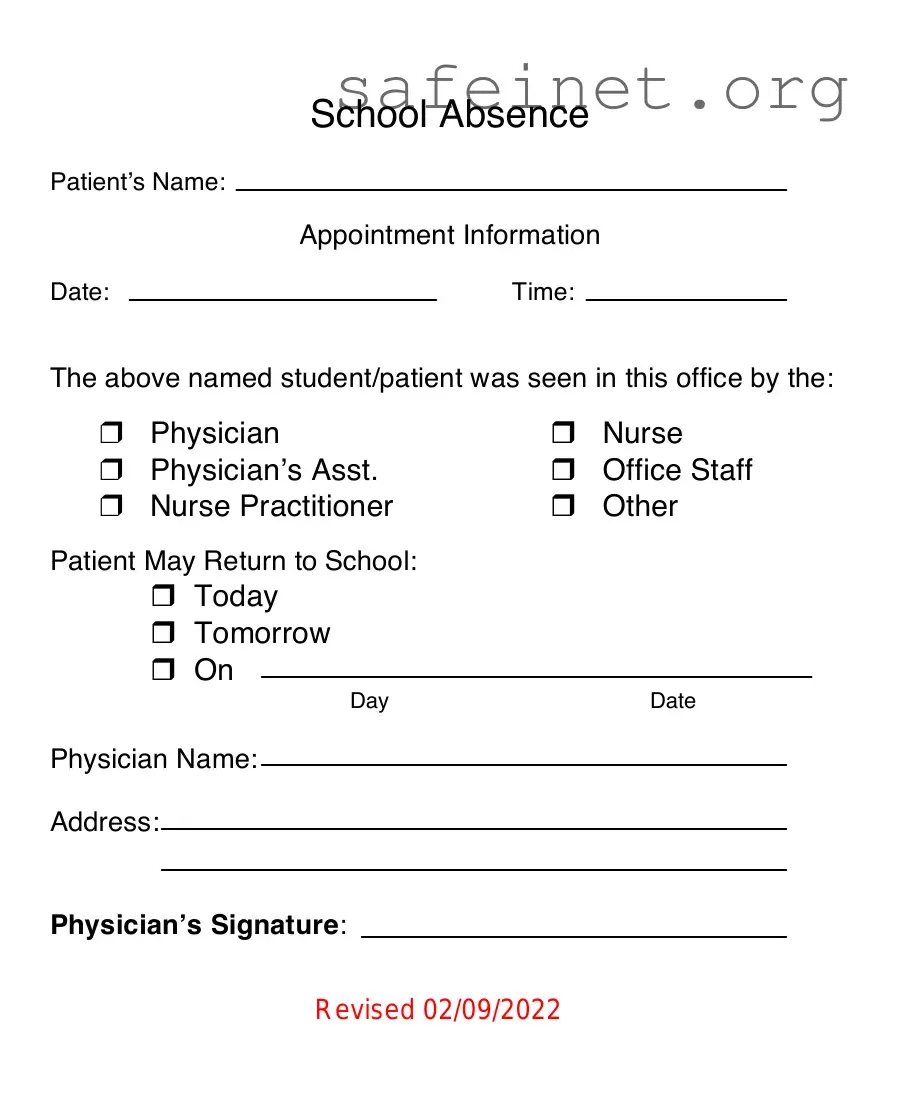
The School Absence form serves as an important document for students who need to communicate their absence from school due to medical reasons. This form captures essential information, including the patient’s name, the date and time of the medical appointment, and the identity of the healthcare provider who attended to the student, whether it was a physician, nurse, or another medical professional. It also indicates when the student is cleared to return to school, offering options for same-day, next-day, or specific date returns. The physician's name and signature authenticate the form, ensuring that the absence is officially recognized by the school. This streamlined process not only helps maintain accurate attendance records but also supports students in managing their health and education effectively.
School Absence
Patientʼs Name:
Appointment Information
Date:Time:
The above named student/patient was seen in this office by the:
|
Physician |
Nurse |
|
Physicianʼs Asst. |
Office Staff |
|
Nurse Practitioner |
Other |
Patient May Return to School:
Today
Tomorrow
On
DayDate
Physician Name:
Address:
Physicianʼs Signature:
Revised 02/09/2022
| Fact Name | Description |
|---|---|
| Patient's Name | The form requires the name of the student or patient to document the absence accurately. |
| Appointment Information | Details such as the date and time of the appointment must be filled out to validate the absence. |
| Provider Information | The form includes options to indicate who provided the medical care, such as a physician or nurse. |
| Return Date | Options for when the student may return to school are provided, ensuring clarity for both parents and school officials. |
| Governing Law | In many states, school absence forms are governed by education laws that require documentation of medical appointments. |
Completing the School Absence form is essential for ensuring that the school is informed about a student's absence due to a medical appointment. After filling out the form, it should be submitted to the appropriate school personnel to maintain accurate attendance records.
What is the purpose of the School Absence form?
The School Absence form serves as an official document to inform the school about a student's absence due to a medical appointment. It provides essential information regarding the patient's visit and ensures that the school has accurate records of the student's health-related absences.
Who needs to fill out the School Absence form?
The form should be completed by the healthcare provider who saw the student. This could be a physician, nurse, or any other qualified medical staff. It is important that the form is filled out accurately to convey the necessary details to the school.
What information is required on the form?
The form requires the patient's name, appointment date and time, the name of the healthcare provider, and their signature. Additionally, it indicates when the student may return to school, which could be the same day, the following day, or a specified date.
When should the School Absence form be submitted?
The form should be submitted as soon as possible after the medical appointment. This helps ensure that the school is promptly informed of the student's absence and can update their records accordingly.
Can the form be used for any type of medical appointment?
Yes, the School Absence form can be used for various types of medical appointments, including routine check-ups, specialist visits, or any situation where a student must miss school for health reasons.
What should I do if I lose the School Absence form?
If the form is lost, it is advisable to contact the healthcare provider's office to request a new copy. Maintaining accurate records is crucial, and the school may require the form to verify the absence.
Is there a deadline for submitting the form to the school?
While there is no strict deadline, it is recommended to submit the form as soon as possible after the appointment. Timely submission helps avoid any issues with attendance records and ensures that the school is aware of the student's situation.
What happens if the form is not submitted?
If the School Absence form is not submitted, the absence may be marked as unexcused. This could potentially impact the student’s attendance record. Therefore, it is essential to provide the form to the school to ensure that the absence is properly documented.
Failing to provide the patient's name clearly. This can lead to confusion and miscommunication regarding the student's absence.
Neglecting to fill in the appointment date and time. Without this information, the school may not understand when the absence occurred.
Choosing an incorrect option for who saw the patient. Whether it was a physician, nurse, or other staff, this detail is crucial for record-keeping.
Not indicating when the patient may return to school. Leaving this section blank can cause uncertainty about the student’s status.
Using unclear or illegible handwriting. If the form cannot be read, it may result in delays or misinterpretations.
Omitting the physician's name. This is essential for verification and follow-up purposes.
Forgetting to include the physician's address. This information may be needed for school records or potential inquiries.
Not obtaining the physician's signature. A signature validates the information provided and confirms the appointment.
Submitting the form without reviewing it for completeness. Double-checking can prevent many common errors.
Failing to keep a copy of the completed form. Retaining a copy is important for personal records and future reference.
When a student is absent from school, several forms and documents may be necessary to ensure proper communication between parents, healthcare providers, and school officials. Each document serves a specific purpose and helps to streamline the process of reporting and managing school absences.
Having these documents ready can facilitate a smoother process when addressing school absences. They help ensure that everyone involved is informed and that the student's needs are met during their time away from school.
The School Absence form is similar to a Medical Excuse Note, which serves to inform schools about a student’s absence due to medical reasons. This note typically includes the patient’s name, the date of the appointment, and the healthcare provider’s signature. Like the School Absence form, it confirms that a student was seen by a medical professional and specifies when the student may return to school, ensuring that educational institutions are aware of the reason for the absence.
Another document that resembles the School Absence form is the Doctor’s Appointment Verification. This verification is used to notify employers or schools about an individual’s medical appointment. It often includes the same essential information: the patient's name, appointment date and time, and a healthcare provider's signature. Both forms validate the legitimacy of the absence and provide a clear timeline for when the individual can resume their regular activities.
A Parent’s Note is also similar to the School Absence form, as it is often used to explain a child's absence from school. This note typically includes the child's name, the dates of absence, and a parent’s signature. While it may not require a medical professional's input, it serves the same purpose of formally notifying the school about a student’s absence, establishing a clear line of communication between parents and educational staff.
The Attendance Appeal Letter can be compared to the School Absence form in that it addresses a student's absence and seeks to explain or justify it. This letter is often submitted to school administration when a student’s attendance record is in question. It includes specific details about the absence and may require supporting documentation, similar to how the School Absence form provides verification from a healthcare provider.
Additionally, the Sick Leave Request form is akin to the School Absence form, as it is used by employees to formally request time off due to illness. This form typically includes the employee's name, dates of absence, and a medical professional’s note when applicable. Both documents aim to communicate the reason for absence clearly and ensure that proper procedures are followed in notifying the relevant parties.
Lastly, the Release of Information form can be related to the School Absence form, particularly when a student’s health information needs to be shared with the school. This form allows healthcare providers to disclose necessary medical details to school officials, ensuring that they understand the reasons behind a student’s absence. Like the School Absence form, it emphasizes the importance of communication between healthcare providers and educational institutions to support the student’s needs.
When filling out the School Absence form, there are several important considerations to keep in mind. Here is a list of things to do and avoid:
Following these guidelines will help ensure the form is completed correctly and efficiently.
Here are some common misconceptions about the School Absence form:
Misconception 1: The form is only needed for long-term absences.
The School Absence form is required for any absence, regardless of duration. Even a single day away from school may necessitate this documentation.
Misconception 2: Only a physician can fill out the form.
While a physician's signature is often required, other qualified healthcare professionals, such as nurse practitioners or physician's assistants, can also complete the form.
Misconception 3: The form must be submitted immediately after the absence.
Although timely submission is encouraged, many schools allow a grace period for parents to provide the completed form after the absence has occurred.
Misconception 4: The form guarantees that the absence will be excused.
Submission of the form does not automatically guarantee that the absence will be excused. Each school has its own policies regarding absences and excuses.
Misconception 5: Parents cannot fill out any part of the form.
Parents can often fill out sections of the form, such as the patient's name and appointment information, before submitting it to a healthcare provider for completion.
Misconception 6: The form is only for medical appointments.
While the form is commonly used for medical-related absences, it can also be used for other valid reasons, such as dental appointments or mental health days.
Misconception 7: The form is not necessary for school activities.
Participation in school activities may require a separate form or documentation. The School Absence form specifically addresses absences from regular classes.
Misconception 8: There is a standard format for the form across all schools.
Each school district may have its own version of the School Absence form. It is important to use the correct form specified by the school your child attends.
Misconception 9: The form does not need to include a return date.
It is essential to indicate when the student is expected to return to school. This information helps schools manage attendance records effectively.
Filling out the School Absence form is an important step for ensuring that students receive the necessary documentation for their time away from school. Here are some key takeaways to keep in mind: