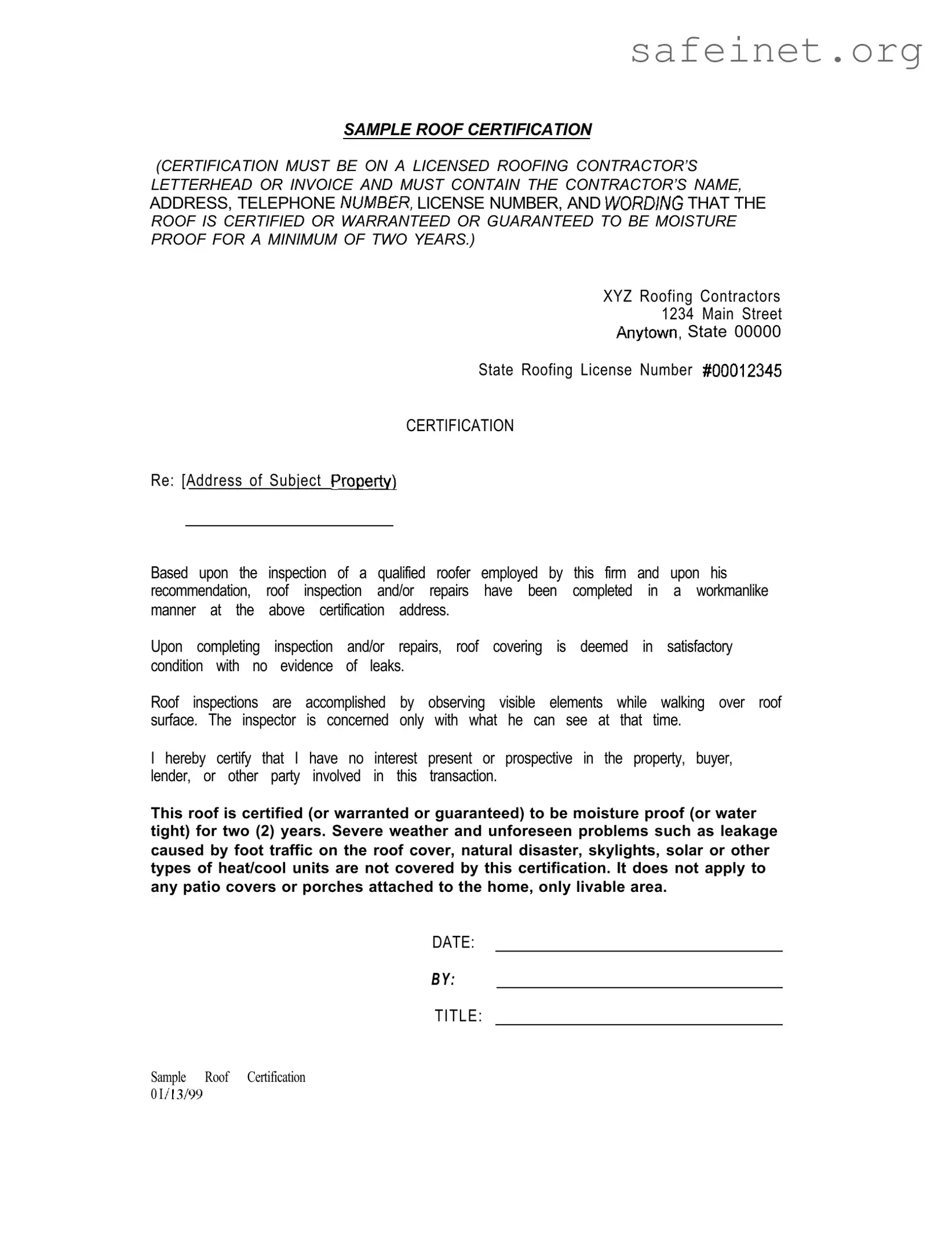
The Sample Roof Certification form serves as an important document for homeowners and contractors alike. It provides assurance that a roof has been inspected and deemed satisfactory by a licensed roofing contractor. This certification must be printed on the contractor's official letterhead or invoice and includes essential details such as the contractor’s name, address, phone number, and license number. The form specifies that the roof is certified to be moisture-proof for a minimum of two years, based on a thorough inspection. The inspector assesses visible elements of the roof while walking over its surface, ensuring no leaks are present at the time of inspection. It is important to note that the certification does not cover damages from severe weather, foot traffic, or other unforeseen issues. Additionally, it is limited to the main livable area of the home and does not extend to patio covers or porches. The certification also includes a declaration that the inspector has no financial interest in the property or parties involved in the transaction.
SAMPLE ROOF CERTIFICATION
(CERTIFICATION MUST BE ON A LICENSED ROOFING CONTRACTOR’S LETTERHEAD OR INVOICE AND MUST CONTAIN THE CONTRACTOR’S NAME,
ADDRESS, TELEPHONE NUMSER, LICENSE NUMBER, AND WORDlNG THAT THE
ROOF IS CERTIFIED OR WARRANTEED OR GUARANTEED TO BE MOISTURE PROOF FOR A MINIMUM OF TWO YEARS.)
XYZ Roofing Contractors
1234 Main Street
Anytown, State 00000
State Roofing License Number #00012345
CERTIFICATION
Re: [Address of Subject Property)
Based upon the inspection of a qualified roofer employed by this firm and upon his recommendation, roof inspection and/or repairs have been completed in a workmanlike manner at the above certification address.
Upon completing inspection and/or repairs, roof covering is deemed in satisfactory condition with no evidence of leaks.
Roof inspections are accomplished by observing visible elements while walking over roof surface. The inspector is concerned only with what he can see at that time.
I hereby certify that I have no interest present or prospective in the property, buyer, lender, or other party involved in this transaction.
This roof is certified (or warranted or guaranteed) to be moisture proof (or water tight) for two (2) years. Severe weather and unforeseen problems such as leakage caused by foot traffic on the roof cover, natural disaster, skylights, solar or other types of heat/cool units are not covered by this certification. It does not apply to any patio covers or porches attached to the home, only livable area.
DATE:
BY:
TITLE:
Sample Roof Certification 0I/13/w
| Fact Name | Description |
|---|---|
| Form Requirement | The Sample Roof Certification must be on the letterhead or invoice of a licensed roofing contractor. |
| Contact Information | It must include the contractor’s name, address, telephone number, and license number. |
| Certification Duration | The roof is certified to be moisture proof for a minimum of two years. |
| Inspection Process | Roof inspections are conducted by qualified roofers, focusing on visible elements during a physical inspection. |
| Exclusions | This certification does not cover damage from severe weather, foot traffic, or issues related to skylights and other installations. |
Completing the Sample Roof Certification form requires attention to detail. This certification must be issued on the letterhead or invoice of a licensed roofing contractor. It ensures that the roof has been inspected and is certified to be moisture-proof for a minimum of two years. Follow the steps below to fill out the form correctly.
What is the purpose of the Sample Roof Certification form?
The Sample Roof Certification form serves as a formal declaration by a licensed roofing contractor regarding the condition of a roof. It indicates that the roof has been inspected and any necessary repairs have been completed. This certification assures homeowners, buyers, and lenders that the roof is moisture-proof for a minimum of two years, providing peace of mind regarding potential water damage.
What information must be included on the certification?
To be valid, the Sample Roof Certification must be printed on the letterhead or invoice of a licensed roofing contractor. Essential details include the contractor’s name, address, telephone number, and state roofing license number. Additionally, the document must explicitly state that the roof is certified, warranted, or guaranteed to be moisture-proof for at least two years. This information establishes the legitimacy of the certification and the qualifications of the contractor.
What limitations are associated with the roof certification?
While the certification provides a two-year guarantee against moisture issues, it does have limitations. It does not cover damage caused by severe weather, natural disasters, or issues arising from foot traffic on the roof. Furthermore, the certification is only applicable to the livable areas of the home, excluding patio covers or porches. This means that homeowners should be aware of these exclusions when relying on the certification for insurance or property sale purposes.
How is the roof inspection conducted?
The roof inspection is performed by a qualified roofer who visually assesses the roof while walking on its surface. This inspection focuses on observable elements, allowing the contractor to identify any apparent issues. However, it is important to note that the inspection is limited to what can be seen at the time, meaning hidden problems may not be detected. Homeowners should consider this aspect when evaluating the thoroughness of the inspection and the resulting certification.
Failing to use licensed roofing contractor's letterhead or invoice. This is essential for the form to be valid.
Omitting the contractor’s name, address, or telephone number. Each of these details is crucial for identification and contact purposes.
Not including the license number. This number verifies that the contractor is authorized to perform roofing work.
Using vague language instead of stating that the roof is certified, warranted, or guaranteed to be moisture proof for a minimum of two years. Clear wording is necessary to avoid confusion.
Neglecting to specify the address of the subject property in the certification. This detail links the certification to a specific location.
Failing to state the date of certification. Without a date, the certification may lack validity.
Not having the signature of the person certifying the roof. This signature is a sign of accountability and authority.
Leaving out the title of the person signing the document. This helps establish their role and expertise.
Misunderstanding the scope of the certification. It does not cover damage from severe weather or unforeseen problems like foot traffic or natural disasters.
Assuming the certification applies to patio covers or porches. The certification is only valid for livable areas, so clarity is key.
When dealing with roofing certifications, several other forms and documents may be necessary to ensure a comprehensive understanding of the property’s condition and the responsibilities of all parties involved. Below is a list of common documents that often accompany the Sample Roof Certification form, each serving a unique purpose in the roofing and real estate process.
Each of these documents plays a vital role in protecting the interests of homeowners, contractors, and potential buyers. Understanding their significance can help facilitate smoother transactions and better maintenance of roofing systems.
The Sample Roof Certification form shares similarities with a Home Inspection Report. Both documents serve to assess the condition of a property, specifically focusing on the roof in this case. A Home Inspection Report typically includes a thorough evaluation of various home components, including the roof, plumbing, and electrical systems. Like the Sample Roof Certification, it provides a professional opinion based on an inspection, but it often covers a broader range of issues. Both documents aim to inform buyers and lenders about the state of the property, ensuring transparency in real estate transactions.
Another document akin to the Sample Roof Certification is the Warranty Deed. While a Warranty Deed primarily serves to transfer property ownership, it also provides assurances regarding the property's title. The similarities lie in the guarantees both documents offer. The Sample Roof Certification guarantees the roof's moisture-proof status for two years, while a Warranty Deed guarantees that the seller holds clear title to the property, free from encumbrances. Both documents instill confidence in buyers regarding their investment.
The Roof Inspection Report is also comparable to the Sample Roof Certification. This document is specifically focused on the roof and provides detailed findings from a professional inspection. Like the Sample Roof Certification, it outlines the condition of the roof and identifies any potential issues. However, while the Roof Inspection Report may not include a warranty, it serves a similar purpose in informing stakeholders about the roof's condition and any necessary repairs.
The Certificate of Insurance (COI) for roofing contractors is another relevant document. A COI provides proof that a roofing contractor carries liability insurance, which protects property owners from potential damages during roof work. Similar to the Sample Roof Certification, a COI reassures property owners about the professionalism and reliability of the contractor. Both documents aim to mitigate risk in real estate transactions, though they focus on different aspects of the roofing process.
Another document that parallels the Sample Roof Certification is the Maintenance Agreement. This agreement outlines the responsibilities of a contractor regarding ongoing roof maintenance. While the Sample Roof Certification guarantees a specific condition for a limited time, a Maintenance Agreement may include periodic inspections and repairs. Both documents emphasize the importance of maintaining the roof's integrity and protecting the property from potential issues.
The Roof Repair Invoice is also similar to the Sample Roof Certification. An invoice details the work performed on the roof, including repairs and associated costs. While it does not certify the roof's condition, it provides evidence of completed work. Both documents serve as records of the contractor's engagement with the property, ensuring that the owner has documentation of the services provided and the condition of the roof at a specific time.
The Property Disclosure Statement is another document that shares similarities with the Sample Roof Certification. This statement is typically provided by sellers to disclose known issues with the property, including the roof's condition. Like the Sample Roof Certification, it aims to inform potential buyers about the state of the property. Both documents are crucial for transparency in real estate transactions, helping buyers make informed decisions.
Finally, the Building Permit can be compared to the Sample Roof Certification. A Building Permit is required for construction or major renovations, including roofing work. It ensures that the work complies with local codes and regulations. While the Sample Roof Certification focuses on the condition of the roof post-inspection, both documents are essential in the context of property improvements. They serve to protect the interests of property owners and ensure that work is completed to a satisfactory standard.
When filling out the Sample Roof Certification form, it is essential to follow specific guidelines to ensure accuracy and compliance. Here are four important do's and don'ts:
Understanding the Sample Roof Certification form is essential for homeowners and property buyers. However, several misconceptions can lead to confusion. Here are six common misunderstandings:
By clarifying these misconceptions, property owners can make more informed decisions regarding their roofing needs and expectations.
When filling out and using the Sample Roof Certification form, it is essential to keep several important points in mind. This form serves as a formal declaration regarding the condition of a roof and its ability to resist moisture.
By adhering to these guidelines, individuals can ensure that their Sample Roof Certification form is completed accurately and effectively, providing peace of mind regarding the roof's condition.