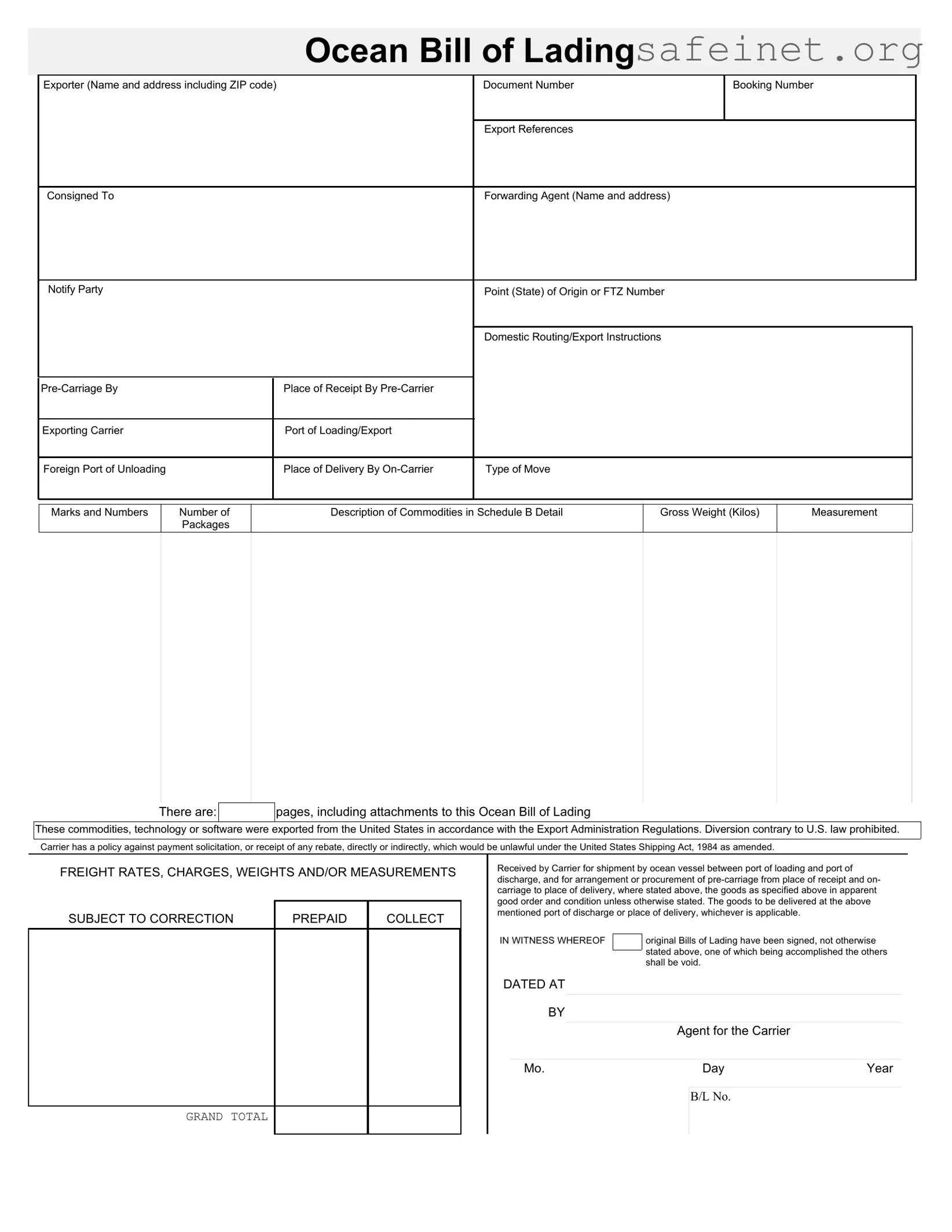
The Sample Ocean Bill of Lading form is a crucial document in international shipping, serving multiple essential functions. It acts as a receipt for goods, a contract between the shipper and the carrier, and a document of title. Key elements of the form include details about the exporter, such as their name and address, along with specific identifiers like the document number and booking number. It also lists the forwarding agent, the notify party, and the point of origin, ensuring that all parties are informed and accountable. Important shipping logistics are captured, including the port of loading, the foreign port of unloading, and the place of delivery. Additionally, the form requires a detailed description of the commodities being shipped, including their gross weight and packaging details. It emphasizes compliance with U.S. export regulations and includes important legal disclaimers about freight rates and charges. The document concludes with a declaration that the goods are received in good order, unless stated otherwise, highlighting the carrier's responsibilities. Overall, this form is vital for ensuring smooth and lawful international trade operations.

Ocean Bill of Lading
Exporter (Name and address including ZIP code) |
|
Document Number |
|
Booking Number |
|||||
|
|
|
|
|
|
|
|
|
|
|
|
|
|
|
|
Export References |
|
|
|
|
|
|
|
|
|
|
|
|
|
Consigned To |
|
|
|
|
Forwarding Agent (Name and address) |
|
|||
|
|
|
|
|
|
|
|
|
|
Notify Party |
|
|
|
|
Point (State) of Origin or FTZ Number |
|
|||
|
|
|
|
|
|
|
|
|
|
|
|
|
|
|
|
Domestic Routing/Export Instructions |
|
||
|
|
|
|
|
|
|
|
|
|
|
|
|
Place of Receipt By |
|
|
|
|
||
|
|
|
|
|
|
|
|
|
|
Exporting Carrier |
|
|
|
Port of Loading/Export |
|
|
|
|
|
|
|
|
|
|
|
|
|
|
|
Foreign Port of Unloading |
|
|
|
Place of Delivery By |
Type of Move |
|
|
|
|
|
|
|
|
|
|
|
|
|
|
|
|
|
|
|
|
|
|||
Marks and Numbers |
|
Number of |
|
|
Description of Commodities in Schedule B Detail |
Gross Weight (Kilos) |
Measurement |
||
|
|
Packages |
|
|
|
|
|
|
|
There are:
pages, including attachments to this Ocean Bill of Lading
These commodities, technology or software were exported from the United States in accordance with the Export Administration Regulations. Diversion contrary to U.S. law prohibited.
Carrier has a policy against payment solicitation, or receipt of any rebate, directly or indirectly, which would be unlawful under the United States Shipping Act, 1984 as amended.
FREIGHT RATES, CHARGES, WEIGHTS AND/OR MEASUREMENTS
SUBJECT TO CORRECTION |
PREPAID |
COLLECT |
GRAND TOTAL
Received by Carrier for shipment by ocean vessel between port of loading and port of discharge, and for arrangement or procurement of
IN WITNESS WHEREOF |
|
original Bills of Lading have been signed, not otherwise |
|
|
stated above, one of which being accomplished the others |
|
|
|
|
|
shall be void. |
DATED AT
BY
Agent for the Carrier
Mo. |
Day |
Year |
B/L NO.
| Fact Name | Description |
|---|---|
| Exporter Information | The form requires the exporter's name and address, including ZIP code, to ensure proper identification and compliance with regulations. |
| Legal Compliance | It states that the commodities exported comply with U.S. Export Administration Regulations, emphasizing the legal responsibility of the exporter. |
| Carrier Policy | The document includes a policy against unlawful payment solicitation, in accordance with the United States Shipping Act of 1984, as amended. |
| Freight Charges | Freight rates, charges, weights, and measurements are subject to correction, highlighting the importance of accuracy in shipping documentation. |
Filling out the Sample Ocean Bill of Lading form is essential for shipping goods internationally. This document ensures that all parties involved have clear information about the shipment. Follow these steps to complete the form accurately.
What is an Ocean Bill of Lading?
An Ocean Bill of Lading is a crucial shipping document used in international trade. It serves as a receipt for goods shipped, a contract between the shipper and carrier, and a document of title for the cargo. Essentially, it outlines the details of the shipment, including the parties involved, the nature of the goods, and the terms of transport.
Who are the key parties involved in an Ocean Bill of Lading?
The key parties include the exporter, who is the person or company sending the goods; the forwarding agent, who manages the logistics; and the carrier, who transports the goods. The notify party is also important, as this entity is informed about the shipment's arrival and any necessary actions.
What information is required on the Ocean Bill of Lading?
The form requires several details, such as the names and addresses of the exporter, forwarding agent, and notify party. It also includes the booking number, document number, port of loading, foreign port of unloading, and a description of the commodities being shipped. Gross weight and measurements of the cargo are also essential for accurate processing.
What does "prepaid" and "collect" mean in the context of freight charges?
"Prepaid" indicates that the freight charges have been paid by the shipper before shipment. Conversely, "collect" means that the freight charges will be paid by the consignee upon delivery. This distinction is vital for understanding who is responsible for payment at different stages of the shipping process.
What regulations govern the export of goods as noted on the Ocean Bill of Lading?
The document states that the exported commodities must comply with the Export Administration Regulations. These regulations ensure that exports meet U.S. laws, particularly concerning national security and foreign policy. Violations can result in severe penalties, including fines and restrictions on future shipments.
What should I do if there is an error on the Ocean Bill of Lading?
If you notice an error, it is crucial to address it immediately. Contact the carrier or forwarding agent to rectify the mistake. Corrections to freight rates, charges, weights, or measurements can be made, but timely communication is essential to avoid complications during shipping.
Why is it important to keep a copy of the Ocean Bill of Lading?
Keeping a copy is important for several reasons. It serves as proof of shipment and can be essential for resolving disputes. Additionally, it provides a record of the terms agreed upon between the shipper and carrier. In case of loss or damage, having this document on hand can facilitate claims and ensure proper follow-up.
Incomplete Information: Failing to provide all required details, such as the exporter’s name, address, and ZIP code, can lead to processing delays. Each section must be filled out thoroughly to avoid complications.
Incorrect Document Number: Entering the wrong document number can cause confusion and may result in shipment errors. Always double-check this information for accuracy.
Missing Consignee Details: Not specifying the consigned party or forwarding agent can create issues with delivery. Ensure that the names and addresses are clearly stated.
Errors in Commodity Description: Providing vague or incorrect descriptions of the commodities can lead to customs issues. Use precise language and refer to the Schedule B for accurate classifications.
Ignoring Weight and Measurement Requirements: Inaccurate gross weight or measurement entries can result in additional charges or shipment delays. Always verify these figures before submission.
Neglecting to Sign: Omitting the signature of the agent for the carrier renders the Bill of Lading invalid. Ensure that all necessary signatures are obtained and dated appropriately.
The Ocean Bill of Lading is a crucial document in international shipping, serving as a receipt for goods and a contract between the shipper and carrier. However, it is often accompanied by other important forms and documents that facilitate the shipping process. Below is a list of ten such documents, each playing a unique role in ensuring smooth transactions and compliance with regulations.
Understanding these documents and their purposes can greatly enhance the efficiency of the shipping process. Each plays a vital role in ensuring that goods are transported smoothly and comply with all necessary regulations. By being aware of these forms, shippers and consignees can navigate the complexities of international shipping with greater confidence.
The Air Waybill (AWB) serves as a crucial document in air freight transport. Similar to the Ocean Bill of Lading, it acts as a receipt for goods and a contract between the shipper and the carrier. It includes details such as the names and addresses of the shipper and consignee, the nature of the goods, and the terms of transport. However, unlike the Ocean Bill of Lading, the AWB is not a document of title, meaning it does not confer ownership of the goods being transported. This document is essential for international air shipments, ensuring that all parties are aware of their responsibilities and the terms of the shipment.
The Truck Bill of Lading is another document that shares similarities with the Ocean Bill of Lading. This document is used for land transportation and serves as a receipt for the goods and a contract between the shipper and the trucking company. Like its ocean counterpart, it includes critical information such as the names of the parties involved, the description of the cargo, and the routing instructions. However, the Truck Bill of Lading is specifically tailored for domestic shipments, highlighting the different modes of transport while maintaining similar functions in terms of legal responsibilities.
The Rail Waybill is a document used in rail transport that parallels the Ocean Bill of Lading in many ways. It serves as a contract between the shipper and the rail carrier, detailing the shipment's origin, destination, and the nature of the goods. Both documents function as receipts for the goods, ensuring that the carrier acknowledges receipt in good condition. However, the Rail Waybill is specific to rail transport, which introduces unique regulations and practices that differ from maritime shipping.
The Combined Transport Bill of Lading integrates multiple modes of transportation into a single document. It functions similarly to the Ocean Bill of Lading by acting as a contract and receipt for goods. This document is particularly useful when goods are transported by sea, air, and land. It provides clarity on the entire journey of the cargo, including any transfers between different carriers. This document is essential for international shipments that require coordination across various transport modes, ensuring that all parties are informed and accountable.
The Delivery Order is another document that complements the Ocean Bill of Lading. This document is issued by the carrier or freight forwarder, authorizing the release of cargo to a designated party. While the Ocean Bill of Lading serves as the primary contract for the shipment, the Delivery Order facilitates the transfer of goods at the destination. It ensures that only authorized individuals can claim the cargo, providing an additional layer of security in the shipping process.
Lastly, the Packing List is a document that, while not a contract, is often used alongside the Ocean Bill of Lading. It details the contents of a shipment, including the quantity, weight, and description of the items. The Packing List is essential for customs clearance and helps the consignee verify that the correct goods have been received. While the Ocean Bill of Lading outlines the terms of transport, the Packing List provides a comprehensive inventory of the shipped items, ensuring transparency and accuracy in the shipping process.
When filling out the Sample Ocean Bill of Lading form, it is important to adhere to specific guidelines to ensure accuracy and compliance. Below is a list of things to do and avoid during this process.
Understanding the Sample Ocean Bill of Lading can be challenging, and misconceptions often arise. Here are ten common misconceptions, along with clarifications to help demystify this important shipping document.
While it serves as a receipt, the Bill of Lading also acts as a contract between the shipper and the carrier, detailing the terms of transport.
In fact, it is a legally binding document that outlines the responsibilities and rights of all parties involved in the shipping process.
There are different types of Bills of Lading, including ocean, air, and inland, each serving specific purposes and adhering to different regulations.
Changing the destination typically requires formal procedures and may not be allowed, depending on the terms outlined in the Bill of Lading.
It is essential to ensure that the Bill of Lading is appropriate for the specific type of goods being shipped, as some items may have special requirements.
While it outlines the carrier's obligations, delivery is contingent on various factors, including customs clearance and compliance with regulations.
Both the shipper and the carrier must sign the document to validate it and ensure that all parties acknowledge the terms.
This document is crucial for international shipments, as it serves as proof of ownership and is often required by customs authorities.
Each shipment requires its own Bill of Lading. Attempting to use one document for multiple shipments can lead to legal complications.
Freight rates, charges, and weights can be subject to correction based on actual measurements and conditions, as noted in the Bill of Lading.
By addressing these misconceptions, individuals involved in shipping can better navigate the complexities of the Ocean Bill of Lading and ensure a smoother shipping experience.
When filling out the Sample Ocean Bill of Lading form, it is essential to ensure accuracy and completeness. Here are some key takeaways to keep in mind:
By paying attention to these details, the process of filling out the Ocean Bill of Lading can be smoother and more efficient. Ensuring accuracy not only helps in compliance but also aids in the timely delivery of goods.