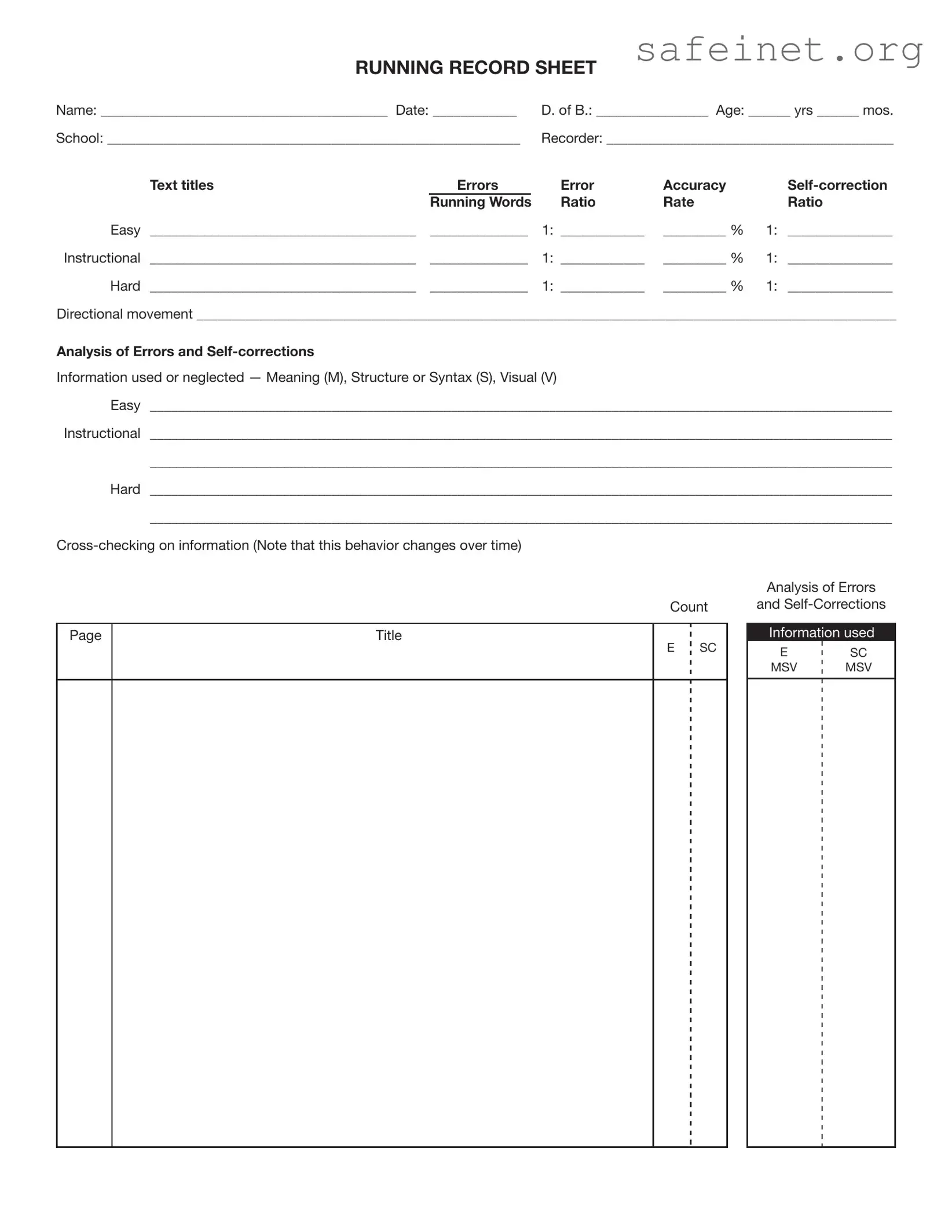
The Running Record Sheet is an essential tool for educators and reading specialists, providing a structured way to assess a student's reading abilities. This form captures critical information, including the student's name, date, date of birth, age, and school, making it easy to track progress over time. It allows the recorder to document various text titles and categorize them as easy, instructional, or hard, which helps in understanding the student's reading level. The form also includes sections for noting errors, error accuracy, self-correction rates, and running words ratio, which provide insight into the student's reading fluency and comprehension skills. Additionally, the analysis of errors and self-corrections helps educators pinpoint specific areas where a student may struggle, whether that be in meaning, structure, or visual recognition. By utilizing this comprehensive approach, teachers can tailor their instruction to meet each student's unique needs, fostering a more effective learning environment.

RUNNING RECORD SHEET
Name: _________________________________________ Date: ____________ |
D. of B.: ________________ Age: ______ yrs ______ mos. |
|||||
School: ___________________________________________________________ |
Recorder: _________________________________________ |
|||||
|
Text titles |
Errors |
|
Error |
Accuracy |
|
|
|
Running Words |
Ratio |
Rate |
Ratio |
|
Easy |
______________________________________ |
______________ |
|
1: ____________ |
_________ % |
1: _______________ |
Instructional |
______________________________________ |
______________ |
|
1: ____________ |
_________ % |
1: _______________ |
Hard |
______________________________________ |
______________ |
|
1: ____________ |
_________ % |
1: _______________ |
Directional movement ____________________________________________________________________________________________________
Analysis of Errors and
Information used or neglected — Meaning (M), Structure or Syntax (S), Visual (V)
Easy __________________________________________________________________________________________________________
Instructional __________________________________________________________________________________________________________
__________________________________________________________________________________________________________
Hard __________________________________________________________________________________________________________
__________________________________________________________________________________________________________
Page
Title
Count
ESC
Analysis of Errors
and
Information used
ESC
MSV MSV

Page
Title
Count
ESC
Analysis of Errors
and
Information used
ESC
MSV MSV
| Fact Name | Description |
|---|---|
| Name Field | This section allows the recorder to write the name of the student being assessed. |
| Date | The date of the assessment is recorded to track progress over time. |
| Date of Birth | Recording the student's date of birth helps determine their age and developmental stage. |
| Age | The age of the student is noted in years and months, providing context for the assessment. |
| School Information | The school name is included to identify the educational setting of the student. |
| Recorder Name | The name of the person conducting the assessment is recorded for accountability. |
| Error Accuracy | This metric indicates the percentage of errors made by the student during reading. |
| Self-Correction | This section tracks how often the student corrects their own reading mistakes. |
| Governing Laws | In some states, specific educational laws may govern the use of assessment forms like this one. |
Once you have the Running Record Sheet form in front of you, it’s time to fill it out accurately. This process will help you gather essential information about the reading performance. Follow these steps carefully to complete the form.
What is a Running Record Sheet?
A Running Record Sheet is a tool used primarily in educational settings to assess a student’s reading abilities. It allows educators to track a student’s reading performance, including errors, self-corrections, and overall comprehension. This form provides valuable insights into how a student interacts with text and helps in planning targeted instruction.
How do I fill out the Running Record Sheet?
To fill out the Running Record Sheet, start by entering the student’s name, date, date of birth, age, and school information at the top. As the student reads a selected text, record any errors they make, along with self-corrections. You will also need to note the total number of running words and calculate accuracy and self-correction ratios based on the student’s performance.
What are the different categories on the Running Record Sheet?
The Running Record Sheet is divided into three main categories: Easy, Instructional, and Hard. Each category reflects the difficulty level of the text the student is reading. Easy texts are those the student can read comfortably, instructional texts are at their instructional level, and hard texts present significant challenges. This categorization helps educators understand where a student is thriving and where they may need additional support.
What do the error and self-correction ratios indicate?
The error ratio shows the percentage of errors made compared to the total words read, while the self-correction ratio indicates how often a student corrects their own mistakes. A high accuracy percentage suggests that a student is reading at an appropriate level, while a high self-correction ratio can indicate that the student is engaged and aware of their reading process.
Why is directional movement important in reading?
Directional movement refers to how a student moves through the text, typically from left to right. Observing this behavior helps educators understand a student’s reading fluency and their ability to track words effectively. If a student struggles with directional movement, it may indicate a need for further support in developing their reading skills.
How can I analyze errors and self-corrections?
When analyzing errors and self-corrections, consider the types of errors made. Categorize them based on meaning (M), structure or syntax (S), and visual (V) cues. This analysis helps identify patterns in a student’s reading behavior, revealing areas where they may need additional instruction or practice.
What is cross-checking, and why is it important?
Cross-checking is the process by which a reader verifies information from the text using different sources, such as context, visuals, and prior knowledge. It is essential because it demonstrates a reader’s ability to make connections and enhances comprehension. Observing a student’s cross-checking behavior can provide insights into their reading strategies and overall understanding.
How often should I use the Running Record Sheet?
The frequency of using the Running Record Sheet can vary based on individual student needs and instructional goals. Generally, it is beneficial to conduct running records regularly, such as once every few weeks or after completing a unit of study. This consistent monitoring allows educators to track progress and adjust instruction as needed.
What should I do with the data collected from the Running Record Sheet?
After collecting data from the Running Record Sheet, use it to inform your teaching practices. Analyze the information to identify strengths and weaknesses in a student’s reading abilities. This data can guide lesson planning, help set specific reading goals, and facilitate discussions with parents about their child’s progress.
Incomplete Information: Failing to fill in all required fields, such as the name, date, or age, can lead to confusion later. Ensure that every section is completed accurately.
Miscalculating Ratios: Errors in calculating the error and self-correction ratios can distort the analysis. Double-check your math to ensure accuracy.
Neglecting Observations: Overlooking the analysis of errors and self-corrections can result in missed insights. It is essential to document these observations thoroughly.
Inconsistent Terminology: Using different terms for the same concept can create confusion. Stick to the terminology provided in the form for clarity.
The Running Record Sheet form is a valuable tool used to assess a student's reading performance. However, it is often used in conjunction with several other documents that provide a comprehensive view of a student's literacy development. Below is a list of common forms and documents that are frequently paired with the Running Record Sheet.
Using these documents in conjunction with the Running Record Sheet can provide a more complete picture of a student's reading abilities. This holistic approach supports targeted interventions and encourages student growth in literacy.
The Running Record Sheet is similar to the Reading Observation Form. Both documents are used to track a reader's performance during a reading session. They help educators identify strengths and weaknesses in a student's reading skills. The Reading Observation Form typically includes sections for noting the reader's fluency, comprehension, and any specific strategies they use while reading. Like the Running Record Sheet, it provides a structured way to gather data that can inform instruction.
Another document that shares similarities is the Literacy Assessment Checklist. This checklist is designed to evaluate various aspects of a student's literacy skills, including phonemic awareness, vocabulary, and comprehension. It allows educators to record observations in a systematic manner. Both the Literacy Assessment Checklist and the Running Record Sheet aim to provide a comprehensive view of a student's reading abilities, making it easier to tailor instruction to meet individual needs.
The Informal Reading Inventory (IRI) is also comparable to the Running Record Sheet. An IRI assesses a student's reading level through a series of graded passages. Educators record errors and comprehension responses, much like in a running record. This document helps determine a student's instructional level and guides future reading instruction. Both tools focus on gathering detailed information about a student's reading process and progress.
Lastly, the Student Reading Profile serves a similar purpose. This document compiles various reading assessments and observations into one profile for each student. It includes information on reading habits, preferences, and performance across different texts. Like the Running Record Sheet, the Student Reading Profile provides a holistic view of a student's reading journey, allowing educators to make informed decisions about their teaching strategies.
When filling out the Running Record Sheet form, keep the following guidelines in mind:
Misconceptions about the Running Record Sheet can lead to confusion and misapplication. Here are nine common misunderstandings, along with clarifications to help everyone better understand this valuable tool.
Understanding these misconceptions can enhance the effectiveness of the Running Record Sheet and ultimately support the development of stronger readers.
When filling out and using the Running Record Sheet form, keep these key takeaways in mind: