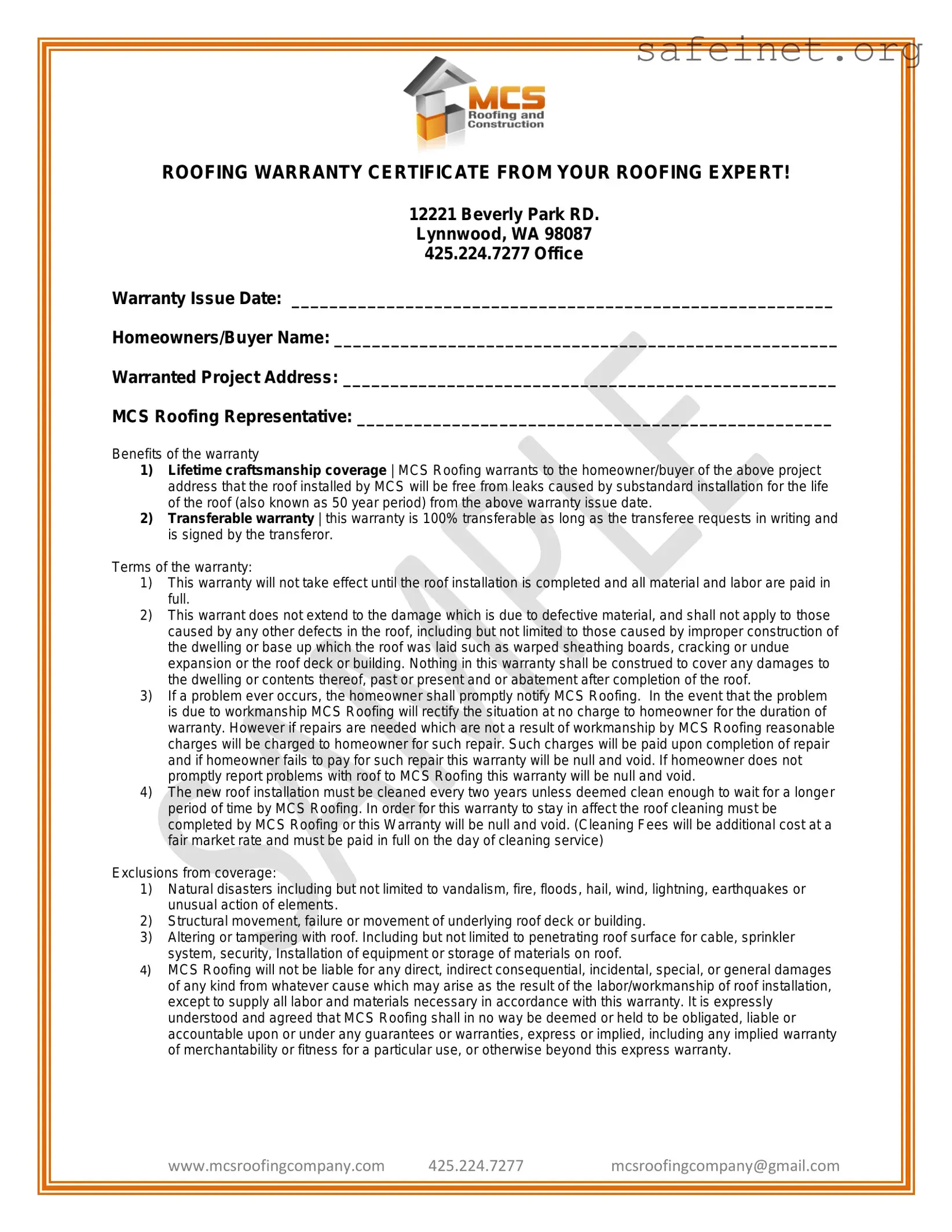
The Roofing Warranty Certificate is an essential document that outlines the terms and benefits of the warranty provided by MCS Roofing for their roofing installations. This certificate, issued from the MCS Roofing office in Lynnwood, Washington, serves as a formal acknowledgment of the warranty issued to the homeowner or buyer. Key components of the form include the warranty issue date, the homeowner's name, and the address of the warranted project, ensuring that all relevant details are captured. The warranty offers lifetime craftsmanship coverage, guaranteeing that the roof will remain free from leaks due to substandard installation for a period of up to 50 years. Importantly, this warranty is transferable, allowing future homeowners to benefit from the coverage, provided that the transfer is requested in writing. The terms specify that the warranty becomes effective only after the completion of the roof installation and full payment for materials and labor. Exclusions from coverage are clearly defined, including damage from natural disasters and alterations to the roof. Homeowners are also required to maintain the roof by having it cleaned every two years by MCS Roofing to keep the warranty valid. Should any issues arise, homeowners must promptly notify MCS Roofing to ensure that any necessary repairs are addressed at no cost if they are due to workmanship. This comprehensive warranty certificate not only protects the homeowner's investment but also establishes clear expectations for both parties involved.
ROOFING WARRANTY CERTIFICATE FROM YOUR ROOFING EXPERT!
12221 Beverly Park RD.
Lynnwood, WA 98087
425.224.7277 Office
Warranty Issue Date: _________________________________________________________
Homeowners/Buyer Name: _____________________________________________________
Warranted Project Address: ____________________________________________________
MCS Roofing Representative: __________________________________________________
Benefits of the warranty
1)Lifetime craftsmanship coverage | MCS Roofing warrants to the homeowner/buyer of the above project address that the roof installed by MCS will be free from leaks caused by substandard installation for the life of the roof (also known as 50 year period) from the above warranty issue date.
2)Transferable warranty | this warranty is 100% transferable as long as the transferee requests in writing and is signed by the transferor.
Terms of the warranty:
1)This warranty will not take effect until the roof installation is completed and all material and labor are paid in full.
2)This warrant does not extend to the damage which is due to defective material, and shall not apply to those caused by any other defects in the roof, including but not limited to those caused by improper construction of the dwelling or base up which the roof was laid such as warped sheathing boards, cracking or undue expansion or the roof deck or building. Nothing in this warranty shall be construed to cover any damages to the dwelling or contents thereof, past or present and or abatement after completion of the roof.
3)If a problem ever occurs, the homeowner shall promptly notify MCS Roofing. In the event that the problem is due to workmanship MCS Roofing will rectify the situation at no charge to homeowner for the duration of warranty. However if repairs are needed which are not a result of workmanship by MCS Roofing reasonable charges will be charged to homeowner for such repair. Such charges will be paid upon completion of repair and if homeowner fails to pay for such repair this warranty will be null and void. If homeowner does not promptly report problems with roof to MCS Roofing this warranty will be null and void.
4)The new roof installation must be cleaned every two years unless deemed clean enough to wait for a longer period of time by MCS Roofing. In order for this warranty to stay in affect the roof cleaning must be completed by MCS Roofing or this Warranty will be null and void. (Cleaning Fees will be additional cost at a fair market rate and must be paid in full on the day of cleaning service)
Exclusions from coverage:
1)Natural disasters including but not limited to vandalism, fire, floods, hail, wind, lightning, earthquakes or unusual action of elements.
2)Structural movement, failure or movement of underlying roof deck or building.
3)Altering or tampering with roof. Including but not limited to penetrating roof surface for cable, sprinkler system, security, Installation of equipment or storage of materials on roof.
4)MCS Roofing will not be liable for any direct, indirect consequential, incidental, special, or general damages of any kind from whatever cause which may arise as the result of the labor/workmanship of roof installation, except to supply all labor and materials necessary in accordance with this warranty. It is expressly understood and agreed that MCS Roofing shall in no way be deemed or held to be obligated, liable or accountable upon or under any guarantees or warranties, express or implied, including any implied warranty of merchantability or fitness for a particular use, or otherwise beyond this express warranty.
www.mcsroofingcompany.com |
425.224.7277 |
| Fact Name | Details |
|---|---|
| Company Information | MCS Roofing is located at 12221 Beverly Park RD, Lynnwood, WA 98087. |
| Warranty Issue Date | The warranty issue date must be filled out on the form. |
| Homeowner Information | The form requires the homeowner's or buyer's name to be provided. |
| Project Address | The warranted project address must be clearly stated on the form. |
| Lifetime Coverage | The warranty covers craftsmanship for the life of the roof, typically 50 years. |
| Transferability | This warranty is fully transferable with a written request signed by the transferor. |
| Conditions for Validity | The warranty is valid only after full payment for materials and labor. |
| Cleaning Requirement | The roof must be cleaned every two years to maintain warranty coverage. |
| Exclusions | Natural disasters and structural issues are excluded from warranty coverage. |
| Liability Limitations | MCS Roofing is not liable for indirect or consequential damages beyond the warranty. |
Once you have the Roofing Warranty Certificate form in hand, you can begin filling it out. This form is essential for establishing the warranty on your newly installed roof. Ensure that all information is accurate and complete, as this will help in future communications regarding your warranty. Follow these steps to fill out the form correctly.
After completing these steps, review the form for any errors or missing information. Once confirmed, you can submit the form as instructed by MCS Roofing. Keeping a copy for your records is also a wise decision, as it will serve as proof of warranty should any issues arise in the future.
What does the Roofing Warranty Certificate cover?
The Roofing Warranty Certificate provides homeowners with a lifetime craftsmanship coverage. This means that if the roof installed by MCS Roofing has any leaks caused by substandard installation, the company will address these issues at no cost for the life of the roof, which is generally considered to be a 50-year period from the warranty issue date. Additionally, the warranty is transferable, allowing new homeowners to benefit from the coverage as long as the transfer is requested in writing and signed by the original homeowner.
Are there any conditions that could void the warranty?
Yes, there are specific conditions that could void the warranty. For instance, the warranty only takes effect once the roof installation is complete and all associated costs have been paid in full. If the homeowner fails to promptly report any issues to MCS Roofing, the warranty may also become null and void. Furthermore, the roof must be cleaned every two years by MCS Roofing to maintain the warranty's validity. If this cleaning is not performed, the warranty will not be honored.
What types of damages are excluded from the warranty coverage?
The warranty does not cover damages resulting from natural disasters such as floods, fires, or earthquakes. It also excludes damages caused by structural movement or any alterations made to the roof, such as installing equipment or penetrating the roof surface. Additionally, MCS Roofing is not liable for any indirect or consequential damages that may arise from the roof installation, beyond the labor and materials specified in the warranty.
How should homeowners address issues with their roof under this warranty?
If a homeowner experiences any problems with their roof, they should promptly notify MCS Roofing. If the issue is determined to be due to workmanship, MCS Roofing will fix it at no charge. However, if the problem arises from other causes, the homeowner may incur reasonable charges for repairs. It's essential to communicate any issues quickly to ensure that the warranty remains valid and that necessary repairs can be addressed efficiently.
Incomplete Information: One of the most common mistakes is failing to fill out all required fields on the Roofing Warranty Certificate. Homeowners often overlook sections like the Warranty Issue Date or the Homeowners/Buyer Name. Incomplete forms can delay the warranty process and cause confusion later on.
Missing Signature: Another frequent error is neglecting to sign the form. Without the homeowner's signature, the warranty may not be considered valid. It’s crucial to ensure that all necessary signatures are provided to avoid any issues in the future.
Incorrect Project Address: Entering an incorrect project address can lead to complications when filing claims. Homeowners must double-check that the Warranted Project Address matches the location where the roofing work was performed. Mismatches can result in the warranty being deemed void.
Failure to Understand Terms: Many homeowners do not take the time to read and understand the warranty terms. Ignoring important details, such as the necessity for regular roof cleaning or the implications of not reporting issues promptly, can lead to unintended consequences. Familiarizing oneself with the warranty's terms is essential for maintaining coverage.
When obtaining a Roofing Warranty Certificate, several other forms and documents may also be necessary to ensure a comprehensive understanding of the warranty and its conditions. Below is a list of commonly used documents that complement the Roofing Warranty Certificate.
Understanding these documents can help homeowners navigate their roofing warranty more effectively. Each document plays a vital role in ensuring that the warranty remains valid and that any potential issues are addressed promptly.
The Roofing Warranty Certificate is similar to a Homeowners Insurance Policy. Both documents provide protection for homeowners, albeit in different ways. A homeowners insurance policy covers a wide range of damages to the home, including those caused by natural disasters, theft, and accidents. In contrast, the Roofing Warranty Certificate specifically addresses the workmanship of the roof installation and guarantees that it will remain free from leaks due to poor installation. While the insurance policy may cover damage after it occurs, the warranty focuses on the quality of the work done, ensuring peace of mind for the homeowner regarding their roof's integrity.
Another document that shares similarities with the Roofing Warranty Certificate is the Manufacturer’s Product Warranty. This warranty is provided by the roofing material manufacturer and covers defects in the materials used for the roof. Just as the Roofing Warranty Certificate ensures that the installation is done correctly, the Manufacturer’s Product Warranty guarantees that the materials themselves will perform as promised. Both warranties work hand-in-hand, as a quality installation can help ensure the materials function effectively, while the manufacturer's warranty provides additional coverage for material defects.
The Service Contract is another document akin to the Roofing Warranty Certificate. A service contract outlines the terms and conditions under which maintenance and repairs will be performed on a property. Like the roofing warranty, it specifies what is covered, the duration of coverage, and any exclusions. Homeowners can rely on both documents to protect their investment and ensure that necessary repairs or maintenance are carried out according to agreed-upon terms. However, while a service contract may cover various systems in the home, the Roofing Warranty Certificate is solely focused on the roof.
Next, consider the Home Inspection Report, which shares a common goal with the Roofing Warranty Certificate: ensuring the home is in good condition. A home inspection report details the current state of a property, including the roof. This document can help identify issues that need addressing before a warranty is issued. While the inspection report provides a snapshot of the home's condition at a specific time, the Roofing Warranty Certificate offers ongoing protection against future workmanship-related issues, creating a safety net for homeowners.
Lastly, the Maintenance Agreement is similar to the Roofing Warranty Certificate in that it sets expectations for ongoing care. A maintenance agreement outlines the responsibilities of the homeowner and the service provider regarding upkeep. For instance, the Roofing Warranty Certificate requires roof cleaning every two years to maintain coverage. Similarly, a maintenance agreement may specify routine checks and services for various home systems. Both documents emphasize the importance of proactive care to prevent issues before they arise, ensuring the longevity of the homeowner's investment.
When filling out the Roofing Warranty Certificate form, it is important to follow specific guidelines to ensure the warranty is valid. Below are eight things you should and shouldn't do.
Misconception 1: The warranty covers all types of roof damage.
Many homeowners believe that the roofing warranty certificate protects against any and all damage to their roof. In reality, the warranty specifically excludes damages caused by natural disasters, structural issues, and alterations made to the roof. Understanding these limitations is crucial for homeowners.
Misconception 2: The warranty is valid indefinitely.
Some may think that the warranty lasts forever. However, the warranty is valid for a period of 50 years, but only if specific conditions are met. This includes timely reporting of any issues and regular roof cleaning every two years.
Misconception 3: The warranty automatically transfers to a new homeowner.
Homeowners often assume that the warranty will automatically transfer to the next owner of the home. This is not the case. The warranty is transferable, but it requires a written request and signature from the original homeowner.
Misconception 4: MCS Roofing will cover all repair costs.
There is a common belief that MCS Roofing will handle all repairs at no cost. While the company will cover repairs resulting from their workmanship, any issues arising from other causes will incur charges. Homeowners should be prepared for potential costs.
Misconception 5: Cleaning the roof is optional.
Many homeowners think that roof cleaning is not a necessary part of maintaining their warranty. In fact, regular cleaning is a requirement. If the cleaning is not performed by MCS Roofing or within the specified timeframe, the warranty may become void.
Understanding the Roofing Warranty Certificate form is essential for homeowners who want to ensure the longevity and protection of their roofing investment. Here are some key takeaways to keep in mind:
By keeping these points in mind, homeowners can make informed decisions and maintain their roofing warranty effectively.