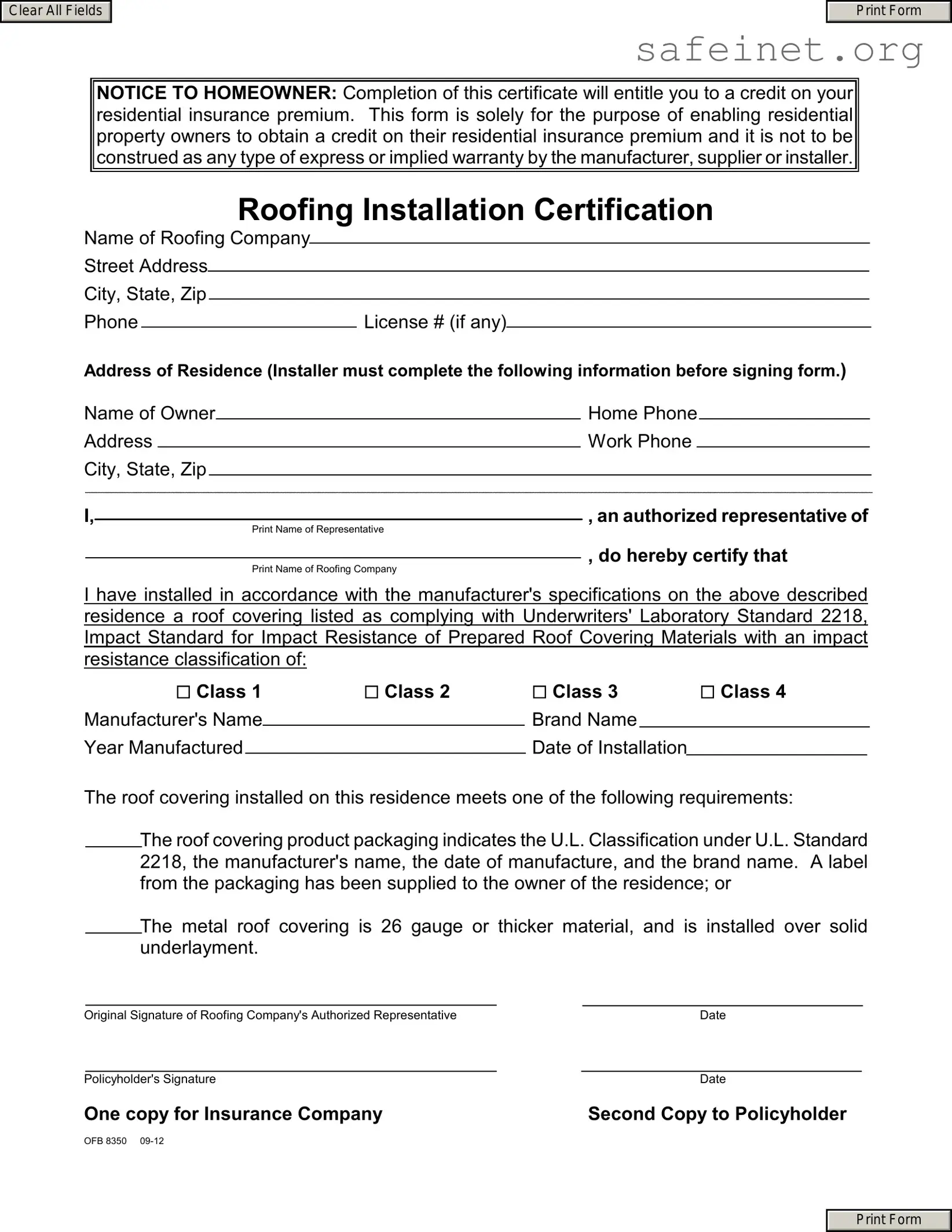
The Roofing Installation Certification form is an essential document for homeowners looking to secure a credit on their residential insurance premiums. By completing this form, property owners can benefit from potential savings while ensuring their roofing installation meets specific standards. The form requires detailed information about the roofing company, including its name, address, and license number, if applicable. Homeowners must also provide their details, such as their name, address, and contact numbers. An authorized representative from the roofing company must certify that the installation complies with the manufacturer's specifications and meets the Underwriters' Laboratory Standard 2218 for impact resistance. This includes selecting the appropriate impact resistance classification, which ranges from Class 1 to Class 4. Additionally, the form outlines the requirements for the roof covering, such as the need for proper labeling or material thickness. Once completed, the form serves as proof of compliance and is necessary for obtaining the insurance premium credit. Homeowners will receive copies for their records, and one must be submitted to the insurance company. Completing this form not only helps in potential savings but also ensures that the roofing work meets industry standards.
Clear All Fields
Print Form
NOTICE TO HOMEOWNER: Completion of this certificate will entitle you to a credit on your residential insurance premium. This form is solely for the purpose of enabling residential property owners to obtain a credit on their residential insurance premium and it is not to be construed as any type of express or implied warranty by the manufacturer, supplier or installer.
Roofing Installation Certification
Name of Roofing Company
Street Address
City, State, Zip
PhoneLicense # (if any)
Address of Residence (Installer must complete the following information before signing form.)
Name of Owner |
|
Home Phone |
|
|
|||||
Address |
|
|
|
Work Phone |
|
|
|||
City, State, Zip |
|
|
|
|
|
|
|||
I, |
|
|
, an authorized representative of |
||||||
|
|
||||||||
|
|
|
|
|
Print Name of Representative |
||||
|
|
|
|
|
|
, do hereby certify that |
|||
|
|
|
|
|
|
||||
|
|
|
|
|
Print Name of Roofing Company |
||||
I have installed in accordance with the manufacturer's specifications on the above described residence a roof covering listed as complying with Underwriters' Laboratory Standard 2218, Impact Standard for Impact Resistance of Prepared Roof Covering Materials with an impact resistance classification of:
Class 1 |
Class 2 |
|
Class 3 |
Class 4 |
||||
Manufacturer's Name |
|
|
Brand Name |
|
|
|
||
Year Manufactured |
|
|
|
Date of Installation |
|
|
||
|
|
|
|
|
|
|
|
|
The roof covering installed on this residence meets one of the following requirements:
The roof covering product packaging indicates the U.L. Classification under U.L. Standard 2218, the manufacturer's name, the date of manufacture, and the brand name. A label from the packaging has been supplied to the owner of the residence; or
The metal roof covering is 26 gauge or thicker material, and is installed over solid underlayment.
|
|
|
|
|
Original Signature of Roofing Company's Authorized Representative |
|
Date |
||
|
|
|
|
|
|
Policyholder's Signature |
|
Date |
|
One copy for Insurance Company |
|
Second Copy to Policyholder |
||
OFB 8350 |
|
|
|
|
Print Form
| Fact Name | Details |
|---|---|
| Purpose of the Form | This form allows homeowners to obtain a credit on their residential insurance premium after roofing installation. |
| Warranty Disclaimer | The form does not provide any express or implied warranty from the manufacturer, supplier, or installer. |
| Certification Requirement | An authorized representative from the roofing company must certify that the installation complies with the manufacturer's specifications. |
| U.L. Compliance | The roof covering must meet Underwriters' Laboratory Standard 2218 for impact resistance, classified from Class 1 to Class 4. |
| State-Specific Laws | In states like Florida, the form must comply with Florida Statute § 627.0629 regarding insurance credits for roofing installations. |
After completing the Roofing Installation Certification form, you will submit it to your insurance company to receive a credit on your residential insurance premium. Ensure that all information is accurate and complete before submission to avoid any delays in processing.
What is the purpose of the Roofing Installation Certification form?
The Roofing Installation Certification form is designed for residential property owners to obtain a credit on their insurance premiums. By completing this form, homeowners can demonstrate that their roof installation meets certain standards, which may lead to reduced insurance costs.
Who is responsible for filling out the Roofing Installation Certification form?
The roofing contractor or an authorized representative of the roofing company is responsible for completing the form. This includes providing details about the installation, such as the manufacturer's specifications and the impact resistance classification of the roofing material used.
What information is required on the form?
The form requires several pieces of information, including the name and contact details of the roofing company, the address of the residence, and the name of the homeowner. Additionally, the form must include details about the roofing material, such as the manufacturer's name, brand, year manufactured, and installation date.
What is meant by "impact resistance classification"?
Impact resistance classification refers to the ability of roofing materials to withstand impact from external forces, such as hail or debris. The classifications range from Class 1 to Class 4, with Class 4 indicating the highest level of impact resistance. This classification is based on standards set by Underwriters' Laboratories (U.L.) under Standard 2218.
What documentation should accompany the form?
The roofing contractor should provide proof that the installed roof covering meets the required standards. This can include product packaging that indicates the U.L. classification, the manufacturer's name, and the date of manufacture. A label from the packaging should also be supplied to the homeowner as part of the documentation.
How does the certification affect my insurance premium?
By submitting the Roofing Installation Certification form, homeowners may qualify for a credit on their residential insurance premium. Insurance companies often reward policyholders for having roofs that meet higher safety and durability standards, potentially leading to lower premiums.
What happens if the form is not completed correctly?
If the form is not completed correctly, it may not be accepted by the insurance company. This could result in the homeowner missing out on the potential premium credit. It is essential to ensure that all required fields are filled out accurately and that the necessary documentation is provided.
Do I need to keep a copy of the Roofing Installation Certification form?
Yes, homeowners should retain a copy of the Roofing Installation Certification form for their records. This can be useful for future reference, especially when renewing insurance policies or in the event of a claim related to the roof.
Is the Roofing Installation Certification form a warranty?
No, the Roofing Installation Certification form is not a warranty. It is solely a means for homeowners to obtain a credit on their insurance premium. The form does not imply any express or implied warranty from the manufacturer, supplier, or installer regarding the roof's performance or durability.
Neglecting to complete all required fields: Many individuals fail to fill in all necessary sections, such as the roofing company's name, address, or license number. This can lead to delays in processing the certification.
Incorrectly listing the roofing company's information: Providing inaccurate details about the roofing company can create issues. Ensure the name and contact information are correct.
Missing the homeowner's signature: Some homeowners forget to sign the form. Without this signature, the certification is incomplete and may not be accepted by the insurance company.
Failing to specify the impact resistance classification: It is essential to select one of the impact resistance classifications. Omitting this information can invalidate the certification.
Not providing the date of installation: Leaving out the installation date can raise questions about the validity of the certification. Always include this date.
Omitting the manufacturer's information: The form requires the manufacturer's name and brand name. Failing to include this information can lead to complications with insurance claims.
Not keeping a copy of the completed form: It is important to retain a copy of the certification for personal records. Many forget this step, which can create problems in the future.
The Roofing Installation Certification form is an essential document for homeowners seeking to secure insurance premium credits after a roofing installation. However, it is often accompanied by several other forms and documents that provide additional information and legal assurances related to the roofing project. Below is a list of commonly used documents that may accompany the Roofing Installation Certification form.
In summary, while the Roofing Installation Certification form is crucial for obtaining insurance credits, these accompanying documents play significant roles in ensuring the project is legally compliant and that both parties are protected. Homeowners should be diligent in gathering and reviewing all related paperwork to facilitate a smooth roofing installation process and to secure their benefits effectively.
The Roofing Installation Certification form shares similarities with the Home Inspection Report. Both documents serve to provide assurance to homeowners regarding the quality and safety of their property. The Home Inspection Report is typically completed by a certified inspector and details the condition of various elements within a home, including the roof. Like the Roofing Installation Certification, it can influence insurance premiums, as a positive report may lead to lower costs. Both documents are crucial for homeowners looking to protect their investment and ensure compliance with safety standards.
Another document that resembles the Roofing Installation Certification is the Certificate of Insurance. This document is issued by an insurance company and serves as proof that a contractor carries the necessary insurance coverage for their work. Just as the Roofing Installation Certification confirms the proper installation of roofing materials, the Certificate of Insurance assures homeowners that their contractor is financially protected against potential liabilities. Both documents help homeowners feel secure in their choices and can be essential for obtaining certain insurance credits.
The Building Permit is another related document. It is required by local governments before construction or major renovations can begin. The Roofing Installation Certification, while focused on the specific installation of roofing materials, complements the Building Permit by ensuring that the work performed meets local codes and standards. Both documents help to ensure that construction projects are carried out safely and legally, protecting the homeowner from future complications.
The Warranty Certificate also shares similarities with the Roofing Installation Certification. A Warranty Certificate guarantees that the roofing materials will perform as promised for a specific period. Like the Roofing Installation Certification, it provides reassurance to homeowners about the quality of the installation. While the Roofing Installation Certification confirms that the installation was done correctly, the Warranty Certificate offers protection against defects in the materials themselves. Together, these documents enhance the homeowner's confidence in their roofing investment.
Another document that aligns with the Roofing Installation Certification is the Contractor's License. This document demonstrates that a contractor has met specific qualifications and is authorized to perform work in a particular state or locality. The Roofing Installation Certification, on the other hand, focuses on the specific installation of roofing materials. Both documents are vital for homeowners to ensure they are hiring qualified professionals, which ultimately protects their investment and ensures compliance with local regulations.
Lastly, the Completion Certificate is akin to the Roofing Installation Certification. This document is issued upon the completion of a construction project and indicates that the work has been finished according to the agreed-upon specifications. Similar to the Roofing Installation Certification, the Completion Certificate serves as a form of verification that the work has been done correctly. Both documents provide homeowners with peace of mind, confirming that the project has met the necessary standards and can help in future insurance claims or property sales.
When filling out the Roofing Installation Certification form, attention to detail is crucial. Here are ten things you should and shouldn't do:
Misconceptions about the Roofing Installation Certification form can lead to confusion for homeowners. Below are eight common misunderstandings clarified.
Here are key takeaways regarding the Roofing Installation Certification form: