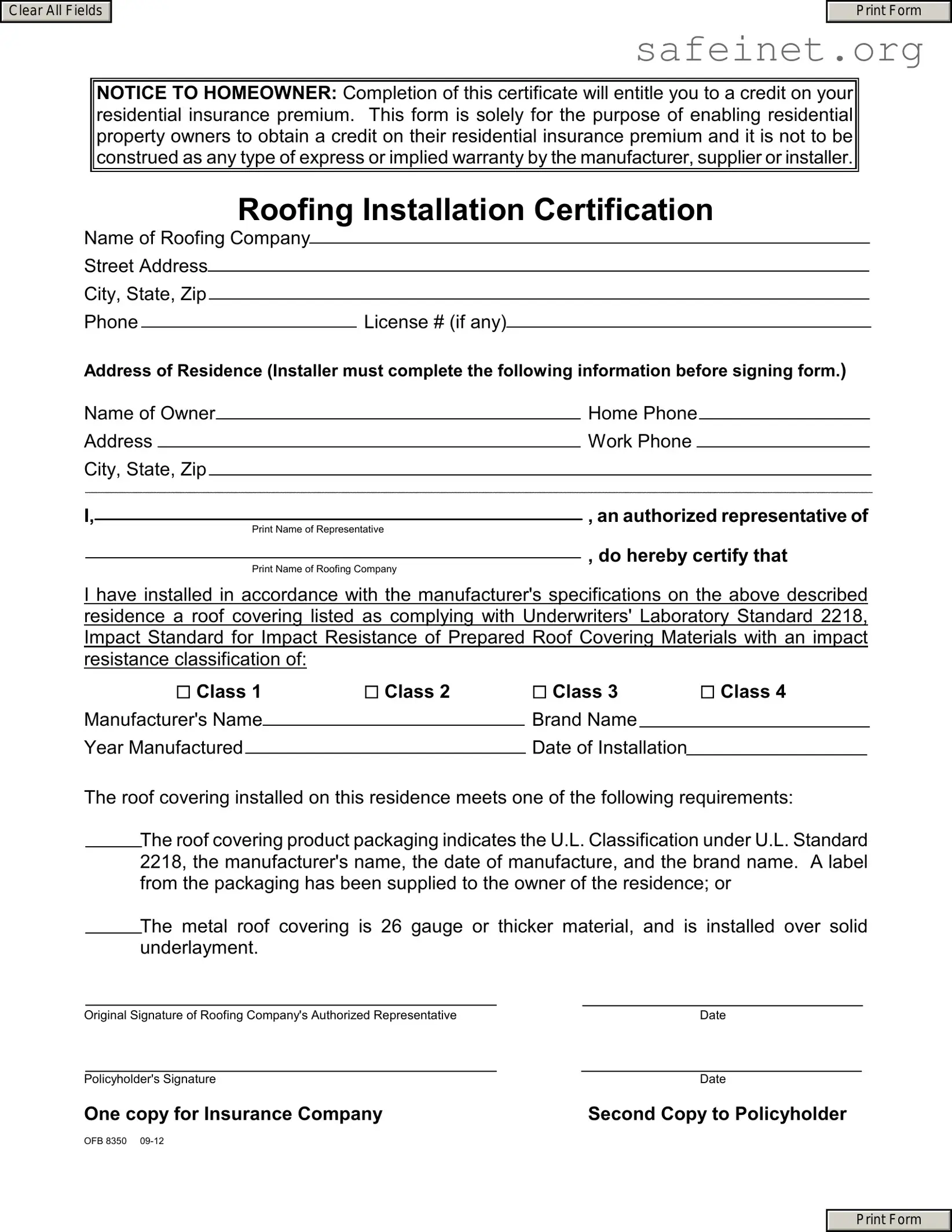
The Roofing Certificate form plays a crucial role in helping homeowners in Texas reduce their residential insurance premiums. By completing this form, property owners can certify that their roof meets specific standards for impact resistance, which can lead to potential savings on insurance costs. This certification is particularly valuable as it outlines essential details such as the roofing company’s information, the type of roofing materials used, and the date of installation. Importantly, the form requires the roofing company to confirm that the installation complies with the manufacturer's specifications and Underwriters’ Laboratory Standard 2218. Homeowners should note that while the form facilitates premium reductions, it does not serve as a warranty from the manufacturer or installer. The document must be signed by an authorized representative of the roofing company, and both the homeowner and the insurance company should retain copies for their records. Misrepresenting information on this form can lead to serious legal consequences, including charges of fraud, underscoring the importance of accuracy and honesty in its completion.
Clear All Fields
Print Form
NOTICE TO HOMEOWNER: Completion of this certificate will entitle you to a credit on your residential insurance premium. This form is solely for the purpose of enabling residential property owners to obtain a credit on their residential insurance premium and it is not to be construed as any type of express or implied warranty by the manufacturer, supplier or installer.
Roofing Installation Certification
Name of Roofing Company
Street Address
City, State, Zip
PhoneLicense # (if any)
Address of Residence (Installer must complete the following information before signing form.)
Name of Owner |
|
Home Phone |
|
|
|||||
Address |
|
|
|
Work Phone |
|
|
|||
City, State, Zip |
|
|
|
|
|
|
|||
I, |
|
|
, an authorized representative of |
||||||
|
|
||||||||
|
|
|
|
|
Print Name of Representative |
||||
|
|
|
|
|
|
, do hereby certify that |
|||
|
|
|
|
|
|
||||
|
|
|
|
|
Print Name of Roofing Company |
||||
I have installed in accordance with the manufacturer's specifications on the above described residence a roof covering listed as complying with Underwriters' Laboratory Standard 2218, Impact Standard for Impact Resistance of Prepared Roof Covering Materials with an impact resistance classification of:
Class 1 |
Class 2 |
|
Class 3 |
Class 4 |
||||
Manufacturer's Name |
|
|
Brand Name |
|
|
|
||
Year Manufactured |
|
|
|
Date of Installation |
|
|
||
|
|
|
|
|
|
|
|
|
The roof covering installed on this residence meets one of the following requirements:
The roof covering product packaging indicates the U.L. Classification under U.L. Standard 2218, the manufacturer's name, the date of manufacture, and the brand name. A label from the packaging has been supplied to the owner of the residence; or
The metal roof covering is 26 gauge or thicker material, and is installed over solid underlayment.
|
|
|
|
|
Original Signature of Roofing Company's Authorized Representative |
|
Date |
||
|
|
|
|
|
|
Policyholder's Signature |
|
Date |
|
One copy for Insurance Company |
|
Second Copy to Policyholder |
||
OFB 8350 |
|
|
|
|
Print Form
| Fact Name | Details |
|---|---|
| Purpose | This certificate allows homeowners to qualify for a reduction in residential insurance premiums. |
| Governing Law | Texas Insurance Code, Section homeowner insurance premium reductions. |
| Certification Requirement | The roofing company must certify that the installation meets manufacturer specifications and U.L. Standard 2218. |
| Impact Resistance Classifications | Roof coverings are classified into four categories: Class 1, Class 2, Class 3, and Class 4 based on impact resistance. |
| Labeling Requirement | As of January 1, 1999, all roofing materials must be labeled with the U.L. classification and manufacturer details. |
| Signature Requirement | An authorized representative of the roofing company must sign the form to validate the certification. |
| Distribution of Copies | One copy of the completed certificate must be retained by the homeowner, and another must be sent to the insurance company. |
Filling out the Roofing Certificate form is a straightforward process that can help homeowners secure a reduction in their residential insurance premiums. Follow the steps below to ensure that all necessary information is accurately provided. Once completed, the form will need to be submitted to the appropriate parties.
What is the purpose of the Roofing Certificate form?
The Roofing Certificate form is designed to help homeowners obtain a reduction in their residential insurance premiums. By completing this form, homeowners can certify that their roof has been installed according to the manufacturer's specifications and meets certain impact resistance standards. It is important to note that this form does not serve as a warranty from the manufacturer, supplier, or installer.
Who needs to complete the Roofing Certificate form?
The Roofing Certificate form must be completed by an authorized representative of the roofing company that installed the roof. This representative must provide specific information about the roofing materials used, including compliance with Underwriters’ Laboratory Standard 2218. Homeowners will also need to provide their personal information and the address of the residence.
What information is required on the Roofing Certificate form?
The form requires several key pieces of information. This includes the name and address of the roofing company, the name of the homeowner, and details about the roof installation. Additionally, the roofing company must indicate the impact resistance classification of the roof covering and provide the manufacturer's name, brand name, and date of installation. Proper labeling of the roofing materials is also necessary.
How does the Roofing Certificate form affect my insurance premiums?
By submitting the Roofing Certificate form, homeowners may qualify for a reduction in their residential insurance premiums. Insurance companies often offer discounts for roofs that meet specific standards for durability and impact resistance. However, the actual amount of the premium reduction will depend on the individual insurance provider's policies and the specifics of the roof installation.
What should I do with the Roofing Certificate form after completion?
Once the Roofing Certificate form is completed and signed by the roofing company's authorized representative, it is important to retain a copy for your records. One copy should be submitted to your insurance company to apply for the premium reduction, while the homeowner should keep another copy for future reference. Make sure to store it in a safe place, as it may be needed for any future insurance inquiries.
Failing to include the name of the roofing company. This is essential for identification.
Omitting the license number if applicable. This can raise questions about the legitimacy of the installation.
Not providing the correct address of the residence. Accuracy is crucial for insurance records.
Leaving out the date of installation. This information helps establish the timeline of the roofing work.
Not checking the correct U.L. classification for the roofing material. This can affect the premium reduction.
Forgetting to include the manufacturer’s name and brand name. This information is necessary for verification.
Neglecting to obtain the signature of the authorized representative. Without this, the form is not valid.
Failing to provide a label from the packaging to the homeowner. This is important for proof of compliance.
Not retaining a copy of the form for personal records. Homeowners should keep this for future reference.
The Roofing Certificate form serves a crucial purpose for homeowners seeking to reduce their residential insurance premiums. However, it is often accompanied by several other important documents that help ensure compliance with regulations and provide necessary information to insurance companies. Below is a list of these documents, each with a brief description.
Understanding these accompanying documents is essential for homeowners looking to navigate the insurance landscape effectively. Each document plays a vital role in ensuring that the roofing work is compliant and that the homeowner can benefit from any applicable insurance premium reductions.
The Certificate of Occupancy is a document that indicates a building's compliance with local building codes and regulations. It is issued by the local government after a thorough inspection of the property. Similar to the Roofing Certificate, it serves as a verification tool. Both documents assure stakeholders—homeowners in the case of the Roofing Certificate and tenants or buyers in the case of the Certificate of Occupancy—that certain standards have been met. This helps in reducing risks associated with property ownership and can also lead to lower insurance premiums.
The Home Warranty Certificate provides assurance to homeowners that certain repairs or replacements will be covered for a specified period after the purchase of a home. Like the Roofing Certificate, it aims to protect the homeowner's investment. Both documents serve as a form of risk management. While the Roofing Certificate focuses on the roof's compliance and quality, the Home Warranty Certificate encompasses a broader range of home systems and appliances, providing peace of mind to the homeowner.
The Energy Efficiency Certificate is another important document that verifies a home's energy performance. This certificate is often required for certain financing options or incentives. Similar to the Roofing Certificate, it helps homeowners qualify for reductions in costs, such as energy bills or insurance premiums. Both documents encourage compliance with specific standards, ultimately benefiting the homeowner by promoting safer and more efficient living environments.
The Title Insurance Policy protects homeowners from potential disputes over property ownership. While it does not directly relate to roofing, it shares the goal of safeguarding the homeowner's investment. Like the Roofing Certificate, the Title Insurance Policy provides assurance that certain conditions have been met. Both documents play a crucial role in the real estate transaction process, giving homeowners confidence in their property’s legal standing and condition.
The Home Inspection Report is a detailed assessment of a property's condition. This document is typically generated before a home sale and helps buyers understand the state of the home. Similar to the Roofing Certificate, it serves to inform homeowners about potential issues that may need addressing. Both documents are vital in the decision-making process, as they provide essential information that can influence financial decisions, such as insurance premiums or necessary repairs.
When filling out the Roofing Certificate form, follow these guidelines to ensure a smooth process.
By adhering to these dos and don'ts, you can help ensure that your Roofing Certificate form is completed correctly and efficiently.
Here are some common misconceptions about the Roofing Certificate form that homeowners should be aware of:
When it comes to the Roofing Certificate form, understanding its importance and how to fill it out correctly can lead to significant savings on your residential insurance premiums. Here are some key takeaways to keep in mind:
By following these guidelines, homeowners can ensure they are taking the right steps to benefit from potential insurance premium reductions while also protecting themselves legally.