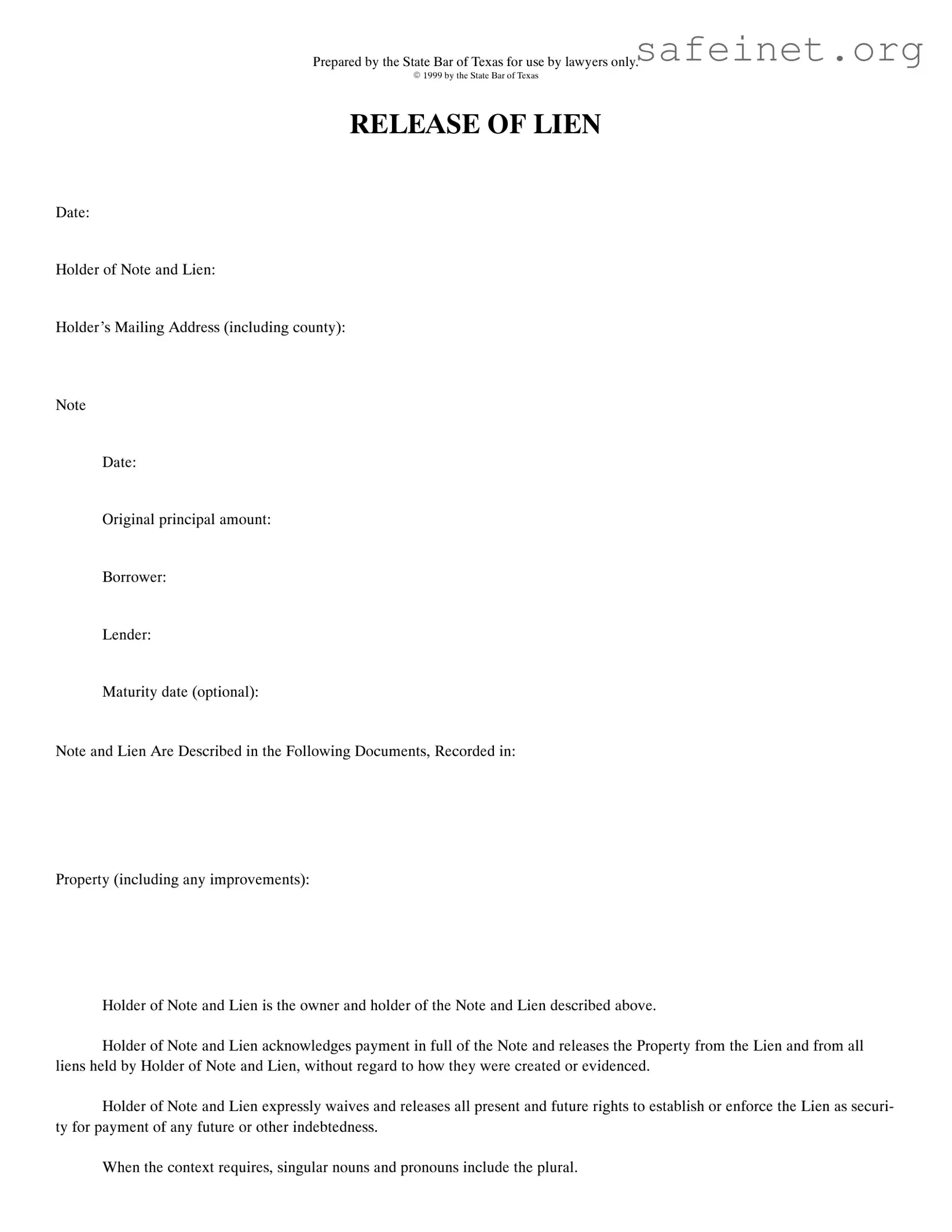
In Texas, the Release of Lien form serves as a crucial document for property owners and lenders alike. This form signifies the formal acknowledgment of payment in full for a loan secured by a lien on a property. When a borrower fulfills their financial obligations, the holder of the note and lien is responsible for completing this document, which releases the property from any claims associated with the lien. The form requires specific details, such as the names of the borrower and lender, the original principal amount of the loan, and a description of the property involved. Additionally, it includes an acknowledgment section that must be notarized, ensuring the authenticity of the signatures involved. By signing this document, the holder not only relinquishes their rights to enforce the lien but also waives any future claims related to that debt. Understanding the significance of this form is essential for anyone navigating the complexities of property ownership and financing in Texas.
Prepared by the State Bar of Texas for use by lawyers only.
E 1999 by the State Bar of Texas
RELEASE OF LIEN
Date:
Holder of Note and Lien:
Holder’s Mailing Address (including county):
Note
Date:
Original principal amount:
Borrower:
Lender:
Maturity date (optional):
Note and Lien Are Described in the Following Documents, Recorded in:
Property (including any improvements):
Holder of Note and Lien is the owner and holder of the Note and Lien described above.
Holder of Note and Lien acknowledges payment in full of the Note and releases the Property from the Lien and from all liens held by Holder of Note and Lien, without regard to how they were created or evidenced.
Holder of Note and Lien expressly waives and releases all present and future rights to establish or enforce the Lien as securi- ty for payment of any future or other indebtedness.
When the context requires, singular nouns and pronouns include the plural.
|
(Acknowledgment) |
|
STATE OF TEXAS |
|
|
COUNTY OF |
|
|
This instrument was acknowledged before me on |
, |
|
by |
. |
|
|
|
|
|
Notary Public, State of Texas |
|
|
Notary’s name (printed): |
|
|
Notary’s commission expires: |
|
|
(Corporate Acknowledgment) |
|
STATE OF TEXAS |
|
|
COUNTY OF |
|
|
This instrument was acknowledged before me on |
, |
|
by |
, |
|
of |
|
|
a |
|
corporation, on behalf of said corporation. |
|
|
|
|
Notary Public, State of Texas |
|
|
Notary’s name (printed): |
|
|
Notary’s commission expires: |
|
AFTER RECORDING RETURN TO: |
PREPARED IN THE LAW OFFICE OF: |
| Fact Name | Description |
|---|---|
| Purpose | The Release of Lien form is used to officially acknowledge that a lien on a property has been satisfied and is no longer in effect. |
| Governing Law | This form is governed by Texas property law, specifically under the Texas Property Code. |
| Usage Restrictions | This form is intended for use by licensed attorneys in Texas, as prepared by the State Bar of Texas. |
| Acknowledgment Requirement | The form must be acknowledged by a notary public to validate the release of the lien. |
Completing the Release of Lien form in Texas is a straightforward process. This document serves to formally acknowledge that a lien has been satisfied and releases the property from any claims associated with that lien. After filling out the form, it will need to be signed and notarized before being filed with the appropriate county office.
What is a Release of Lien Texas form?
The Release of Lien Texas form is a legal document used to officially release a lien on a property. When a borrower pays off their debt, the holder of the lien acknowledges this payment and relinquishes their claim on the property. This form is essential to clear the title of the property and is typically prepared by an attorney for use in Texas.
Who needs to sign the Release of Lien Texas form?
The form must be signed by the holder of the note and lien, who is the individual or entity that lent the money and placed the lien on the property. If the holder is a corporation, an authorized representative must sign on behalf of the corporation. The signatures must be notarized to ensure the document is legally binding.
How does one file the Release of Lien Texas form?
To file the Release of Lien Texas form, the completed document must be recorded with the county clerk in the county where the property is located. It is important to ensure that all required information is accurately filled out, including the holder's mailing address and the property details. After recording, a copy should be kept for personal records.
What happens if the Release of Lien Texas form is not filed?
If the Release of Lien Texas form is not filed after the debt is paid, the lien may still appear to be in effect. This can create issues for the property owner, as it may hinder their ability to sell or refinance the property. It is crucial to complete this process to ensure clear ownership and avoid potential legal complications in the future.
Incomplete Information: Failing to provide all necessary details can lead to complications. Ensure that every field, such as the holder’s mailing address and the property description, is filled out completely. Missing information can delay the process or result in the form being rejected.
Incorrect Dates: Entering the wrong date for the note or the acknowledgment can create confusion. It is crucial to double-check all dates to ensure they reflect the accurate timeline of the loan and lien. An incorrect date may invalidate the release.
Notary Errors: The acknowledgment section must be signed by a notary public. If the notary's name is not printed correctly or their commission is not up-to-date, it could render the document ineffective. Always verify that the notary's details are accurate and that they are authorized to sign.
Failure to Record: After filling out the form, it must be recorded with the appropriate county office. Neglecting to do this step means the lien may still appear active. Ensure that you follow through with recording the document to officially release the lien.
The Release of Lien form is a crucial document in Texas real estate transactions, signifying the satisfaction of a debt and the release of a lien on a property. However, several other forms and documents are often used in conjunction with this release to ensure clarity and compliance in the legal process. Below are some of the common documents associated with the Release of Lien in Texas.
Understanding these documents can help individuals navigate the complexities of property transactions more effectively. Each plays a specific role in ensuring that all parties involved are protected and that the transaction is legally sound.
The Satisfaction of Mortgage document serves a similar purpose to the Release of Lien in Texas. This document is executed by a lender to confirm that a mortgage has been paid in full. Once the mortgage is satisfied, the lender relinquishes any claim to the property. Like the Release of Lien, the Satisfaction of Mortgage provides a clear statement that the borrower has fulfilled their financial obligations, thus removing any encumbrance on the property. This ensures that the property title is free and clear, allowing the borrower to transfer or sell the property without complications.
The Deed of Reconveyance is another document closely related to the Release of Lien. This form is used primarily in the context of a trust deed. When a borrower pays off their loan secured by a trust deed, the trustee executes a Deed of Reconveyance to transfer the property back to the borrower. Similar to the Release of Lien, this document signifies the end of the lender's interest in the property, ensuring that the borrower has full ownership rights once again. It is essential for clearing the title, especially when the property is to be sold or refinanced.
The Termination of Lease document also shares similarities with the Release of Lien. While this document typically pertains to rental agreements, it serves to formally end the landlord's claim to the property once the lease obligations have been fulfilled. Just as the Release of Lien removes the lender's claim, the Termination of Lease eliminates the landlord's rights over the tenant's use of the property. This is crucial for both parties, as it provides legal clarity and allows for the potential sale or new leasing of the property without lingering obligations.
Finally, the Assignment of Lien is another document that bears resemblance to the Release of Lien. This document allows a lienholder to transfer their rights to another party. When a lien is assigned, the original lienholder relinquishes their claim on the property, similar to how a Release of Lien operates. The new lienholder then assumes responsibility for the lien, which may affect the property’s title. This transfer is essential for maintaining accurate records and ensuring that all parties involved are aware of their rights and obligations regarding the property.
When filling out the Release Of Lien Texas form, it is crucial to follow specific guidelines to ensure accuracy and compliance. Here are six important dos and don'ts to consider:
Completing this form accurately is essential for the release of the lien. Take your time to review each section carefully. Errors or omissions could lead to complications down the line.
Understanding the Release of Lien form in Texas is crucial for both borrowers and lenders. However, several misconceptions often arise regarding this important document. Below are nine common misunderstandings, each explained for clarity.
Being aware of these misconceptions can help individuals navigate the complexities of lien releases more effectively. Understanding the true nature of the Release of Lien form in Texas empowers both borrowers and lenders to make informed decisions.
When dealing with the Release of Lien form in Texas, here are some key takeaways to keep in mind: