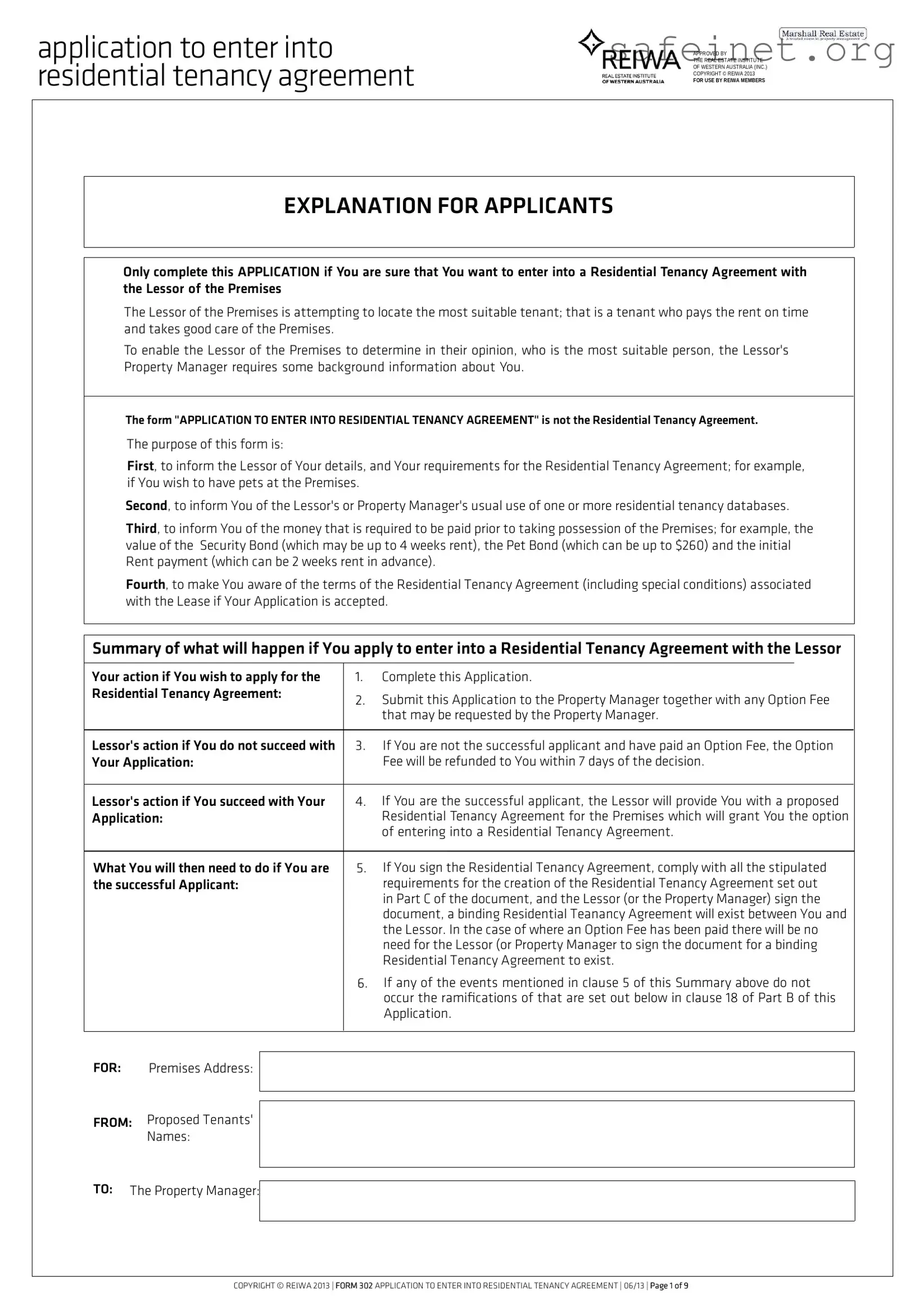
The Reiwa Tenancy Application form is a crucial document for anyone looking to enter into a residential tenancy agreement in Western Australia. This form, approved by the Real Estate Institute of Western Australia, serves multiple purposes. First, it collects essential information about potential tenants, including their personal details and specific requirements, such as pet ownership. Second, it informs applicants about the usual practices of the lessor or property manager regarding tenancy databases, which may be used to assess an applicant's rental history. Additionally, the form outlines the financial obligations that applicants must meet before taking possession of the premises, including the security bond, pet bond, and initial rent payment. Furthermore, it provides clarity on the process that follows an application, detailing what happens if an applicant is successful or not. Understanding these components is vital for prospective tenants to navigate the rental process effectively and ensure compliance with all necessary requirements.
application to enter into residential tenancy agreement
APPROVED BY
THE REAL ESTATE INSTITUTE OF WESTERN AUSTRALIA (INC.) COPYRIGHT © REIWA 2013
FOR USE BY REIWA MEMBERS
EXPLANATION FOR APPLICANTS
Only complete this APPLICATION if You are sure that You want to enter into a Residential Tenancy Agreement with the Lessor of the Premises
The Lessor of the Premises is attempting to locate the most suitable tenant; that is a tenant who pays the rent on time and takes good care of the Premises.
To enable the Lessor of the Premises to determine in their opinion, who is the most suitable person, the Lessor's Property Manager requires some background information about You.
The form "APPLICATION TO ENTER INTO RESIDENTIAL TENANCY AGREEMENT" is not the Residential Tenancy Agreement.
The purpose of this form is:
First, to inform the Lessor of Your details, and Your requirements for the Residential Tenancy Agreement; for example, if You wish to have pets at the Premises.
Second, to inform You of the Lessor's or Property Manager's usual use of one or more residential tenancy databases.
Third, to inform You of the money that is required to be paid prior to taking possession of the Premises; for example, the value of the Security Bond (which may be up to 4 weeks rent), the Pet Bond (which can be up to $260) and the initial Rent payment (which can be 2 weeks rent in advance).
Fourth, to make You aware of the terms of the Residential Tenancy Agreement (including special conditions) associated with the Lease if Your Application is accepted.
Summary of what will happen if You apply to enter into a Residential Tenancy Agreement with the Lessor
Your action if You wish to apply for the |
1. |
Complete this Application. |
|
||
Residential Tenancy Agreement: |
2. |
Submit this Application to the Property Manager together with any Option Fee |
|||
|
|
|
|||
|
|
|
|
that may be requested by the Property Manager. |
|
|
|
|
|
||
Lessor's action if You do not succeed with |
3. |
If You are not the successful applicant and have paid an Option Fee, the Option |
|||
Your Application: |
|
Fee will be refunded to You within 7 days of the decision. |
|||
|
|
|
|
||
Lessor's action if You succeed with Your |
4. |
If You are the successful applicant, the Lessor will provide You with a proposed |
|||
Application: |
|
Residential Tenancy Agreement for the Premises which will grant You the option |
|||
|
|
|
|
of entering into a Residential Tenancy Agreement. |
|
|
|
|
|
||
What You will then need to do if You are |
5. |
If You sign the Residential Tenancy Agreement, comply with all the stipulated |
|||
the successful Applicant: |
|
requirements for the creation of the Residential Tenancy Agreement set out |
|||
|
|
|
|
in Part C of the document, and the Lessor (or the Property Manager) sign the |
|
|
|
|
|
document, a binding Residential Teanancy Agreement will exist between You and |
|
|
|
|
|
the Lessor. In the case of where an Option Fee has been paid there will be no |
|
|
|
|
|
need for the Lessor (or Property Manager to sign the document for a binding |
|
|
|
|
|
Residential Tenancy Agreement to exist. |
|
|
|
|
6. If any of the events mentioned in clause 5 of this Summary above do not |
||
|
|
|
|
occur the ramifications of that are set out below in clause 18 of Part B of this |
|
|
|
|
|
Application. |
|
|
|
|
|
|
|
FOR: |
|
|
|
|
|
Premises Address: |
|
|
|
|
|
|
|
|
|
|
|
|
|
|
|
|
|
FROM: |
Proposed Tenants' |
|
|
|
|
|
Names: |
|
|
|
|
|
|
|
|
|
|
TO: The Property Manager:
COPYRIGHT © REIWA 2013 | FORM 302 APPLICATION TO ENTER INTO RESIDENTIAL TENANCY AGREEMENT | 06/13 | Page 1 of 9

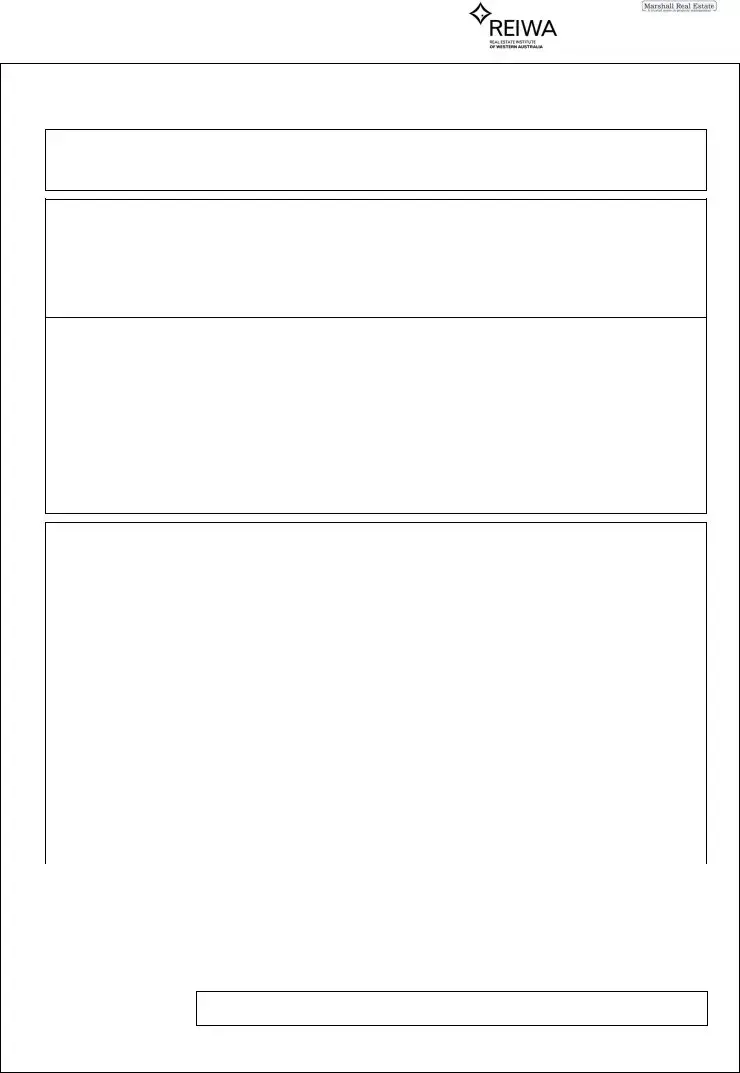
application to enter into residential tenancy agreement
APPROVED BY
THE REAL ESTATE INSTITUTE OF WESTERN AUSTRALIA (INC.) COPYRIGHT © REIWA 2013
FOR USE BY REIWA MEMBERS
|
|
|
|
|
|
|
|
PART A |
|
|||
|
|
|
|
|
|
|
|
(TO BE COMPLETED BY PROPERTY MANAGER) |
|
|||
|
|
|
|
|
|
|
|
|
|
|
|
|
|
|
|
|
|
|
|
|
|
|
|
|
|
|
|
|
|
|
|
|
|
|
|
|
|
|
|
1. |
Premises |
|
|
|
|
|
|
|
|
||
|
|
|
|
|
|
|
|
|
|
|
|
|
|
2. |
Rent |
$ |
|
|
|
|
|
|
per week |
||
|
|
|
|
|
|
|
||||||
|
|
|
|
|
|
|
|
|
|
|
||
|
|
|
|
|
|
|
|
|
|
|||
|
3. |
Option Fee (if applicable) $ |
|
|
|
|
|
|
|
|||
|
|
|
|
|
|
|
||||||
|
4. |
If You are the successful applicant, and wish to enter into a Residential Tenancy Agreement with the Lessor, You will be required to pay the following |
||||||||||
|
|
money to the Property Manager: |
|
|
|
|
|
|
||||
|
|
REQUIRED MONEY |
|
|
|
|
|
|
||||
|
|
(a) |
Security bond of |
$ |
|
|
|
|
|
|||
|
|
|
|
|
|
|
||||||
|
|
(b) Pet bond (if applicable) |
$ |
|
|
|
|
|
||||
|
|
|
|
|
|
|
||||||
|
|
|
|
|
|
|
||||||
|
|
(c) First two weeks rent |
$ |
|
|
|
|
|
||||
|
|
|
|
|
|
|
||||||
|
|
|
|
|
|
|
||||||
|
|
(d) Less Option Fee (if paid) |
$ |
|
|
|
|
|
||||
|
|
|
|
|
|
|
||||||
|
|
|
|
|
|
|
||||||
|
|
|
|
|
|
|
$ |
|
|
|
|
|
|
|
|
|
|
|
|
|
|
|
|
|
|
|
|
(e) |
Total |
0 |
|
|
|
|
||||
|
|
|
|
|
|
|
||||||
|
|
|
|
|
|
|
|
|
|
|
|
|
COPYRIGHT © REIWA 2013 | FORM 302 APPLICATION TO ENTER INTO RESIDENTIAL TENANCY AGREEMENT | 06/13 | Page 2 of 9
application to enter into residential tenancy agreement
APPROVED BY
THE REAL ESTATE INSTITUTE OF WESTERN AUSTRALIA (INC.) COPYRIGHT © REIWA 2013
FOR USE BY REIWA MEMBERS
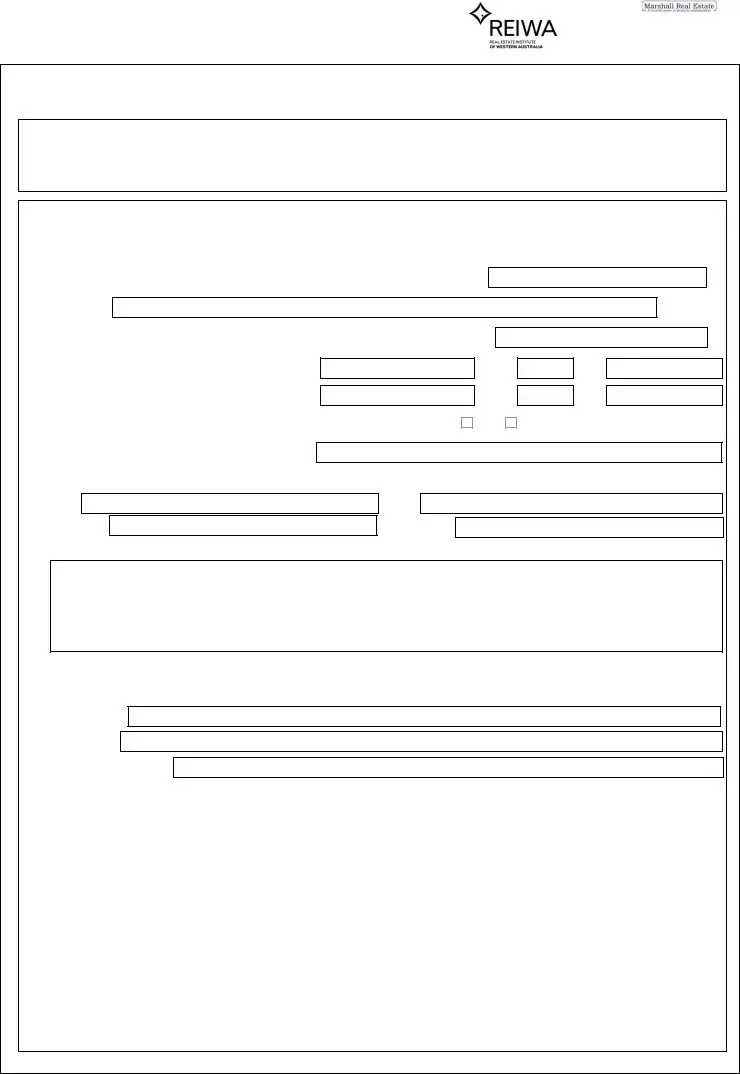
PART B
(TO BE COMPLETED BY YOU)
NOTE: This document is not a residential tenancy agreement and does not grant any right to occupy the Premises
INFORMATION FROM "YOU" (the proposed tenant or tenants)
TENANCY DETAILS
5. |
You require the tenancy for a period of |
|
months from |
|
to |
|
|
|
|
|
|
6.At a rent of $
7. |
Total number of persons to occupy the Premises |
Adults |
|
Children |
|
Ages |
|
|
|
|
|
|
|
per week
8. |
Pets - |
Type of Pet |
|
Breed |
|
|
Type of Pet |
|
Breed |
|
|
|
||
|
|
|
||
|
|
|
|
|
9.Do You intend applying for a residential tenancy bond from a State Government Department?
Number
Number
Yes
No
Age
Age
If Yes, $ |
|
Branch: |
|
|
|
10.Bank account details for refund of Option Fee (if applicable) Bank:
Account No.:
BSB:
Account Name:
11.Any Special Conditions requested by You:
NOTE: The Lessor is not obliged to accept any of the Your Special Conditions.
12.The address at which You wish to receive the Residential Tenancy Agreement if You are successful and/or notices relating to tenancy
Email (optional):
Fax (optional):
Postal address (required):
13.You declare that You are not bankrupt and that all of the information supplied in this Application is true and correct and is not misleading in anyway.
14.You acknowledge that, having inspected the Premises, You will accept possession of the Premises in the condition it was in as at the date of inspection.
15.By Signing this application You are making an application to lease the Premises. The Lessor may or may not send You a proposed Residential Tenancy Agreement for the Premises.
16.If You are the successful applicant, the Lessor will send You a proposed Residential Tenancy Agreement for the Premises which will contain information about
Parts A, B and C. Parts A and B can be viewed on reiwa.com.au. Part C will also include additional terms agreed to by the parties, a draft of which is attached to this Application.
17.If a sum for an Option Fee is stipulated in Part A, you must pay that Option Fee to the Property Manager at the same time you make this application.
The Option Fee must be paid by you by cash or cheque. If You are not the successful applicant and have paid an Option Fee, the Option Fee will be refunded to you by way of an electronic transfer to your bank account details set out in Part B within 7 days of the decision.
COPYRIGHT © REIWA 2013 | FORM 302 APPLICATION TO ENTER INTO RESIDENTIAL TENANCY AGREEMENT | 06/13 | Page 3 of 9
application to enter into residential tenancy agreement
APPROVED BY
THE REAL ESTATE INSTITUTE OF WESTERN AUSTRALIA (INC.) COPYRIGHT © REIWA 2013
FOR USE BY REIWA MEMBERS
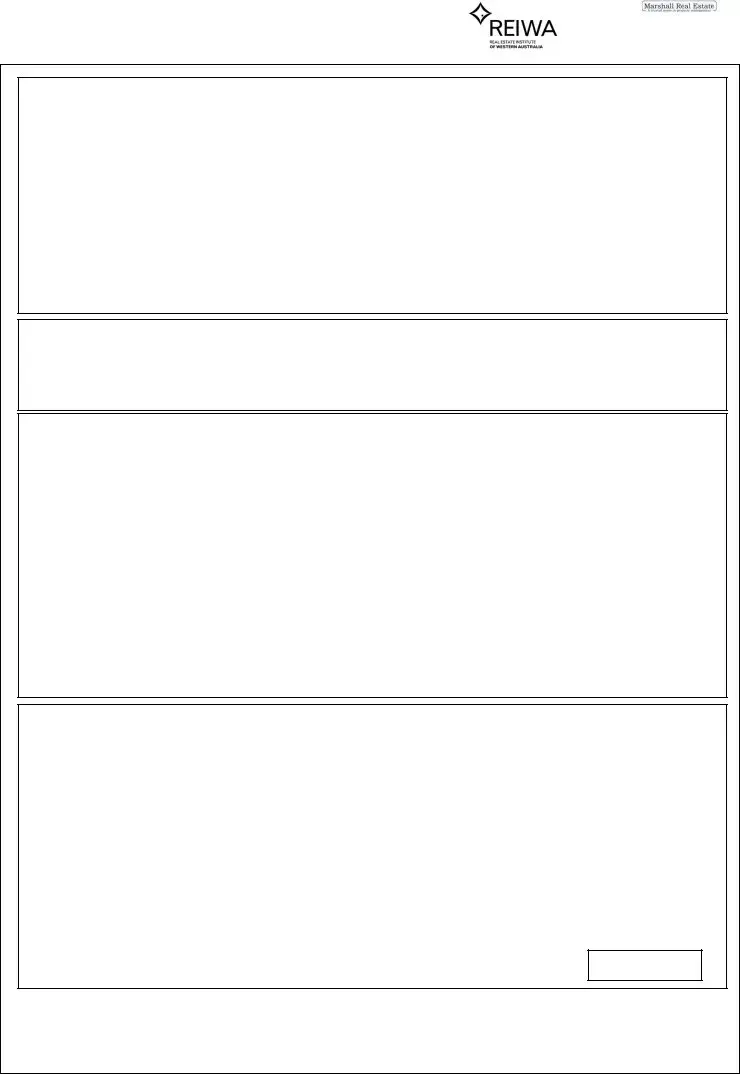
18.If You are the successful application the Lessor will provide you with a proposed Residential Tenancy Agreement for the Premises which will grant You the option of entering into a Residential Tenancy Agreement:
(a)if You sign the Residential Tenancy Agreement, comply with all the stipulated requirements for the creation of a binding Residential Tenancy Agreement as set out in Part C of the document (eg returning the document to the Property Manager by the stipulated time, paying full stipulated rental and bond); and;
(i)if an Option Fee has been paid THEN a binding Residential Tenancy Agreement will exist between You and the Lessor and any Option Fee will be refunded to You or applied towards the rent; or
(ii)if no Option Fee has been paid and if neither the Lessor nor the Property Manager sign the document THEN no binding Residential Tenancy Agreement will exist between You and the Lessor, and any Option Fee will be refunded to You within 7 days of the decision;
or
(iii)if no Option Fee has been paid and if the Lessor (or the Property Manager) signs the document, THEN a binding Residential Tenancy Agreement will exist between You and the Lessor.
(b)if You do not sign the Residential Tenancy Agreement or if You do not comply with the
19.YOU MUST UNDERSTAND THAT IF YOU ARE THE SUCCESSFUL APPLICANT AND THE LESSOR PROVIDES YOU WITH A PROPOSED RESIDENTIAL TENANCY AGREEMENT BUT YOU DO NOT COMPLY WITH
20.DEFINITIONS
(a)"Act" means the Residential Tenancies Act 1987 including any amendments.
"Application" means this Application to enter into a Residential Tenancy Agreement.
"Business Day" means any day except a Sunday or public holiday in Western Australia. "Lessor" means the person/entity with the authority to lease the Premises.
"Option Fee" means a payment as referred to in section 27(2)(a) of the Act. The amount of the Option Fee is specified in Part A of this application. The amount of the Option Fee is capped as follows:
(i)where the weekly rental under the Residential Tenancy Agreement is $500 or less, an Option Fee of up to $50 is payable;
(ii)where the weekly rental under the Residential Tenancy Agreement exceeds $500, an Option Fee of up to $100 is payable;
(ii)where the Residential Tenancy Agreement is for residential premises south of the 26th parallel of south latitude and the weekly rent is $1,200 or more, an Option Fee of up to $1,200 is payable.
"Premises" means the address specified on the first page of this document. Any items included or excluded will appear in Part A of the proposed Residential Tenancy Agreement.
"Property Manager" means the real estate agent appointed by the Lessor to lease and manage the Premises.
"Residential Tenancy Agreement" means an agreement in writing in the form prescribed by the Act, comprising of Parts A, B and C. Part C will include additional special conditions as agreed between the parties.
"You" or "Your" means the person or persons making the Application to Lease the Premises.
(b)All acts and things that the Lessor is required or empowered to do may be done by the Lessor or their Property Manager.
21.You agree that for the purpose of this Application, the Lessor or Property Manager may make enquiries of the persons given as referees, next of kin or emergency contacts provided by You, and also make enquiries of such other persons or agencies as the Lessor may see fit.
The personal information You give in this Application or collected from other sources is necessary for the Lessor or Property Manager to
verify Your identity, to process and evaluate the Application, to manage the tenancy and to conduct the Property Manager's business. Personal information collected about You in this Application and during the course of the tenancy if the Application is successful may be disclosed for the purpose for which it was collected to other parties including to the Lessor, referees, other Property Managers, prospective lessors, third party operators of residential tenancy databases, and prospective buyers of the Premises. Information already held on residential tenancy databases may also be disclosed to the Property Manager or Lessor.
If You enter into the Residential Tenancy Agreement or You fail to comply with Your obligations under any Residential Tenancy Agreement that fact and other relevant personal information collected about You during the course of this Application (including information provided separately to this application) or the Residential Tenancy Agreement may also be disclosed to the Lessor, third party operators of tenancy reference databases (to the extent permitted by law), other Property Managers, prospective lessors and prospective buyers of the Premises.
If You would like to access the personal information the Lessor or Property Manager holds, You can do so by contacting the Property Manager. See also the attached notice regarding use of residential tenancy databases.
You can also correct this information if it is inaccurate, incomplete or
Initials
COPYRIGHT © REIWA 2013 | FORM 302 APPLICATION TO ENTER INTO RESIDENTIAL TENANCY AGREEMENT | 06/13 | Page 4 of 9

application to enter into residential tenancy agreement
APPROVED BY
THE REAL ESTATE INSTITUTE OF WESTERN AUSTRALIA (INC.) COPYRIGHT © REIWA 2013
FOR USE BY REIWA MEMBERS
NOTICE OF USE OF ONE OR MORE RESIDENTIAL TENANCY DATABASES
Section 82C - Residential Tenancies Act 1987
1.It is the Property Manager's usual practice to use one or more residential databases for the purpose of checking an applicant's tenancy history.
2.The name of each residential tenancy database the Property Manager or Lessor usually uses, or may use, for deciding whether a residential tenancy agreement should be entered into with a person are set out below:
3.The contact details for the database operator(s) who operates the database(s) used by the PM as referred to above are as follows:
(a)TICA (strike out if inapplicable)
(i)Address: PO Box 120, Concord NSW 2137
(ii)Telephone: 190 222 0346. Calls are charged $5.45 per minute including GST (higher for mobile or pay phones)
(iii)Facsimile: (02) 9743 4844
(iv)Website: www.tica.com.au
(b)National Tenancy Database (strike out if inapplicable)
(i)Address: GPO Box 13294, George Street 120, Brisbane QLD 4003
(ii)Telephone: 1300 563 826
(iii)Facsimile: (07) 3009 0619
(iv)Email: [email protected]
(v)Website: www.ntd.net.au
(c)Other Databases (if applicable)
(i) |
Name: |
|
|
|
|
|
|
|
|
|
|
|
|
|
(ii) |
Address: |
|
|
|
|
|
|
|
|
|
|
|
|
|
(iii) |
Telephone: |
|
|
|
|
|
|
|
|
|
|
|||
(iv) |
Facsimile: |
|
||
|
|
|
||
|
|
|||
(v) |
Email: |
|
||
(vi) |
|
|
||
|
||||
Website: |
|
|||
|
|
|
|
|
4.The applicant may obtain information from the database operator in the following manner:
(a)as to TICA:
(i)Postal and fax application forms can be downloaded from www.tica.com.au . Information regarding applicatino fees can be found on the application form;
(b)as to the National Tenancy Database;
(i)A request for rental history file can be downloaded from www.ntd.net.au . A link to the form can be found under the tab "For Tenants".
(ii)A request for rental history may be submitted by post, fax or email.
(c) |
as to |
|
(i) |
NOTE: This notice is required to be given regardless of whether the Property Manager intends to conduct a search on the particular applicant.
COPYRIGHT © REIWA 2013 | FORM 302 APPLICATION TO ENTER INTO RESIDENTIAL TENANCY AGREEMENT | 06/13 | Page 5 of 9
| Fact Name | Description | Governing Law |
|---|---|---|
| Purpose of the Form | The form is used to apply for a Residential Tenancy Agreement, providing the Lessor with necessary information about the applicant. | Residential Tenancies Act 1987 |
| Option Fee Details | An Option Fee may be required when applying. The amount depends on the weekly rent and can be refunded if the application is unsuccessful. | Residential Tenancies Act 1987 |
| Security Bond Requirements | Applicants must be aware of the security bond, which can be up to four weeks' rent, along with any applicable pet bond. | Residential Tenancies Act 1987 |
| Application Submission | The completed application must be submitted to the Property Manager, along with any required fees. | Residential Tenancies Act 1987 |
| Binding Agreement Conditions | If accepted, the applicant must comply with specific requirements to create a binding Residential Tenancy Agreement. | Residential Tenancies Act 1987 |
Completing the Reiwa Tenancy Application form is a crucial step for anyone looking to secure a rental property. This form gathers essential information to help the property manager assess your suitability as a tenant. Following the steps outlined below will ensure that your application is complete and increases your chances of being selected for the tenancy.
Once you have completed these steps, you can submit your application to the property manager. They will review your information and determine if you meet the criteria for tenancy. If your application is successful, you will receive a proposed Residential Tenancy Agreement for further action.
What is the purpose of the Reiwa Tenancy Application form?
The Reiwa Tenancy Application form is designed for individuals who wish to apply for a residential tenancy agreement. It serves several purposes: it collects essential background information about the applicant, informs the lessor of the applicant's requirements, and outlines the financial obligations associated with the tenancy, such as security bonds and initial rent payments. Importantly, this form is not a tenancy agreement itself but a preliminary step in the leasing process.
What information do I need to provide in the application?
Applicants must provide various details in the form, including personal information, desired tenancy duration, rental amount, and the number of occupants. Additionally, information about any pets, special conditions, and bank account details for potential refunds is required. It is crucial to ensure that all information is accurate and complete, as this will impact the processing of the application.
What happens after I submit my application?
Once the application is submitted, the property manager will review it. If the application is successful, the applicant will receive a proposed residential tenancy agreement. The applicant must then sign this agreement and meet any stipulated conditions, such as paying the required fees. If the application is unsuccessful, any option fee paid will be refunded within seven days.
Are there any fees associated with the application process?
Yes, there are several potential fees that applicants may encounter. These include an option fee, which may be required at the time of application, a security bond, and the first two weeks of rent in advance. The specific amounts will be outlined in the application form and may vary based on the property and rental terms.
What if I want to include special conditions in my application?
Applicants can request special conditions in their application, such as permission for pets or modifications to the property. However, it is important to note that the lessor is not obligated to accept these conditions. The property manager will review all requests, but acceptance is at the lessor's discretion.
Incomplete Information: Many applicants fail to provide all the required details in the application form. This includes missing out on essential personal information such as full names, contact details, or rental history.
Ignoring Special Conditions: Some individuals overlook the section where they can specify special conditions. Failing to mention specific requests, such as needing to accommodate pets, can lead to misunderstandings later.
Incorrect Financial Details: Entering wrong figures for the rent or security bond is a common mistake. Ensure that the amounts match what is stipulated in the rental agreement to avoid confusion.
Omitting Bank Account Information: Applicants often neglect to include their bank account details for the refund of the option fee. This can delay the process significantly if they are not selected.
Not Declaring Bankruptcy: Some applicants may fail to acknowledge their bankruptcy status, if applicable. This is crucial information that can impact their application.
Failure to Review the Premises: Not inspecting the property prior to application submission is a mistake. It’s essential to understand the condition of the premises before committing.
Missing Signatures: Finally, neglecting to sign the application can lead to automatic disqualification. A signature confirms that the applicant agrees to all terms and conditions outlined in the form.
When applying for a rental property, the Reiwa Tenancy Application form is often accompanied by several other important documents. These documents help both the prospective tenant and the property manager streamline the application process and ensure that all necessary information is collected. Below is a list of common forms and documents that are typically used alongside the Reiwa Tenancy Application form.
These documents collectively support the Reiwa Tenancy Application form and provide a comprehensive view of the applicant's qualifications. By preparing these materials in advance, prospective tenants can enhance their chances of securing their desired rental property.
The Reiwa Tenancy Application form shares similarities with a Rental Application form commonly used in many states across the U.S. Like the Reiwa form, a typical Rental Application collects essential information about the prospective tenant, including personal details, rental history, and employment information. Both forms serve as a preliminary step before entering into a binding lease agreement, allowing landlords to assess the suitability of applicants based on their background and financial stability. Additionally, both documents outline the potential costs associated with the rental, such as security deposits and first month’s rent, ensuring that applicants are aware of their financial commitments before proceeding.
Another document that resembles the Reiwa Tenancy Application is the Lease Agreement itself. While the Reiwa form is an application to enter into a lease, a Lease Agreement is the formal contract that outlines the terms and conditions of the tenancy once an application is accepted. Both documents emphasize the importance of the tenant's obligations, such as paying rent on time and maintaining the property. They also typically include clauses regarding the duration of the lease, responsibilities for repairs, and the process for terminating the agreement, ensuring clarity and mutual understanding between the landlord and tenant.
The Rental Reference Form is another document that parallels the Reiwa Tenancy Application. This form is often requested by landlords to gather feedback from previous landlords or property managers about a tenant's rental history. Similar to the Reiwa form, it seeks to provide insight into the applicant's reliability and behavior as a tenant. Both documents aim to help landlords make informed decisions by verifying the information provided by the tenant and assessing their suitability for the property in question.
Lastly, the Tenant Screening Report is akin to the Reiwa Tenancy Application in that it serves as a tool for landlords to evaluate potential tenants. This report typically includes credit history, criminal background checks, and eviction history. Like the Reiwa form, it helps landlords determine whether an applicant is likely to fulfill their rental obligations. Both documents ultimately aim to protect the interests of the landlord while ensuring that tenants are aware of the scrutiny they may face in the application process.
When filling out the Reiwa Tenancy Application form, certain actions can help ensure your application is processed smoothly. Below are seven things you should and shouldn't do.
This is not true. The application form is simply a request to enter into a tenancy agreement. It collects information about the applicant but does not grant any rights to occupy the premises.
Submitting the application does not guarantee approval. The lessor will review all applications and choose the most suitable tenant based on various factors.
In fact, the application requires financial details, including information about your ability to pay rent and any option fees. This helps the lessor assess your suitability as a tenant.
While paying an option fee may indicate your interest, it does not automatically secure the property. The lessor still needs to approve your application.
This is incorrect. The lessor is not obligated to accept any special conditions you request in your application.
Approval of your application is just the first step. You must sign the Residential Tenancy Agreement and fulfill any financial obligations before moving in.
Different property managers may have varying requirements or processes. It's essential to follow the specific guidelines provided by the property manager you are dealing with.
While the property manager is required to protect your information, it may still be shared with third parties for verification purposes, such as tenancy databases.
The Reiwa Tenancy Application form is essential for those wishing to enter into a Residential Tenancy Agreement with a lessor.
Before completing the form, ensure you genuinely want to lease the premises.
The lessor seeks a suitable tenant who pays rent promptly and maintains the property well.
Provide accurate background information to assist the property manager in evaluating your application.
Understand that this application does not grant you any rights to occupy the premises until a formal agreement is signed.
Be prepared to disclose any special conditions you may have, such as pet ownership, though the lessor is not obligated to accept them.
Note that an option fee may be required when submitting your application, which will be refunded if you are not selected.
If successful, you will receive a proposed Residential Tenancy Agreement outlining the terms of your tenancy.
Signing the agreement and fulfilling all requirements will create a binding contract between you and the lessor.
Failure to comply with the stipulated requirements may result in the lapse of your application and forfeiture of any option fee paid.