The Recommendation Letter form serves as a vital tool in various contexts, including academic applications, job searches, and professional endorsements. This form typically includes essential sections that allow the recommender to provide detailed insights about the candidate’s qualifications, skills, and character. It often requires information about the relationship between the recommender and the candidate, ensuring that the endorsement is credible and relevant. Key aspects may include the recommender's contact information, the candidate’s accomplishments, and specific examples that illustrate the candidate's strengths. Additionally, the form may prompt the recommender to rate the candidate on various attributes, further enhancing the letter's impact. Properly completing this form can significantly influence a candidate's opportunities, making it crucial for both parties to approach it thoughtfully.
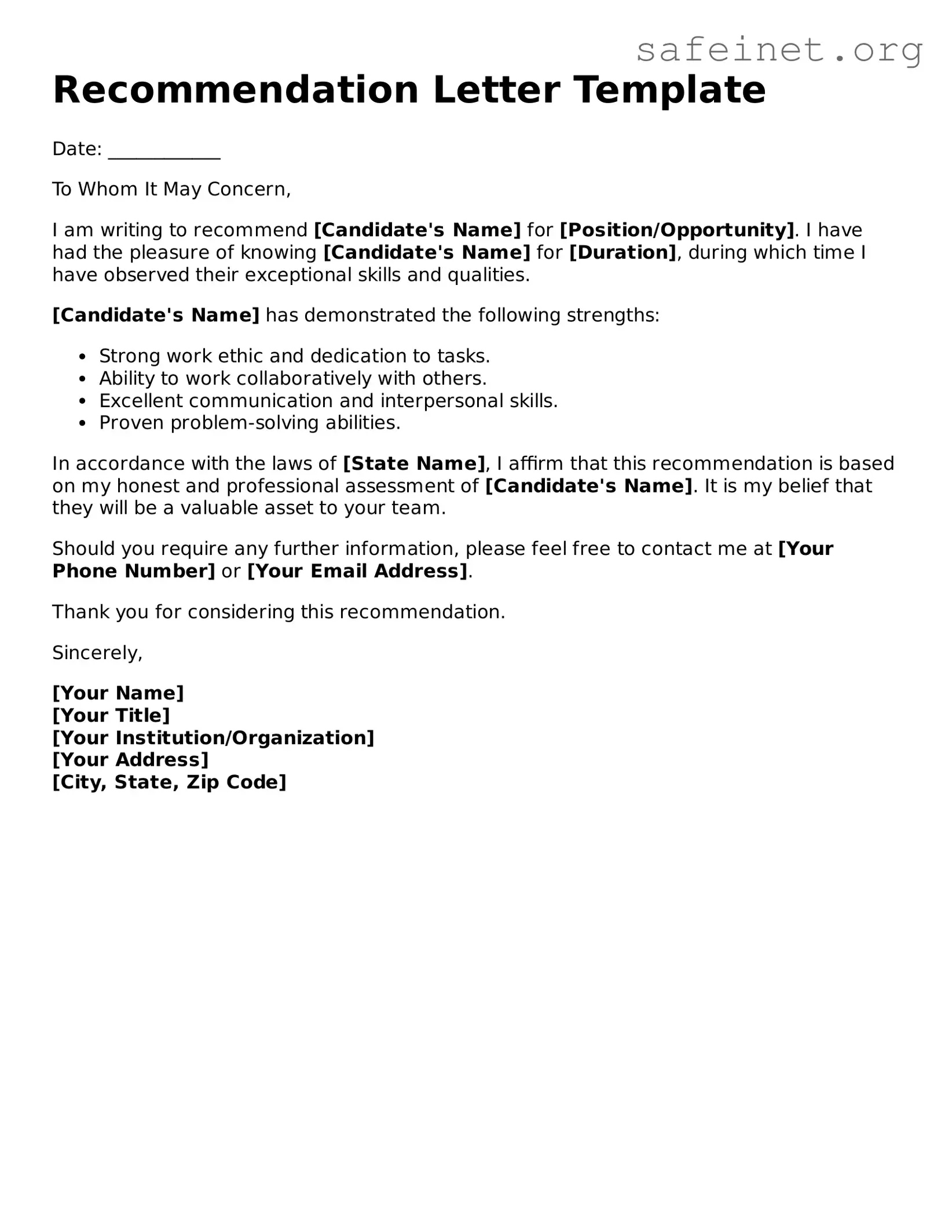
Recommendation Letter Template
Date: ____________
To Whom It May Concern,
I am writing to recommend [Candidate's Name] for [Position/Opportunity]. I have had the pleasure of knowing [Candidate's Name] for [Duration], during which time I have observed their exceptional skills and qualities.
[Candidate's Name] has demonstrated the following strengths:
In accordance with the laws of [State Name], I affirm that this recommendation is based on my honest and professional assessment of [Candidate's Name]. It is my belief that they will be a valuable asset to your team.
Should you require any further information, please feel free to contact me at [Your Phone Number] or [Your Email Address].
Thank you for considering this recommendation.
Sincerely,
[Your Name]
[Your Title]
[Your Institution/Organization]
[Your Address]
[City, State, Zip Code]
| Fact Name | Description |
|---|---|
| Purpose | The Recommendation Letter form is used to provide a formal endorsement of an individual's skills, qualifications, and character. |
| Format | This form typically includes sections for the recommender's information, the recipient's details, and the body of the recommendation. |
| State-Specific Requirements | Different states may have specific guidelines for how recommendation letters should be formatted and submitted. |
| Governing Laws | In some states, such as California, the use of recommendation letters is governed by education and employment laws to ensure fairness and transparency. |
Completing the Recommendation Letter form is an important step in providing a strong endorsement for an individual. This process requires careful attention to detail to ensure that all necessary information is accurately conveyed. Follow the steps below to fill out the form effectively.
Once you have completed the form, review it for any errors or omissions. A well-prepared recommendation letter can significantly impact the recipient's prospects. Make sure to submit the form according to the required guidelines.
What is the purpose of the Recommendation Letter form?
The Recommendation Letter form is designed to facilitate the process of requesting and providing recommendations. It serves as a structured way for individuals to gather endorsements from colleagues, supervisors, or other professionals. The form typically outlines the necessary information required from both the recommender and the individual requesting the recommendation, ensuring clarity and consistency in the submission process.
Who should complete the Recommendation Letter form?
The individual seeking a recommendation should complete the form. This person typically provides the recommender with information about their background, accomplishments, and the context of the recommendation. The recommender will then fill out the necessary sections, offering their insights and endorsement based on their experiences with the individual.
How should the Recommendation Letter form be submitted?
What information is typically required on the Recommendation Letter form?
Commonly, the Recommendation Letter form will require basic information such as the names and contact details of both the individual requesting the recommendation and the recommender. Additionally, it may ask for details about the relationship between the two parties, the context in which the recommendation is being made, and specific attributes or achievements that should be highlighted in the letter. Providing thorough and accurate information will help the recommender create a more effective endorsement.
Neglecting to Follow Instructions: Many individuals overlook the specific guidelines provided for the recommendation letter. Each institution may have unique requirements regarding content, length, and format. Failing to adhere to these instructions can lead to a recommendation that does not meet the expectations of the reviewing committee.
Using Generic Language: A common mistake is writing a letter that lacks personal insight. Generic phrases do not convey the applicant's unique qualities or experiences. Instead, the letter should reflect specific examples of the individual's skills and accomplishments, making it more compelling.
Overlooking the Importance of Relationships: The strength of a recommendation often hinges on the relationship between the recommender and the applicant. Failing to articulate how well the recommender knows the applicant can weaken the letter. A strong recommendation should highlight the context of their relationship and the recommender's credibility.
Ignoring Deadlines: Timeliness is crucial. Many applicants miss deadlines because their recommenders do not submit the letters on time. It is essential to communicate deadlines clearly and ensure that the recommenders are aware of the timeline for submission.
Providing Insufficient Context: A recommendation letter should not only praise the applicant but also provide context for that praise. Without context, the accolades may come off as empty. Including specific examples and anecdotes can help paint a fuller picture of the applicant's abilities.
Failing to Edit and Proofread: Errors in spelling, grammar, or punctuation can detract from the professionalism of a recommendation letter. A lack of attention to detail might lead the reader to question the recommender's credibility. Careful editing is vital to ensure clarity and professionalism.
Not Tailoring the Letter: A one-size-fits-all approach often does not work in recommendation letters. Each letter should be tailored to the specific program or opportunity the applicant is pursuing. Customizing the content to align with the values and goals of the institution can significantly enhance the letter's impact.
When applying for jobs, schools, or other opportunities, a Recommendation Letter form is often used. However, several other documents can support your application and enhance your chances of success. Below is a list of forms and documents commonly used alongside the Recommendation Letter form.
Using these documents effectively can strengthen your application and provide a well-rounded view of your qualifications. Make sure to tailor each document to suit the specific opportunity you are pursuing.
A reference letter serves a purpose similar to that of a recommendation letter. Both documents aim to provide insight into an individual's character, skills, and qualifications. While a recommendation letter is often requested for specific opportunities, such as jobs or academic programs, a reference letter may be more general. It is typically written by someone who knows the individual well, such as a former employer or teacher, and can vouch for their abilities and work ethic. The tone is usually supportive and highlights the strengths of the individual being referenced.
A testimonial is another document that shares similarities with a recommendation letter. Like a recommendation letter, a testimonial is a written statement that attests to someone's abilities or character. However, testimonials are often more informal and may be used in marketing or promotional contexts, such as on a website or brochure. They provide a personal account of experiences with the individual and can help establish credibility and trust. Both documents serve to endorse the individual, but testimonials often focus more on personal experiences rather than professional qualifications.
An endorsement letter is also comparable to a recommendation letter. This type of letter is typically written by a respected individual in a particular field, lending their support to someone seeking a position or opportunity. Endorsement letters can carry significant weight, as they come from established figures who can influence decision-makers. While recommendation letters may focus on specific skills and experiences, endorsement letters often emphasize the individual’s potential and fit for a role, providing a broader perspective on their capabilities.
When filling out a Recommendation Letter form, it’s important to approach the task thoughtfully. Here are some essential dos and don’ts to keep in mind:
When it comes to recommendation letters, many people hold misconceptions that can lead to confusion. Understanding these misconceptions can help clarify the process and ensure that the letters serve their intended purpose. Here are nine common misconceptions about the recommendation letter form:
By dispelling these misconceptions, applicants can better navigate the recommendation letter process and maximize their chances of success.
When filling out and using the Recommendation Letter form, keep the following key takeaways in mind: