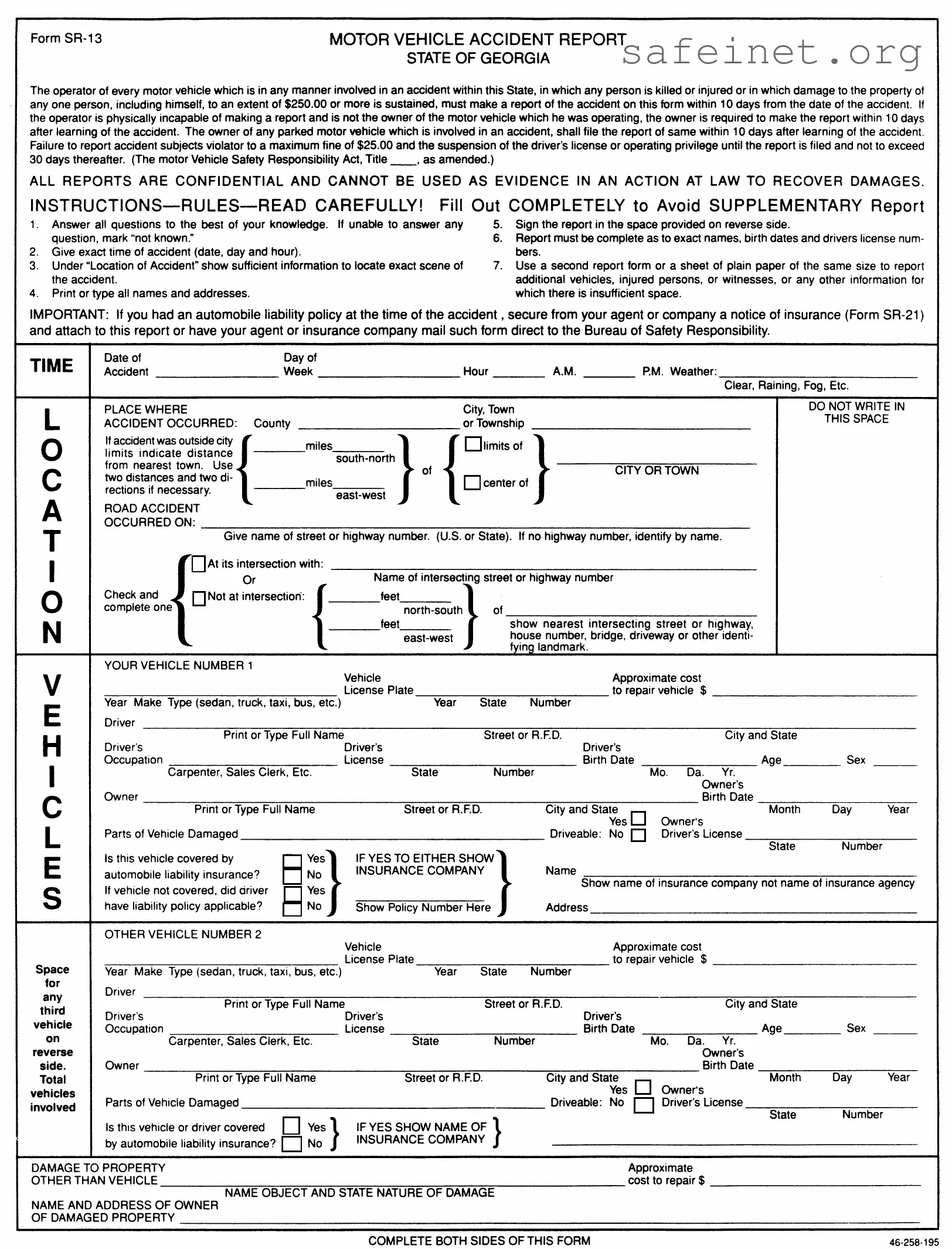
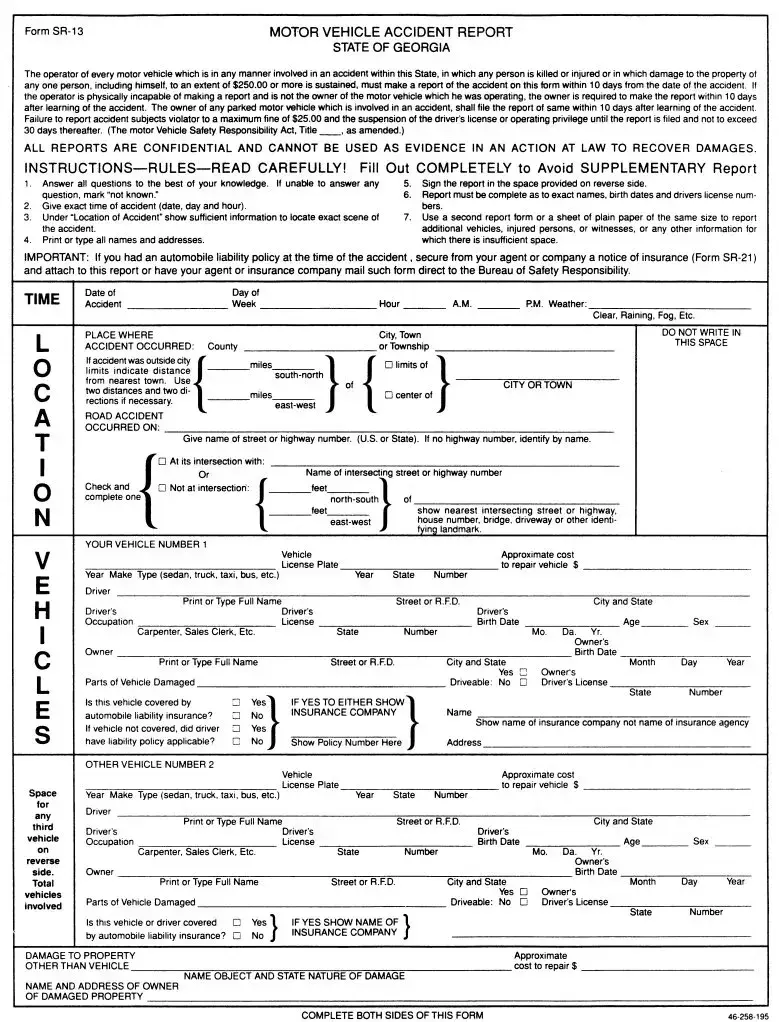
The Personal Accident Report SR-13 GA form is a critical document for anyone involved in a motor vehicle accident in Georgia. This form must be completed and submitted within 10 days of the accident if there are injuries, fatalities, or property damage exceeding $250. The responsibility to file lies primarily with the vehicle operator, but if they are incapacitated, the vehicle owner must step in. Additionally, owners of parked vehicles that are involved in accidents are also required to report. Failing to file this report can lead to fines and potential suspension of driving privileges. The form requires detailed information, including the exact time and location of the accident, vehicle details, and the names and addresses of all parties involved. It is essential to answer every question accurately, as incomplete submissions may necessitate supplementary reports. Importantly, all reports are confidential and cannot be used as evidence in legal proceedings. Therefore, understanding how to properly fill out the SR-13 GA form is crucial for compliance and protection of rights following an accident.
| Fact Name | Fact Details |
|---|---|
| Purpose of Form | The SR-13 form is used to report motor vehicle accidents in Georgia where there are injuries, fatalities, or property damage exceeding $250. |
| Reporting Timeframe | Operators must complete the report within 10 days of the accident date. |
| Owner Responsibility | If the driver cannot report the accident, the vehicle owner must file the report within the same 10-day period. |
| Penalty for Non-Compliance | Failure to report an accident can result in a fine of up to $25 and possible suspension of the driver's license. |
| Confidentiality Clause | All reports are confidential and cannot be used as evidence in legal actions for damages. |
| Governing Law | The form is governed by the Motor Vehicle Safety Responsibility Act in Georgia. |
Completing the Personal Accident Report SR 13 GA form is an important step following a motor vehicle accident. This form must be filled out accurately and submitted within 10 days of the accident. Below are the steps to help you fill out the form correctly.
After completing these steps, review the form for any missing information. Once satisfied, submit it as required. Remember, timely submission is crucial to avoid penalties.
What is the purpose of the Personal Accident Report SR-13 GA form?
The Personal Accident Report SR-13 GA form is designed to document motor vehicle accidents in the state of Georgia. If any person is injured or killed, or if property damage exceeds $250, the operator of the vehicle involved must file this report within 10 days of the incident. This form ensures that all relevant details about the accident are recorded, which can be essential for insurance claims and legal matters.
Who is required to file the SR-13 GA form?
Any motor vehicle operator involved in an accident that results in injury, death, or property damage exceeding $250 must complete the SR-13 GA form. If the operator is unable to file the report due to physical incapacity and is not the vehicle owner, then the vehicle owner must submit the report within the same 10-day timeframe. Additionally, the owner of a parked vehicle involved in an accident is also required to file the report after learning of the incident.
What happens if the SR-13 GA form is not filed on time?
Failure to file the SR-13 GA form within the required 10 days can lead to serious consequences. A violator may face a maximum fine of $25 and could have their driver's license or operating privileges suspended until the report is submitted. This suspension can last up to 30 days after the report is filed. Timely reporting is crucial to avoid these penalties and to ensure compliance with Georgia's Motor Vehicle Safety Responsibility Act.
Are the details in the SR-13 GA form confidential?
Yes, all reports submitted using the SR-13 GA form are confidential. They cannot be used as evidence in any legal action to recover damages. This confidentiality is designed to protect the individuals involved in the accident and encourages honest reporting of the incident without fear of legal repercussions.
Incompleteness of Information: Many individuals fail to provide all necessary details, such as the exact time and location of the accident. Omitting this information can lead to complications in processing the report.
Incorrect Names and Addresses: It's crucial to print or type names and addresses clearly. Mistakes in spelling or incorrect addresses can cause delays or misunderstandings.
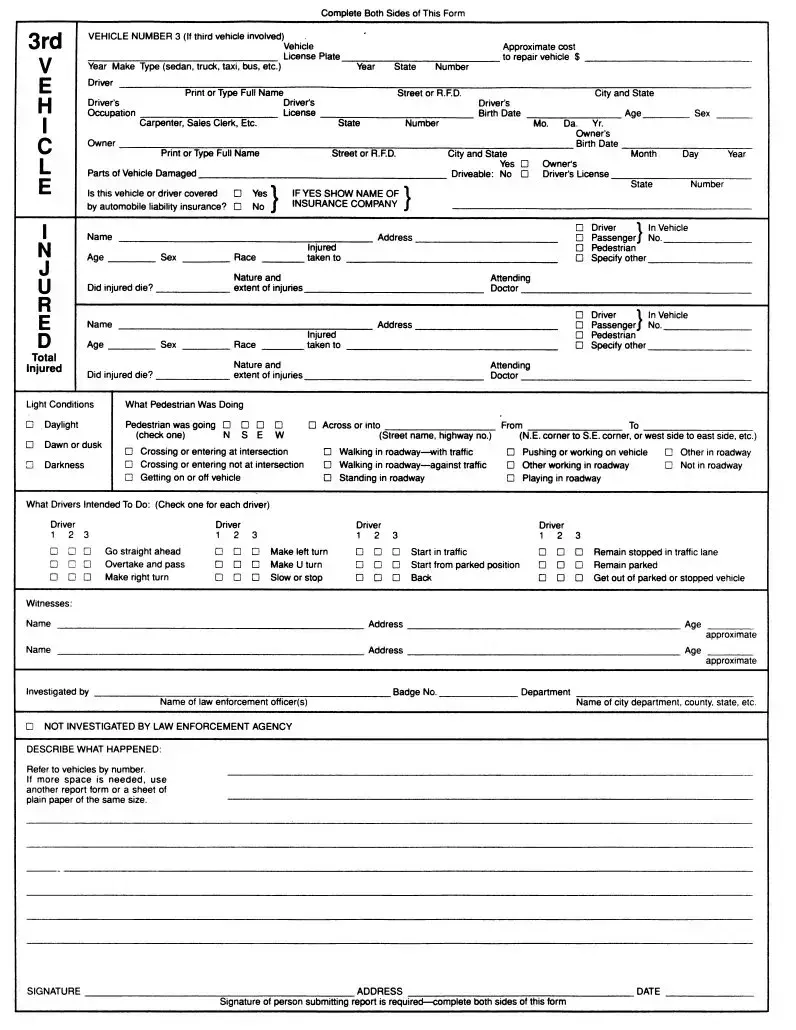
Failure to Report All Vehicles: If multiple vehicles are involved, individuals often neglect to use a second report form or additional paper. This oversight can hinder a complete understanding of the accident.
Neglecting Insurance Information: Not providing details about insurance coverage can lead to issues. It’s essential to indicate whether the vehicle was covered by an automobile liability policy at the time of the accident.
Inadequate Description of Damages: Failing to specify the nature and extent of damages to property other than vehicles can result in confusion. Clear descriptions help in assessing the situation accurately.
Not Signing the Report: A common mistake is forgetting to sign the report. The signature is a vital component of the document, and without it, the report may be considered invalid.
The Personal Accident Report SR-13 GA form is essential for documenting motor vehicle accidents in Georgia. However, several other forms and documents often accompany it to ensure a comprehensive report and facilitate the claims process. Here’s a list of those documents:
Collecting these documents can streamline the claims process and provide a clearer picture of the incident. It’s important to ensure that all relevant information is gathered to support any claims or legal actions that may follow.
The Motor Vehicle Accident Report (MVAR) is a document similar to the Personal Accident Report SR 13 GA form. Like the SR 13 GA, the MVAR is used to report accidents involving motor vehicles. It requires details about the accident, including the date, time, location, and parties involved. Both forms aim to gather essential information for insurance and legal purposes. They also emphasize the importance of filing the report within a specific timeframe following the accident to avoid penalties.
The Uniform Accident Report (UAR) serves a similar purpose as the SR 13 GA form. This report is often used across multiple states to document motor vehicle accidents. It includes sections for information about the vehicles, drivers, and any injuries sustained. Like the SR 13 GA, the UAR must be completed promptly, ensuring that accurate information is available for insurance claims and legal proceedings.
The Accident Report Form (ARF) is another document comparable to the SR 13 GA. This form is typically used by law enforcement agencies to compile details about traffic incidents. It includes sections for witness statements and diagrams of the accident scene. Similar to the SR 13 GA, the ARF aims to provide a comprehensive account of the accident for investigative and insurance purposes.
The Insurance Claim Form is also akin to the Personal Accident Report SR 13 GA. While it is primarily used for filing claims with insurance companies, it requires similar information regarding the accident, including details about the vehicles involved and any injuries. Both forms play a crucial role in the claims process, ensuring that all relevant information is documented for review.
The Property Damage Report is another document that shares similarities with the SR 13 GA form. This report focuses specifically on damage to property resulting from an accident. It requires details about the property damaged, the extent of the damage, and the parties involved. Like the SR 13 GA, it is essential for insurance claims and legal documentation.
The Incident Report Form is comparable to the Personal Accident Report SR 13 GA in that it is used to document various incidents, including accidents. This form gathers information about the incident, including the time, location, and individuals involved. Both forms emphasize the importance of accurate reporting and timely submission to ensure that all necessary details are captured for further action.
The Witness Statement Form is similar to the SR 13 GA in that it collects information from individuals who observed the accident. While the SR 13 GA focuses on the parties involved in the accident, the Witness Statement Form captures the perspectives of those who may provide additional context. Both forms are vital for creating a complete picture of the incident for legal and insurance purposes.
The Medical Report Form is another document that can be seen as related to the SR 13 GA. While it primarily focuses on injuries sustained during an accident, it often accompanies accident reports to provide a comprehensive view of the incident's consequences. Both forms highlight the importance of documenting injuries and their potential impact on the parties involved.
When filling out the Personal Accident Report SR-13 GA form, there are several important practices to follow and avoid. Here are five recommendations:
In addition to the things you should do, there are also important actions to avoid:
Misconceptions about the Personal Accident Report SR-13 GA form can lead to confusion and potential legal issues. Here are five common misconceptions, along with clarifications to help individuals understand their responsibilities when involved in a motor vehicle accident.
Filling out the Personal Accident Report SR-13 in Georgia is a crucial step after being involved in a motor vehicle accident. Here are some key takeaways to keep in mind:
By following these guidelines, you can ensure that your Personal Accident Report is completed accurately and submitted on time, helping to facilitate any necessary insurance claims or legal processes.