In Pennsylvania, the Transfer-on-Death Deed (TOD Deed) offers a streamlined way for property owners to transfer real estate to their beneficiaries upon their passing, without the need for probate. This innovative legal tool allows individuals to retain full control of their property during their lifetime, while ensuring that their wishes are honored after they are gone. The form is straightforward, requiring essential details such as the names of the property owner(s), the designated beneficiary or beneficiaries, and a legal description of the property. One of the key advantages of the TOD Deed is its ability to bypass the often lengthy and costly probate process, allowing heirs to gain immediate ownership of the property. Additionally, this deed can be revoked or modified at any time before the owner's death, providing flexibility and peace of mind. Understanding the nuances of the Pennsylvania Transfer-on-Death Deed is crucial for anyone looking to simplify their estate planning and ensure a smooth transition of their assets to loved ones.
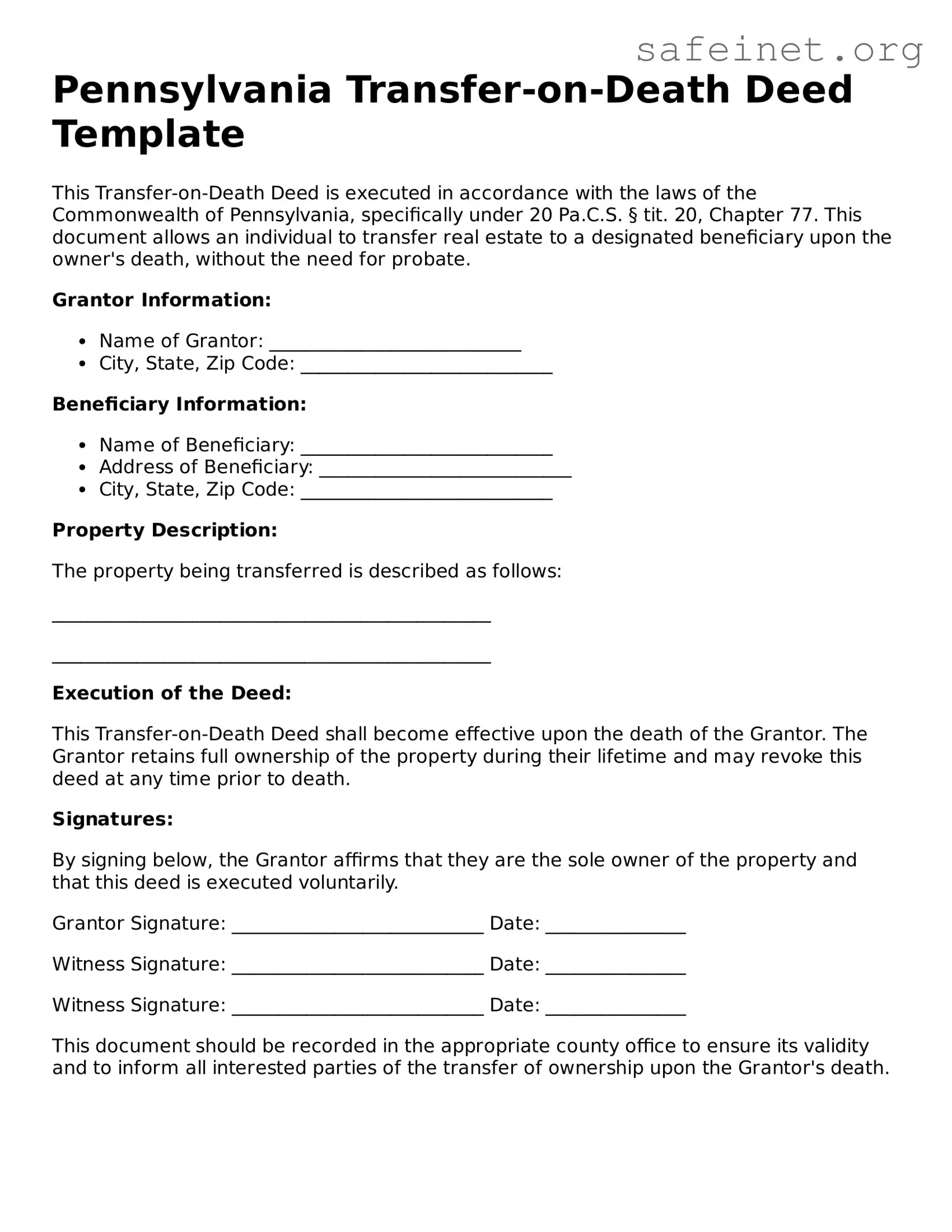
Pennsylvania Transfer-on-Death Deed Template
This Transfer-on-Death Deed is executed in accordance with the laws of the Commonwealth of Pennsylvania, specifically under 20 Pa.C.S. § tit. 20, Chapter 77. This document allows an individual to transfer real estate to a designated beneficiary upon the owner's death, without the need for probate.
Grantor Information:
Beneficiary Information:
Property Description:
The property being transferred is described as follows:
_______________________________________________
_______________________________________________
Execution of the Deed:
This Transfer-on-Death Deed shall become effective upon the death of the Grantor. The Grantor retains full ownership of the property during their lifetime and may revoke this deed at any time prior to death.
Signatures:
By signing below, the Grantor affirms that they are the sole owner of the property and that this deed is executed voluntarily.
Grantor Signature: ___________________________ Date: _______________
Witness Signature: ___________________________ Date: _______________
Witness Signature: ___________________________ Date: _______________
This document should be recorded in the appropriate county office to ensure its validity and to inform all interested parties of the transfer of ownership upon the Grantor's death.
| Fact Name | Description |
|---|---|
| Definition | A Transfer-on-Death (TOD) deed allows a property owner to transfer real estate to a beneficiary upon their death without going through probate. |
| Governing Law | The Pennsylvania Transfer-on-Death Deed is governed by 20 Pa.C.S. § 6111.1. |
| Eligibility | Any individual who owns real estate in Pennsylvania can create a TOD deed. |
| Beneficiary Requirements | The beneficiary must be a person or a qualified entity, such as a trust. |
| Revocation | A TOD deed can be revoked at any time before the death of the property owner. |
| Execution Requirements | The deed must be signed by the property owner and witnessed by two individuals or notarized. |
| Filing | The TOD deed must be recorded in the county where the property is located to be effective. |
| Tax Implications | Transfer-on-Death deeds do not affect property taxes until the transfer occurs after the owner's death. |
Once you have the Pennsylvania Transfer-on-Death Deed form ready, it’s important to fill it out accurately to ensure that your intentions are clearly documented. After completing the form, you will need to sign it in the presence of a notary public and then file it with the appropriate county office to make it effective.
What is a Transfer-on-Death Deed in Pennsylvania?
A Transfer-on-Death Deed (TOD Deed) is a legal document that allows property owners in Pennsylvania to transfer real estate to designated beneficiaries upon their death. This deed enables the property to bypass the probate process, simplifying the transfer of ownership and ensuring that the property goes directly to the intended beneficiaries without court involvement.
Who can create a Transfer-on-Death Deed?
Any individual who is the sole owner or a co-owner of real estate in Pennsylvania can create a Transfer-on-Death Deed. It is important that the property owner has the legal capacity to execute the deed, meaning they must be of sound mind and at least 18 years old.
How do I complete a Transfer-on-Death Deed?
To complete a Transfer-on-Death Deed, the property owner must fill out the form with accurate information. This includes the owner's name, the legal description of the property, and the names of the beneficiaries. After completing the form, it must be signed in the presence of a notary public and then recorded with the county's office where the property is located.
Is there a fee to file a Transfer-on-Death Deed?
Yes, there may be a fee associated with recording the Transfer-on-Death Deed. This fee varies by county in Pennsylvania. It is advisable to check with the local county recorder's office for the specific fee amount and any additional requirements that may apply.
Can I change or revoke a Transfer-on-Death Deed?
Yes, a Transfer-on-Death Deed can be revoked or changed at any time before the property owner's death. To do this, the property owner must create a new deed that explicitly revokes the previous one or must execute a formal revocation document. It is crucial to ensure that the revocation is properly recorded to avoid any confusion later.
What happens if a beneficiary predeceases the property owner?
If a designated beneficiary passes away before the property owner, the transfer of the property will not occur to that beneficiary. Instead, the property will typically pass to the remaining beneficiaries, if any are named. If no alternate beneficiaries are listed, the property may become part of the owner's estate and subject to probate.
Are there any tax implications with a Transfer-on-Death Deed?
Generally, there are no immediate tax implications for the property owner when executing a Transfer-on-Death Deed. However, beneficiaries may be subject to inheritance tax when they receive the property. It is advisable for both property owners and beneficiaries to consult with a tax professional to understand any potential tax consequences.
Can a Transfer-on-Death Deed be used for all types of property?
A Transfer-on-Death Deed can be used for most types of real estate, including residential homes, commercial properties, and vacant land. However, it cannot be used for personal property, such as vehicles or bank accounts. It is important to ensure that the deed complies with Pennsylvania laws and regulations regarding real estate transfers.
Failing to include all required information. Each section of the form must be filled out completely. Missing details can lead to delays or rejection of the deed.
Not signing the deed. A Transfer-on-Death Deed must be signed by the property owner. Without a signature, the document is not valid.
Using incorrect names. Ensure that the names of both the grantor (the person transferring the property) and the grantee (the person receiving the property) are spelled correctly and match official identification.
Neglecting to have the deed notarized. In Pennsylvania, the deed must be notarized to be legally binding. Failing to do this can invalidate the transfer.
Not recording the deed in a timely manner. After signing and notarizing, the deed must be recorded with the county recorder of deeds. Delays can complicate the transfer process.
Overlooking the need for witnesses. Depending on local laws, some deeds may require witnesses to be present during the signing. Verify the requirements for your specific situation.
Using outdated forms. Always ensure you are using the most current version of the Transfer-on-Death Deed form. Older versions may not comply with current laws.
Failing to consult with an attorney or a professional. While not mandatory, seeking advice can help avoid mistakes and ensure that the deed meets all legal requirements.
The Pennsylvania Transfer-on-Death Deed form is a valuable tool for individuals looking to transfer real estate upon death without the need for probate. However, there are several other forms and documents that are often used in conjunction with this deed to ensure a smooth transition of property ownership. Below is a list of these documents, each serving a unique purpose in the property transfer process.
Understanding these accompanying documents is crucial for anyone considering a Transfer-on-Death Deed in Pennsylvania. Each document plays a significant role in ensuring that property is transferred smoothly and according to the owner's wishes, minimizing complications for heirs and beneficiaries.
The Pennsylvania Transfer-on-Death Deed (TOD) form shares similarities with the Last Will and Testament. Both documents serve to transfer property upon the death of the owner. However, a key difference lies in the timing of the transfer. A will only takes effect after the owner's death and must go through probate, while a TOD deed allows for immediate transfer of property without the need for probate, making it a more straightforward option for many individuals looking to simplify the process of passing on their assets.
An additional document that resembles the TOD deed is the Revocable Living Trust. Like the TOD deed, a living trust allows for the transfer of assets outside of probate. In this arrangement, the individual creates a trust during their lifetime, placing assets within it. Upon their death, the assets are managed and distributed according to the trust's terms. This method can provide more control over asset distribution and can also offer privacy, as trusts typically do not go through public probate proceedings.
The Joint Tenancy with Right of Survivorship also parallels the TOD deed. In a joint tenancy arrangement, two or more individuals own property together, and upon the death of one owner, the surviving owner automatically inherits the deceased owner's share. This method provides a seamless transfer of property, similar to how a TOD deed operates, without the need for probate. However, it requires joint ownership from the outset, which may not be suitable for everyone.
The Life Estate Deed is yet another document that shares characteristics with the TOD deed. A life estate deed allows an individual to retain the right to use and occupy a property during their lifetime while designating another person as the remainderman who will receive the property after their death. This arrangement ensures that the property bypasses probate, similar to a TOD deed, but it also imposes certain limitations on the property owner’s ability to sell or modify the property without the remainderman's consent.
Finally, the Beneficiary Designation form is comparable to the TOD deed in that it allows for the transfer of assets upon death. Commonly used for bank accounts, retirement accounts, and insurance policies, this form enables individuals to name a beneficiary who will receive the asset directly, avoiding probate. Like the TOD deed, this method simplifies the transfer process and ensures that the designated beneficiary receives the asset without delay.
When filling out the Pennsylvania Transfer-on-Death Deed form, there are important considerations to keep in mind. Below is a list of things you should and shouldn't do.
By following these guidelines, you can help ensure that the process goes smoothly and that your wishes are honored.
The Pennsylvania Transfer-on-Death Deed (TODD) is a useful tool for estate planning, but several misconceptions surround its use. Understanding these misconceptions can help individuals make informed decisions about their estate. Here are ten common misconceptions about the Pennsylvania Transfer-on-Death Deed:
Understanding these misconceptions can empower individuals to utilize the Pennsylvania Transfer-on-Death Deed effectively in their estate planning. By clarifying these points, people can make better decisions that align with their financial and familial goals.
When filling out and using the Pennsylvania Transfer-on-Death Deed form, keep the following key takeaways in mind:
By following these steps, you can ensure that your Transfer-on-Death Deed is executed properly and meets your estate planning needs.