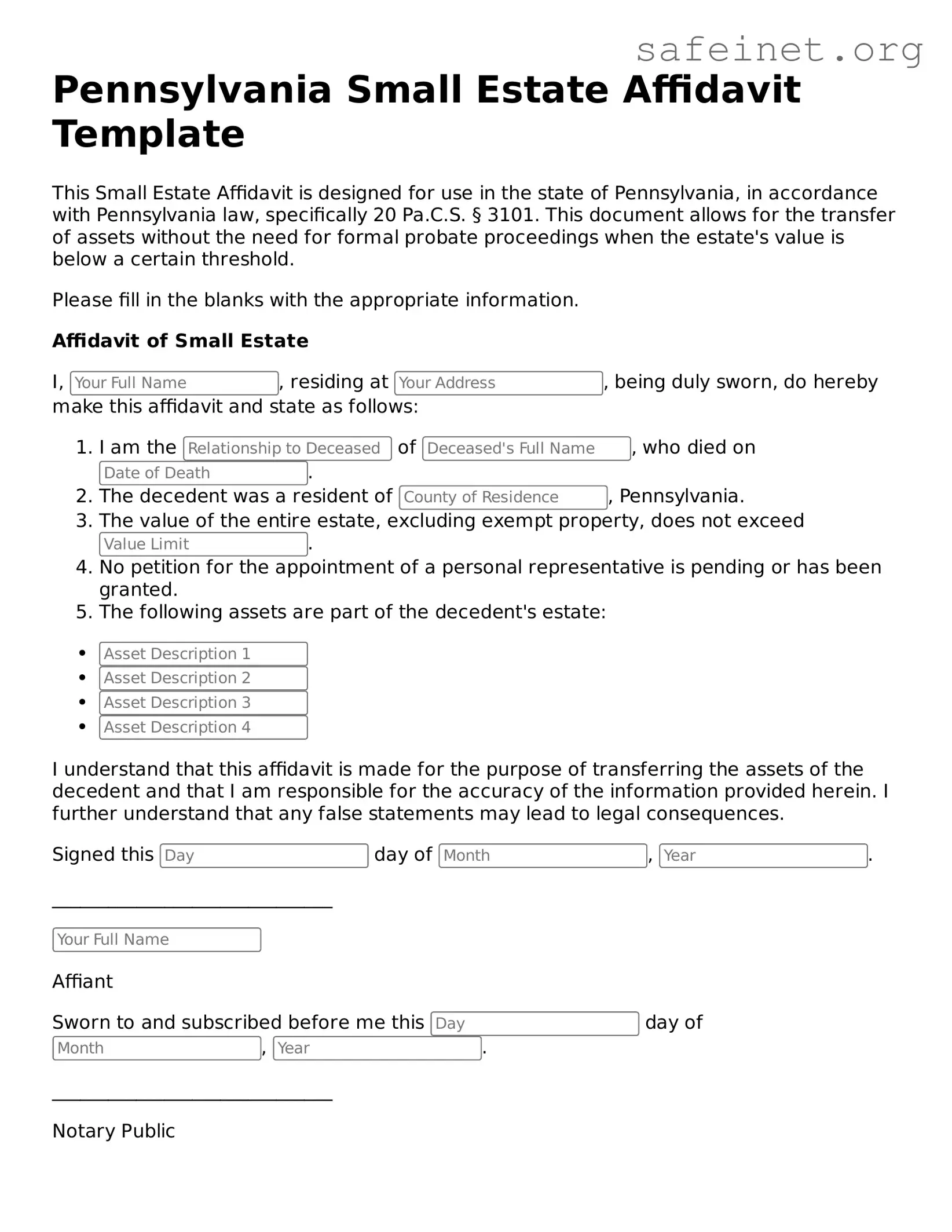
In Pennsylvania, when a loved one passes away, navigating the complexities of their estate can feel overwhelming, especially during such an emotional time. The Small Estate Affidavit form offers a streamlined option for heirs and beneficiaries dealing with estates that fall below a certain value threshold. This form allows individuals to bypass the lengthy probate process, enabling them to claim assets directly. Designed for estates valued at $50,000 or less, it simplifies the transfer of property, bank accounts, and other assets without the need for formal court proceedings. To utilize the Small Estate Affidavit, one must meet specific eligibility criteria and follow a clear set of instructions, ensuring that the process remains accessible and efficient. By understanding how this form works, individuals can alleviate some of the burdens that come with settling an estate, allowing them to focus on what truly matters during a difficult time.
Pennsylvania Small Estate Affidavit Template
This Small Estate Affidavit is designed for use in the state of Pennsylvania, in accordance with Pennsylvania law, specifically 20 Pa.C.S. § 3101. This document allows for the transfer of assets without the need for formal probate proceedings when the estate's value is below a certain threshold.
Please fill in the blanks with the appropriate information.
Affidavit of Small Estate
I, , residing at , being duly sworn, do hereby make this affidavit and state as follows:
I understand that this affidavit is made for the purpose of transferring the assets of the decedent and that I am responsible for the accuracy of the information provided herein. I further understand that any false statements may lead to legal consequences.
Signed this day of , .
______________________________
Affiant
Sworn to and subscribed before me this day of , .
______________________________
Notary Public
| Fact Name | Description |
|---|---|
| Purpose | The Pennsylvania Small Estate Affidavit is used to transfer assets of a deceased person when the total value of the estate is below a certain threshold. |
| Threshold Amount | The current threshold for using the Small Estate Affidavit in Pennsylvania is $50,000 for estates without real estate. |
| Governing Law | The use of the Small Estate Affidavit is governed by 20 Pa.C.S. § 3101 et seq. |
| Eligibility | Only individuals who are entitled to inherit under Pennsylvania law can use the Small Estate Affidavit. |
| Filing Requirements | The affidavit must be signed by the affiant and notarized, and it may need to be presented to financial institutions or other entities holding the deceased's assets. |
| Limitations | This form cannot be used if the deceased owned real estate or if the estate exceeds the specified value limit. |
After gathering the necessary information and documents, you are ready to complete the Pennsylvania Small Estate Affidavit form. This process requires careful attention to detail to ensure accuracy. Once the form is filled out, it will need to be submitted to the appropriate court or authority for further processing.
What is a Pennsylvania Small Estate Affidavit?
The Pennsylvania Small Estate Affidavit is a legal document that allows individuals to settle the estate of a deceased person without going through the lengthy and often costly probate process. This form is typically used when the total value of the deceased's estate is below a certain threshold, which, as of 2023, is $50,000 for personal property. This means that if the estate's value falls within this limit, heirs can use the affidavit to claim assets directly, simplifying the transfer of property and ensuring that the deceased's wishes are honored more efficiently.
Who is eligible to use the Small Estate Affidavit?
To be eligible to use the Small Estate Affidavit, you must be a qualified heir of the deceased. This includes individuals such as a spouse, child, or parent. Additionally, the deceased must have had a total estate value below the specified limit at the time of their passing. It's important to note that if there is a will, the affidavit can still be used, but it must be in accordance with the terms outlined in that will. If the estate includes real estate, other procedures may be necessary, as the Small Estate Affidavit primarily addresses personal property.
How do I complete the Small Estate Affidavit?
Completing the Small Estate Affidavit involves several steps. First, you will need to obtain the form, which can often be found online or through local court offices. Fill out the affidavit with accurate information about the deceased, including their name, date of death, and details about the estate's assets. You will also need to provide information about yourself as the affiant. After completing the form, it must be signed in front of a notary public. Once notarized, the affidavit can be presented to banks, financial institutions, or other entities holding the deceased's assets to facilitate their transfer.
What happens after I submit the Small Estate Affidavit?
After submitting the Small Estate Affidavit, the next steps depend on the specific assets involved. If the affidavit is accepted by the institutions holding the deceased's assets, they will release the funds or property to you as the affiant. However, it's crucial to keep copies of the affidavit and any supporting documents, as you may need them for future reference or in case any disputes arise. If the affidavit is challenged or if the estate's value is later found to exceed the limit, you may need to consider formal probate proceedings. Always consult with a legal professional if you encounter any complexities during this process.
Incomplete Information: Failing to provide all required personal information can lead to delays. Ensure that names, addresses, and other details are accurate and complete.
Incorrect Value Assessment: Underestimating or overestimating the value of the estate can result in complications. It is essential to conduct a thorough valuation of all assets.
Missing Signatures: Not obtaining necessary signatures from all interested parties can invalidate the affidavit. Make sure to have everyone who is entitled to inherit sign the document.
Failure to Include Supporting Documents: Omitting required documents, such as death certificates or proof of asset ownership, can hinder the process. Gather all necessary paperwork before submission.
Ignoring State-Specific Requirements: Each state has unique rules regarding small estate affidavits. Familiarize yourself with Pennsylvania's specific requirements to avoid errors.
Not Notarizing the Affidavit: Some individuals overlook the need for notarization. A notary public must witness the signing of the affidavit to ensure its validity.
Submitting to the Wrong Court: Filing the affidavit in the incorrect jurisdiction can cause unnecessary delays. Verify the appropriate court for submission based on the decedent's residence.
The Pennsylvania Small Estate Affidavit is a useful tool for individuals dealing with the estate of a deceased person. However, several other forms and documents often accompany this affidavit to ensure the proper handling of the estate. Below is a list of these essential documents, each serving a specific purpose in the estate settlement process.
Understanding these documents is crucial for a smooth estate settlement process. Each plays a significant role in ensuring that the deceased’s wishes are honored and that all legal requirements are met.
The Pennsylvania Small Estate Affidavit is similar to the Last Will and Testament in that both documents serve to distribute a deceased person's assets. A Last Will outlines the decedent's wishes regarding how their property should be allocated after death, while the Small Estate Affidavit allows heirs to claim assets without going through a lengthy probate process. Both documents require the signature of the decedent and must adhere to state laws to be valid.
Another document comparable to the Small Estate Affidavit is the Trust Agreement. A Trust Agreement allows individuals to place their assets into a trust, which can be managed by a trustee for the benefit of the beneficiaries. Like the Small Estate Affidavit, a Trust Agreement can help bypass probate, facilitating a quicker transfer of assets to heirs. Both documents aim to simplify the management and distribution of an estate.
The Power of Attorney (POA) shares similarities with the Small Estate Affidavit in that both can be used to handle financial matters. A POA grants an individual the authority to act on behalf of another in financial or legal matters, while the Small Estate Affidavit allows heirs to claim assets after death. Both documents require careful consideration and must be executed according to state law to ensure validity.
The Affidavit of Heirship is another document that aligns with the Small Estate Affidavit. This affidavit serves to establish the identity of heirs when a decedent dies without a will. Like the Small Estate Affidavit, it can help facilitate the transfer of assets without going through probate. Both documents provide a way for heirs to claim their rightful inheritance, simplifying the process of asset distribution.
The Deed of Distribution is also similar to the Small Estate Affidavit, as it is used to transfer property after someone's death. This document outlines how real estate and other assets are distributed among heirs. While the Small Estate Affidavit allows for a broader range of asset claims, the Deed of Distribution specifically addresses real property, making it a focused alternative for asset transfer.
The Inventory of Assets form is comparable to the Small Estate Affidavit in that both documents involve listing the assets of the deceased. The Inventory of Assets is often used during probate proceedings to provide a comprehensive overview of the estate's contents. Conversely, the Small Estate Affidavit allows heirs to claim assets directly, bypassing the need for a detailed inventory in a formal probate process.
The Claim Against Estate form shares similarities with the Small Estate Affidavit in that both can be used to assert rights to an estate. The Claim Against Estate form is typically filed by creditors seeking payment from the estate, while the Small Estate Affidavit is utilized by heirs to claim their inheritance. Both documents play a role in the overall administration of an estate and require adherence to legal procedures.
Lastly, the Will Contest form is related to the Small Estate Affidavit in that both can be involved in disputes over asset distribution. A Will Contest is filed when someone challenges the validity of a will, while the Small Estate Affidavit can be used when heirs seek to claim assets without a will. Both documents highlight the importance of clear legal processes in determining rightful ownership and distribution of an estate.
When filling out the Pennsylvania Small Estate Affidavit form, it is important to follow specific guidelines to ensure accuracy and compliance. Below is a list of things you should and shouldn't do during this process.
The Pennsylvania Small Estate Affidavit is a useful tool for settling the estates of individuals who have passed away. However, several misconceptions surround its use. Here are four common misunderstandings:
When dealing with the Pennsylvania Small Estate Affidavit form, there are several important points to keep in mind. Here are key takeaways to consider:
Understanding these points can help ensure a smoother process when managing a small estate in Pennsylvania.