The Pennsylvania Promissory Note form serves as a vital financial instrument that outlines the terms under which one party agrees to pay another a specified sum of money. This document details essential elements such as the principal amount, interest rate, payment schedule, and maturity date. It also specifies the parties involved—the borrower and the lender—ensuring clarity in the obligations and rights of each. Furthermore, the form may include provisions for default, allowing the lender to take appropriate actions if the borrower fails to meet their payment obligations. By providing a structured framework for the loan agreement, the Pennsylvania Promissory Note helps to protect both parties and promotes transparency in financial transactions. Understanding the nuances of this form is crucial for anyone engaged in lending or borrowing within the state, as it can significantly impact the enforceability of the agreement and the overall financial relationship between the parties involved.
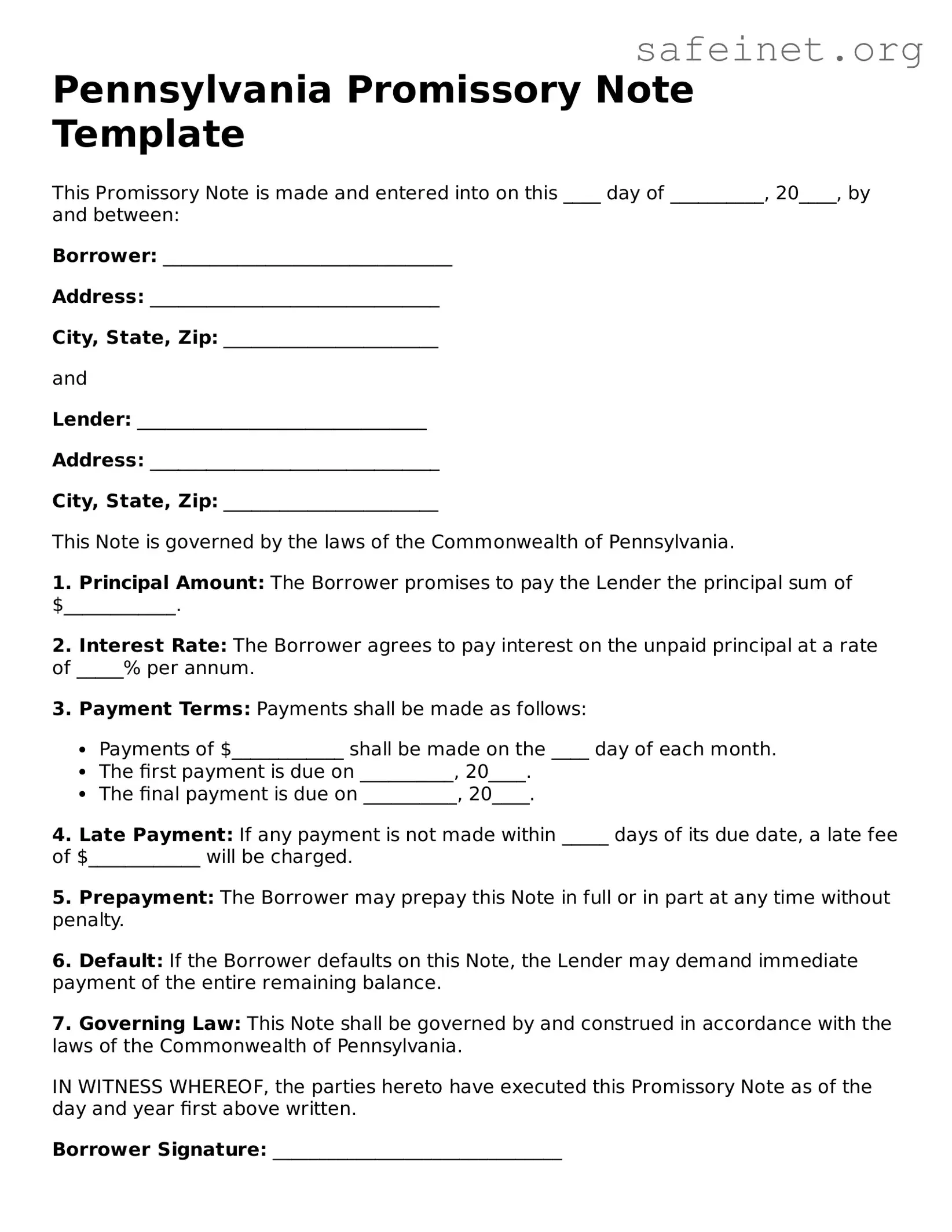
Pennsylvania Promissory Note Template
This Promissory Note is made and entered into on this ____ day of __________, 20____, by and between:
Borrower: _______________________________
Address: _______________________________
City, State, Zip: _______________________
and
Lender: _______________________________
Address: _______________________________
City, State, Zip: _______________________
This Note is governed by the laws of the Commonwealth of Pennsylvania.
1. Principal Amount: The Borrower promises to pay the Lender the principal sum of $____________.
2. Interest Rate: The Borrower agrees to pay interest on the unpaid principal at a rate of _____% per annum.
3. Payment Terms: Payments shall be made as follows:
4. Late Payment: If any payment is not made within _____ days of its due date, a late fee of $____________ will be charged.
5. Prepayment: The Borrower may prepay this Note in full or in part at any time without penalty.
6. Default: If the Borrower defaults on this Note, the Lender may demand immediate payment of the entire remaining balance.
7. Governing Law: This Note shall be governed by and construed in accordance with the laws of the Commonwealth of Pennsylvania.
IN WITNESS WHEREOF, the parties hereto have executed this Promissory Note as of the day and year first above written.
Borrower Signature: _______________________________
Date: _______________________________
Lender Signature: _______________________________
Date: _______________________________
| Fact Name | Details |
|---|---|
| Definition | A Pennsylvania Promissory Note is a written promise to pay a specified amount of money to a designated person or entity. |
| Governing Law | The promissory note is governed by the Pennsylvania Uniform Commercial Code (UCC). |
| Parties Involved | The note involves two parties: the maker (borrower) and the payee (lender). |
| Interest Rate | The interest rate can be fixed or variable, depending on the agreement between the parties. |
| Maturity Date | The note specifies a maturity date, which is when the payment is due. |
| Payment Terms | Payment terms outline how and when payments will be made, such as monthly or lump-sum payments. |
| Default Clause | A default clause may be included, detailing the consequences if the borrower fails to make payments. |
| Signatures Required | The note must be signed by the maker to be legally binding. |
| Notarization | While notarization is not required, it can add an extra layer of validity to the document. |
Once you have the Pennsylvania Promissory Note form in hand, you can start filling it out. This form is essential for documenting a loan agreement between two parties. Follow these steps carefully to ensure that all necessary information is included and accurate.
After completing the form, make copies for both the borrower and lender. This ensures that both parties have a record of the agreement. Keep the original document in a safe place for future reference.
What is a Pennsylvania Promissory Note?
A Pennsylvania Promissory Note is a written promise made by one party to pay a specific sum of money to another party at a defined time or on demand. This legal document outlines the terms of the loan, including the amount borrowed, the interest rate, and the repayment schedule. It serves as a binding agreement that can be enforced in court if necessary. Understanding this document is crucial for both lenders and borrowers, as it provides clarity on the obligations involved in the transaction.
What are the essential components of a Promissory Note in Pennsylvania?
Several key elements must be included in a Pennsylvania Promissory Note to ensure its validity. First, the note should clearly state the names of the parties involved—the borrower and the lender. Next, it must specify the principal amount being borrowed. Additionally, the interest rate should be explicitly mentioned, along with the repayment terms, including due dates and any late fees. Finally, the document should be signed and dated by both parties to confirm their agreement to the terms. These components help protect both parties and provide a clear framework for the loan.
Is a Promissory Note legally binding in Pennsylvania?
Yes, a Promissory Note is legally binding in Pennsylvania, provided it meets certain criteria. For the note to be enforceable, it must be clear and unambiguous in its terms. Both parties should have the legal capacity to enter into the agreement, meaning they are of sound mind and of legal age. If these conditions are met, the note can be enforced in a court of law. This means that if the borrower fails to repay the loan as agreed, the lender has the right to take legal action to recover the owed amount.
Can a Promissory Note be modified after it is signed?
Yes, a Promissory Note can be modified after it has been signed, but both parties must agree to the changes. Any modifications should be documented in writing and signed by both the lender and the borrower to ensure clarity and enforceability. It’s important to keep a record of any amendments, as this helps avoid misunderstandings in the future. A well-documented modification can protect both parties and maintain the integrity of the original agreement.
Incomplete Information: Failing to fill out all required fields can lead to issues. Each section must be completed to ensure the document is legally binding.
Incorrect Amount: Entering the wrong loan amount can create confusion. Double-check the figures to avoid disputes later on.
Missing Signatures: Both the borrower and lender must sign the document. Omitting a signature can invalidate the agreement.
Improper Date: The date of signing is crucial. An incorrect or missing date can complicate the enforcement of the note.
Unclear Terms: Not specifying the repayment terms can lead to misunderstandings. Clearly outline the payment schedule and interest rate to avoid confusion.
When dealing with a Pennsylvania Promissory Note, several other forms and documents often come into play. Understanding these additional documents can help ensure a smoother transaction and provide clarity to all parties involved. Here’s a brief overview of four commonly used forms that complement a promissory note.
By familiarizing yourself with these documents, you can navigate the lending process with greater confidence. Each form plays a crucial role in protecting the interests of both the lender and the borrower, ensuring clarity and accountability throughout the loan agreement.
A loan agreement is a document that outlines the terms and conditions under which one party lends money to another. Similar to a Pennsylvania Promissory Note, it includes details such as the loan amount, interest rate, repayment schedule, and any collateral involved. Both documents serve to establish a clear understanding between the lender and borrower regarding the financial obligation. However, a loan agreement often includes more comprehensive terms, such as default clauses and remedies, which may not be present in a standard promissory note.
A mortgage is another document that bears similarities to a Pennsylvania Promissory Note. While a promissory note is a promise to repay a loan, a mortgage is a security instrument that pledges real property as collateral for that loan. In many cases, a promissory note is accompanied by a mortgage, which provides the lender with a legal claim to the property if the borrower defaults. Both documents are essential in real estate transactions, ensuring that the lender's investment is protected while detailing the borrower's repayment obligations.
A personal guarantee is a document that can also be compared to a Pennsylvania Promissory Note. It involves a third party agreeing to take responsibility for the debt if the primary borrower fails to repay. Like a promissory note, it establishes a financial obligation but adds an extra layer of security for the lender. This is particularly useful in business loans, where the lender may require a personal guarantee from the business owner to mitigate risk. Both documents are designed to provide assurance to the lender regarding repayment.
A letter of credit is another financial document that shares similarities with a Pennsylvania Promissory Note. It serves as a guarantee from a bank or financial institution that a borrower will fulfill their financial obligations. In essence, it assures the lender that they will receive payment, similar to how a promissory note ensures the lender of repayment from the borrower. However, letters of credit are often used in international trade and involve a bank acting on behalf of the borrower, whereas promissory notes are typically direct agreements between individuals or businesses.
When filling out the Pennsylvania Promissory Note form, it’s essential to approach the process carefully. Here are some important dos and don’ts to keep in mind:
By following these guidelines, you can help ensure that your Promissory Note is clear, enforceable, and serves its intended purpose effectively.
When dealing with promissory notes in Pennsylvania, several misconceptions can lead to confusion. Here are seven common myths and the truths behind them.
Understanding these misconceptions can help you navigate the use of promissory notes more effectively. Always consider consulting with a legal professional if you have specific questions or concerns.
When dealing with a Pennsylvania Promissory Note, understanding its key components can help ensure proper use and compliance. Here are some important takeaways:
By following these guidelines, individuals can navigate the process of creating and utilizing a Pennsylvania Promissory Note more effectively.