In Pennsylvania, couples considering marriage often explore the benefits of a prenuptial agreement, a legal document that outlines the distribution of assets and responsibilities in the event of a divorce. This agreement serves as a proactive measure, allowing both parties to establish clear expectations regarding property division, debt management, and spousal support. The Pennsylvania Prenuptial Agreement form is designed to facilitate this process by providing a structured framework for couples to articulate their financial rights and obligations. Essential elements typically included in the form encompass a detailed inventory of each partner's assets, provisions for future earnings, and stipulations regarding the handling of debts. By addressing these aspects upfront, couples can minimize potential conflicts and misunderstandings, fostering a sense of security as they embark on their marital journey. Understanding the nuances of this form is crucial for ensuring that both parties' interests are adequately protected, making it a vital component of modern marital planning.
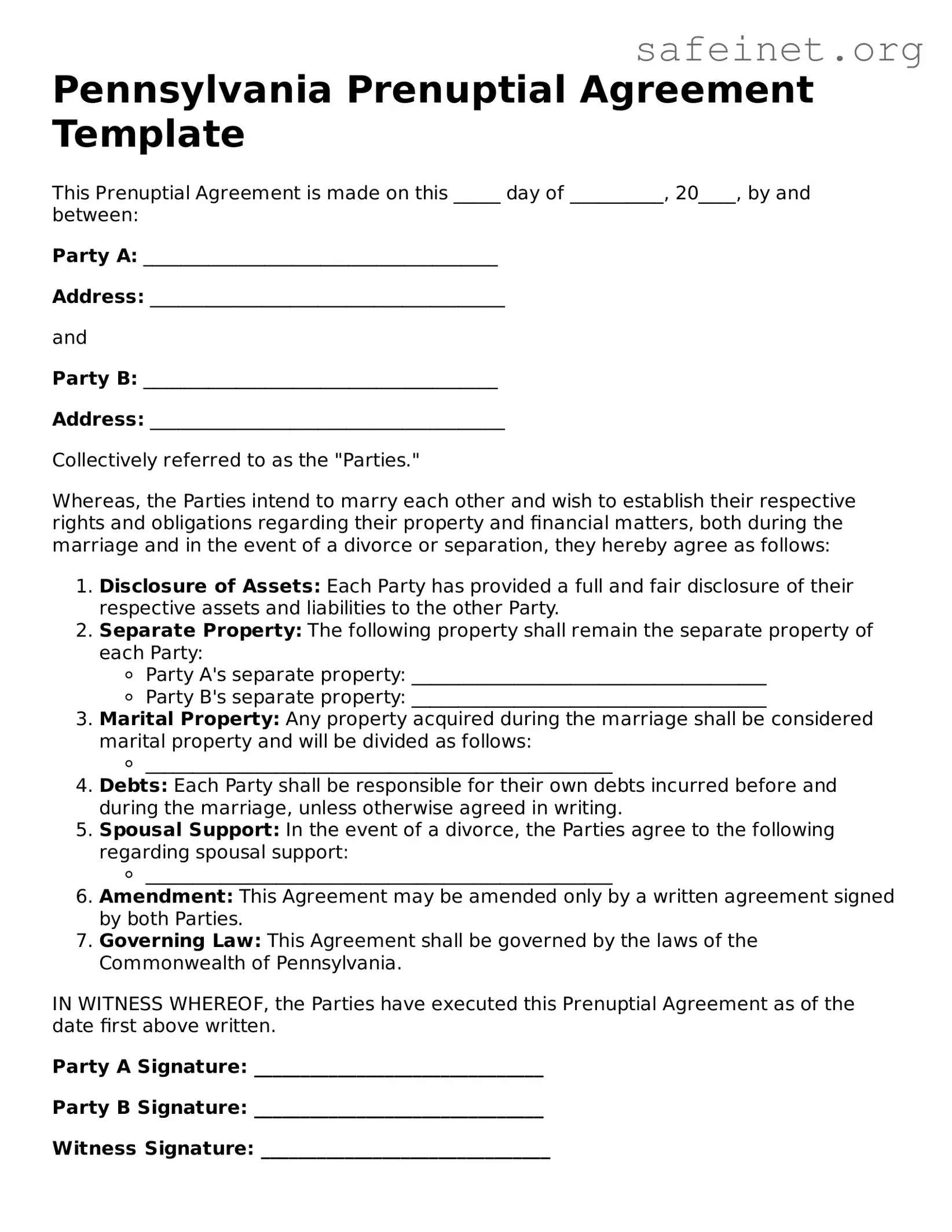
Pennsylvania Prenuptial Agreement Template
This Prenuptial Agreement is made on this _____ day of __________, 20____, by and between:
Party A: ______________________________________
Address: ______________________________________
and
Party B: ______________________________________
Address: ______________________________________
Collectively referred to as the "Parties."
Whereas, the Parties intend to marry each other and wish to establish their respective rights and obligations regarding their property and financial matters, both during the marriage and in the event of a divorce or separation, they hereby agree as follows:
IN WITNESS WHEREOF, the Parties have executed this Prenuptial Agreement as of the date first above written.
Party A Signature: _______________________________
Party B Signature: _______________________________
Witness Signature: _______________________________
Date: _________________________________________
| Fact Name | Description |
|---|---|
| Governing Law | Pennsylvania law governs prenuptial agreements, specifically under the Pennsylvania Uniform Premarital Agreement Act. |
| Purpose | The primary purpose of a prenuptial agreement is to outline the division of assets and responsibilities in the event of divorce or separation. |
| Enforceability | For a prenuptial agreement to be enforceable, it must be in writing and signed by both parties prior to marriage. |
| Full Disclosure | Both parties are required to provide full financial disclosure to ensure that the agreement is fair and equitable. |
| Modification | Prenuptial agreements can be modified or revoked after marriage, provided that both parties agree to the changes in writing. |
Filling out the Pennsylvania Prenuptial Agreement form is an important step for couples considering marriage. This form allows both parties to outline their rights and responsibilities regarding property and financial matters in the event of a divorce or separation. Below are the steps to complete the form accurately.
After completing the form, it is advisable to consult with a legal professional to ensure that all aspects of the agreement are enforceable and meet legal standards. This step can provide additional peace of mind as you move forward with your plans.
What is a prenuptial agreement in Pennsylvania?
A prenuptial agreement, often referred to as a prenup, is a legal document created by two individuals before they marry. This agreement outlines the distribution of assets and financial responsibilities in the event of divorce or separation. In Pennsylvania, prenups can cover various aspects, including property division, spousal support, and debt allocation.
Why should I consider a prenuptial agreement?
Many couples choose to enter into a prenuptial agreement to protect their individual assets and clarify financial responsibilities. It can provide peace of mind by establishing clear terms in case of divorce, helping to avoid lengthy and costly disputes. Additionally, it can be particularly beneficial for those entering a marriage with significant assets, business interests, or children from previous relationships.
What should be included in a Pennsylvania prenuptial agreement?
A well-drafted prenuptial agreement may include provisions regarding the division of property, spousal support, and the handling of debts. Couples can also include stipulations about how to manage finances during the marriage, as well as any other terms they deem important. It is essential that both parties fully disclose their assets and liabilities for the agreement to be enforceable.
Are there any legal requirements for a prenuptial agreement in Pennsylvania?
In Pennsylvania, a prenuptial agreement must be in writing and signed by both parties. It is crucial that both individuals enter into the agreement voluntarily and without coercion. Additionally, each party should ideally have independent legal representation to ensure that their rights are protected and that they fully understand the implications of the agreement.
Can a prenuptial agreement be changed after marriage?
Yes, a prenuptial agreement can be modified or revoked after marriage, but this requires a new written agreement signed by both parties. Changes may be made to reflect new circumstances, such as the birth of children or significant changes in financial situations. It is advisable to consult legal counsel when making modifications to ensure compliance with state laws.
What happens if a prenuptial agreement is contested?
If a prenuptial agreement is contested in Pennsylvania, a court will review the circumstances surrounding the agreement. Factors such as whether both parties had legal representation, if there was full disclosure of assets, and whether the agreement was signed voluntarily will be considered. If the court finds that the agreement is valid, it will be enforced; if not, it may be deemed unenforceable.
How can I ensure my prenuptial agreement is enforceable?
To enhance the enforceability of a prenuptial agreement, both parties should fully disclose their financial situations and assets. Each individual should have their own attorney to review the agreement and provide legal advice. It is also important to avoid signing the agreement under pressure or close to the wedding date, as this could lead to claims of coercion.
Is a prenuptial agreement only for wealthy individuals?
No, prenuptial agreements are not solely for wealthy individuals. They can be beneficial for anyone who wants to clarify financial matters before marriage. Couples with modest assets, those entering a second marriage, or individuals with significant debt may also find value in having a prenup to protect their interests and set expectations.
How do I start the process of creating a prenuptial agreement?
The first step in creating a prenuptial agreement is to discuss the idea openly with your partner. Once both parties agree to pursue a prenup, it is advisable to consult with attorneys who specialize in family law. They can help draft the agreement, ensuring that it meets legal requirements and addresses both parties' needs.
Can a prenuptial agreement cover child custody and support?
In Pennsylvania, while a prenuptial agreement can address certain financial responsibilities related to children, it cannot dictate child custody or child support arrangements. Courts typically determine these matters based on the best interests of the child at the time of divorce or separation. It is essential to approach child-related issues separately from the prenup.
Failing to disclose all assets. It's crucial to list every asset, including bank accounts, real estate, and investments. Omitting even a small asset can lead to complications later.
Not understanding the legal implications. Prenuptial agreements are legally binding. Make sure to grasp what you are agreeing to before signing.
Using vague language. Clarity is key. Avoid ambiguous terms that could be interpreted in multiple ways. Specificity helps prevent disputes in the future.
Neglecting to update the agreement. Life changes, such as having children or acquiring new assets, may require updates to the prenup. Regular reviews are important.
Not seeking legal advice. Consulting with a lawyer can provide valuable insights and ensure that the agreement complies with Pennsylvania laws.
Rushing the process. Take your time to carefully consider the terms. A well-thought-out agreement is more likely to hold up in court.
Ignoring state-specific requirements. Each state has its own rules regarding prenuptial agreements. Familiarize yourself with Pennsylvania's specific requirements.
Forgetting to include provisions for spousal support. Addressing this in the prenup can prevent misunderstandings and disputes later on.
When preparing for a marriage, many couples consider a prenuptial agreement to outline their financial rights and responsibilities. However, this document often goes hand-in-hand with other important forms and documents. Below is a list of seven common documents that are frequently used alongside a Pennsylvania Prenuptial Agreement.
Each of these documents serves a specific purpose and can help couples navigate their financial and legal responsibilities more effectively. By understanding and utilizing these forms, individuals can create a solid foundation for their marriage, ensuring clarity and protection for both parties involved.
A Cohabitation Agreement is similar to a prenuptial agreement in that it outlines the rights and responsibilities of partners who choose to live together without marrying. This document can address issues such as property division, financial responsibilities, and even child custody arrangements if the couple has children. Like a prenuptial agreement, it aims to provide clarity and prevent disputes should the relationship end.
A Postnuptial Agreement serves a similar purpose to a prenuptial agreement but is executed after marriage. This document allows couples to define their financial arrangements and responsibilities while married. It can be particularly useful if circumstances change, such as a significant increase in income or the acquisition of new assets, thus providing a framework for asset protection and management.
A Separation Agreement outlines the terms under which a couple will separate, often addressing issues such as asset division, child custody, and support payments. Similar to a prenuptial agreement, it serves to protect the interests of both parties and can help facilitate a smoother transition during a difficult time. This document is particularly important for couples who may not wish to divorce immediately but need to establish clear guidelines for their separation.
A Marital Settlement Agreement is executed during divorce proceedings and details how the couple will divide their assets and liabilities. Like a prenuptial agreement, it aims to prevent conflict by clearly defining each party's rights and responsibilities. This document can be beneficial in ensuring that both parties understand their obligations and can help expedite the divorce process.
A Trust Agreement is another document that can be compared to a prenuptial agreement, particularly when it comes to protecting assets. A trust allows individuals to place assets in a legal entity that can manage them for beneficiaries. This can be useful in safeguarding family wealth or ensuring that specific assets are passed on according to the individual's wishes, much like how a prenuptial agreement can protect certain assets in a marriage.
A Will is a legal document that outlines how a person's assets will be distributed upon their death. While it serves a different purpose than a prenuptial agreement, both documents focus on asset management and protection. A well-structured will can prevent disputes among heirs and ensure that the deceased's wishes are honored, similar to how a prenuptial agreement clarifies asset division during a marriage or divorce.
An Estate Plan encompasses a variety of documents, including wills, trusts, and powers of attorney. While it is broader in scope than a prenuptial agreement, both aim to provide clarity and direction regarding asset distribution and management. An estate plan can help ensure that a person's wishes are carried out after their death, just as a prenuptial agreement can dictate how assets are handled during and after a marriage.
When filling out the Pennsylvania Prenuptial Agreement form, it's important to approach the process carefully. Here are some things you should and shouldn't do:
Many people hold misconceptions about prenuptial agreements in Pennsylvania. Understanding these misconceptions can help couples make informed decisions. Here are five common misunderstandings:
This is not true. Prenuptial agreements can benefit anyone, regardless of financial status. They help clarify expectations and protect individual assets.
While they are often associated with divorce, prenuptial agreements can also guide couples in the event of death or separation. They provide a clear plan for asset distribution.
In Pennsylvania, prenuptial agreements are generally enforceable if they meet certain legal standards. Courts will uphold them unless they are found to be unfair or were signed under duress.
While it is beneficial to consult a lawyer, couples can draft a basic agreement themselves. However, legal guidance can ensure that the agreement meets all necessary legal requirements.
Many view prenuptial agreements as practical tools for financial planning. They can foster open communication about finances, which is essential for a healthy marriage.
When considering a prenuptial agreement in Pennsylvania, it’s important to understand the essential aspects of the process. Here are some key takeaways to keep in mind:
By keeping these takeaways in mind, you can navigate the process of creating a prenuptial agreement with confidence and clarity.