The Pennsylvania Power of Attorney form is a crucial legal document that allows individuals to appoint someone they trust to make decisions on their behalf. This form comes into play in various situations, such as managing financial affairs, making healthcare choices, or handling real estate transactions. It is important to understand that the authority granted can be broad or limited, depending on the preferences of the person creating the document, known as the principal. In Pennsylvania, the form must be signed and dated by the principal, and it requires a witness or a notary public to ensure its validity. Additionally, the document can specify when the powers become effective, whether immediately or upon the principal's incapacity. Understanding these key elements is essential for anyone considering this important legal tool, as it ensures that their wishes are respected and that their affairs are managed according to their preferences.
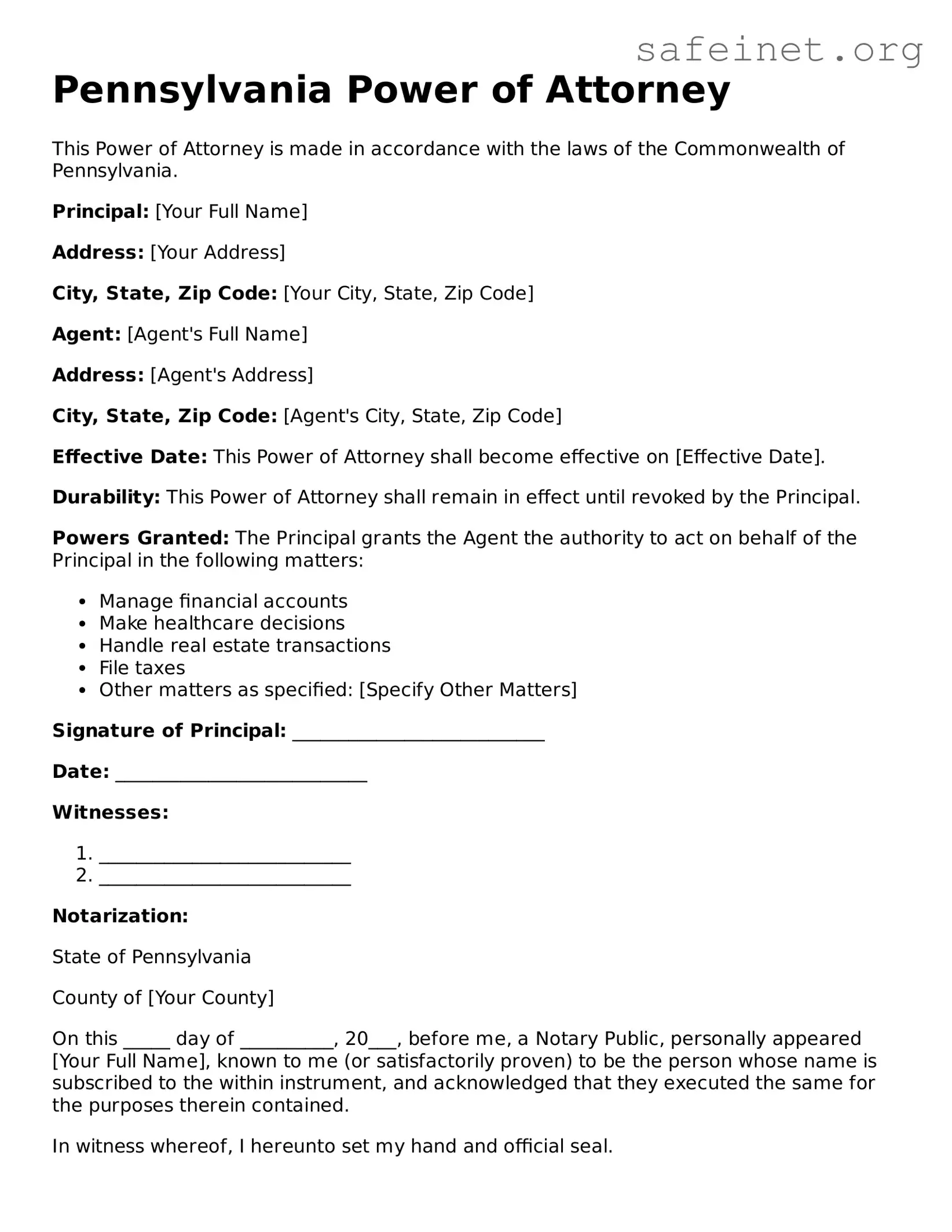
Pennsylvania Power of Attorney
This Power of Attorney is made in accordance with the laws of the Commonwealth of Pennsylvania.
Principal: [Your Full Name]
Address: [Your Address]
City, State, Zip Code: [Your City, State, Zip Code]
Agent: [Agent's Full Name]
Address: [Agent's Address]
City, State, Zip Code: [Agent's City, State, Zip Code]
Effective Date: This Power of Attorney shall become effective on [Effective Date].
Durability: This Power of Attorney shall remain in effect until revoked by the Principal.
Powers Granted: The Principal grants the Agent the authority to act on behalf of the Principal in the following matters:
Signature of Principal: ___________________________
Date: ___________________________
Witnesses:
Notarization:
State of Pennsylvania
County of [Your County]
On this _____ day of __________, 20___, before me, a Notary Public, personally appeared [Your Full Name], known to me (or satisfactorily proven) to be the person whose name is subscribed to the within instrument, and acknowledged that they executed the same for the purposes therein contained.
In witness whereof, I hereunto set my hand and official seal.
______________________________
Notary Public
My commission expires: ____________
| Fact Name | Description |
|---|---|
| Definition | A Power of Attorney (POA) in Pennsylvania allows one person to grant another the authority to act on their behalf in legal and financial matters. |
| Types of POA | Pennsylvania recognizes several types of POAs, including General, Limited, and Durable, each serving different purposes and levels of authority. |
| Governing Laws | The Pennsylvania Power of Attorney Law, found in Title 20 of the Pennsylvania Consolidated Statutes, outlines the rules and requirements for creating and executing a POA. |
| Durability | A Durable Power of Attorney remains effective even if the principal becomes incapacitated, ensuring that decisions can still be made on their behalf. |
| Execution Requirements | The form must be signed by the principal and two witnesses, or a notary public, to be considered valid in Pennsylvania. |
| Revocation | The principal can revoke a Power of Attorney at any time, provided they are competent to do so, typically by providing written notice to the agent and any relevant parties. |
Filling out the Pennsylvania Power of Attorney form is an important step in designating someone to manage your financial and legal affairs. After completing the form, you will need to ensure it is signed and witnessed properly to be legally valid.
What is a Power of Attorney in Pennsylvania?
A Power of Attorney (POA) is a legal document that allows one person, known as the principal, to grant another person, called the agent or attorney-in-fact, the authority to make decisions on their behalf. This can include financial matters, healthcare decisions, or other specific tasks. In Pennsylvania, a POA must be signed by the principal and notarized to be valid.
What types of Power of Attorney are available in Pennsylvania?
In Pennsylvania, there are several types of Power of Attorney. The most common are General Power of Attorney, which grants broad powers to the agent, and Limited Power of Attorney, which restricts the agent's authority to specific tasks or time periods. Additionally, there is a Durable Power of Attorney, which remains effective even if the principal becomes incapacitated. A Healthcare Power of Attorney specifically allows the agent to make medical decisions for the principal.
How do I create a Power of Attorney in Pennsylvania?
To create a Power of Attorney in Pennsylvania, you need to complete the appropriate form, which can be obtained online or from legal resources. The form must clearly state the powers you are granting to your agent. After filling it out, you must sign the document in the presence of a notary public. It is also advisable to discuss your decisions with your agent and family to ensure everyone understands your wishes.
Can I revoke a Power of Attorney in Pennsylvania?
Yes, you can revoke a Power of Attorney at any time as long as you are mentally competent. To revoke it, you should create a written revocation document, sign it, and notify your agent and any institutions that may have relied on the original POA. It’s important to ensure that the revocation is clear to avoid any confusion about your wishes.
What happens if I become incapacitated and have a Power of Attorney?
If you become incapacitated and have a valid Durable Power of Attorney in place, your agent can step in and make decisions on your behalf. This can include managing your finances, paying bills, and making healthcare decisions. If you do not have a Durable Power of Attorney, your loved ones may need to go through the court to obtain guardianship, which can be a lengthy and costly process.
Is it necessary to have a lawyer when creating a Power of Attorney?
While it is not legally required to have a lawyer to create a Power of Attorney in Pennsylvania, consulting with one can provide valuable guidance. A lawyer can help ensure that the document meets all legal requirements and accurately reflects your wishes. This can prevent potential disputes or misunderstandings in the future.
Failing to specify the powers granted. Many individuals overlook the importance of clearly defining what powers are being given to the agent. This can lead to confusion and potential disputes.
Not dating the document. A common mistake is neglecting to include the date on the Power of Attorney form. Without a date, it can be challenging to determine when the authority was granted.
Choosing the wrong agent. Selecting someone who may not have the best interests of the principal at heart can lead to serious issues. It’s crucial to choose a trustworthy individual.
Failing to sign in the presence of a notary. In Pennsylvania, a Power of Attorney must be notarized to be valid. Skipping this step can render the document ineffective.
Not considering alternate agents. If the primary agent cannot serve for any reason, having a backup agent ensures that decisions can still be made without interruption.
Ignoring state-specific requirements. Each state has its own rules regarding Power of Attorney forms. Failing to adhere to Pennsylvania’s specific regulations can invalidate the document.
Overlooking the need for updates. Life circumstances change. Regularly reviewing and updating the Power of Attorney ensures it remains aligned with the principal’s current wishes and needs.
When considering a Pennsylvania Power of Attorney, it’s essential to understand that this document often works in tandem with several other legal forms. Each of these documents serves a specific purpose, enhancing your legal and financial planning. Here’s a list of commonly used forms that complement a Power of Attorney in Pennsylvania.
Understanding these documents and how they interrelate with the Pennsylvania Power of Attorney can significantly impact your estate planning strategy. Each form plays a vital role in ensuring your wishes are followed and your loved ones are protected. Taking the time to prepare these documents thoughtfully can provide peace of mind and clarity for you and your family.
The Durable Power of Attorney is similar to the standard Power of Attorney but with a crucial distinction: it remains effective even if the principal becomes incapacitated. This means that if an individual is unable to make decisions due to illness or injury, the designated agent can still act on their behalf. This document provides peace of mind, ensuring that someone trusted can manage financial and legal affairs without interruption.
The Medical Power of Attorney, also known as a healthcare proxy, allows an individual to designate someone to make medical decisions on their behalf if they are unable to do so. This document is particularly important in situations where immediate medical decisions are necessary, and it ensures that the individual's healthcare preferences are respected. Like the Power of Attorney, it requires careful consideration of whom to trust with such significant responsibilities.
The Living Will is closely related to the Medical Power of Attorney but serves a different purpose. It outlines an individual's wishes regarding medical treatment in end-of-life situations. While the Medical Power of Attorney designates someone to make decisions, the Living Will specifies what kind of treatment an individual wants or does not want, such as life-sustaining measures. This document provides clarity and guidance to family members and healthcare providers during difficult times.
The Revocable Trust, sometimes referred to as a living trust, allows an individual to manage their assets during their lifetime and specify how they should be distributed after death. Similar to a Power of Attorney, it provides a way to avoid probate, making the transfer of assets smoother and quicker. The individual retains control over the trust and can modify it as circumstances change, offering flexibility in estate planning.
The Healthcare Power of Attorney is akin to the Medical Power of Attorney but may vary slightly in terminology depending on the state. It serves the same fundamental purpose: appointing someone to make healthcare decisions on behalf of another person. This document is crucial for ensuring that a person’s medical preferences are honored, especially in critical situations where they cannot communicate their wishes.
The Financial Power of Attorney focuses specifically on financial matters. This document grants an agent the authority to manage the principal's financial affairs, such as paying bills, managing investments, and filing taxes. It can be broad or limited in scope, depending on the principal's needs. This document is vital for individuals who may be unable to handle their finances due to various reasons, including age or health issues.
The Guardianship Agreement is similar in that it involves appointing someone to make decisions for another person, but it typically applies to minors or individuals deemed incapacitated by a court. This legal arrangement grants a guardian the authority to make personal, medical, and financial decisions on behalf of the ward. Unlike a Power of Attorney, which is a voluntary arrangement, guardianship often requires court intervention and oversight.
The Advance Directive combines elements of both the Living Will and the Medical Power of Attorney. It allows individuals to express their healthcare preferences and appoint a healthcare agent. This document ensures that a person's wishes regarding medical treatment are documented and respected, providing a comprehensive approach to healthcare decision-making in the event of incapacity.
The Special Power of Attorney is tailored for specific tasks or transactions. Unlike a general Power of Attorney, which grants broad authority, a Special Power of Attorney limits the agent's powers to particular actions, such as selling a property or managing a specific investment. This document is useful for individuals who want to delegate certain responsibilities without relinquishing overall control.
The Business Power of Attorney is designed for individuals who own a business and need someone to manage business affairs on their behalf. This document allows the appointed agent to make decisions related to the business, including signing contracts and handling financial transactions. It is essential for ensuring that business operations can continue smoothly, especially if the owner is unavailable.
When filling out the Pennsylvania Power of Attorney form, it is important to follow certain guidelines to ensure the document is valid and meets your needs. Below are some dos and don'ts to consider.
When it comes to the Pennsylvania Power of Attorney (POA) form, many people hold misconceptions that can lead to confusion. Here are four common misunderstandings:
This is not true. Different states have different requirements and forms. The Pennsylvania Power of Attorney has specific rules and language that must be followed to be valid. Using a form from another state could lead to complications.
While many people use a POA for financial decisions, it can also cover health care decisions. A health care power of attorney allows someone to make medical choices on your behalf if you are unable to do so.
This is a common fear, but it’s not accurate. You can still manage your own affairs as long as you are capable. The person you designate only acts on your behalf when you choose to allow it.
This is a misconception. You can revoke or change your Power of Attorney at any time, as long as you are mentally competent. It’s important to inform the person you designated and any relevant institutions about the change.
When filling out and using the Pennsylvania Power of Attorney form, consider the following key takeaways: