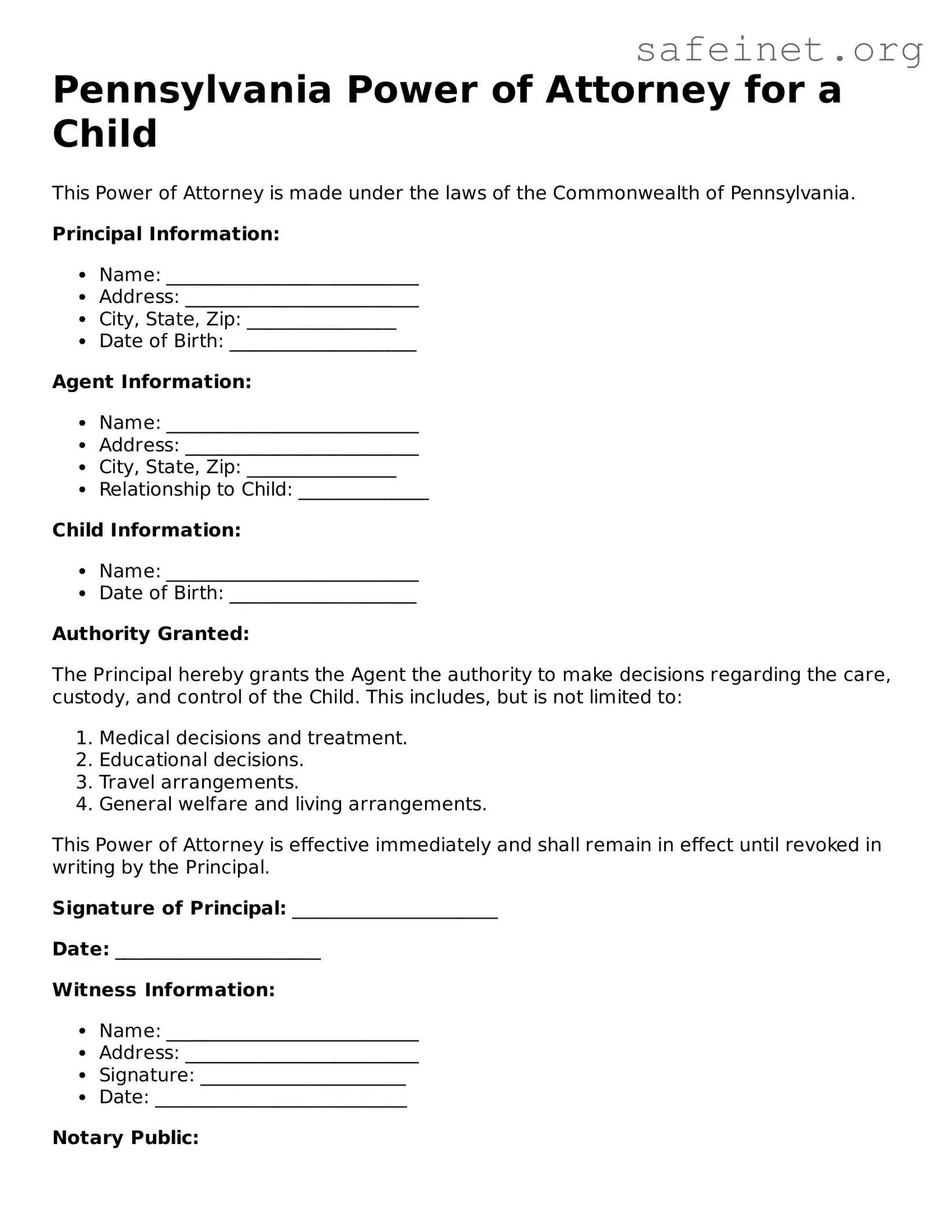
The Pennsylvania Power of Attorney for a Child form is an important legal document that allows a parent or guardian to designate another adult to make decisions on behalf of their child. This form is particularly useful in situations where the parent is temporarily unavailable, such as during travel or medical emergencies. By completing this form, parents can grant authority for various responsibilities, including medical care, education, and general welfare decisions. It is essential to ensure that the designated agent is someone trustworthy and capable of acting in the child's best interest. The form must be signed and notarized to be legally binding, providing peace of mind for parents who need to ensure their child's needs are met when they cannot be present. Understanding the nuances of this form can help parents navigate its use effectively, ensuring that their child's well-being is prioritized during their absence.
Pennsylvania Power of Attorney for a Child
This Power of Attorney is made under the laws of the Commonwealth of Pennsylvania.
Principal Information:
Agent Information:
Child Information:
Authority Granted:
The Principal hereby grants the Agent the authority to make decisions regarding the care, custody, and control of the Child. This includes, but is not limited to:
This Power of Attorney is effective immediately and shall remain in effect until revoked in writing by the Principal.
Signature of Principal: ______________________
Date: ______________________
Witness Information:
Notary Public:
State of Pennsylvania
County of ______________________
Subscribed and sworn before me on this _____ day of ______________, 20__.
_____________________________
Notary Public Signature
My Commission Expires: ________________
| Fact Name | Description |
|---|---|
| Definition | The Pennsylvania Power of Attorney for a Child form allows a parent or guardian to designate another individual to make decisions on behalf of their child. |
| Governing Law | This form is governed by the Pennsylvania Consolidated Statutes, Title 20, Chapter 56. |
| Duration | The authority granted through this form can be limited to a specific time period or remain in effect until revoked. |
| Revocation | A parent or guardian can revoke the Power of Attorney at any time, provided they follow the proper procedures. |
| Notarization | In Pennsylvania, the form must be signed in the presence of a notary public to be considered valid. |
| Limitations | The Power of Attorney does not grant the agent the ability to consent to medical treatment for the child unless specifically stated. |
| Agent Responsibilities | The designated agent is responsible for acting in the best interest of the child and making decisions as outlined in the form. |
| Uses | This form can be useful for temporary guardianship situations, travel, or when parents are unavailable. |
Filling out the Pennsylvania Power of Attorney for a Child form is an important step in ensuring that your child's needs are met when you are unable to care for them. This form allows you to designate someone you trust to make decisions on your child's behalf. Follow these steps carefully to complete the form accurately.
Once the form is filled out and signed, it is important to keep it in a safe place and ensure that the designated individual has access to it. This will help facilitate any necessary decisions regarding your child's care when needed.
What is a Power of Attorney for a Child in Pennsylvania?
A Power of Attorney for a Child is a legal document that allows a parent or legal guardian to grant another adult the authority to make decisions on behalf of their child. This can include decisions about medical care, education, and general welfare. It is often used when a parent is unable to care for their child temporarily due to travel, illness, or other reasons.
Who can be designated as an agent in this Power of Attorney?
Any adult can be designated as an agent in the Power of Attorney for a Child. This could be a relative, family friend, or any trusted individual who is willing and able to take on the responsibilities outlined in the document. It is important to choose someone who understands the needs of the child and is prepared to act in their best interest.
Is the Power of Attorney for a Child form required to be notarized?
Yes, the Power of Attorney for a Child must be signed in the presence of a notary public to be legally valid in Pennsylvania. Notarization adds a layer of authenticity to the document, ensuring that the signatures are legitimate and that the document is executed properly.
How long does the Power of Attorney for a Child remain in effect?
The Power of Attorney for a Child can remain in effect for a specified period, as indicated in the document, or until the parent or guardian revokes it. If no end date is specified, it typically remains valid until the child reaches the age of 18. However, it is advisable to review and update the document as necessary.
Can the Power of Attorney for a Child be revoked?
Yes, the parent or legal guardian has the right to revoke the Power of Attorney at any time. This can be done by providing written notice to the designated agent and any relevant parties. It is important to formally document the revocation to avoid any confusion or misunderstandings.
What decisions can the agent make on behalf of the child?
The agent can make a variety of decisions regarding the child's care, including but not limited to medical treatment, education, and participation in extracurricular activities. The specific powers granted can be tailored in the document to meet the needs of the child and the preferences of the parent or guardian.
Is there a specific form that must be used for the Power of Attorney for a Child?
While Pennsylvania does not mandate a specific form, it is advisable to use a standardized Power of Attorney for a Child template that complies with state laws. This ensures that all necessary elements are included and that the document is legally enforceable.
Do I need legal assistance to create a Power of Attorney for a Child?
While it is not strictly necessary to have legal assistance, consulting with an attorney can provide valuable guidance. An attorney can help ensure that the document is properly drafted, that it meets all legal requirements, and that it accurately reflects the intentions of the parent or guardian.
What happens if the agent is unable to fulfill their duties?
If the designated agent is unable to fulfill their duties due to illness, relocation, or other reasons, the parent or guardian can appoint a new agent or revoke the Power of Attorney. It is important to have a backup plan in place to ensure the child's needs are met at all times.
Are there any limitations to the Power of Attorney for a Child?
Yes, there can be limitations. The Power of Attorney can specify certain powers that the agent does not have, such as making decisions about the child's permanent placement or consent to adoption. Additionally, the agent must always act in the best interest of the child and cannot use their authority for personal gain.
Not Specifying the Duration: One common mistake is failing to clearly state how long the power of attorney is valid. It’s important to specify whether it’s for a specific period or until a certain event occurs.
Omitting Important Details: Some people forget to include essential information about the child, such as their full name, date of birth, and any medical conditions. This information is crucial for clarity and legal validity.
Not Notarizing the Document: A common oversight is neglecting to have the form notarized. In Pennsylvania, notarization is often required for the document to be legally binding.
Choosing the Wrong Agent: Selecting an inappropriate agent can lead to complications. It’s vital to choose someone trustworthy and capable of making decisions in the child’s best interest.
Failing to Review the Document: After filling out the form, some individuals do not take the time to review it thoroughly. Errors or omissions can lead to misunderstandings or legal challenges later on.
When preparing a Pennsylvania Power of Attorney for a Child, several other forms and documents may be helpful to ensure smooth legal processes. These documents can provide additional clarity and protection for both the child and the designated agent. Here’s a list of commonly used forms that complement the Power of Attorney for a Child.
Having these forms and documents prepared alongside the Pennsylvania Power of Attorney for a Child can help ensure that all aspects of the child’s care and well-being are covered. It’s always a good idea to consult with a legal professional to ensure that everything is in order.
The Pennsylvania Power of Attorney for a Child form shares similarities with the General Power of Attorney. Both documents allow an individual to grant authority to another person to act on their behalf. In the case of the General Power of Attorney, the scope of authority can be broad, covering various aspects of a person's financial and legal affairs. Conversely, the Power of Attorney for a Child specifically focuses on the care and custody of a minor, ensuring that the designated agent can make decisions related to the child's welfare, education, and health care.
Another document that resembles the Pennsylvania Power of Attorney for a Child is the Medical Power of Attorney. This form specifically allows an individual to designate someone to make medical decisions on their behalf in the event they become incapacitated. Similar to the Power of Attorney for a Child, the Medical Power of Attorney emphasizes the importance of choosing a trusted individual to make critical decisions. However, the focus here is solely on health care choices rather than broader parental responsibilities.
The Child Custody Agreement is also akin to the Pennsylvania Power of Attorney for a Child. This legal document outlines the terms of custody arrangements between parents or guardians. While the Power of Attorney for a Child grants temporary authority to a designated individual, a Child Custody Agreement formalizes the ongoing responsibilities and rights of parents regarding their child. Both documents aim to prioritize the child's best interests, but they serve different purposes in terms of authority and duration.
Additionally, the Guardianship Agreement bears resemblance to the Power of Attorney for a Child. A Guardianship Agreement is typically established when a court appoints someone to take care of a child when the biological parents are unable to do so. Similar to the Power of Attorney for a Child, this document ensures that the child's needs are met. However, guardianship often involves a more permanent arrangement, while the Power of Attorney is usually temporary and can be revoked at any time.
The Temporary Custody Agreement is another document that parallels the Pennsylvania Power of Attorney for a Child. This agreement allows a parent to grant temporary custody of their child to another individual, often for a specific period. Like the Power of Attorney for a Child, it is designed to ensure that the child is cared for and that decisions can be made in the parent's absence. However, the Temporary Custody Agreement is more focused on the immediate needs and situations of the child, often arising from unforeseen circumstances.
The Adoption Agreement is also similar in that it involves the care and custody of a child. This document formalizes the legal process of adopting a child, transferring parental rights from the biological parents to the adoptive parents. While the Power of Attorney for a Child grants temporary authority for decision-making, an Adoption Agreement is a permanent legal arrangement that establishes a new parent-child relationship. Both documents reflect the commitment to the child's well-being, but they differ significantly in their legal implications.
The Child Support Agreement can also be seen as related to the Pennsylvania Power of Attorney for a Child. This document outlines the financial responsibilities of a parent towards their child. While the Power of Attorney for a Child focuses on decision-making authority, the Child Support Agreement emphasizes the financial aspect of parenting. Both documents aim to support the child’s needs, yet they address different facets of parental responsibility.
Lastly, the Family Care Plan may be compared to the Pennsylvania Power of Attorney for a Child. This plan is often used by military families or those in unique circumstances to outline who will care for their children in the event of an emergency or deployment. Similar to the Power of Attorney for a Child, it designates a trusted individual to take care of the child’s needs. However, the Family Care Plan is more comprehensive, often including additional details about the child’s education, health care, and daily routines.
When filling out the Pennsylvania Power of Attorney for a Child form, it’s important to approach the process with care. This document allows a parent or guardian to designate someone else to make decisions for their child. Here’s a list of things you should and shouldn’t do:
When it comes to the Pennsylvania Power of Attorney for a Child form, there are several misconceptions that can lead to confusion. Understanding these misconceptions is crucial for parents and guardians who want to ensure the proper care of their children. Below is a list of seven common misunderstandings.
By clearing up these misconceptions, parents can make informed decisions about the care and management of their children's needs.
Filling out the Pennsylvania Power of Attorney for a Child form is an important step for parents and guardians. Here are some key takeaways to keep in mind:
By understanding these key points, parents and guardians can effectively navigate the process of using the Pennsylvania Power of Attorney for a Child form, ensuring their child’s needs are met even when they are not present.