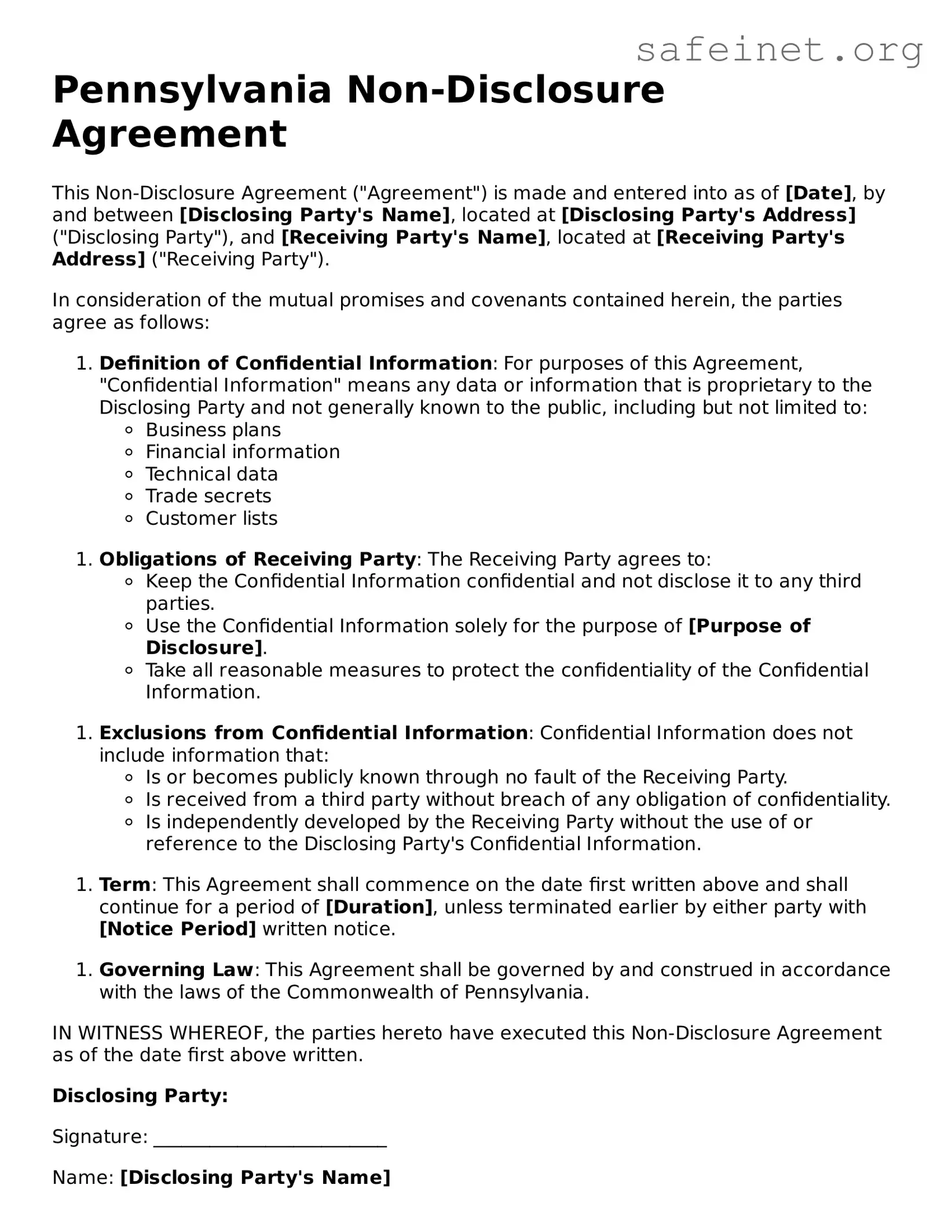
In the realm of business and professional relationships, confidentiality is paramount. The Pennsylvania Non-disclosure Agreement (NDA) form serves as a crucial tool for individuals and organizations seeking to protect sensitive information. This legally binding document establishes a framework within which parties can share proprietary data, trade secrets, or any confidential material without fear of unauthorized disclosure. Key components of the NDA include definitions of confidential information, obligations of the parties involved, the duration of confidentiality, and the consequences of breach. By clearly outlining these aspects, the form fosters trust and encourages open communication while safeguarding vital business interests. Whether you are a small business owner or part of a larger corporation, understanding the importance and structure of the Pennsylvania NDA can significantly enhance your ability to protect your intellectual property and maintain competitive advantage.
Pennsylvania Non-Disclosure Agreement
This Non-Disclosure Agreement ("Agreement") is made and entered into as of [Date], by and between [Disclosing Party's Name], located at [Disclosing Party's Address] ("Disclosing Party"), and [Receiving Party's Name], located at [Receiving Party's Address] ("Receiving Party").
In consideration of the mutual promises and covenants contained herein, the parties agree as follows:
IN WITNESS WHEREOF, the parties hereto have executed this Non-Disclosure Agreement as of the date first above written.
Disclosing Party:
Signature: _________________________
Name: [Disclosing Party's Name]
Title: [Title]
Date: [Date]
Receiving Party:
Signature: _________________________
Name: [Receiving Party's Name]
Title: [Title]
Date: [Date]
| Fact Name | Description |
|---|---|
| Definition | A Non-disclosure Agreement (NDA) is a legal contract that establishes a confidential relationship between parties, protecting sensitive information from being disclosed. |
| Purpose | NDAs are commonly used to safeguard trade secrets, business plans, and proprietary information during negotiations or collaborations. |
| Governing Law | The laws of Pennsylvania govern the interpretation and enforcement of NDAs executed in the state. |
| Types of NDAs | There are two main types: unilateral, where only one party discloses information, and mutual, where both parties share confidential information. |
| Duration | Typically, the duration of confidentiality obligations is specified in the NDA, ranging from a few years to indefinitely, depending on the nature of the information. |
| Enforceability | For an NDA to be enforceable in Pennsylvania, it must be reasonable in scope, duration, and geographic reach. |
| Consequences of Breach | If a party breaches the NDA, they may face legal action, including claims for damages or injunctive relief to prevent further disclosures. |
| Exceptions | Information that is publicly available, independently developed, or already known to the receiving party may not be protected under the NDA. |
| Customization | While templates are available, it's advisable to customize the NDA to fit specific circumstances and needs of the parties involved. |
Filling out the Pennsylvania Non-disclosure Agreement form is straightforward. Once you have completed the form, you will be ready to move forward with your agreement, ensuring that sensitive information remains protected.
What is a Non-disclosure Agreement (NDA) in Pennsylvania?
A Non-disclosure Agreement, commonly known as an NDA, is a legal contract that establishes a confidential relationship between parties. In Pennsylvania, this agreement is often used to protect sensitive information, trade secrets, or proprietary data from being disclosed to unauthorized individuals or entities. By signing an NDA, parties agree not to share or misuse the confidential information provided to them.
Who typically uses a Non-disclosure Agreement?
NDAs are commonly utilized by businesses, entrepreneurs, and individuals who wish to safeguard their confidential information. This can include startups sharing business plans with potential investors, employers disclosing sensitive company data to employees, or partners discussing joint ventures. Essentially, anyone who needs to protect their proprietary information may benefit from an NDA.
What information is usually protected by an NDA?
Typically, an NDA protects a wide range of sensitive information. This may include business strategies, customer lists, financial data, intellectual property, and technical specifications. The specifics of what is considered confidential should be clearly defined within the agreement to ensure that all parties understand their obligations.
Are there different types of NDAs?
Yes, there are generally two types of NDAs: unilateral and mutual. A unilateral NDA involves one party disclosing information to another party, while a mutual NDA involves both parties sharing confidential information with each other. The choice between these types depends on the nature of the relationship and the information being shared.
How long does the confidentiality obligation last?
The duration of confidentiality obligations can vary and is typically specified within the NDA. In Pennsylvania, it is common for the obligations to last for a set number of years or until the confidential information becomes public knowledge. Parties should carefully consider the appropriate time frame based on the nature of the information being protected.
What are the consequences of violating an NDA?
Violating an NDA can lead to serious consequences, including legal action. The injured party may seek damages for any losses incurred due to the breach. In some cases, the party may also seek injunctive relief, which is a court order to prevent further disclosure of the confidential information. It is crucial for all parties to understand the potential repercussions of breaching the agreement.
Is it necessary to have a lawyer review an NDA?
While it is not legally required to have a lawyer review an NDA, it is highly advisable. A legal professional can help ensure that the agreement is properly drafted, covers all necessary elements, and complies with Pennsylvania law. This can provide peace of mind and protect the interests of all parties involved.
Incomplete Information: One common mistake is failing to provide all required information. This includes names, addresses, and relevant details about the parties involved. Omitting any of these can render the agreement invalid.
Not Defining Confidential Information: Another frequent error is not clearly defining what constitutes confidential information. Vague descriptions can lead to misunderstandings and disputes later on.
Ignoring the Duration of the Agreement: Some individuals neglect to specify how long the non-disclosure obligations last. Without a clear timeframe, it can be unclear when the agreement ends, potentially leading to legal complications.
Failing to Review the Agreement: Lastly, many people do not take the time to review the agreement thoroughly before signing. This can result in agreeing to terms that are not fully understood or acceptable.
In business transactions, protecting sensitive information is crucial. Alongside the Pennsylvania Non-disclosure Agreement (NDA), several other forms and documents are commonly utilized to ensure confidentiality and clarify the terms of collaboration. Below is a list of these essential documents.
Utilizing these documents in conjunction with a Pennsylvania Non-disclosure Agreement can create a robust framework for protecting sensitive information and fostering trust in business relationships. Each document serves a specific purpose, enhancing the overall security of confidential communications.
A Non-Disclosure Agreement (NDA) is similar to a Confidentiality Agreement. Both documents serve the primary purpose of protecting sensitive information shared between parties. While an NDA often focuses on preventing the disclosure of trade secrets and proprietary information, a Confidentiality Agreement can cover a broader range of confidential data, including business strategies and client lists. The terms of both agreements ensure that the receiving party understands their obligation to keep the information private.
An Employment Agreement also shares similarities with an NDA. Many employment contracts include confidentiality clauses that restrict employees from sharing sensitive company information during and after their employment. This protects the employer's interests and ensures that proprietary knowledge remains within the organization. Both documents aim to safeguard intellectual property and maintain a competitive edge.
A Mutual Non-Disclosure Agreement is similar in that it involves two parties sharing confidential information with each other. Unlike a standard NDA, which typically protects one party, a Mutual NDA ensures that both parties are bound by the same confidentiality obligations. This type of agreement is often used in joint ventures or collaborations, where both sides need to share sensitive information to work together effectively.
A Proprietary Information Agreement (PIA) is closely related to an NDA. It specifically focuses on protecting proprietary information, which can include trade secrets, formulas, and processes unique to a business. While an NDA may cover a wider range of confidential information, a PIA hones in on the proprietary aspects, ensuring that any shared information remains protected from unauthorized use or disclosure.
A Licensing Agreement can also bear similarities to an NDA. When a company licenses its technology or intellectual property, it often requires the licensee to sign an NDA to protect its proprietary information. This ensures that the licensee does not disclose or misuse the technology or information provided, maintaining the licensor's competitive advantage and control over its intellectual property.
A Sales Agreement sometimes includes confidentiality provisions akin to those in an NDA. When businesses negotiate sales, they may share sensitive pricing, customer lists, or product specifications. Including confidentiality clauses within the Sales Agreement protects this information from being disclosed to competitors, ensuring that both parties maintain their competitive positions in the market.
Lastly, a Partnership Agreement often contains confidentiality provisions similar to those found in an NDA. When forming a partnership, the parties may need to share sensitive information about their businesses. The confidentiality clauses within the Partnership Agreement help protect that information, ensuring that all partners are committed to maintaining privacy and trust throughout their collaboration.
When filling out the Pennsylvania Non-disclosure Agreement form, it’s important to approach the process with care. Here are some key things you should and shouldn't do:
When it comes to Non-disclosure Agreements (NDAs) in Pennsylvania, several misconceptions can lead to confusion. Understanding these common misunderstandings is crucial for anyone considering entering into such an agreement. Below are seven prevalent misconceptions about the Pennsylvania Non-disclosure Agreement form.
This is not true. NDAs can be beneficial for individuals, small businesses, and startups as well. Anyone who wishes to protect sensitive information can use an NDA.
Each NDA can be tailored to fit specific needs. The terms and conditions may vary significantly based on the nature of the information being protected and the parties involved.
While an NDA restricts the sharing of confidential information, it does not prevent general discussions about your work or industry. It’s important to understand the specific limitations of the agreement.
While NDAs are generally enforceable, they must meet certain legal criteria to be considered valid. If the terms are overly broad or unreasonable, they may not hold up in court.
There are exceptions to this rule. For instance, if the information becomes public knowledge through no fault of your own, or if you are required by law to disclose it, you may be exempt from the NDA.
Most NDAs have a specified duration. After this period, the obligation to keep the information confidential may expire, depending on the terms outlined in the agreement.
While legal advice is beneficial, individuals can draft their own NDAs. However, it is advisable to seek professional guidance to ensure that the agreement meets all necessary legal requirements.
By addressing these misconceptions, individuals and businesses can make more informed decisions regarding the use of Non-disclosure Agreements in Pennsylvania. Understanding the true nature of NDAs can empower parties to protect their valuable information effectively.
When filling out and using the Pennsylvania Non-disclosure Agreement (NDA) form, there are several important points to consider. Here are key takeaways to keep in mind:
By following these guidelines, you can effectively use the Pennsylvania Non-disclosure Agreement form to protect your confidential information.