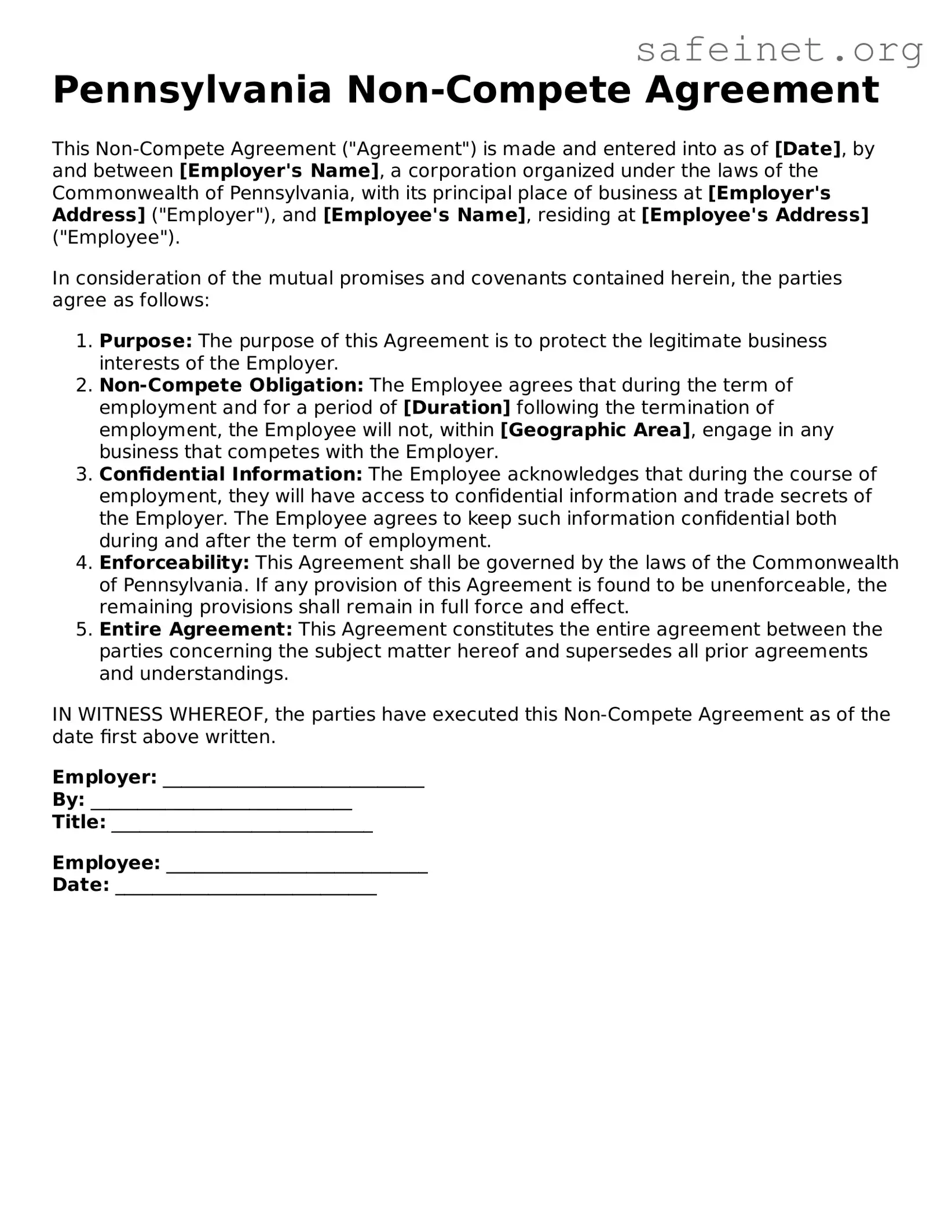
In Pennsylvania, the Non-compete Agreement form plays a crucial role in defining the boundaries of employee and employer relationships. This document outlines the terms under which an employee agrees not to engage in activities that directly compete with their employer after leaving the company. Key aspects of the form include the duration of the non-compete period, the geographic scope of the restriction, and the specific activities that are prohibited. By clearly stating these elements, the agreement aims to protect the employer's business interests while also considering the rights of the employee. Understanding the implications of signing such a form is essential for both parties, as it can significantly impact future employment opportunities and business operations. The form also addresses the potential for legal enforcement, highlighting the importance of reasonable restrictions that align with Pennsylvania law. Navigating these agreements requires careful consideration, as they can shape professional trajectories and influence market competition.
Pennsylvania Non-Compete Agreement
This Non-Compete Agreement ("Agreement") is made and entered into as of [Date], by and between [Employer's Name], a corporation organized under the laws of the Commonwealth of Pennsylvania, with its principal place of business at [Employer's Address] ("Employer"), and [Employee's Name], residing at [Employee's Address] ("Employee").
In consideration of the mutual promises and covenants contained herein, the parties agree as follows:
IN WITNESS WHEREOF, the parties have executed this Non-Compete Agreement as of the date first above written.
Employer: ____________________________
By: ____________________________
Title: ____________________________
Employee: ____________________________
Date: ____________________________
| Fact Name | Detail |
|---|---|
| Governing Law | Pennsylvania law governs non-compete agreements. |
| Enforceability | Non-compete agreements in Pennsylvania must be reasonable in duration and geographic scope to be enforceable. |
| Consideration | In Pennsylvania, valid consideration is required for a non-compete agreement to be enforceable, often provided at the start of employment. |
| Public Policy | Pennsylvania courts may refuse to enforce non-compete agreements that significantly restrict an individual's ability to earn a living. |
Once you have the Pennsylvania Non-compete Agreement form in hand, it’s time to fill it out accurately. Completing this form is essential for ensuring clarity in your agreement. Follow these steps to ensure you fill it out correctly.
After completing the form, keep a copy for your records. You may need to present this document in the future, so ensure it is stored safely. If necessary, consult with a legal professional to discuss any implications of the agreement.
What is a Non-compete Agreement in Pennsylvania?
A Non-compete Agreement is a legal document that restricts an employee from engaging in activities that compete with their employer after leaving the company. In Pennsylvania, such agreements must be reasonable in scope, duration, and geographic area to be enforceable. They are often used to protect trade secrets, customer relationships, and other valuable business interests.
Are Non-compete Agreements enforceable in Pennsylvania?
Yes, Non-compete Agreements can be enforceable in Pennsylvania, but they are subject to specific legal standards. Courts will typically evaluate the reasonableness of the agreement based on factors such as duration, geographic scope, and the legitimate business interests of the employer. An agreement that is overly broad or restrictive may be deemed unenforceable.
How long can a Non-compete Agreement last in Pennsylvania?
The duration of a Non-compete Agreement in Pennsylvania varies, but generally, it should be limited to a period that is reasonable under the circumstances. Common durations range from six months to two years. However, the specific length may depend on the nature of the business and the employee's role within the company.
What should I consider before signing a Non-compete Agreement?
Before signing a Non-compete Agreement, carefully review the terms and conditions. Consider how the agreement may impact your future employment opportunities. It's important to understand the geographic limitations and the duration of the restrictions. Seeking legal advice may also be beneficial to ensure that your rights are protected.
Can I negotiate the terms of a Non-compete Agreement?
Yes, negotiating the terms of a Non-compete Agreement is possible. Many employers are open to discussions about the scope, duration, and geographic limits of the agreement. It's advisable to communicate your concerns and seek a mutually beneficial arrangement. A clear understanding can help prevent future disputes.
What happens if I violate a Non-compete Agreement?
If you violate a Non-compete Agreement, your former employer may take legal action against you. This could include seeking an injunction to prevent you from continuing the competing activity and possibly pursuing damages. It is crucial to understand the terms of the agreement to avoid potential legal consequences.
Inaccurate Information: Individuals often provide incorrect personal details, such as their name, address, or job title. This can lead to confusion and potential legal issues.
Failure to Specify Duration: Many people neglect to clearly define the time period during which the non-compete agreement is effective. This omission can make the agreement unenforceable.
Vague Geographic Scope: Some forms include a general area without specifying exact locations. A non-compete agreement should clearly outline the geographic boundaries to avoid ambiguity.
Not Understanding Terms: It is common for individuals to sign the agreement without fully understanding its implications. This can lead to unintended restrictions on future employment opportunities.
When entering into a Pennsylvania Non-compete Agreement, several other forms and documents may be relevant to ensure clarity and legal compliance. These documents help outline expectations, protect interests, and establish a clear understanding between parties. Here’s a list of commonly used documents alongside a Non-compete Agreement:
Each of these documents plays a role in defining the relationship between the parties involved. They help ensure that everyone understands their rights and responsibilities, particularly regarding competition and confidentiality. Properly managing these agreements can prevent misunderstandings and legal disputes in the future.
The Pennsylvania Non-compete Agreement is similar to the Employment Agreement. Both documents establish the terms of the working relationship between an employer and an employee. While the Employment Agreement outlines job responsibilities, compensation, and benefits, the Non-compete Agreement specifically addresses restrictions on the employee’s ability to work for competitors after leaving the company. This ensures that the employer's proprietary information and competitive edge are protected, while the Employment Agreement provides a broader framework for the employment relationship.
Another document that resembles the Pennsylvania Non-compete Agreement is the Confidentiality Agreement, often referred to as a Non-disclosure Agreement (NDA). Both agreements aim to protect sensitive information. The Confidentiality Agreement focuses on preventing the sharing of confidential information during and after employment, whereas the Non-compete Agreement restricts the employee from entering into direct competition with the employer post-employment. Together, these documents help safeguard a company’s intellectual property and trade secrets.
The Partnership Agreement shares similarities with the Non-compete Agreement in that it often includes clauses to prevent partners from competing against each other during and after the partnership. In a Partnership Agreement, partners may agree not to engage in business activities that would harm the partnership's interests. This mutual understanding fosters trust and collaboration, similar to how a Non-compete Agreement protects an employer's interests from former employees.
The Independent Contractor Agreement is another document that parallels the Non-compete Agreement. While an Independent Contractor Agreement outlines the terms of service between a business and a contractor, it may also include non-compete clauses. These clauses prevent the contractor from working with competing businesses during and after their engagement with the contracting company. This ensures that the contractor does not leverage sensitive information obtained during their work for competitive advantage.
A Sales Representative Agreement also bears resemblance to the Non-compete Agreement. This type of agreement often includes provisions that limit a sales representative’s ability to work for competing firms after their contract ends. By doing so, it protects the company’s client relationships and proprietary sales strategies. Both agreements emphasize the importance of safeguarding business interests in competitive markets.
The Franchise Agreement is another document that can be compared to the Non-compete Agreement. Franchise Agreements typically include clauses that restrict franchisees from operating competing businesses within a certain geographical area for a specified time after the agreement ends. This is similar to a Non-compete Agreement, which seeks to protect a business's market position and brand identity from former employees who might otherwise join competing enterprises.
Lastly, the Licensing Agreement can be seen as akin to the Non-compete Agreement. Licensing Agreements often contain terms that prevent the licensee from using the licensed material in a way that competes with the licensor’s business. Both documents aim to create a clear understanding of the boundaries of business operations, ensuring that proprietary information and competitive advantages are not misused by former employees or partners.
When filling out the Pennsylvania Non-compete Agreement form, it is important to follow certain guidelines to ensure that the document is completed accurately and effectively. Below are four things to consider doing and not doing during this process.
Things You Should Do:
Things You Shouldn't Do:
Many individuals misunderstand the Pennsylvania Non-compete Agreement form. Here are four common misconceptions:
When it comes to filling out and using the Pennsylvania Non-compete Agreement form, there are several important points to keep in mind. Here are some key takeaways that can help you navigate this process effectively:
By keeping these takeaways in mind, you can better navigate the complexities of non-compete agreements in Pennsylvania and protect your interests effectively.