In Pennsylvania, a Medical Power of Attorney (MPOA) serves as a crucial tool for individuals seeking to ensure their healthcare preferences are honored when they cannot communicate those wishes themselves. This legal document allows you to designate a trusted person, often referred to as your agent, to make medical decisions on your behalf. It is essential to choose someone who understands your values and preferences regarding medical treatment. The MPOA not only empowers your agent to make decisions about life-sustaining treatments but also provides guidance on your wishes concerning end-of-life care, organ donation, and other healthcare matters. By completing this form, you can alleviate the burden on your loved ones during difficult times and ensure that your medical care aligns with your personal beliefs. Understanding the nuances of the MPOA form, including the necessary signatures and the importance of discussing your choices with your agent, can help you navigate this important aspect of healthcare planning effectively.
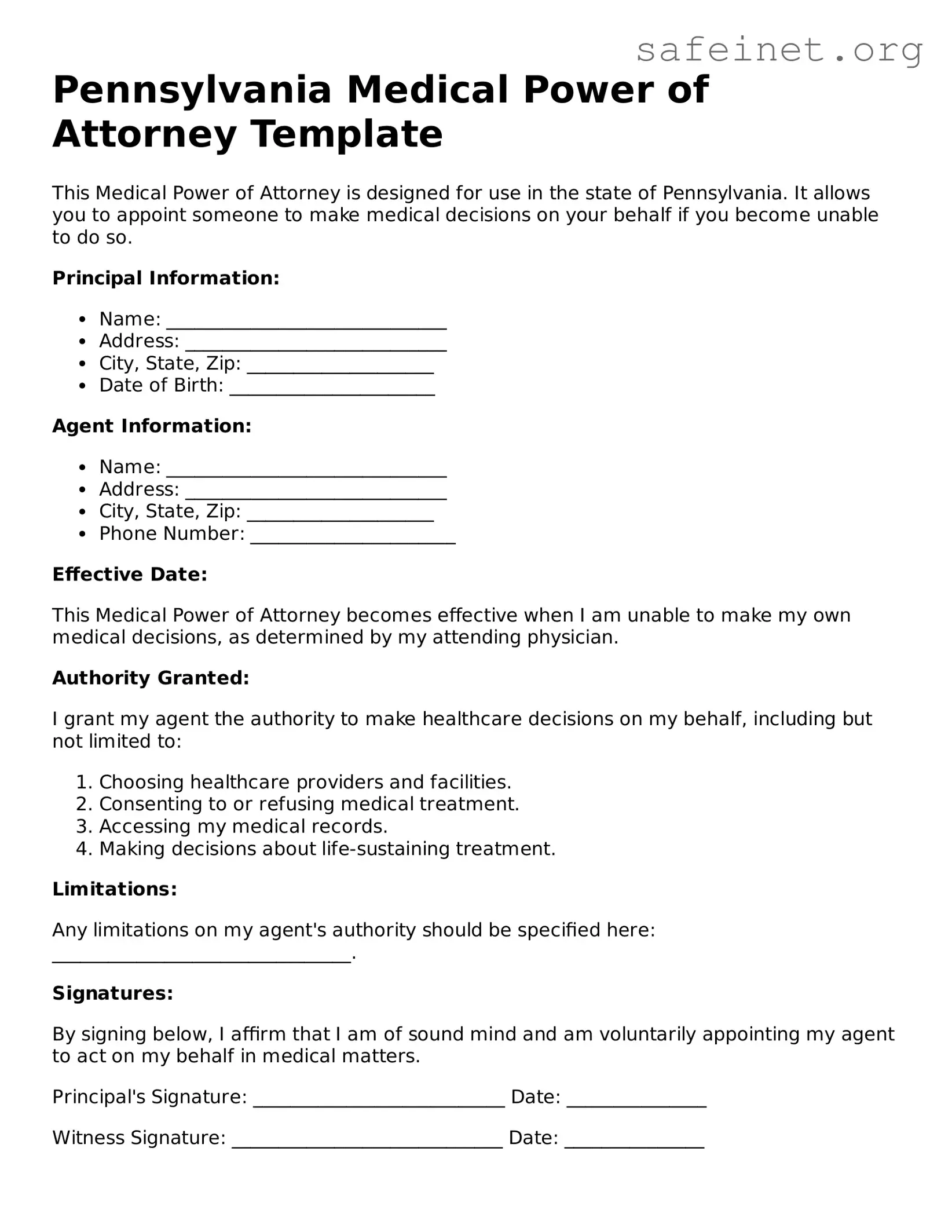
Pennsylvania Medical Power of Attorney Template
This Medical Power of Attorney is designed for use in the state of Pennsylvania. It allows you to appoint someone to make medical decisions on your behalf if you become unable to do so.
Principal Information:
Agent Information:
Effective Date:
This Medical Power of Attorney becomes effective when I am unable to make my own medical decisions, as determined by my attending physician.
Authority Granted:
I grant my agent the authority to make healthcare decisions on my behalf, including but not limited to:
Limitations:
Any limitations on my agent's authority should be specified here: ________________________________.
Signatures:
By signing below, I affirm that I am of sound mind and am voluntarily appointing my agent to act on my behalf in medical matters.
Principal's Signature: ___________________________ Date: _______________
Witness Signature: _____________________________ Date: _______________
Witness Signature: _____________________________ Date: _______________
This document must be signed in the presence of two witnesses who are not related to you or named as your agent.
It is advisable to keep this document in a safe place and share copies with your agent and healthcare providers.
| Fact Name | Description |
|---|---|
| Definition | The Pennsylvania Medical Power of Attorney allows individuals to appoint someone to make healthcare decisions on their behalf if they become unable to do so. |
| Governing Law | This form is governed by the Pennsylvania Consolidated Statutes, Title 20, Chapter 54. |
| Eligibility | Any adult who is at least 18 years old can create a Medical Power of Attorney in Pennsylvania. |
| Agent Requirements | The appointed agent must be at least 18 years old and cannot be an employee of a healthcare facility where the principal is receiving care. |
| Signing Requirements | The form must be signed by the principal in the presence of two witnesses or a notary public. |
| Witnesses | Witnesses cannot be the appointed agent, a healthcare provider, or an employee of a healthcare provider. |
| Revocation | The principal can revoke the Medical Power of Attorney at any time, as long as they are mentally competent. |
| Durability | This power of attorney remains effective even if the principal becomes incapacitated, unless stated otherwise in the document. |
| Additional Provisions | Individuals may include specific instructions regarding medical treatment and end-of-life care within the form. |
Filling out the Pennsylvania Medical Power of Attorney form is an important step in designating someone to make medical decisions on your behalf in case you are unable to do so. This process involves careful consideration of your choices and ensuring that your wishes are clearly communicated.
What is a Pennsylvania Medical Power of Attorney?
A Pennsylvania Medical Power of Attorney is a legal document that allows you to appoint someone to make healthcare decisions on your behalf if you become unable to do so. This trusted person, known as your agent or proxy, will have the authority to make medical choices in line with your wishes, ensuring that your healthcare preferences are respected even when you can't communicate them yourself.
Who can be appointed as my agent in a Medical Power of Attorney?
You can appoint any competent adult as your agent in a Pennsylvania Medical Power of Attorney. This could be a family member, a close friend, or anyone you trust to make important medical decisions for you. It's crucial to choose someone who understands your values and wishes regarding healthcare.
Do I need a lawyer to create a Medical Power of Attorney in Pennsylvania?
No, you don’t necessarily need a lawyer to create a Medical Power of Attorney in Pennsylvania. The form can be completed on your own, as long as it meets the state's legal requirements. However, consulting with a lawyer can provide additional peace of mind and ensure that your document is tailored to your specific needs.
How do I ensure my Medical Power of Attorney is valid?
To ensure your Medical Power of Attorney is valid in Pennsylvania, you must sign the document in the presence of two witnesses or a notary public. The witnesses cannot be your agent, your healthcare provider, or anyone who stands to gain from your estate. Following these guidelines will help confirm that your document holds up when needed.
Can I revoke my Medical Power of Attorney once it’s been created?
Yes, you can revoke your Medical Power of Attorney at any time as long as you are still competent. To do this, you should create a written notice of revocation and inform your agent and any healthcare providers about the change. It’s wise to destroy any copies of the previous document to avoid confusion.
What happens if I don’t have a Medical Power of Attorney?
If you don’t have a Medical Power of Attorney and become unable to make your own healthcare decisions, your family may have to go through a court process to appoint a guardian. This can be time-consuming and stressful for your loved ones. Having a Medical Power of Attorney in place can help avoid this situation and ensure your wishes are followed without unnecessary complications.
Failing to clearly identify the principal (the person granting authority). This can lead to confusion about who the document represents.
Not specifying the agent (the person authorized to make medical decisions). It's crucial to name someone trustworthy and capable.
Overlooking the need for witnesses. Pennsylvania law requires that the document be signed in the presence of two witnesses.
Not dating the form. A date is essential for establishing when the authority begins and ensuring the document is current.
Using vague language. Clear and specific instructions about medical preferences help avoid misunderstandings.
Neglecting to discuss wishes with the agent beforehand. Open communication ensures that the agent understands the principal's desires.
Failing to review and update the document regularly. Life circumstances change, and so may medical preferences.
Not considering potential conflicts of interest. Choosing an agent who may benefit from the principal's medical decisions can lead to ethical dilemmas.
Using an outdated version of the form. Always ensure that the most current version is used to comply with state laws.
Forgetting to provide copies of the signed document to relevant parties. Agents, family members, and healthcare providers should all have access.
When preparing a Pennsylvania Medical Power of Attorney, it is beneficial to consider additional forms and documents that can complement this important legal instrument. Each document serves a specific purpose and can help ensure that your healthcare wishes are honored and that your affairs are managed effectively.
Incorporating these documents alongside the Pennsylvania Medical Power of Attorney can provide comprehensive guidance for healthcare decisions. Each form plays a vital role in ensuring that your wishes are respected and that your loved ones have the necessary authority to act on your behalf.
The Pennsylvania Medical Power of Attorney form is similar to a general Power of Attorney (POA) in that both documents allow an individual to appoint someone else to make decisions on their behalf. While a general POA can cover a wide range of decisions, including financial matters, a Medical Power of Attorney is specifically focused on health care decisions. This distinction is crucial, as it ensures that your chosen representative can act in your best interest regarding medical treatments, end-of-life care, and other health-related issues when you are unable to do so yourself.
Another document that shares similarities with the Medical Power of Attorney is the Living Will. A Living Will outlines your wishes regarding medical treatment in situations where you cannot express your preferences, such as terminal illness or incapacitation. While the Medical Power of Attorney designates someone to make decisions for you, the Living Will serves as a guide for that person, providing clear instructions about your treatment preferences. Together, these documents ensure that your health care decisions are honored and respected.
The Advance Directive is also akin to the Medical Power of Attorney. In Pennsylvania, an Advance Directive encompasses both the Medical Power of Attorney and the Living Will. This comprehensive document allows you to appoint a health care agent and specify your medical treatment preferences in one place. This combination can simplify the decision-making process for your loved ones, as they will have a clear understanding of your wishes and the authority to act on your behalf.
A Health Care Proxy is another document that functions similarly to the Medical Power of Attorney. Like the Medical POA, a Health Care Proxy allows you to appoint someone to make medical decisions for you when you are unable to communicate your wishes. The primary difference is that a Health Care Proxy is often used in states that do not have a separate Medical Power of Attorney form. This means that while the terminology may differ, the purpose remains the same: ensuring that your health care preferences are honored.
The Do Not Resuscitate (DNR) order is related to the Medical Power of Attorney in that both deal with end-of-life decisions. A DNR order specifically instructs medical personnel not to perform cardiopulmonary resuscitation (CPR) if your heart stops or if you stop breathing. While a Medical Power of Attorney allows your agent to make broader health care decisions, a DNR focuses on a specific aspect of your care. Having both documents can provide clarity and ensure that your wishes are respected in critical situations.
Another similar document is the Physician Orders for Life-Sustaining Treatment (POLST). The POLST form translates your health care preferences into actionable medical orders, making it clear to medical personnel what treatments you want or do not want in emergencies. While the Medical Power of Attorney designates a person to make decisions, the POLST provides specific instructions that must be followed by health care providers. This ensures that your wishes are honored at all levels of care.
The Mental Health Power of Attorney is also worth mentioning. This document allows you to designate someone to make decisions about your mental health treatment if you become unable to do so. While the Medical Power of Attorney covers general health care, the Mental Health Power of Attorney specifically addresses mental health issues. This distinction is important, as mental health treatment can involve different considerations and approaches compared to physical health care.
Lastly, the Guardianship documents can be compared to the Medical Power of Attorney. If an individual becomes incapacitated and has not appointed a Medical Power of Attorney, a court may appoint a guardian to make health care decisions on their behalf. While the Medical Power of Attorney allows you to choose your representative, guardianship can involve a legal process to determine who will make decisions for you. This makes the Medical Power of Attorney a proactive way to ensure your preferences are respected without needing court intervention.
Filling out a Pennsylvania Medical Power of Attorney form is an important step in ensuring that your healthcare wishes are respected. To help you navigate this process smoothly, here are some essential dos and don'ts.
By following these guidelines, you can create a Medical Power of Attorney that truly reflects your desires and ensures that your healthcare decisions are in trusted hands.
Understanding the Pennsylvania Medical Power of Attorney form is essential for making informed decisions about healthcare. However, several misconceptions can lead to confusion. Here are eight common misconceptions:
Many people believe that a Medical Power of Attorney is only relevant when a person is at the end of their life. In reality, it can be used for any medical decision when an individual is unable to communicate their wishes, regardless of their health status.
While it is true that individuals can choose their agents, not everyone is eligible. The appointed agent must be at least 18 years old and capable of making informed decisions.
This is not accurate. A Medical Power of Attorney works in conjunction with other documents, such as a living will. If both documents exist, healthcare providers will refer to the most recent directives.
In Pennsylvania, a Medical Power of Attorney does not need to be notarized to be valid. However, it must be signed by the principal and two witnesses to ensure it meets legal requirements.
This misconception is incorrect. Individuals can revoke or modify their Medical Power of Attorney at any time, as long as they are mentally competent to do so.
Healthcare providers are required to follow the agent's decisions, but only if those decisions align with the patient's wishes and best interests. If there is a conflict, providers may seek further clarification.
This is a common myth. Anyone over the age of 18 can benefit from having a Medical Power of Attorney, as accidents or sudden illnesses can happen to anyone, regardless of age.
These two documents serve very different purposes. A Medical Power of Attorney designates someone to make healthcare decisions on your behalf, while health insurance provides financial coverage for medical expenses.
Clarifying these misconceptions can help individuals make better decisions regarding their healthcare and ensure their wishes are respected.
When considering a Medical Power of Attorney (MPOA) in Pennsylvania, it's essential to understand its significance and the steps involved in completing the form. Here are some key takeaways:
Understanding these key points can help ensure that your medical preferences are respected and that your agent is prepared to act on your behalf when necessary.