When couples in Pennsylvania decide to separate, a Marital Separation Agreement can serve as a vital tool in outlining the terms of their separation. This document addresses various aspects of the couple's lives, including the division of assets and debts, child custody arrangements, and spousal support. By clearly defining these issues, both parties can minimize misunderstandings and potential conflicts down the road. The agreement allows couples to establish their own terms, rather than leaving decisions to the court, which can lead to a more amicable separation process. Furthermore, this form can provide peace of mind, ensuring that both parties are on the same page regarding their responsibilities and rights during this transitional period. Understanding the key components of the Pennsylvania Marital Separation Agreement is essential for anyone considering this step, as it lays the groundwork for a smoother path forward.
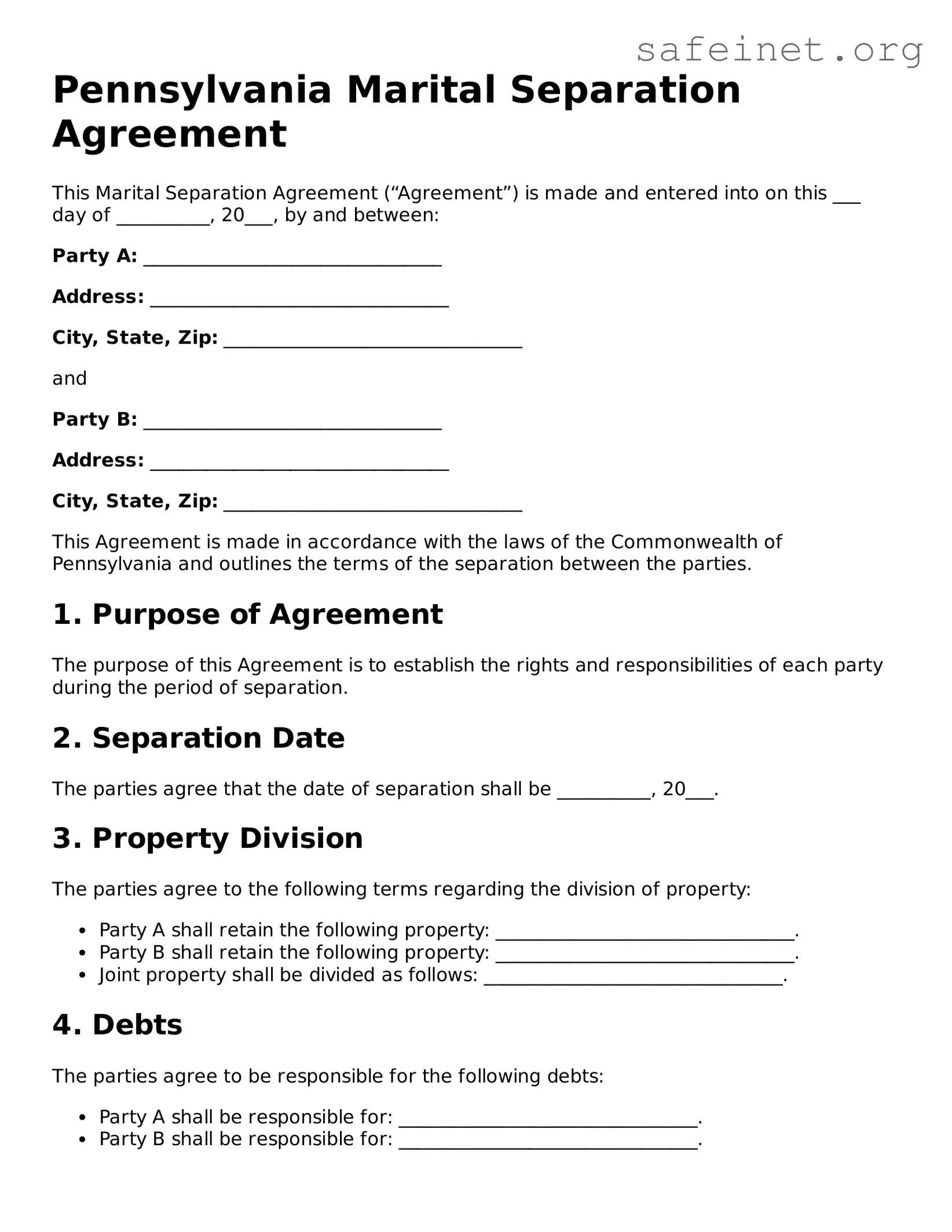
Pennsylvania Marital Separation Agreement
This Marital Separation Agreement (“Agreement”) is made and entered into on this ___ day of __________, 20___, by and between:
Party A: ________________________________
Address: ________________________________
City, State, Zip: ________________________________
and
Party B: ________________________________
Address: ________________________________
City, State, Zip: ________________________________
This Agreement is made in accordance with the laws of the Commonwealth of Pennsylvania and outlines the terms of the separation between the parties.
1. Purpose of Agreement
The purpose of this Agreement is to establish the rights and responsibilities of each party during the period of separation.
2. Separation Date
The parties agree that the date of separation shall be __________, 20___.
3. Property Division
The parties agree to the following terms regarding the division of property:
4. Debts
The parties agree to be responsible for the following debts:
5. Support and Maintenance
The parties agree that:
6. Children
If applicable, the parties agree on the following regarding custody and support of children:
7. Miscellaneous
This Agreement constitutes the entire understanding between the parties. No modifications shall be valid unless in writing and signed by both parties.
Each party acknowledges that they have had the opportunity to consult with independent legal counsel regarding this Agreement.
IN WITNESS WHEREOF, the parties have executed this Agreement as of the date first above written.
Party A Signature: ________________________________
Date: ________________________________
Party B Signature: ________________________________
Date: ________________________________
| Fact Name | Description |
|---|---|
| Definition | A Pennsylvania Marital Separation Agreement is a legal document that outlines the terms of separation between spouses. |
| Governing Law | This agreement is governed by Pennsylvania state law, specifically the Pennsylvania Divorce Code. |
| Purpose | The agreement serves to clarify rights and responsibilities during the separation period. |
| Content | It typically includes provisions on asset division, child custody, and support obligations. |
| Not Mandatory | While beneficial, a Marital Separation Agreement is not legally required in Pennsylvania. |
| Enforceability | Once signed, the agreement can be enforced in court, provided it meets legal standards. |
| Modification | Parties can modify the agreement later, but changes must be documented in writing and signed by both spouses. |
Once you have the Pennsylvania Marital Separation Agreement form in front of you, it is essential to understand the information required to complete it accurately. This agreement outlines the terms of separation between spouses, addressing various aspects such as property division, support obligations, and child custody arrangements. After filling out the form, you will typically proceed with filing it in the appropriate court and possibly attend a hearing, depending on your situation.
What is a Pennsylvania Marital Separation Agreement?
A Pennsylvania Marital Separation Agreement is a legal document that outlines the terms and conditions agreed upon by spouses who are separating but not yet divorced. This agreement typically covers issues such as property division, debt responsibilities, child custody, and support obligations. It serves to clarify expectations and responsibilities during the separation period.
Is a Marital Separation Agreement legally binding in Pennsylvania?
Yes, a Marital Separation Agreement is legally binding in Pennsylvania as long as both parties voluntarily sign the document. Courts generally uphold these agreements, provided they are fair and entered into without coercion. However, it is advisable to consult with a legal professional to ensure that the agreement complies with state laws and adequately protects both parties' interests.
Do I need a lawyer to create a Marital Separation Agreement?
While it is not legally required to have a lawyer draft a Marital Separation Agreement, it is highly recommended. An attorney can help ensure that the agreement is comprehensive, addresses all necessary issues, and complies with Pennsylvania law. Having legal guidance can also help prevent future disputes and misunderstandings.
What happens if one spouse does not follow the agreement?
If one spouse fails to adhere to the terms of the Marital Separation Agreement, the other spouse may seek enforcement through the court system. The court can compel compliance, modify the agreement, or address any violations. It is crucial to keep a copy of the signed agreement and document any breaches for potential legal action.
Can a Marital Separation Agreement be modified?
Yes, a Marital Separation Agreement can be modified if both parties agree to the changes. It is essential to document any modifications in writing and have both parties sign the revised agreement. If there are significant changes in circumstances, such as income or living arrangements, it may be necessary to revisit the agreement to ensure it remains fair and relevant.
How long does a Marital Separation Agreement last?
The duration of a Marital Separation Agreement can vary depending on the terms set by the parties. Typically, the agreement remains in effect until a divorce is finalized, or until the parties agree to modify or terminate the agreement. It is important to clearly outline the duration and any conditions for termination within the document itself.
What issues can be addressed in a Marital Separation Agreement?
A Marital Separation Agreement can address various issues, including but not limited to property division, spousal support, child custody arrangements, child support, and the allocation of debts. The agreement should cover all relevant matters to minimize potential conflicts and provide clarity for both parties during the separation period.
Failing to include all necessary personal information. It's important to provide complete names, addresses, and contact details for both parties.
Not specifying the date of separation. This date is crucial for legal and financial reasons.
Overlooking the division of assets and debts. All property and liabilities should be clearly outlined to avoid future disputes.
Neglecting to address child custody and support issues. If children are involved, arrangements must be made for their care and financial support.
Using vague language. Clarity is key in legal documents. Each term should be defined to prevent misunderstandings.
Failing to have the agreement notarized. A notarized signature adds an extra layer of validity to the document.
Not reviewing the agreement with a legal professional. Legal advice can help identify potential issues before finalizing the document.
Ignoring state-specific requirements. Each state has its own laws regarding separation agreements, which must be followed.
Forgetting to keep copies of the signed agreement. Both parties should retain a copy for their records.
When navigating a marital separation in Pennsylvania, several forms and documents may accompany the Marital Separation Agreement. Each of these documents serves a specific purpose in the process, helping to clarify responsibilities and protect the rights of both parties. Below is a list of commonly used forms and documents.
Understanding these documents can help streamline the separation process. Having clear agreements in place can reduce conflict and ensure that both parties are aware of their rights and responsibilities.
The Pennsylvania Marital Separation Agreement form is similar to a Divorce Settlement Agreement. Both documents are designed to outline the terms of the separation or divorce between spouses. They address issues such as property division, child custody, and support obligations. While the Marital Separation Agreement focuses on the period of separation before a divorce is finalized, the Divorce Settlement Agreement formalizes the terms after a divorce has been granted. In essence, both documents serve to clarify the rights and responsibilities of each party, but at different stages of the dissolution of marriage.
Another document that bears similarity is the Separation Agreement. This document is often used in various states to formalize the arrangements made by spouses who have decided to live apart. Like the Pennsylvania Marital Separation Agreement, it covers important matters such as asset distribution and child care arrangements. However, the Separation Agreement can be used in situations where divorce is not imminent, allowing couples to negotiate terms while remaining married but living separately.
The Child Custody Agreement is also comparable to the Pennsylvania Marital Separation Agreement. This document specifically addresses the custody and visitation rights of parents regarding their children. While the Marital Separation Agreement may include provisions for child custody, the Child Custody Agreement focuses exclusively on the best interests of the child. It details how parental responsibilities will be shared, ensuring that both parents are on the same page regarding their children's upbringing.
The Property Settlement Agreement serves a similar purpose in terms of asset division. This document outlines how marital property will be divided upon separation or divorce. It is often a component of a larger Marital Separation Agreement but can stand alone if both parties agree on property distribution. The clarity provided by a Property Settlement Agreement helps to prevent future disputes over assets, making it a critical tool in the separation process.
The Support Agreement, which details spousal or child support obligations, is another related document. This agreement specifies the amount and duration of support payments one spouse will provide to the other or for their children. While the Marital Separation Agreement may include support provisions, a Support Agreement can provide a more detailed framework for financial responsibilities, ensuring that all parties understand their obligations during the separation period.
Finally, the Cohabitation Agreement can also be seen as similar in nature. Although typically used by unmarried couples, it outlines the terms of living together and addresses issues like property rights and financial responsibilities. In a way, it mirrors the Marital Separation Agreement by establishing clear expectations and responsibilities between partners. While the context differs, both agreements aim to prevent misunderstandings and provide a structured approach to shared living arrangements.
When filling out the Pennsylvania Marital Separation Agreement form, it’s essential to approach the process with care. Here are some key dos and don’ts to keep in mind:
When it comes to the Pennsylvania Marital Separation Agreement form, many people hold misconceptions that can lead to confusion. Here are nine common misunderstandings, along with clarifications to help set the record straight:
A marital separation agreement is not a divorce. It outlines the terms of separation but does not legally end the marriage.
While it is a private agreement, once signed, it can be enforceable in court, making it important to ensure all terms are clear and fair.
Although having a lawyer can be beneficial, individuals can draft their own agreements as long as they comply with Pennsylvania laws.
Child custody arrangements must be explicitly included in the agreement; they are not automatically addressed.
Any couple considering separation can benefit from a marital separation agreement, regardless of whether children are involved.
Agreements can be modified if both parties agree to the changes, making it a flexible tool during separation.
Even if divorce is not on the horizon, a separation agreement can help clarify responsibilities and expectations during the separation period.
While a well-drafted agreement can help, courts will still review it to ensure it is fair and in the best interest of any children involved.
Asset division depends on what the couple agrees upon in the separation agreement. It does not automatically mean a 50/50 split.
Understanding these misconceptions can help individuals navigate their separation more effectively. Always consider seeking professional advice when drafting such important documents.
When navigating the Pennsylvania Marital Separation Agreement form, several key points should be considered to ensure clarity and compliance with state laws. Here are nine essential takeaways:
These takeaways highlight the importance of careful consideration and thorough understanding when completing the Pennsylvania Marital Separation Agreement form. Taking the time to address each aspect thoughtfully can lead to a smoother separation process.