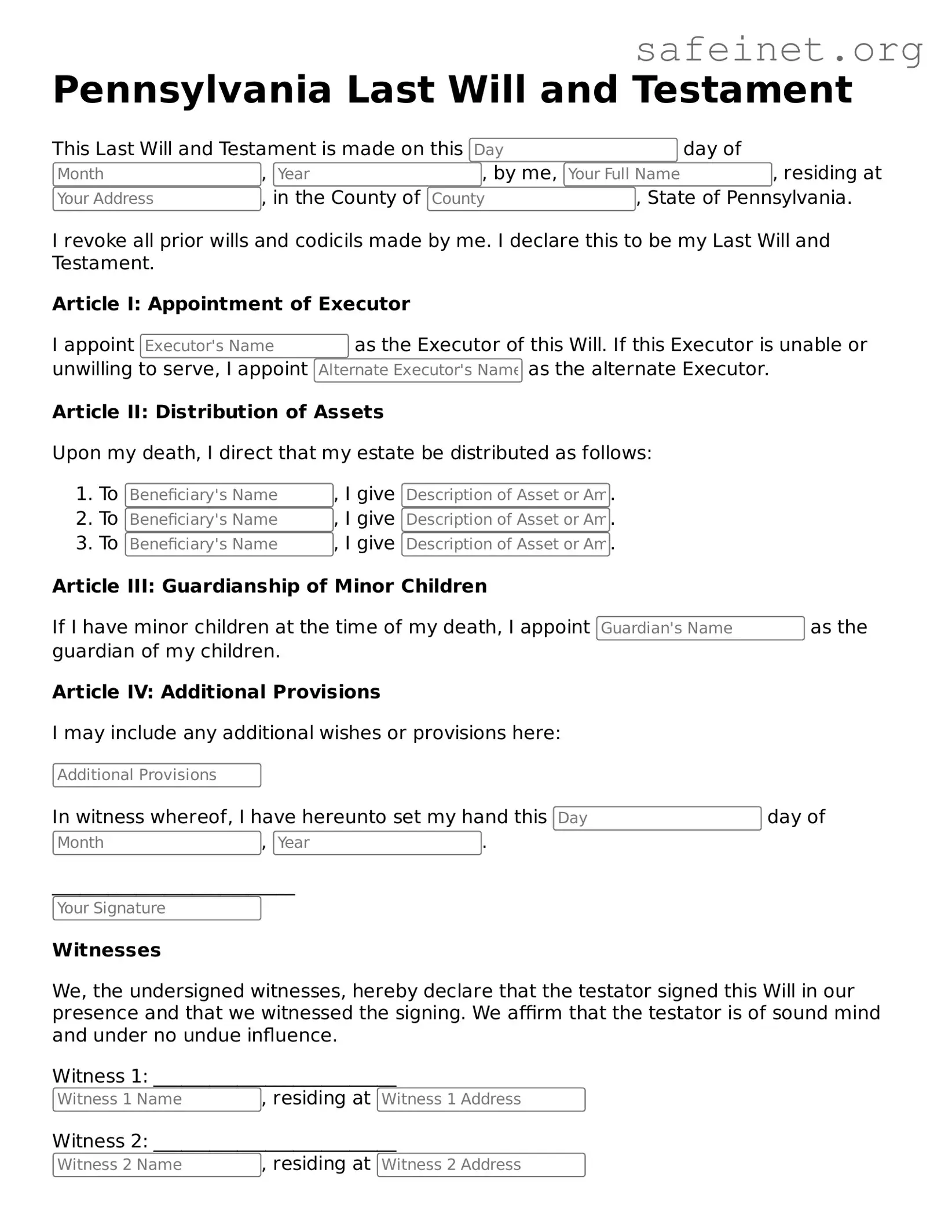
In Pennsylvania, the Last Will and Testament form serves as a crucial document that outlines an individual's final wishes regarding the distribution of their assets upon passing. This legal instrument not only designates beneficiaries who will inherit property but also appoints an executor responsible for managing the estate and ensuring that the terms of the will are carried out. It is essential for individuals to clearly articulate their intentions, as ambiguity can lead to disputes among heirs. Furthermore, the form typically requires the testator's signature and the signatures of witnesses, underscoring the importance of adhering to specific legal formalities to ensure its validity. In addition to asset distribution, the will may also address guardianship for minor children, providing peace of mind to parents regarding their children's future. Understanding the nuances of this form is vital for anyone looking to secure their legacy and ensure their wishes are honored after they are gone.
Pennsylvania Last Will and Testament
This Last Will and Testament is made on this day of , , by me, , residing at , in the County of , State of Pennsylvania.
I revoke all prior wills and codicils made by me. I declare this to be my Last Will and Testament.
Article I: Appointment of Executor
I appoint as the Executor of this Will. If this Executor is unable or unwilling to serve, I appoint as the alternate Executor.
Article II: Distribution of Assets
Upon my death, I direct that my estate be distributed as follows:
Article III: Guardianship of Minor Children
If I have minor children at the time of my death, I appoint as the guardian of my children.
Article IV: Additional Provisions
I may include any additional wishes or provisions here:
In witness whereof, I have hereunto set my hand this day of , .
__________________________
Witnesses
We, the undersigned witnesses, hereby declare that the testator signed this Will in our presence and that we witnessed the signing. We affirm that the testator is of sound mind and under no undue influence.
Witness 1: __________________________
, residing at
Witness 2: __________________________
, residing at
| Fact Name | Description |
|---|---|
| Governing Law | The Pennsylvania Last Will and Testament is governed by the Pennsylvania Probate, Estates and Fiduciaries Code. |
| Age Requirement | In Pennsylvania, you must be at least 18 years old to create a valid will. |
| Witness Requirement | Two witnesses are required to sign the will, affirming that they witnessed the testator sign the document. |
| Revocation | A will can be revoked by creating a new will or by physically destroying the original document. |
| Holographic Wills | Pennsylvania recognizes holographic wills, which are handwritten and do not require witnesses if signed by the testator. |
| Self-Proving Wills | A self-proving will includes a notarized affidavit from the witnesses, making the probate process easier. |
| Testator's Intent | The will must clearly express the testator's intent regarding the distribution of their assets after death. |
| Executor Appointment | The testator can appoint an executor in the will to manage the estate and ensure the terms are carried out. |
| Beneficiary Designation | Beneficiaries can be individuals or organizations, and they should be clearly identified in the will. |
| Filing Requirements | While a will does not need to be filed until the testator's death, it is advisable to keep it in a safe place. |
Once you have the Pennsylvania Last Will and Testament form, you are ready to begin the process of completing it. This is an important step in ensuring your wishes are clearly stated and legally recognized. Follow the steps below carefully to fill out the form correctly.
After completing the form, ensure it is stored in a safe place. Consider discussing your will with your executor and beneficiaries to avoid any confusion in the future.
What is a Last Will and Testament in Pennsylvania?
A Last Will and Testament is a legal document that outlines how a person wishes to distribute their assets after their death. In Pennsylvania, this document allows individuals to specify who will inherit their property, name guardians for minor children, and designate an executor to manage their estate. Creating a will ensures that your wishes are respected and can help avoid disputes among family members during a difficult time.
Who can create a Last Will and Testament in Pennsylvania?
In Pennsylvania, any individual who is at least 18 years old and of sound mind can create a Last Will and Testament. This means you should be able to understand the nature of the document and the implications of your decisions. It's important to ensure that the will reflects your true intentions and is free from undue influence.
What are the requirements for a valid will in Pennsylvania?
To be considered valid in Pennsylvania, a Last Will and Testament must be in writing and signed by the testator, the person making the will. Additionally, it should be witnessed by at least two individuals who are present at the same time. These witnesses must also sign the will, affirming that they observed the testator sign it. Following these requirements helps ensure that the will is legally enforceable.
Can I change or revoke my will in Pennsylvania?
Yes, you can change or revoke your Last Will and Testament at any time while you are alive and of sound mind. To make changes, you can create a new will that explicitly revokes the previous one or add a codicil, which is an amendment to the existing will. It is crucial to follow the same formalities for signing and witnessing as required for the original will to ensure that the changes are valid.
Failing to properly identify the testator. It is crucial to clearly state the full name and address of the person making the will. Omitting this information can lead to confusion and potential legal challenges.
Not signing the will in the presence of witnesses. Pennsylvania law requires that the will be signed by the testator in front of at least two witnesses. If this step is overlooked, the will may not be considered valid.
Using outdated forms or templates. Laws can change, and using an old version of the will form may result in non-compliance with current legal standards. Always ensure the form is the latest version.
Failing to include specific bequests. People often forget to specify particular items or amounts of money they wish to leave to beneficiaries. This can lead to disputes among heirs.
Neglecting to update the will after major life events. Changes such as marriage, divorce, or the birth of children should prompt a review and possible revision of the will to reflect new circumstances.
Overlooking the importance of a self-proving affidavit. Including this affidavit can simplify the probate process by confirming the validity of the will without needing to locate witnesses later.
When preparing a Last Will and Testament in Pennsylvania, several other forms and documents may be necessary to ensure that your estate is managed according to your wishes. These documents help clarify your intentions and provide guidance for your loved ones and the courts. Below is a list of commonly used forms that complement a will.
Using these documents in conjunction with your Last Will and Testament can help create a comprehensive estate plan. Each serves a specific purpose and can provide peace of mind for you and your loved ones.
The Pennsylvania Living Will is a document that outlines an individual's preferences regarding medical treatment in the event they become incapacitated. Similar to a Last Will and Testament, it allows individuals to express their wishes, but it specifically focuses on healthcare decisions rather than the distribution of assets. Both documents require the individual to be of sound mind and executed in accordance with state laws to ensure their validity.
A Power of Attorney (POA) is another important legal document. It grants a designated person the authority to make decisions on behalf of someone else, particularly in financial or legal matters. Like a Last Will and Testament, a POA must be executed while the individual is still alive and capable of making decisions. Both documents can be revoked or amended, providing flexibility to the individual in managing their affairs.
The Pennsylvania Advance Directive combines elements of both a Living Will and a Power of Attorney. It allows individuals to specify their healthcare preferences while also designating someone to make medical decisions on their behalf. This document is similar to a Last Will and Testament in that it is a means of expressing personal wishes and ensuring that those wishes are respected when one is unable to communicate them directly.
A Trust is a legal arrangement where one party holds property for the benefit of another. While a Last Will and Testament distributes assets upon death, a Trust can manage and distribute assets both during a person's lifetime and after their death. Both documents serve to control the distribution of assets, but a Trust can offer additional benefits such as avoiding probate and providing ongoing management of assets.
A Codicil is an amendment or addition to an existing Last Will and Testament. It allows an individual to make changes without drafting an entirely new will. Similar to a Last Will, a Codicil must adhere to specific legal requirements to be valid. This document provides a way for individuals to update their wishes regarding asset distribution while maintaining the original framework of their will.
The Pennsylvania Declaration of Guardian for Minor Children is a document that allows parents to designate a guardian for their children in the event of their death or incapacitation. While a Last Will and Testament primarily addresses asset distribution, both documents can include provisions for the care and custody of minor children. This ensures that an individual's wishes regarding guardianship are clearly stated and legally recognized.
The Family Settlement Agreement is a legal document that outlines the terms agreed upon by family members regarding the distribution of an estate. Similar to a Last Will and Testament, it addresses how assets will be divided among heirs. However, this agreement typically occurs after the death of the individual and can help resolve disputes among family members, reflecting the deceased’s wishes as interpreted by the surviving family.
When filling out the Pennsylvania Last Will and Testament form, it’s important to approach the process with care. Here’s a list of things you should and shouldn’t do to ensure your will is valid and accurately reflects your wishes.
When it comes to creating a Last Will and Testament in Pennsylvania, many individuals hold misconceptions that can lead to confusion or complications. Understanding these misconceptions can help ensure that your wishes are clearly articulated and legally binding. Here are nine common misconceptions:
This is not true. Everyone, regardless of their financial status, should have a will to ensure their wishes are honored after their passing. A will helps manage the distribution of personal belongings, regardless of their value.
Many people believe that only those who own significant assets need a will. However, a will can also address personal items, guardianship of children, and other important matters.
Some may think that simply stating their wishes verbally is sufficient. In Pennsylvania, a will must be in writing and signed to be considered valid.
This misconception can lead to frustration. In reality, wills can be amended or revoked at any time, as long as the individual is of sound mind.
While it is true that there are specific requirements for a will to be valid, Pennsylvania does recognize handwritten wills, also known as holographic wills, as long as they meet certain criteria.
While debts do need to be addressed, it is not a simple matter of paying them off before any distribution. The estate's assets may need to be liquidated to settle debts before beneficiaries receive their inheritance.
This is not always the case. While spouses do have certain rights, the specifics can depend on how the will is structured and the presence of any other heirs.
A will can also include provisions for what happens if the individual becomes incapacitated. This can help ensure that their wishes are followed during their lifetime, not just after their passing.
While there may be some costs involved, creating a will can be straightforward and affordable. Many resources, including online templates and legal assistance, can simplify the process.
Addressing these misconceptions can lead to a clearer understanding of the importance of a Last Will and Testament in Pennsylvania. By ensuring that your wishes are documented properly, you can provide peace of mind for yourself and your loved ones.
When filling out and using the Pennsylvania Last Will and Testament form, there are several important points to keep in mind. Understanding these can help ensure that your wishes are honored and that the process goes smoothly for your loved ones.
By keeping these key points in mind, you can create a Last Will and Testament that effectively communicates your wishes and helps ease the process for your loved ones during a difficult time.