In Pennsylvania, families choosing to homeschool their children must navigate specific legal requirements to ensure compliance with state regulations. One of the essential steps in this process is the submission of the Homeschool Letter of Intent form. This form serves as a formal notification to the local school district that parents intend to provide home education for their child or children. It includes key details such as the names and ages of the students, the educational goals for the upcoming year, and the curriculum to be used. Additionally, parents must affirm their commitment to adhere to Pennsylvania’s homeschooling laws, which outline the necessary educational standards and assessment methods. Timely submission of this form is crucial, as it not only establishes the family's intent but also initiates the legal framework within which the homeschooling experience will unfold. Understanding the nuances of this form can significantly ease the transition into homeschooling and ensure a successful educational journey.
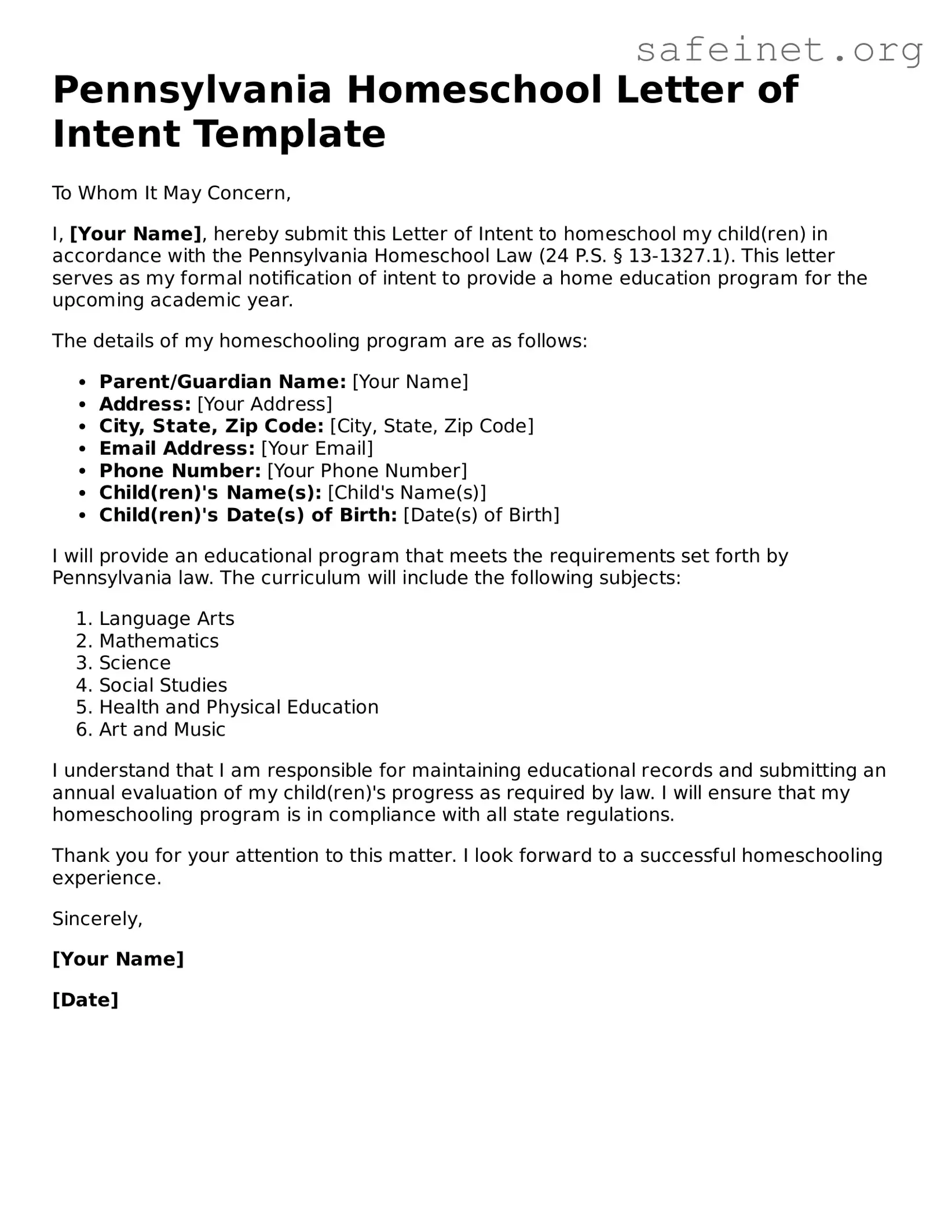
Pennsylvania Homeschool Letter of Intent Template
To Whom It May Concern,
I, [Your Name], hereby submit this Letter of Intent to homeschool my child(ren) in accordance with the Pennsylvania Homeschool Law (24 P.S. § 13-1327.1). This letter serves as my formal notification of intent to provide a home education program for the upcoming academic year.
The details of my homeschooling program are as follows:
I will provide an educational program that meets the requirements set forth by Pennsylvania law. The curriculum will include the following subjects:
I understand that I am responsible for maintaining educational records and submitting an annual evaluation of my child(ren)'s progress as required by law. I will ensure that my homeschooling program is in compliance with all state regulations.
Thank you for your attention to this matter. I look forward to a successful homeschooling experience.
Sincerely,
[Your Name]
[Date]
| Fact Name | Description |
|---|---|
| Purpose | The Pennsylvania Homeschool Letter of Intent form is used to formally notify the local school district of a parent's intention to homeschool their child. |
| Governing Law | The form is governed by the Pennsylvania School Code, specifically under 24 P.S. § 13-1327.1. |
| Submission Deadline | Parents must submit the Letter of Intent at least 14 days before the start of the homeschool program. |
| Required Information | The form requires basic information, including the child's name, age, and the educational program being used. |
| Annual Renewal | Each year, parents must submit a new Letter of Intent to continue homeschooling their child. |
| Record Keeping | Parents are encouraged to keep a copy of the submitted Letter of Intent for their records. |
| Notification of Changes | If there are any changes in the homeschooling status, such as a change in address or educational program, parents must notify the school district. |
| Local School District | The form must be submitted to the local school district where the child resides. |
| Additional Requirements | Along with the Letter of Intent, parents may need to provide evidence of educational materials or curriculum being used. |
Once you have the Pennsylvania Homeschool Letter of Intent form ready, it's time to fill it out accurately. This form is essential for notifying your local school district of your intent to homeschool your child. Follow these steps to ensure that you complete the form correctly.
After completing the form, make sure to keep a copy for your records. You will need to submit the original to your local school district, which will acknowledge your intent to homeschool. This is an important step in ensuring that your homeschooling journey starts off on the right foot.
What is the Pennsylvania Homeschool Letter of Intent form?
The Pennsylvania Homeschool Letter of Intent form is a document that parents or guardians must submit to their local school district when they decide to homeschool their child. This form serves as an official notification to the school district that the parents are choosing to educate their child at home, rather than in a traditional school setting. It is an essential step in the homeschooling process in Pennsylvania, ensuring compliance with state regulations.
Who needs to submit the Letter of Intent?
Any parent or guardian who intends to homeschool their child in Pennsylvania must submit the Letter of Intent. This requirement applies to children of compulsory school age, which is typically from age 6 until age 18. If you have multiple children being homeschooled, you will need to submit a separate Letter of Intent for each child.
When should the Letter of Intent be submitted?
The Letter of Intent should be submitted to the local school district at the beginning of the homeschooling period. If you are starting homeschooling at the beginning of the school year, it is advisable to submit the letter before the school year begins. If you are withdrawing a child from a public or private school to begin homeschooling, the letter should be submitted as soon as possible to avoid any gaps in the child's education.
What information is required on the Letter of Intent?
The Letter of Intent typically requires basic information about the child, including their name, age, and grade level. Additionally, the form may ask for the name and address of the parent or guardian, as well as a statement indicating the intent to homeschool. Some school districts may have specific requirements or additional information that they request, so it is important to check with your local district for any specific guidelines.
Is there a specific format for the Letter of Intent?
What happens after submitting the Letter of Intent?
Once the Letter of Intent is submitted, the local school district will acknowledge receipt of the document. The district may follow up with additional questions or requests for information, but generally, the submission of the letter is sufficient to notify them of your homeschooling plans. Parents should be aware that they are responsible for complying with Pennsylvania's homeschooling laws, including maintaining educational records and submitting an annual evaluation of the child's progress.
Incomplete Information: Many individuals fail to provide all required details. This includes not listing the full name of the child or the parent/guardian.
Incorrect Age or Grade Level: Some people mistakenly indicate the wrong age or grade for their child, which can lead to confusion.
Missing Signatures: A common oversight is neglecting to sign the form. Without a signature, the form cannot be processed.
Failure to Submit on Time: Parents often forget to submit the letter by the required deadline, which can affect their homeschooling status.
Not Including Contact Information: Some forget to provide up-to-date contact information, making it difficult for the school district to reach them.
Ignoring Specific Instructions: Each school district may have different requirements. Ignoring these can result in an incomplete submission.
Submitting Multiple Forms: Occasionally, individuals submit more than one letter of intent for the same child, which can lead to confusion and delays.
When families decide to homeschool in Pennsylvania, they must complete a variety of forms and documents in addition to the Homeschool Letter of Intent. These documents help ensure compliance with state regulations and provide a framework for educational planning. Below is a list of common forms and documents that are often used alongside the Homeschool Letter of Intent.
These documents work together to create a structured and compliant homeschooling experience in Pennsylvania. By preparing and maintaining these forms, families can ensure that they meet state requirements while providing a quality education for their children.
The Pennsylvania Homeschool Letter of Intent form is similar to the Notice of Intent to Homeschool, which is a document often required in various states. This form serves as an official notification to the local school district that parents intend to educate their children at home. Like the Pennsylvania form, it typically requires basic information about the student and the educational plan, ensuring that the authorities are aware of the parents' decision and can provide necessary resources or oversight.
Another comparable document is the Educational Plan, which outlines the curriculum and educational goals for the homeschool year. This plan, much like the Letter of Intent, must be submitted to the local school district. It details the subjects to be taught, the instructional methods, and any assessments that will be used. Both documents aim to ensure that homeschooling adheres to state educational standards and provides a structured learning environment for the child.
The Affidavit of Intent to Homeschool is also similar in purpose and function. This document is often required to affirm that the parent or guardian has the legal right to educate their child at home. It typically includes information about the educational qualifications of the parent, similar to the requirements outlined in the Pennsylvania Homeschool Letter of Intent. This affidavit serves as a formal declaration, reinforcing the legitimacy of the homeschooling process.
The Homeschool Registration Form, found in many states, parallels the Pennsylvania Letter of Intent by requiring parents to register their homeschool with the local education authority. This form often includes details about the student and the educational approach being taken. Like the Letter of Intent, it is a necessary step in ensuring that the home education is recognized and monitored by the state.
The Curriculum Approval Form is another document that shares similarities with the Letter of Intent. This form is often submitted to confirm that the chosen curriculum meets state educational requirements. Just as the Pennsylvania form indicates a commitment to home education, the Curriculum Approval Form ensures that the learning materials are appropriate and align with educational standards.
The Annual Assessment Report is akin to the Pennsylvania Homeschool Letter of Intent in that it serves as a follow-up document. After submitting the Letter of Intent, parents are often required to provide evidence of educational progress. This report typically includes test scores or evaluations, ensuring that the child is meeting academic benchmarks, similar to the oversight intended by the initial Letter of Intent.
The Statement of Compliance is another relevant document. This form is used to confirm that the homeschool program adheres to state laws and regulations. It is similar to the Pennsylvania Letter of Intent in that both documents are designed to ensure that homeschooling practices are in line with educational requirements, providing accountability to the education system.
The Notification of Withdrawal from Public School is also comparable to the Homeschool Letter of Intent. This document is used when a parent decides to remove their child from a public school to begin homeschooling. It serves as a formal notification to the school district, similar to how the Letter of Intent informs authorities of the shift to home education.
The Home Education Program Enrollment Form is another document that serves a similar purpose. This form is used to enroll a child in a home education program, providing necessary details about the student and the educational plan. Like the Pennsylvania Letter of Intent, it is a crucial step in establishing the legitimacy of the homeschooling process within the state’s educational framework.
Lastly, the Homeschooling Agreement is a document that can resemble the Letter of Intent. This agreement may outline the expectations and responsibilities of both the parent and the child in the homeschooling process. It serves to clarify the commitment to home education, much like the Pennsylvania form, ensuring that all parties are on the same page regarding educational goals and methods.
When filling out the Pennsylvania Homeschool Letter of Intent form, it’s important to follow specific guidelines to ensure your submission is successful. Here are seven things to keep in mind:
By following these guidelines, you can ensure a smoother process in your homeschooling journey in Pennsylvania.
Homeschooling in Pennsylvania can be an enriching experience for many families. However, there are several misconceptions surrounding the Homeschool Letter of Intent form that can lead to confusion. Here are seven common misconceptions, along with clarifications to help you better understand the process.
In reality, the form is straightforward and requires basic information about the student and the educational program. Most families find it manageable to complete.
Once you submit the initial Letter of Intent, you do not need to resubmit it annually unless you are changing your educational approach or the student is changing school districts.
This is not true. The form does not require notarization; you simply need to sign it before submitting it to your local school district.
The form does not require you to submit a detailed curriculum plan. However, you should have a general idea of the subjects you will cover.
While the form is a notification, approval is not required. The school district may not deny your intent to homeschool, but they can request additional information.
This is a common misunderstanding. Pennsylvania law does not require parents to have specific educational credentials to homeschool their children.
Even if you have been homeschooling for years, you must submit a new Letter of Intent if you change your educational program or if your child is transitioning to a new school district.
Understanding these misconceptions can help you navigate the homeschooling process in Pennsylvania with greater confidence. Being informed allows you to focus on what truly matters: providing a quality education for your child.
Filling out and using the Pennsylvania Homeschool Letter of Intent form is a crucial step for families choosing to homeschool their children. Below are key takeaways to consider: