The Pennsylvania General Power of Attorney form is a crucial legal document that empowers an individual, known as the agent or attorney-in-fact, to make decisions on behalf of another person, referred to as the principal. This form is particularly important for managing financial matters, healthcare decisions, and other personal affairs when the principal is unable to do so themselves. Key aspects of the form include the scope of authority granted to the agent, which can be broad or limited based on the principal's preferences. It is essential to specify which powers the agent will have, such as handling bank transactions, signing contracts, or making medical decisions. Additionally, the form requires the principal's signature, and it must be notarized to ensure its validity. Understanding the implications of granting such authority is vital, as it can significantly impact the principal's life and assets. The form also allows for the appointment of alternate agents, providing a backup in case the primary agent is unavailable. Overall, the Pennsylvania General Power of Attorney form serves as a powerful tool for individuals seeking to ensure their wishes are respected and their affairs are managed effectively in times of need.
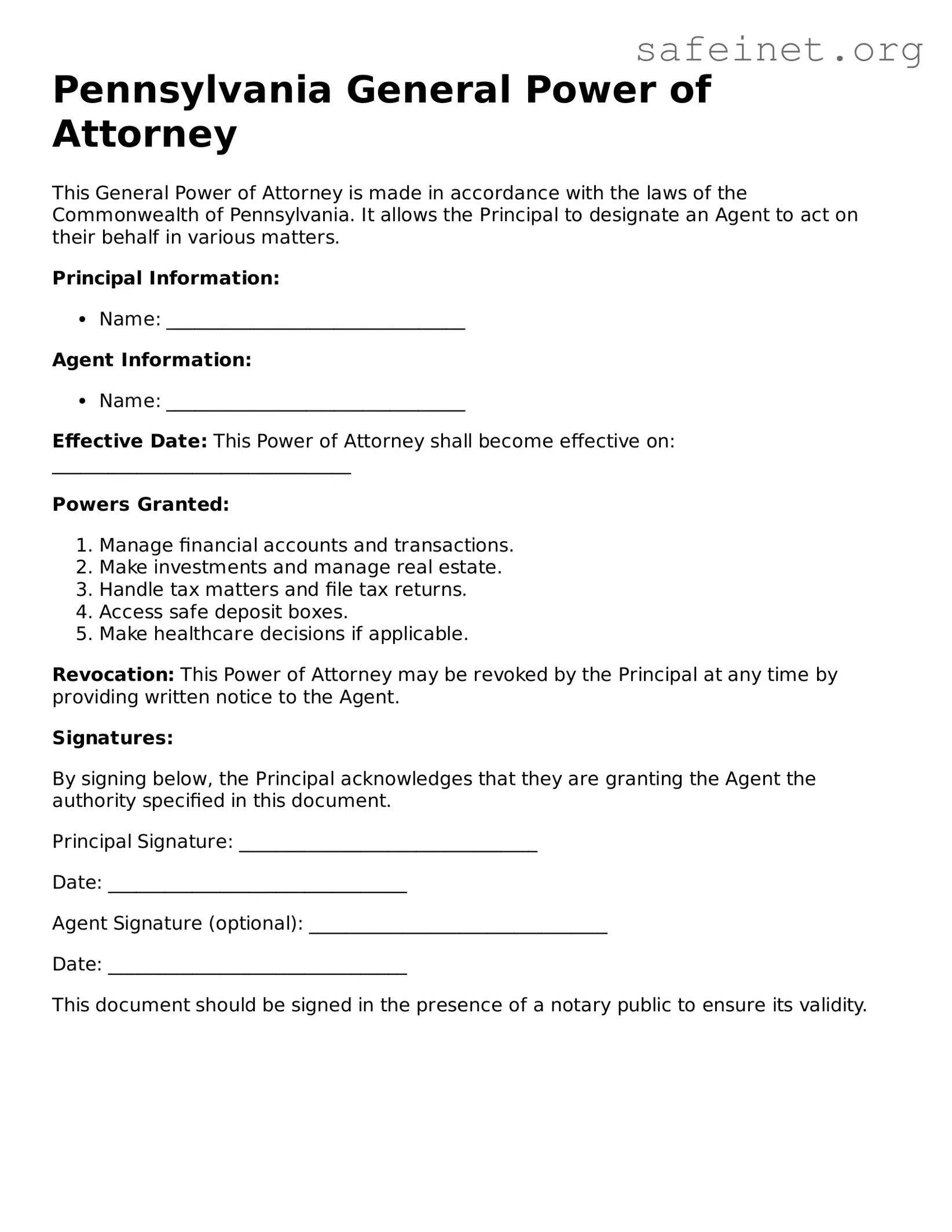
Pennsylvania General Power of Attorney
This General Power of Attorney is made in accordance with the laws of the Commonwealth of Pennsylvania. It allows the Principal to designate an Agent to act on their behalf in various matters.
Principal Information:
Agent Information:
Effective Date: This Power of Attorney shall become effective on: ________________________________
Powers Granted:
Revocation: This Power of Attorney may be revoked by the Principal at any time by providing written notice to the Agent.
Signatures:
By signing below, the Principal acknowledges that they are granting the Agent the authority specified in this document.
Principal Signature: ________________________________
Date: ________________________________
Agent Signature (optional): ________________________________
Date: ________________________________
This document should be signed in the presence of a notary public to ensure its validity.
| Fact Name | Description |
|---|---|
| Definition | The Pennsylvania General Power of Attorney form allows an individual (the principal) to grant authority to another person (the agent) to make decisions on their behalf. |
| Governing Law | This form is governed by the Pennsylvania Consolidated Statutes, specifically Title 20, Chapter 56. |
| Durability | The General Power of Attorney can be made durable, meaning it remains effective even if the principal becomes incapacitated. |
| Revocation | The principal has the right to revoke the General Power of Attorney at any time, as long as they are mentally competent to do so. |
| Agent's Responsibilities | The agent is expected to act in the best interest of the principal, making decisions that align with the principal's wishes and values. |
| Signing Requirements | The form must be signed by the principal in the presence of a notary public, and it may also require witnesses depending on the specific circumstances. |
Filling out the Pennsylvania General Power of Attorney form requires careful attention to detail. After completing the form, it is essential to have it signed and notarized to ensure its validity. Follow these steps to accurately fill out the form.
What is a Pennsylvania General Power of Attorney form?
A Pennsylvania General Power of Attorney form is a legal document that allows one person, known as the principal, to grant another person, known as the agent or attorney-in-fact, the authority to act on their behalf. This authority can encompass a wide range of financial and legal matters, such as managing bank accounts, handling real estate transactions, and making healthcare decisions. It is a versatile tool that can be tailored to fit the specific needs of the principal, ensuring that their interests are represented even if they are unable to make decisions themselves.
What are the key components of a General Power of Attorney in Pennsylvania?
The key components of a General Power of Attorney in Pennsylvania include the identification of the principal and the agent, a detailed description of the powers being granted, and the principal's signature. Additionally, it may require a witness signature and notarization to ensure its validity. It is important for the principal to clearly outline the scope of authority given to the agent, as this will determine what actions the agent can take on their behalf. The form should also specify any limitations or conditions that apply to the agent's authority.
Can a General Power of Attorney be revoked in Pennsylvania?
Yes, a General Power of Attorney can be revoked at any time by the principal, as long as they are mentally competent to do so. To revoke the document, the principal should create a written notice of revocation and communicate it to the agent and any relevant third parties. It is advisable to also destroy any copies of the original General Power of Attorney to prevent confusion. If the principal becomes incapacitated, the power granted in the General Power of Attorney remains in effect unless it is specifically stated to end upon incapacity.
When should someone consider using a General Power of Attorney?
A General Power of Attorney is particularly useful for individuals who want to ensure that their financial and legal matters are managed in their absence or if they become incapacitated. It is often recommended for older adults, individuals undergoing medical treatments, or those who travel frequently. Additionally, it can serve as a proactive measure for anyone who wishes to designate a trusted person to handle their affairs, providing peace of mind that their interests will be protected even when they cannot be present to manage them personally.
Not Choosing the Right Agent: Many people fail to carefully consider who they want to appoint as their agent. This individual will have significant authority over financial and legal matters, so it’s essential to choose someone trustworthy and responsible.
Leaving Sections Blank: Some individuals mistakenly leave certain sections of the form blank, thinking it won’t matter. However, incomplete forms can lead to confusion and may invalidate the document.
Failing to Specify Powers: It’s crucial to clearly outline the powers you are granting to your agent. Vague language can lead to misunderstandings about what your agent can or cannot do on your behalf.
Not Signing in Front of a Notary: In Pennsylvania, a General Power of Attorney must be signed in front of a notary public. Neglecting this step can render the document ineffective.
Ignoring Revocation Procedures: If you decide to revoke the power of attorney, some people forget to follow proper procedures. It’s important to formally notify your agent and any institutions that may have a copy of the document.
Not Reviewing Regularly: Life circumstances change, and so do relationships. Failing to review and update your General Power of Attorney regularly can lead to issues if your chosen agent is no longer suitable.
The Pennsylvania General Power of Attorney form is a crucial document that allows one person to act on behalf of another in financial and legal matters. When using this form, several other documents may be needed to ensure that all aspects of the principal's wishes are properly addressed. Below is a list of commonly used forms and documents that often accompany the General Power of Attorney.
Each of these documents plays a vital role in ensuring that the principal's intentions are honored and that their affairs are managed according to their wishes. Properly completing and maintaining these forms can provide peace of mind and clarity in complex situations.
The Pennsylvania General Power of Attorney (POA) form shares similarities with the Durable Power of Attorney. Both documents allow an individual to designate someone else to make decisions on their behalf. The key difference lies in the durability of the authority granted. A Durable Power of Attorney remains effective even if the principal becomes incapacitated, while a standard General Power of Attorney may become invalid in such situations. This makes the Durable Power of Attorney particularly useful for long-term planning, ensuring that your chosen representative can act when you are unable to do so.
Another document that resembles the General Power of Attorney is the Medical Power of Attorney. This form specifically grants authority to someone to make healthcare decisions for you if you are unable to communicate your wishes. While the General POA can cover a wide range of financial and legal matters, the Medical Power of Attorney is focused solely on health-related decisions. Both documents empower an agent to act on your behalf, but they cater to different aspects of your life, emphasizing the importance of having both types of authority in place.
The Living Will is also akin to the General Power of Attorney, though it serves a different purpose. A Living Will outlines your preferences for medical treatment in situations where you are unable to express your wishes, such as terminal illness or incapacitation. While the General Power of Attorney allows someone to make decisions on your behalf, the Living Will provides specific instructions regarding your care. Having both documents ensures that your healthcare preferences are respected while also designating someone to handle other important matters.
Lastly, the Revocable Trust can be compared to the General Power of Attorney in terms of managing assets. A Revocable Trust allows you to place your assets into a trust during your lifetime, which can then be managed by a trustee for your benefit. Like the General Power of Attorney, it enables the management of your financial affairs, but it also provides a mechanism for transferring assets upon your death without going through probate. Both documents facilitate the handling of your financial matters, but they do so in different ways, highlighting the need for comprehensive estate planning.
When filling out the Pennsylvania General Power of Attorney form, it is important to approach the task with care. Here are some essential guidelines to follow:
By following these guidelines, you can ensure that the process is smoother and that your intentions are clearly communicated.
Understanding the Pennsylvania General Power of Attorney form is crucial for those considering its use. However, several misconceptions can lead to confusion. Below is a list of common misunderstandings regarding this form.
Addressing these misconceptions can help individuals make informed decisions about the use of a General Power of Attorney in Pennsylvania.
When considering the Pennsylvania General Power of Attorney form, it's essential to understand its significance and the steps involved in completing it. Here are some key takeaways to keep in mind:
By keeping these points in mind, you can navigate the process of filling out and using the Pennsylvania General Power of Attorney form with confidence.