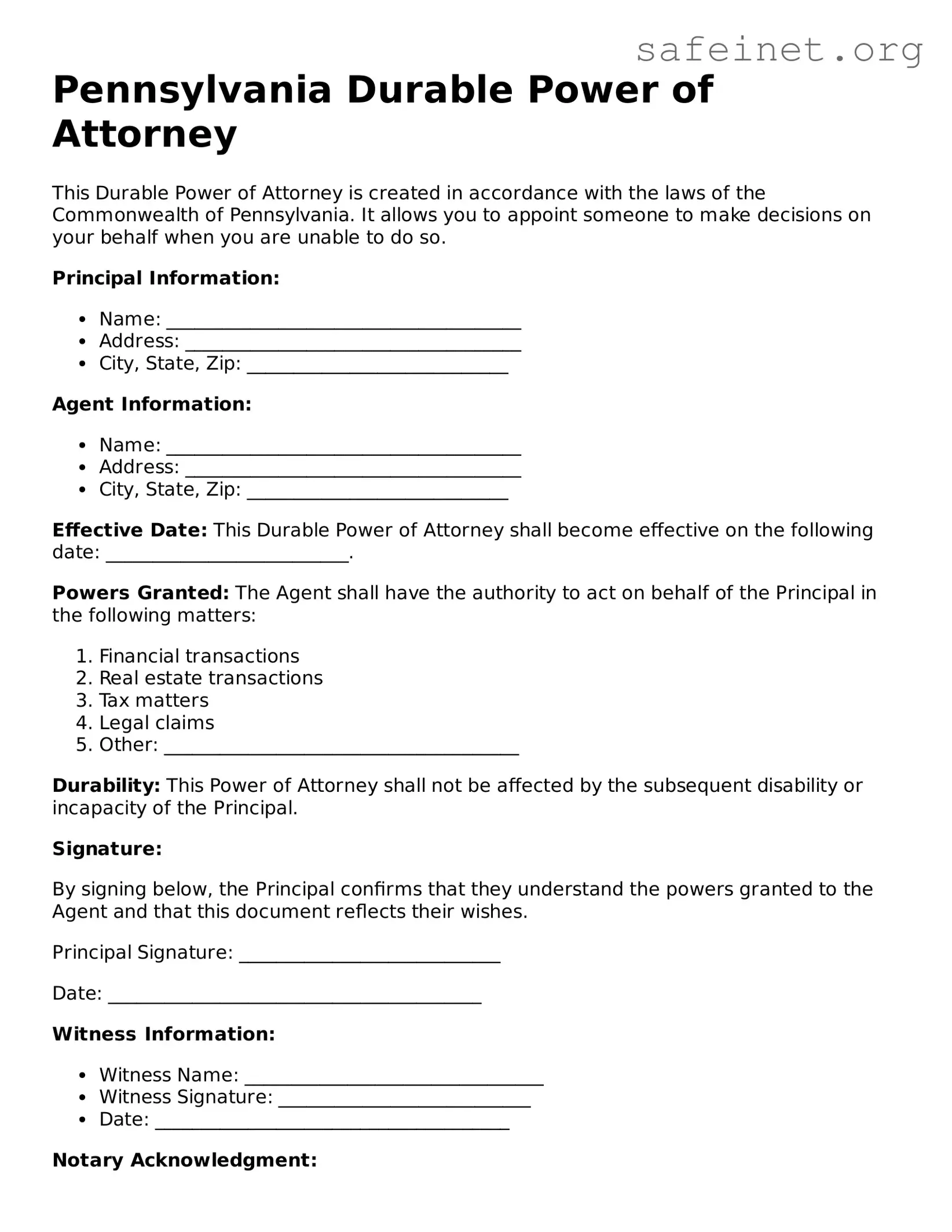
In Pennsylvania, the Durable Power of Attorney (DPOA) form serves as a crucial legal instrument that empowers individuals to designate a trusted person, known as an agent, to make decisions on their behalf regarding financial and healthcare matters. This form is particularly significant because it remains effective even if the principal becomes incapacitated, ensuring that their wishes are respected and their affairs are managed without interruption. The DPOA allows the principal to specify the scope of authority granted to the agent, which can range from handling day-to-day financial transactions to making critical healthcare decisions. Moreover, the form must be executed with specific formalities, including the principal’s signature and the presence of a notary, to ensure its validity. Understanding the nuances of this document is essential for anyone considering its use, as it not only provides peace of mind but also safeguards against potential conflicts and confusion during challenging times.
Pennsylvania Durable Power of Attorney
This Durable Power of Attorney is created in accordance with the laws of the Commonwealth of Pennsylvania. It allows you to appoint someone to make decisions on your behalf when you are unable to do so.
Principal Information:
Agent Information:
Effective Date: This Durable Power of Attorney shall become effective on the following date: __________________________.
Powers Granted: The Agent shall have the authority to act on behalf of the Principal in the following matters:
Durability: This Power of Attorney shall not be affected by the subsequent disability or incapacity of the Principal.
Signature:
By signing below, the Principal confirms that they understand the powers granted to the Agent and that this document reflects their wishes.
Principal Signature: ____________________________
Date: ________________________________________
Witness Information:
Notary Acknowledgment:
State of Pennsylvania, County of _______________________.
On this _____ day of _______________, 20___, before me, a notary public, personally appeared ______________________, known to me to be the person whose name is subscribed to this instrument, and acknowledged that they executed the same for the purposes therein contained.
Notary Public Signature: ________________________
My Commission Expires: ________________________
| Fact Name | Description |
|---|---|
| Definition | A Pennsylvania Durable Power of Attorney form allows an individual to appoint someone else to make financial and legal decisions on their behalf, even if they become incapacitated. |
| Governing Law | This form is governed by the Pennsylvania Consolidated Statutes, Title 20, Chapter 56. |
| Durability | The "durable" aspect means that the power of attorney remains effective even if the principal becomes mentally incapacitated. |
| Revocation | The principal can revoke the Durable Power of Attorney at any time as long as they are mentally competent to do so. |
Filling out the Pennsylvania Durable Power of Attorney form is an important step in ensuring that your financial and legal affairs are managed according to your wishes. Once you have completed the form, it will need to be signed and possibly notarized to ensure its validity.
What is a Durable Power of Attorney in Pennsylvania?
A Durable Power of Attorney is a legal document that allows you to appoint someone to make decisions on your behalf if you become unable to do so. This could be due to illness, injury, or any other reason that affects your ability to manage your affairs. The term "durable" means that the power of attorney remains in effect even if you become incapacitated.
Who can be appointed as an agent in a Durable Power of Attorney?
You can choose anyone you trust to be your agent, as long as they are at least 18 years old and mentally competent. This could be a family member, friend, or even a professional, such as an attorney. It is important to discuss your decision with the person you choose to ensure they are willing to take on this responsibility.
What powers can I give my agent in the Durable Power of Attorney?
You can grant your agent a wide range of powers, including managing your finances, making healthcare decisions, and handling legal matters. You have the option to specify what powers you want to include or limit. It’s essential to be clear about your wishes to avoid any confusion later on.
How do I create a Durable Power of Attorney in Pennsylvania?
To create a Durable Power of Attorney, you must fill out the appropriate form. This form must be signed by you and notarized. It is recommended to consult with a legal professional to ensure the document meets all legal requirements and accurately reflects your wishes. Once completed, you should provide copies to your agent and any relevant institutions, such as banks or healthcare providers.
Can I revoke a Durable Power of Attorney in Pennsylvania?
Yes, you can revoke a Durable Power of Attorney at any time as long as you are mentally competent. To do this, you should create a written revocation document and notify your agent and any institutions that had a copy of the original Durable Power of Attorney. This ensures that everyone is aware of the change and that your wishes are respected.
Not choosing the right agent: Many individuals fail to select an agent who is trustworthy and capable of managing their financial affairs. It is crucial to choose someone who understands your wishes and can act in your best interest.
Not specifying powers clearly: Some people overlook the importance of detailing the specific powers granted to the agent. Ambiguities can lead to misunderstandings and conflicts down the line.
Failing to sign and date: A common mistake is neglecting to sign and date the document. Without a signature, the form may not be considered valid, rendering it ineffective.
Not having witnesses or notarization: Pennsylvania requires that the Durable Power of Attorney be either witnessed or notarized. Many individuals forget this step, which can invalidate the document.
Ignoring updates: Life circumstances change, and so do relationships. Failing to review and update the Durable Power of Attorney can lead to outdated information or unintended consequences.
Not discussing with the agent: Many people fill out the form without discussing their intentions with the chosen agent. Open communication is essential to ensure that the agent understands their responsibilities and your wishes.
When creating a Pennsylvania Durable Power of Attorney, it's essential to consider additional documents that can complement this important legal tool. These forms help ensure that your wishes are respected and that your affairs are managed according to your preferences in the event of incapacity. Below is a list of commonly used forms and documents that you may want to consider.
Considering these additional documents can provide peace of mind and clarity regarding your wishes. It is advisable to consult with a legal professional to ensure that all forms are properly completed and aligned with your overall estate planning goals. Taking these steps now can save your loved ones from potential difficulties in the future.
The Pennsylvania Durable Power of Attorney (DPOA) form is similar to a General Power of Attorney (GPOA). Both documents allow an individual, known as the principal, to designate another person, called the agent, to act on their behalf. However, the key difference lies in the durability of the authority granted. A GPOA typically becomes ineffective if the principal becomes incapacitated, whereas a DPOA remains valid even if the principal is no longer able to make decisions for themselves. This feature makes the DPOA particularly valuable for long-term planning.
A Medical Power of Attorney (MPOA) is another document that shares similarities with the DPOA. Like the DPOA, the MPOA allows an individual to appoint an agent to make decisions on their behalf. However, the MPOA specifically pertains to healthcare decisions. This document is crucial for ensuring that medical preferences are honored when an individual cannot communicate their wishes due to illness or injury. Both documents require the principal to choose a trusted individual to act in their best interests.
A Health Care Proxy is another document that operates similarly to the DPOA. This document allows an individual to appoint someone to make healthcare decisions on their behalf if they are unable to do so. Like the MPOA, a Health Care Proxy focuses on medical decisions. The primary distinction is that a Health Care Proxy may not include broader financial powers, making it more limited in scope compared to the DPOA.
The Revocable Trust is also comparable to the DPOA in that both documents allow for the management of assets. A Revocable Trust enables an individual to transfer assets into a trust, which can then be managed by a trustee. This arrangement can help avoid probate and provide for seamless management of assets in the event of incapacity. While the DPOA grants authority to an agent to manage assets, a Revocable Trust does so through a legal entity, providing a different structure for asset management.
The Advance Directive combines elements of both the Living Will and the MPOA. It allows individuals to express their wishes regarding medical treatment and appoint an agent to make healthcare decisions. This document is comprehensive, ensuring that both specific treatment preferences and decision-making authority are clearly outlined. The Advance Directive serves as a crucial tool for individuals to communicate their healthcare wishes effectively.
The Guardianship Petition is another relevant document. While not directly similar to the DPOA, it addresses the need for decision-making authority when an individual becomes incapacitated. A Guardianship Petition is filed in court to appoint a guardian for someone who cannot manage their own affairs. This process can be more complex and time-consuming than establishing a DPOA, which allows individuals to choose their own agents without court intervention.
The Special Power of Attorney (SPOA) is also similar to the DPOA but with a narrower focus. An SPOA grants specific powers to an agent for particular transactions or decisions, such as selling a property or managing a bank account. Unlike the DPOA, which provides broad authority, the SPOA is limited to the tasks explicitly outlined in the document. This specificity can be beneficial for individuals who want to restrict the powers granted to their agents.
Finally, the Financial Power of Attorney (FPOA) is closely related to the DPOA, as both documents enable an agent to manage financial matters. The FPOA specifically focuses on financial transactions, such as managing bank accounts, paying bills, and handling investments. While the DPOA can encompass both financial and healthcare decisions, the FPOA is dedicated solely to financial affairs, making it a useful tool for individuals who want to separate these responsibilities.
When filling out the Pennsylvania Durable Power of Attorney form, it's important to be mindful of certain practices. Here’s a list of things you should and shouldn’t do:
Understanding the Pennsylvania Durable Power of Attorney (DPOA) form is crucial for anyone considering this important legal document. However, several misconceptions can cloud the true nature and purpose of a DPOA. Here are ten common misunderstandings:
By dispelling these misconceptions, individuals can make more informed decisions regarding their Durable Power of Attorney and ensure their wishes are respected in times of need.
When filling out and using the Pennsylvania Durable Power of Attorney form, consider the following key takeaways: