In Pennsylvania, the Do Not Resuscitate (DNR) Order form plays a crucial role in ensuring that individuals can make their own choices about medical treatment at the end of life. This form allows patients to express their wishes regarding resuscitation efforts, specifically in situations where their heart or breathing stops. It is important for patients to understand that the DNR Order must be completed and signed by a physician, ensuring that medical staff are aware of the patient’s preferences. The form is often accompanied by a discussion between the patient, their family, and healthcare providers to clarify the implications of such a decision. Furthermore, the DNR Order must be clearly visible and accessible to emergency responders and medical personnel. By having this form in place, individuals can maintain control over their medical care, aligning treatment with their values and desires, particularly during critical moments when decisions must be made quickly.
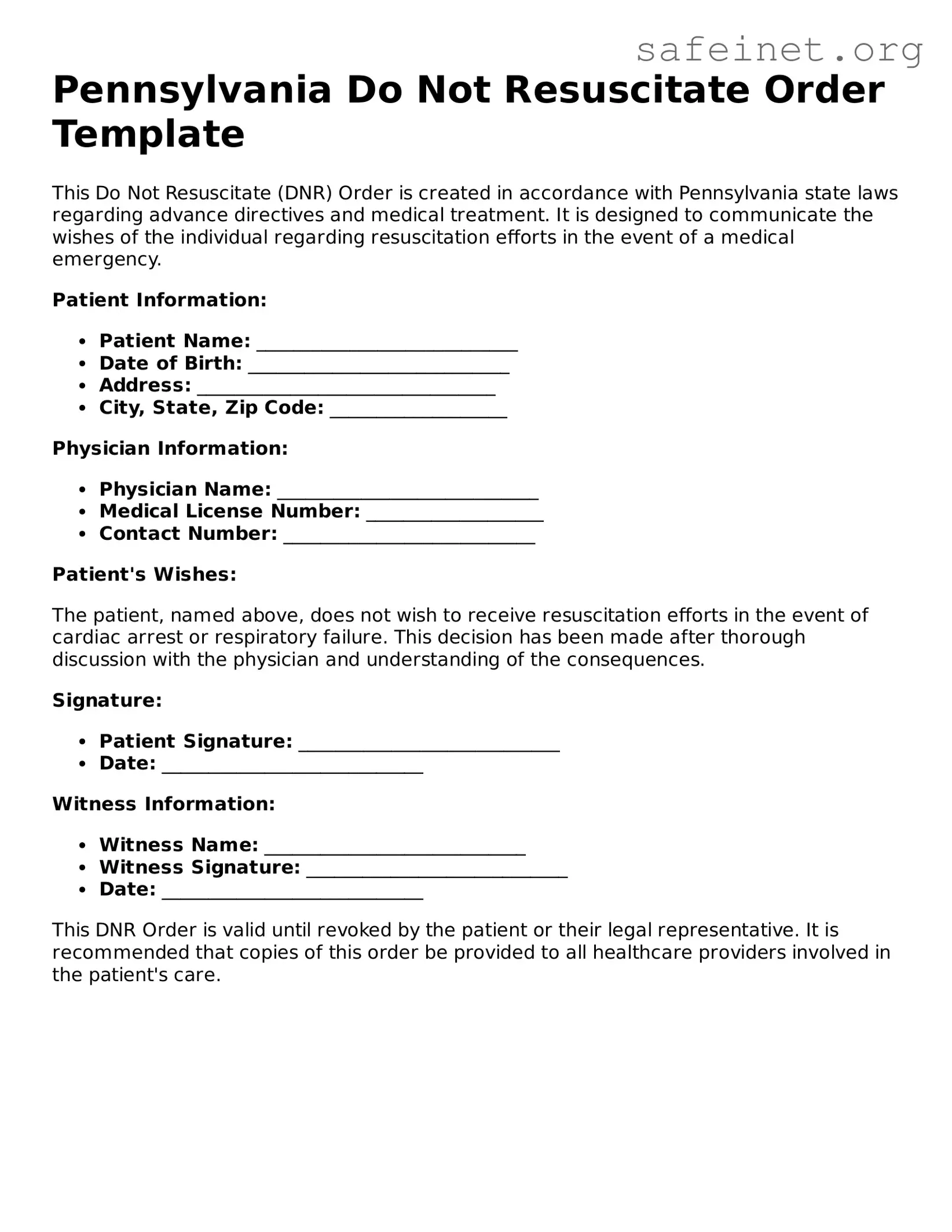
Pennsylvania Do Not Resuscitate Order Template
This Do Not Resuscitate (DNR) Order is created in accordance with Pennsylvania state laws regarding advance directives and medical treatment. It is designed to communicate the wishes of the individual regarding resuscitation efforts in the event of a medical emergency.
Patient Information:
Physician Information:
Patient's Wishes:
The patient, named above, does not wish to receive resuscitation efforts in the event of cardiac arrest or respiratory failure. This decision has been made after thorough discussion with the physician and understanding of the consequences.
Signature:
Witness Information:
This DNR Order is valid until revoked by the patient or their legal representative. It is recommended that copies of this order be provided to all healthcare providers involved in the patient's care.
| Fact Name | Description |
|---|---|
| Governing Law | The Pennsylvania Do Not Resuscitate (DNR) Order is governed by the Pennsylvania Consolidated Statutes, Title 20, Chapter 54. |
| Purpose | The DNR Order allows individuals to refuse resuscitation efforts in case of cardiac or respiratory arrest. |
| Eligibility | Any adult with decision-making capacity can complete a DNR Order, or a parent or guardian can do so for a minor. |
| Form Requirements | The DNR Order must be signed by the patient or their representative and a physician. |
| Revocation | A DNR Order can be revoked at any time by the patient or their legal representative. |
| Distribution | It is important to distribute copies of the DNR Order to healthcare providers and keep one in a visible location. |
Filling out the Pennsylvania Do Not Resuscitate Order form is an important step for individuals who wish to communicate their preferences regarding medical treatment in emergency situations. This process involves a few straightforward steps that ensure your wishes are documented clearly.
Once you have completed the form, it is essential to communicate your decisions with your healthcare provider and loved ones. This will help ensure that your wishes are respected in any medical situation that arises.
What is a Do Not Resuscitate (DNR) Order in Pennsylvania?
A Do Not Resuscitate Order is a legal document that allows an individual to refuse cardiopulmonary resuscitation (CPR) in the event of a medical emergency. In Pennsylvania, this order is typically used by individuals who have a serious medical condition and wish to avoid aggressive life-saving measures that may not align with their healthcare goals or personal wishes.
Who can initiate a DNR Order in Pennsylvania?
In Pennsylvania, a DNR Order can be initiated by a patient who is capable of making their own medical decisions. If the patient is unable to make decisions, a legally authorized representative, such as a family member or designated healthcare proxy, may initiate the order on their behalf.
What are the requirements for a valid DNR Order in Pennsylvania?
For a DNR Order to be valid in Pennsylvania, it must be signed by a physician and include specific information such as the patient's name, the physician's name, and the date the order was signed. Additionally, the patient or their representative must have consented to the order. It is also important for the order to be clearly documented in the patient's medical record.
How is a DNR Order implemented in a medical setting?
When a DNR Order is in place, medical personnel are required to follow the order in emergency situations. This means that if a patient experiences cardiac arrest or respiratory failure, healthcare providers will not perform CPR or other resuscitative measures. Medical staff should have access to the DNR Order to ensure compliance with the patient’s wishes.
Can a DNR Order be revoked or changed?
Yes, a DNR Order can be revoked or changed at any time by the patient or their authorized representative. To revoke the order, the individual should communicate their decision clearly to their healthcare providers. It is advisable to document the revocation in writing to avoid any confusion in medical settings.
Is a DNR Order the same as a living will?
No, a DNR Order is not the same as a living will. A living will outlines an individual’s wishes regarding medical treatment in the event they become unable to communicate their preferences. While a DNR specifically addresses resuscitation efforts, a living will may cover a broader range of medical interventions and end-of-life care decisions.
Where can individuals obtain a DNR Order form in Pennsylvania?
Individuals can obtain a DNR Order form from various sources, including hospitals, healthcare providers, and online resources from the Pennsylvania Department of Health. It is important to ensure that the form used complies with Pennsylvania law and is properly filled out and signed.
What should individuals discuss with their healthcare providers regarding a DNR Order?
Individuals should have open discussions with their healthcare providers about their health status, prognosis, and personal values regarding end-of-life care. It is essential to understand the implications of a DNR Order and how it aligns with one’s healthcare goals. Healthcare providers can offer guidance and answer questions to help individuals make informed decisions.
Failing to properly complete all required sections of the form. Each section must be filled out clearly to ensure the document is valid.
Not signing the form. The patient or their authorized representative must sign the document for it to be effective.
Using outdated versions of the form. Always ensure you are using the most current version of the Pennsylvania Do Not Resuscitate Order form.
Overlooking the need for a witness signature. Some versions of the form require a witness to sign, which is crucial for validation.
Neglecting to discuss the order with healthcare providers. Communication with medical professionals is essential to ensure everyone understands the patient's wishes.
Not keeping copies of the completed form. It's important to retain copies for personal records and to share with healthcare facilities.
When considering end-of-life decisions, it's essential to have the right documents in place. Alongside the Pennsylvania Do Not Resuscitate (DNR) Order form, several other forms can help ensure that your healthcare wishes are respected. Here’s a look at some of the most common documents that complement a DNR order.
Having these documents in place not only clarifies your wishes but also provides peace of mind for you and your loved ones. It’s always wise to discuss these options with family members and healthcare professionals to ensure everyone is on the same page. Remember, your choices matter, and being prepared can make a significant difference in times of need.
The Pennsylvania Do Not Resuscitate (DNR) Order form shares similarities with an Advance Healthcare Directive. An Advance Healthcare Directive is a legal document that allows individuals to outline their preferences for medical treatment in situations where they cannot communicate their wishes. Like the DNR, this document ensures that a person’s healthcare choices are respected, particularly regarding life-sustaining treatments. Both documents empower individuals to make decisions about their medical care in advance, thereby providing clarity for healthcare providers and loved ones during critical moments.
Another document akin to the Pennsylvania DNR is the Physician Orders for Life-Sustaining Treatment (POLST) form. The POLST is designed for individuals with serious health conditions who want to convey their treatment preferences clearly and succinctly. Similar to the DNR, the POLST form includes specific instructions regarding resuscitation efforts and other medical interventions. Both documents serve as vital tools for ensuring that a person’s wishes are honored, particularly in emergency situations, and they are often recognized by healthcare providers across various settings.
A Living Will is also comparable to the Pennsylvania DNR Order form. A Living Will is a type of advance directive that allows individuals to specify their preferences for end-of-life care, including the refusal of resuscitation and other life-sustaining measures. While the DNR focuses primarily on resuscitation efforts, the Living Will encompasses a broader range of medical decisions, providing a comprehensive view of a person’s wishes regarding treatment at the end of life. Both documents aim to alleviate the burden on family members and healthcare providers by clearly articulating an individual’s desires.
Finally, a Healthcare Power of Attorney (POA) is another document that shares characteristics with the Pennsylvania DNR Order form. A Healthcare POA allows individuals to designate someone to make medical decisions on their behalf if they become incapacitated. While the DNR specifically addresses resuscitation preferences, the Healthcare POA can include instructions about various medical treatments, including those related to end-of-life care. Both documents work together to ensure that a person’s healthcare preferences are respected and upheld, particularly when they are unable to communicate those wishes themselves.
When filling out the Pennsylvania Do Not Resuscitate (DNR) Order form, it is essential to approach the process with care and attention. This document communicates your wishes regarding resuscitation efforts in the event of a medical emergency. Here are some important dos and don'ts to consider:
By following these guidelines, you can ensure that your wishes are clearly communicated and respected in critical situations.
Understanding the Pennsylvania Do Not Resuscitate (DNR) Order form is essential for individuals and families making end-of-life decisions. However, several misconceptions often arise. Here are eight common misconceptions explained.
A DNR means no medical treatment at all. This is not true. A DNR order specifically addresses resuscitation efforts in the event of cardiac arrest. Other medical treatments can still be provided, including pain management and comfort care.
Only terminally ill patients can have a DNR. This misconception overlooks that a DNR can be appropriate for anyone who wishes to avoid resuscitation efforts, regardless of their overall health status.
A DNR is the same as a living will. While both documents relate to end-of-life care, they serve different purposes. A living will outlines a person's wishes regarding medical treatments, while a DNR specifically addresses resuscitation efforts.
You can only get a DNR from a hospital. In Pennsylvania, a DNR order can be completed outside of a hospital setting. Individuals can obtain a DNR form from their healthcare provider or download it from state health department resources.
A DNR is permanent and cannot be changed. This is incorrect. Individuals can revoke or modify a DNR order at any time, as long as they are capable of making decisions about their healthcare.
Family members can make a DNR decision without consent. In Pennsylvania, a DNR order must be signed by the patient or their legally authorized representative. Family members cannot make this decision unilaterally.
Healthcare providers must follow a DNR order in all situations. While healthcare providers are generally obligated to honor a DNR order, there are specific circumstances, such as when the order is unclear or incomplete, where they may need to take additional steps.
Having a DNR means you will receive less care. This is a misconception. A DNR order does not mean that a patient will receive less care; rather, it focuses on the type of care desired in the event of a cardiac arrest.
Clarifying these misconceptions can help individuals and families make informed decisions regarding their healthcare preferences and ensure that their wishes are respected.
Filling out and using the Pennsylvania Do Not Resuscitate (DNR) Order form requires careful consideration and understanding of its implications. Here are key takeaways to keep in mind:
Understanding these points can help ensure that your healthcare preferences are respected in critical situations.