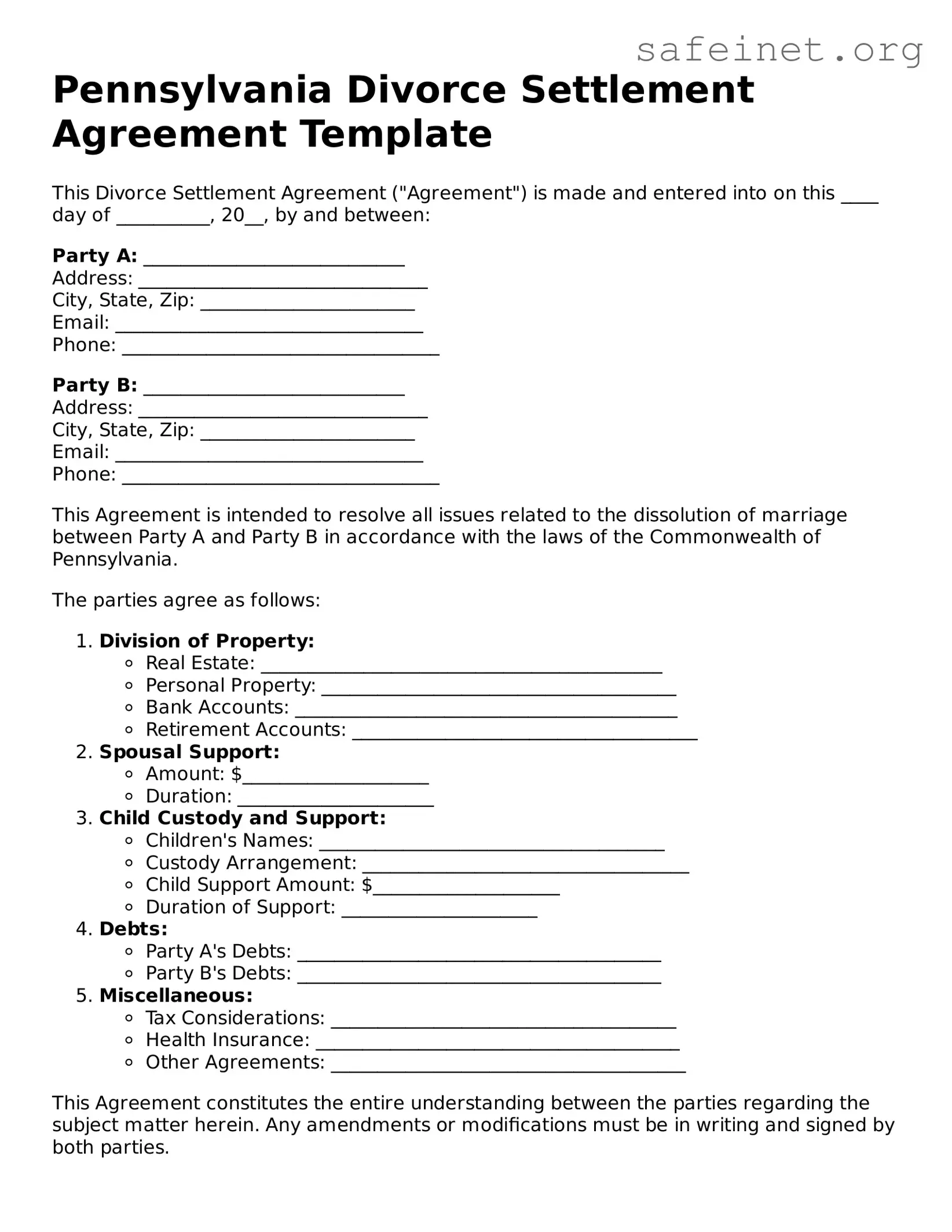
When navigating the complexities of divorce in Pennsylvania, one of the most critical documents that couples must address is the Divorce Settlement Agreement form. This form serves as a comprehensive outline of the terms agreed upon by both parties, covering essential aspects such as the division of marital property, spousal support, and child custody arrangements. Each section of the agreement aims to provide clarity and fairness, ensuring that both individuals understand their rights and responsibilities moving forward. The form also addresses issues related to child support, detailing the financial obligations of each parent to ensure the well-being of their children. By formalizing these agreements in writing, the Divorce Settlement Agreement not only helps to prevent future disputes but also serves as a legally binding document that can be enforced by the court. Understanding the significance of this form is crucial for anyone looking to achieve a smooth transition during a challenging time.
Pennsylvania Divorce Settlement Agreement Template
This Divorce Settlement Agreement ("Agreement") is made and entered into on this ____ day of __________, 20__, by and between:
Party A: ____________________________
Address: _______________________________
City, State, Zip: _______________________
Email: _________________________________
Phone: __________________________________
Party B: ____________________________
Address: _______________________________
City, State, Zip: _______________________
Email: _________________________________
Phone: __________________________________
This Agreement is intended to resolve all issues related to the dissolution of marriage between Party A and Party B in accordance with the laws of the Commonwealth of Pennsylvania.
The parties agree as follows:
This Agreement constitutes the entire understanding between the parties regarding the subject matter herein. Any amendments or modifications must be in writing and signed by both parties.
IN WITNESS WHEREOF, the parties have executed this Divorce Settlement Agreement as of the date first above written.
______________________________
Party A Signature
______________________________
Party B Signature
______________________________
Date
| Fact Name | Description |
|---|---|
| Governing Law | The Pennsylvania Divorce Settlement Agreement is governed by the Pennsylvania Divorce Code, Title 23 of the Pennsylvania Consolidated Statutes. |
| Purpose | This form outlines the terms of the divorce settlement between spouses, addressing issues such as property division, spousal support, and child custody. |
| Mutual Agreement | Both parties must agree to the terms outlined in the settlement for the document to be valid and enforceable. |
| Filing Requirement | The completed agreement must be filed with the court as part of the divorce proceedings to finalize the divorce. |
| Legal Review | It is advisable for both parties to seek legal counsel before signing the agreement to ensure that their rights are protected. |
After obtaining the Pennsylvania Divorce Settlement Agreement form, you will need to complete it accurately to ensure a smooth divorce process. This form outlines the terms of your divorce, including asset division, child custody, and support arrangements. Follow the steps below to fill out the form correctly.
Once you have filled out the form, review it carefully to ensure all information is accurate and complete. You may then proceed with filing the form with the appropriate court as part of your divorce proceedings.
What is a Divorce Settlement Agreement in Pennsylvania?
A Divorce Settlement Agreement is a legal document that outlines the terms of a divorce between two parties. It addresses issues such as the division of property, alimony, child custody, and child support. This agreement is essential for ensuring both parties understand their rights and obligations after the divorce is finalized.
Who needs to complete a Divorce Settlement Agreement?
Both spouses involved in the divorce should complete the Divorce Settlement Agreement. It is important for both parties to agree on the terms to avoid disputes later. If children are involved, the agreement will also need to address custody and support matters.
How is a Divorce Settlement Agreement created?
The agreement can be drafted by either party or their attorneys. It is important to discuss and negotiate the terms together. Once both parties agree on the terms, the document should be signed and dated. It is advisable to have a lawyer review the agreement to ensure it meets legal standards.
Is a Divorce Settlement Agreement legally binding?
Yes, once signed by both parties and approved by the court, the Divorce Settlement Agreement becomes legally binding. This means that both parties are required to adhere to the terms outlined in the agreement. Failure to comply may result in legal consequences.
What happens if we cannot agree on the terms?
If both parties cannot reach an agreement, they may need to go to court. A judge will then make decisions regarding property division, custody, and support. It is often beneficial to seek mediation before resorting to court, as mediation can help facilitate a resolution without the need for a trial.
Can the terms of the Divorce Settlement Agreement be modified later?
Yes, certain terms can be modified after the agreement is finalized, particularly those related to child support and custody. However, modifications typically require a court approval. It is important to document any changes and follow the proper legal procedures to ensure the modifications are enforceable.
Do I need an attorney to draft a Divorce Settlement Agreement?
While it is not required to have an attorney, it is highly recommended. An attorney can provide valuable guidance, ensure that your rights are protected, and help you understand the legal implications of the agreement. They can also assist in negotiating terms with the other party.
What information is typically included in a Divorce Settlement Agreement?
A Divorce Settlement Agreement generally includes details about the division of assets and debts, alimony arrangements, child custody and visitation schedules, and child support obligations. It may also address health insurance and tax-related matters. Each agreement can vary based on the specific circumstances of the couple.
How long does it take to finalize a Divorce Settlement Agreement?
The time it takes to finalize a Divorce Settlement Agreement can vary widely. It depends on how quickly both parties can negotiate and agree on the terms. If both parties are cooperative, it may take a few weeks. If there are disputes, it may take several months or longer.
Where do I file the Divorce Settlement Agreement?
The Divorce Settlement Agreement should be filed with the court where the divorce is being processed. This is typically the county court in Pennsylvania where one of the spouses resides. After filing, the court will review the agreement, and if approved, it will become part of the official court record.
Incomplete Information: One of the most common mistakes is leaving sections of the form blank. Every part of the form is important, and missing information can lead to delays or complications in the divorce process.
Incorrect Financial Disclosure: Failing to accurately report income, expenses, and assets can cause significant issues. Both parties must provide a clear picture of their financial situation to ensure a fair settlement.
Ignoring Child Custody Guidelines: Many overlook the importance of detailing child custody arrangements. It's crucial to specify custody and visitation schedules to avoid future conflicts.
Not Considering Tax Implications: People often forget to think about how the settlement will affect their taxes. Understanding the tax consequences of asset division can save money in the long run.
Failing to Review State Laws: Each state has different laws regarding divorce settlements. Not being familiar with Pennsylvania's specific requirements can lead to mistakes that could have been easily avoided.
Rushing the Process: Taking the time to thoroughly complete the form is essential. Rushing through can lead to mistakes that might require additional legal action to correct.
Not Seeking Legal Advice: Some individuals attempt to fill out the form without consulting a lawyer. Professional guidance can provide clarity and help avoid common pitfalls.
When navigating the process of divorce in Pennsylvania, several important forms and documents accompany the Divorce Settlement Agreement. Each document serves a specific purpose and can help streamline the proceedings. Below is a list of commonly used forms that may be required or beneficial during this process.
Understanding these documents can significantly ease the divorce process in Pennsylvania. Each form plays a vital role in ensuring that all legal requirements are met and that both parties are treated fairly throughout the proceedings.
The Pennsylvania Divorce Settlement Agreement form shares similarities with the Marital Settlement Agreement, which is commonly used in divorce cases. Both documents outline the terms of the divorce, including asset division, child custody arrangements, and spousal support. They serve to clarify the expectations of both parties, ensuring that the agreed-upon terms are documented and enforceable. While the Pennsylvania version may have specific state requirements, the overall purpose and structure are quite similar.
Another document akin to the Divorce Settlement Agreement is the Separation Agreement. This document is often created when spouses decide to live apart but are not yet ready to file for divorce. Like the Divorce Settlement Agreement, it addresses issues such as property division, child custody, and support obligations. However, the Separation Agreement can serve as a temporary measure, whereas the Divorce Settlement Agreement is final and binding upon the dissolution of marriage.
The Child Custody Agreement also bears resemblance to the Divorce Settlement Agreement, particularly in cases where children are involved. This document focuses specifically on the arrangements for child custody and visitation. While the Divorce Settlement Agreement encompasses broader issues, the Child Custody Agreement zeroes in on the child's best interests, detailing how parenting responsibilities will be shared. Both documents aim to provide clarity and stability for families during and after divorce proceedings.
Similarly, the Property Settlement Agreement is another document that aligns closely with the Divorce Settlement Agreement. This form specifically addresses the division of marital assets and debts. It breaks down how property acquired during the marriage will be divided, ensuring that both parties understand their rights and obligations. While the Divorce Settlement Agreement includes various aspects of divorce, the Property Settlement Agreement focuses solely on financial matters.
The Parenting Plan is also comparable to the Divorce Settlement Agreement, especially regarding child-related issues. This document outlines how parents will share responsibilities and make decisions about their children’s upbringing. It provides a detailed framework for co-parenting, covering aspects such as education, healthcare, and extracurricular activities. Like the Divorce Settlement Agreement, the Parenting Plan seeks to minimize conflict and promote a cooperative relationship between parents post-divorce.
The Spousal Support Agreement is another relevant document that shares characteristics with the Divorce Settlement Agreement. This agreement specifically addresses financial support from one spouse to another after separation or divorce. It outlines the terms of support, including duration and amount, ensuring that both parties have a clear understanding of their financial responsibilities. While the Divorce Settlement Agreement includes spousal support as one of its components, the Spousal Support Agreement hones in on this critical aspect of post-marital finances.
Lastly, the Financial Disclosure Statement bears a strong connection to the Divorce Settlement Agreement. This document requires both parties to disclose their financial information, including income, expenses, assets, and liabilities. Transparency is crucial in divorce proceedings, and this statement helps ensure that both parties are fully informed before entering into a settlement. While the Divorce Settlement Agreement relies on the information provided in the Financial Disclosure Statement, the latter serves as a foundational tool for equitable negotiations.
When filling out the Pennsylvania Divorce Settlement Agreement form, it’s crucial to approach the task with care. Here are some important dos and don'ts to keep in mind:
When navigating the Pennsylvania Divorce Settlement Agreement form, individuals often encounter various misconceptions. Understanding these myths can help clarify the process and ensure that parties are well-informed. Below are six common misconceptions:
By addressing these misconceptions, individuals can approach the divorce process with greater confidence and clarity, ensuring that their rights and interests are adequately represented.
Filling out and using the Pennsylvania Divorce Settlement Agreement form can be a significant step in the divorce process. Understanding the key elements can help ensure a smoother transition for everyone involved. Here are some important takeaways to consider:
Taking the time to understand and properly fill out the Divorce Settlement Agreement can lead to a smoother process and a more positive outcome for all parties involved.