When it comes to transferring property ownership in Pennsylvania, the Deed form plays a crucial role in ensuring that the transaction is legally recognized and binding. This document serves as the official record of the transfer, detailing essential information such as the names of the parties involved, a description of the property, and the terms of the transfer. Understanding the different types of deeds—like warranty deeds, quitclaim deeds, and special purpose deeds—is vital, as each serves a unique purpose and offers varying levels of protection to the buyer. Additionally, the Deed form must be properly executed, which includes signatures from both the grantor and grantee, as well as notarization. Filing the completed deed with the appropriate county office is a necessary step to finalize the transfer and make the ownership change public. Familiarity with these aspects will not only streamline the process but also safeguard your interests in the property transaction.
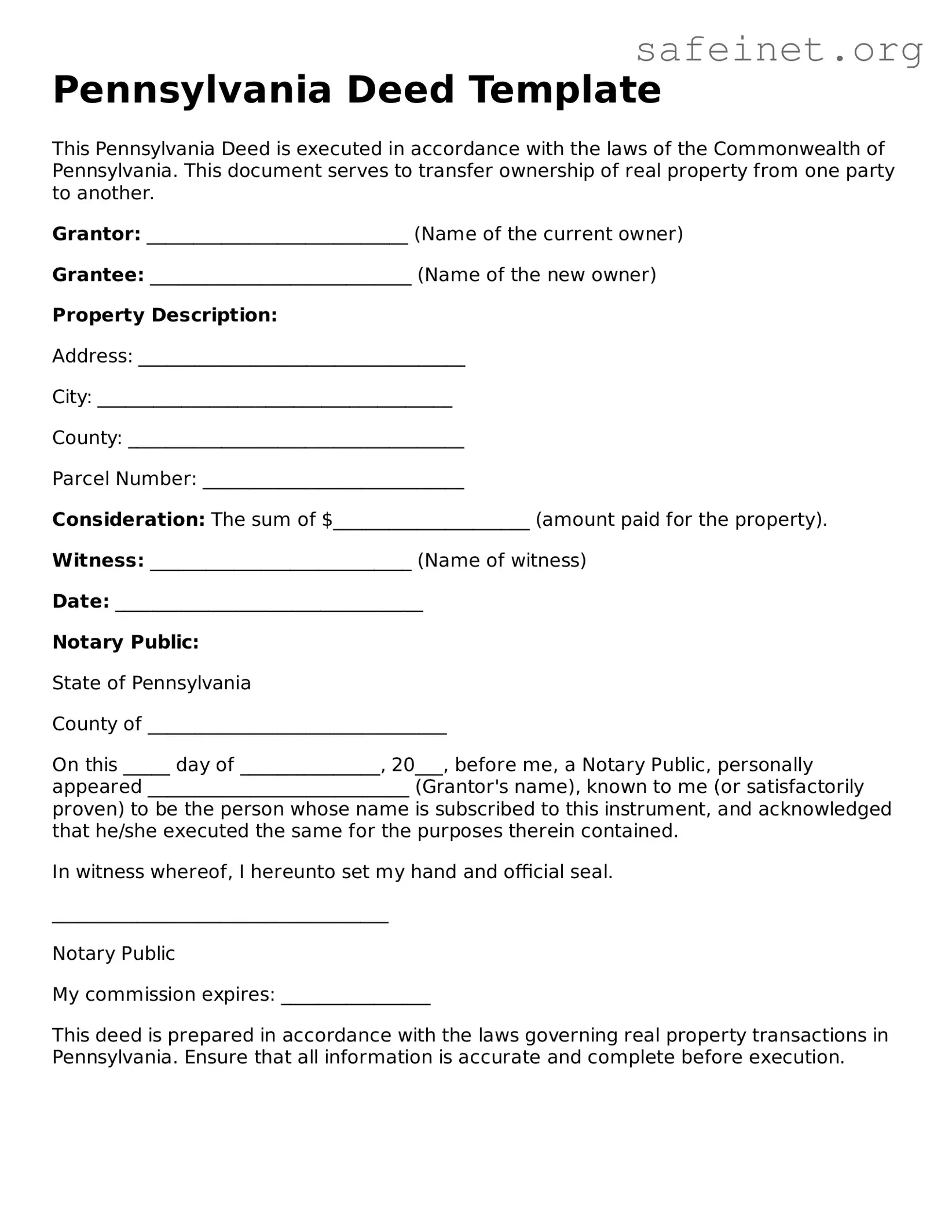
Pennsylvania Deed Template
This Pennsylvania Deed is executed in accordance with the laws of the Commonwealth of Pennsylvania. This document serves to transfer ownership of real property from one party to another.
Grantor: ____________________________ (Name of the current owner)
Grantee: ____________________________ (Name of the new owner)
Property Description:
Address: ___________________________________
City: ______________________________________
County: ____________________________________
Parcel Number: ____________________________
Consideration: The sum of $_____________________ (amount paid for the property).
Witness: ____________________________ (Name of witness)
Date: _________________________________
Notary Public:
State of Pennsylvania
County of ________________________________
On this _____ day of _______________, 20___, before me, a Notary Public, personally appeared ____________________________ (Grantor's name), known to me (or satisfactorily proven) to be the person whose name is subscribed to this instrument, and acknowledged that he/she executed the same for the purposes therein contained.
In witness whereof, I hereunto set my hand and official seal.
____________________________________
Notary Public
My commission expires: ________________
This deed is prepared in accordance with the laws governing real property transactions in Pennsylvania. Ensure that all information is accurate and complete before execution.
| Fact Name | Description |
|---|---|
| Governing Law | The Pennsylvania Deed form is governed by the Pennsylvania Consolidated Statutes, Title 21, Chapter 1. |
| Types of Deeds | Common types of deeds in Pennsylvania include Warranty Deeds, Quitclaim Deeds, and Special Purpose Deeds. |
| Signature Requirement | For a Pennsylvania Deed to be valid, it must be signed by the grantor in the presence of a notary public. |
| Recording | To protect ownership rights, the deed should be recorded in the county where the property is located. |
Filling out a Pennsylvania Deed form is an important step in transferring property ownership. After completing the form, it will need to be signed and notarized before being submitted to the appropriate county office for recording.
What is a Pennsylvania Deed form?
A Pennsylvania Deed form is a legal document used to transfer ownership of real estate from one party to another. It outlines the details of the property being transferred, including its legal description, and identifies the grantor (the seller) and the grantee (the buyer). This form must be properly executed and recorded to ensure the transfer is legally recognized.
What types of deeds are available in Pennsylvania?
In Pennsylvania, there are several types of deeds, including warranty deeds, quitclaim deeds, and special warranty deeds. A warranty deed provides a guarantee that the grantor holds clear title to the property and has the right to sell it. A quitclaim deed transfers whatever interest the grantor has in the property without any guarantees. Special warranty deeds offer limited protection, stating that the grantor only warrants the title against claims arising during their ownership.
Do I need to have the deed notarized?
Yes, in Pennsylvania, a deed must be notarized to be valid. This means that the grantor must sign the deed in the presence of a notary public, who will then affix their seal to the document. Notarization helps to verify the identities of the parties involved and ensures that the deed is executed properly.
How do I record a deed in Pennsylvania?
To record a deed in Pennsylvania, you must take the signed and notarized deed to the county recorder of deeds office where the property is located. There, you will submit the deed along with any required fees. Once recorded, the deed becomes part of the public record, making the transfer of ownership official and providing notice to the public of the change in ownership.
Are there any taxes associated with transferring a deed in Pennsylvania?
Yes, when transferring a deed in Pennsylvania, there may be transfer taxes involved. The state imposes a Realty Transfer Tax, which is typically based on the sale price of the property. Additionally, some local municipalities may impose their own transfer taxes. It’s important to check with your local tax authority to understand the specific taxes that may apply to your transaction.
Can I create my own deed, or should I hire a professional?
While it is possible to create your own deed using templates or forms found online, it is often advisable to consult with a legal professional or a qualified document preparer. They can ensure that the deed is correctly drafted, meets all legal requirements, and is tailored to your specific situation. This can help prevent potential issues or disputes in the future.
Failing to include the correct names of the grantor and grantee. It is essential that the names match exactly as they appear on legal documents.
Not providing a complete legal description of the property. A vague description can lead to confusion and potential legal disputes.
Omitting the date of the transaction. This date is crucial for establishing the timeline of ownership.
Using the wrong type of deed. Different situations may require specific types of deeds, such as a warranty deed or a quitclaim deed.
Neglecting to include the notary's signature and seal. Without this, the deed may not be considered valid.
Not checking for accuracy in property tax identification numbers. Errors here can lead to issues with property taxes and ownership records.
Failing to provide the consideration amount. This refers to the value exchanged for the property and is necessary for legal documentation.
Ignoring local filing requirements. Each county may have specific rules regarding how and where to file the deed.
Not keeping a copy of the filed deed for personal records. This is important for future reference and potential disputes.
Rushing through the process. Taking time to carefully review each section of the deed can prevent costly mistakes.
When transferring property in Pennsylvania, the Deed form is a critical document. However, several other forms and documents are often used in conjunction with the Deed to ensure a smooth transaction. Below is a list of some commonly associated documents.
Understanding these documents is essential for anyone involved in a property transaction in Pennsylvania. Each plays a unique role in ensuring that the transfer of ownership is clear, legal, and fair for all parties involved.
The Pennsylvania Deed form is quite similar to the Quitclaim Deed. A Quitclaim Deed is used to transfer any interest in a property without guaranteeing that the title is clear. This means that if the person transferring the property does not actually own it, the new owner has no recourse. Both documents serve the purpose of transferring property ownership, but a Quitclaim Deed does so without the assurances that come with a warranty deed, making it a more straightforward yet riskier option for the buyer.
Another document that shares similarities with the Pennsylvania Deed is the Warranty Deed. Unlike a Quitclaim Deed, a Warranty Deed provides a guarantee that the seller holds clear title to the property and has the right to sell it. This document protects the buyer from future claims against the property, making it a safer choice. Both documents are used to transfer ownership, but the Warranty Deed offers additional legal protections that can be crucial for buyers.
The Bargain and Sale Deed is also comparable to the Pennsylvania Deed. This type of deed implies that the seller has the right to sell the property but does not guarantee that the title is free from encumbrances. While it is similar to a Warranty Deed in that it transfers ownership, it lacks the warranty of title, making it less secure for the buyer. Thus, both documents facilitate ownership transfer, yet the Bargain and Sale Deed carries more risk for the buyer.
A Special Purpose Deed is another document that resembles the Pennsylvania Deed. This type of deed is often used in specific situations, such as transferring property as part of a divorce settlement or to a trust. While it serves the same fundamental purpose of transferring ownership, the context and circumstances surrounding its use can vary widely. The Special Purpose Deed may include unique stipulations that cater to the specific needs of the parties involved.
The Executor’s Deed is akin to the Pennsylvania Deed in that it is used to transfer property after someone has passed away. This deed is executed by the executor of the estate and conveys the property to the heirs or beneficiaries. While both documents transfer ownership, the Executor’s Deed is specifically tied to the probate process and the distribution of a deceased person’s assets, making its context distinct.
The Trustee’s Deed is another document that functions similarly to the Pennsylvania Deed. This deed is used when a property is held in a trust, and the trustee is responsible for transferring the property to a beneficiary. While both documents facilitate the transfer of property ownership, the Trustee’s Deed involves a fiduciary relationship, where the trustee must act in the best interest of the beneficiaries, adding a layer of responsibility not typically present in standard deeds.
The Bargain and Sale Deed with Covenants is also similar to the Pennsylvania Deed. This type of deed includes certain promises or covenants made by the seller regarding the title. While it facilitates the transfer of ownership like the Pennsylvania Deed, it adds some level of assurance regarding the condition of the title, though it does not offer the full protection of a Warranty Deed. Thus, it strikes a balance between the straightforward transfer of a Quitclaim Deed and the protective nature of a Warranty Deed.
Lastly, the Grant Deed is comparable to the Pennsylvania Deed. This type of deed typically guarantees that the property has not been sold to anyone else and that the seller has not encumbered the property in a way that would affect the buyer’s ownership. While both documents are used to transfer property, the Grant Deed provides some assurances regarding the title, making it a more secure option for buyers compared to a Quitclaim Deed.
When filling out the Pennsylvania Deed form, it is important to follow certain guidelines to ensure accuracy and compliance with state laws. Below is a list of things you should and shouldn't do:
Understanding the Pennsylvania Deed form can be complex, and many people hold misconceptions about its purpose and requirements. Here are nine common misconceptions, along with clarifications to help demystify this important legal document.
Many believe that all deeds serve the same function. However, there are different types of deeds, such as warranty deeds and quitclaim deeds, each serving distinct purposes and offering varying levels of protection to the buyer.
Some think that recording a deed is optional. In reality, while a deed can be valid without recording, failing to do so can create problems with property ownership claims in the future.
It is a common misconception that notarization is not required. In Pennsylvania, a deed must be signed in front of a notary public to be legally valid.
While it is advisable to consult an attorney, especially for complex transactions, individuals can prepare a deed themselves as long as they follow the proper guidelines and requirements.
Some people believe that simply having a deed means ownership is automatically transferred. In fact, the transfer of ownership is effective only when the deed is delivered and accepted by the grantee.
Many think deeds are only necessary during a sale. However, deeds can also be used for gifting property, transferring ownership between family members, or even for estate planning purposes.
While it is crucial to include a property description in most deeds, some informal transfers may not require a detailed description, although this is rare and not advisable.
People often believe that a deed is set in stone once signed. However, deeds can be modified or revoked through legal processes, provided the proper steps are followed.
Finally, many think deeds only pertain to real estate. In reality, deeds can also apply to personal property, such as vehicles or valuable items, depending on state laws.
By addressing these misconceptions, individuals can better navigate the complexities of property ownership and ensure their transactions are secure and legally sound.
When filling out and using the Pennsylvania Deed form, keep the following key takeaways in mind: