In Pennsylvania, homeowners facing the threat of foreclosure have an alternative option that can help ease their financial burden: the Deed in Lieu of Foreclosure form. This legal document allows a homeowner to voluntarily transfer ownership of their property to the lender, effectively settling the mortgage debt without the lengthy and often stressful foreclosure process. By opting for this route, homeowners can avoid the negative impacts of foreclosure on their credit score and regain some control over their financial situation. The form outlines essential details, including the property description, the parties involved, and any existing liens on the property. Additionally, it may specify terms such as the release of liability for the remaining mortgage balance, providing a fresh start for those who find themselves in a difficult financial position. Understanding this option and its implications can empower homeowners to make informed decisions during challenging times.
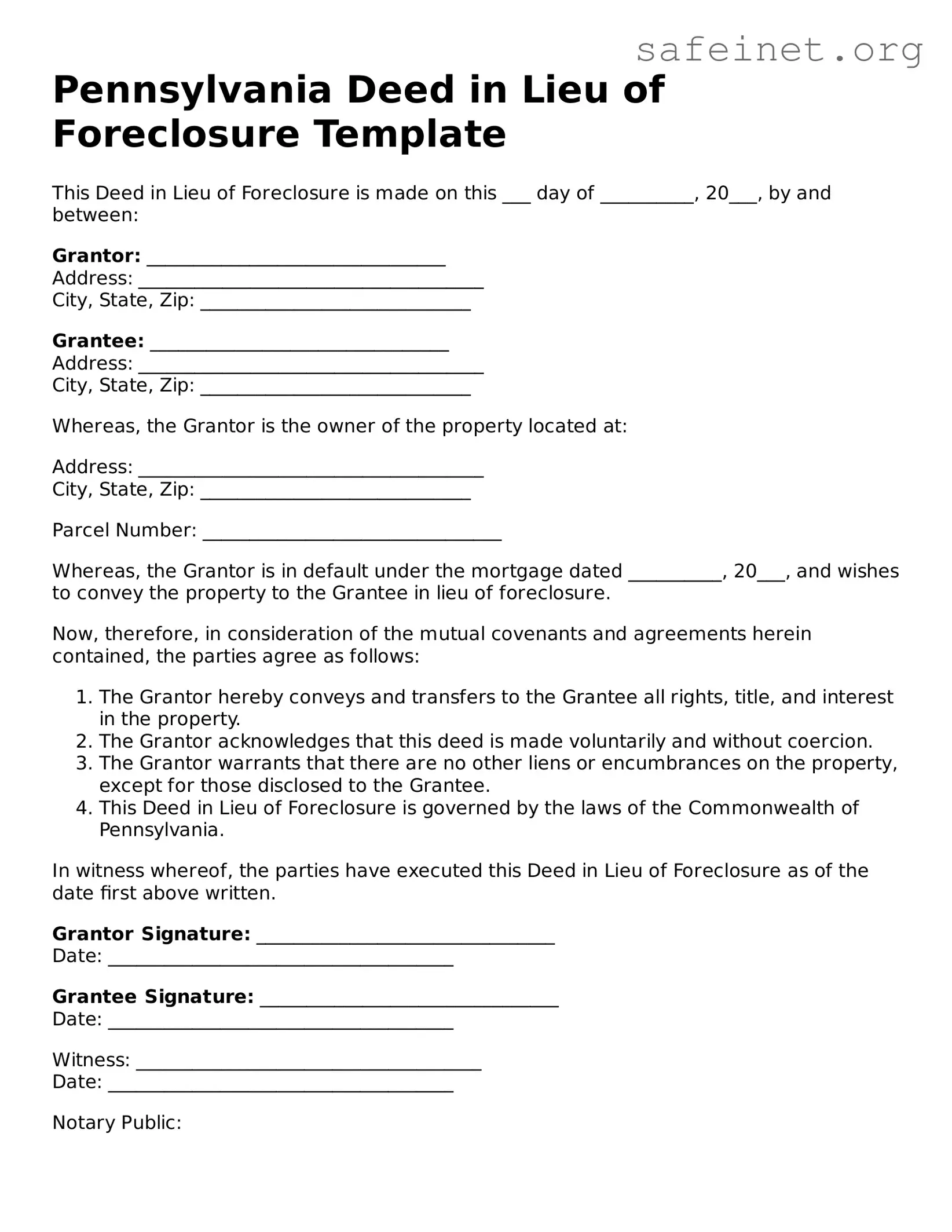
Pennsylvania Deed in Lieu of Foreclosure Template
This Deed in Lieu of Foreclosure is made on this ___ day of __________, 20___, by and between:
Grantor: ________________________________
Address: _____________________________________
City, State, Zip: _____________________________
Grantee: ________________________________
Address: _____________________________________
City, State, Zip: _____________________________
Whereas, the Grantor is the owner of the property located at:
Address: _____________________________________
City, State, Zip: _____________________________
Parcel Number: ________________________________
Whereas, the Grantor is in default under the mortgage dated __________, 20___, and wishes to convey the property to the Grantee in lieu of foreclosure.
Now, therefore, in consideration of the mutual covenants and agreements herein contained, the parties agree as follows:
In witness whereof, the parties have executed this Deed in Lieu of Foreclosure as of the date first above written.
Grantor Signature: ________________________________
Date: _____________________________________
Grantee Signature: ________________________________
Date: _____________________________________
Witness: _____________________________________
Date: _____________________________________
Notary Public:
State of Pennsylvania
County of ________________________________
On this ___ day of __________, 20___, before me, a Notary Public, personally appeared ________________________________, known to me (or satisfactorily proven) to be the person whose name is subscribed to the within instrument, and acknowledged that they executed the same for the purposes therein contained.
In witness whereof, I hereunto set my hand and official seal.
Notary Public Signature: ________________________________
My Commission Expires: ________________________________
| Fact Name | Description |
|---|---|
| Definition | A Deed in Lieu of Foreclosure allows a borrower to transfer property ownership to the lender to avoid foreclosure proceedings. |
| Governing Law | This form is governed by Pennsylvania state law, specifically under the Pennsylvania Consolidated Statutes. |
| Eligibility | Borrowers must be in default on their mortgage to qualify for a Deed in Lieu of Foreclosure. |
| Process | The borrower must formally request the deed transfer and provide necessary documentation to the lender. |
| Benefits | This option can help borrowers avoid the lengthy foreclosure process and potential damage to their credit score. |
| Risks | Borrowers may still face tax implications and potential deficiency judgments depending on the circumstances. |
After completing the Pennsylvania Deed in Lieu of Foreclosure form, the next steps involve ensuring all parties involved understand their rights and responsibilities. It is important to have the document properly executed and recorded with the appropriate county office to finalize the process.
What is a Deed in Lieu of Foreclosure?
A Deed in Lieu of Foreclosure is a legal agreement between a homeowner and a lender. In this arrangement, the homeowner voluntarily transfers the ownership of their property to the lender to avoid the lengthy and costly process of foreclosure. This can be a beneficial option for homeowners who are struggling to make mortgage payments and wish to avoid the negative consequences of foreclosure on their credit history.
Who is eligible for a Deed in Lieu of Foreclosure in Pennsylvania?
Eligibility for a Deed in Lieu of Foreclosure typically depends on the lender's specific policies. Generally, homeowners who are facing financial hardship and are unable to continue making mortgage payments may qualify. It’s important to demonstrate that you have exhausted other options, such as loan modifications or payment plans, before pursuing this route. Additionally, the property must be free of any liens or encumbrances that could complicate the transfer.
What are the benefits of a Deed in Lieu of Foreclosure?
There are several benefits to consider. First, it can help you avoid the lengthy foreclosure process, which can take several months or even years. Second, it allows you to walk away from your mortgage obligation without the severe impact on your credit score that comes with foreclosure. Third, many lenders may be willing to negotiate terms that allow you to remain in the home for a short period post-transfer, providing you with some stability during the transition.
What are the potential drawbacks of a Deed in Lieu of Foreclosure?
While there are advantages, there are also potential drawbacks. One significant concern is that a Deed in Lieu of Foreclosure may still negatively affect your credit score, although typically less so than a foreclosure. Additionally, you may be required to pay taxes on any forgiven debt, depending on your financial situation. Lastly, not all lenders accept Deeds in Lieu, so you may need to negotiate or find a lender willing to work with you.
How does the process work?
The process usually begins with contacting your lender to express your interest in a Deed in Lieu of Foreclosure. After that, you will need to provide documentation of your financial situation. The lender will review your case and may require a formal application. If approved, you will sign the deed, transferring ownership of the property to the lender. The lender may then release you from any remaining mortgage obligations, but it’s crucial to get this in writing.
What documents are needed for a Deed in Lieu of Foreclosure?
You will typically need to provide several documents, including proof of income, a hardship letter explaining your financial situation, and any relevant financial statements. Additionally, you may need to complete a Deed in Lieu application form provided by your lender. It’s important to gather all necessary documentation to streamline the process and increase your chances of approval.
Can I still buy another home after a Deed in Lieu of Foreclosure?
Yes, you can still buy another home after a Deed in Lieu of Foreclosure, but it may take some time. Lenders often require a waiting period before you can qualify for a new mortgage. This period can vary based on the lender's policies and your credit situation. Generally, you may need to wait anywhere from two to four years before applying for a new mortgage, depending on the circumstances.
Is a Deed in Lieu of Foreclosure the same as a short sale?
No, a Deed in Lieu of Foreclosure is not the same as a short sale. In a short sale, the homeowner sells the property for less than the amount owed on the mortgage, and the lender agrees to accept the sale proceeds as full satisfaction of the debt. In contrast, a Deed in Lieu of Foreclosure involves the homeowner transferring the property back to the lender without a sale. Each option has its own implications for credit and financial recovery.
Should I consult with a professional before proceeding?
Yes, it is highly advisable to consult with a financial advisor or a real estate attorney before proceeding with a Deed in Lieu of Foreclosure. They can help you understand the implications of this decision, guide you through the process, and ensure that your rights are protected. Taking informed steps can make a significant difference in your financial future.
Failing to provide accurate property information. Make sure the address and legal description of the property are correct.
Not including all owners on the form. If there are multiple owners, all must sign the deed.
Overlooking required signatures. Each owner must sign in the designated areas.
Neglecting to date the document. Every signature should be dated to validate the agreement.
Using incorrect notary procedures. Ensure that the document is properly notarized, as this is essential for its legal standing.
Not understanding the implications of the deed. It’s crucial to know that this action transfers ownership to the lender.
Failing to keep a copy of the signed deed. Always retain a copy for your records after submission.
Ignoring local laws or requirements. Different counties may have specific rules regarding the deed in lieu of foreclosure.
Rushing through the process. Take your time to review the form and ensure all information is complete and correct.
Not seeking legal advice. Consulting with a legal professional can help avoid costly mistakes.
A Deed in Lieu of Foreclosure is a legal document that allows a homeowner to voluntarily transfer ownership of their property to the lender in order to avoid foreclosure. Along with this form, several other documents may be required to facilitate the process. Below is a list of common forms and documents that are often used in conjunction with the Pennsylvania Deed in Lieu of Foreclosure.
These documents collectively support the Deed in Lieu of Foreclosure process, ensuring that both the borrower and the lender have a clear understanding of their rights and obligations. Proper completion and submission of these forms can facilitate a smoother transition and help avoid further complications in the foreclosure process.
The Pennsylvania Deed in Lieu of Foreclosure form is similar to a mortgage modification agreement. Both documents serve as alternatives to foreclosure, allowing homeowners to retain some level of control over their property. A mortgage modification agreement involves changing the terms of the existing mortgage, such as interest rates or payment schedules, to make it more manageable for the borrower. This process can help prevent foreclosure by allowing the homeowner to continue making payments under more favorable conditions.
Another document that shares similarities is the short sale agreement. In a short sale, the homeowner sells the property for less than the amount owed on the mortgage, with the lender’s approval. Like a deed in lieu, a short sale can help the borrower avoid foreclosure. Both options require the lender's consent and can provide a more favorable outcome for the homeowner than a foreclosure, which can significantly impact their credit score.
The foreclosure settlement agreement also parallels the Deed in Lieu of Foreclosure form. This document is often negotiated between the lender and the borrower to settle the outstanding mortgage debt. It typically involves the borrower agreeing to vacate the property in exchange for a release from further liability. Both documents aim to resolve the mortgage issue without the lengthy process of foreclosure, providing a more immediate resolution for the homeowner.
A loan assumption agreement is another document that can be compared to the Deed in Lieu of Foreclosure. In this scenario, a third party assumes the mortgage obligation from the original borrower. This can relieve the homeowner from their mortgage responsibilities and prevent foreclosure. Similar to a deed in lieu, this process requires lender approval and can be beneficial for all parties involved, including the lender, who may avoid the costs associated with foreclosure.
The bankruptcy filing is also relevant in this context. While it is a more drastic measure, filing for bankruptcy can halt foreclosure proceedings temporarily. Under certain chapters of bankruptcy, homeowners may be able to keep their homes while reorganizing their debts. Both bankruptcy and a deed in lieu of foreclosure can provide a means to address financial distress, though they operate under different legal frameworks and implications.
Another related document is the forbearance agreement. This temporary arrangement allows homeowners to pause or reduce their mortgage payments for a specified period. In exchange, the homeowner agrees to repay the missed payments later. Like a deed in lieu, a forbearance agreement can help prevent foreclosure, allowing borrowers time to improve their financial situation without losing their home.
The real estate purchase agreement can also be likened to the Deed in Lieu of Foreclosure. In this case, a buyer agrees to purchase the property, potentially at a price that satisfies the lender. This agreement can provide a way out for homeowners facing foreclosure while allowing them to sell their property before it goes to auction. Both documents involve negotiations with lenders and can result in a more favorable outcome for the homeowner.
Lastly, the leaseback agreement is similar in that it allows homeowners to sell their property to a buyer while retaining the right to live in the home as a tenant. This arrangement can help homeowners avoid foreclosure while providing them with the flexibility of remaining in their home. Both leaseback and deed in lieu agreements aim to provide solutions for homeowners facing financial difficulties while minimizing the impact on their credit and housing stability.
When filling out the Pennsylvania Deed in Lieu of Foreclosure form, it is crucial to approach the process with care. Here are ten important do's and don'ts to consider:
By following these guidelines, you can help ensure that the process goes smoothly and that all legal requirements are met.
Understanding the Pennsylvania Deed in Lieu of Foreclosure can be challenging. Here are six common misconceptions that often arise regarding this important legal document.
Many people believe that signing a Deed in Lieu of Foreclosure wipes out all debts related to their mortgage. In reality, while it can relieve you of the obligation to repay the mortgage, it may not eliminate other debts, such as second mortgages or liens on the property.
Some assume that a Deed in Lieu of Foreclosure is simply another name for foreclosure. However, they are distinct processes. A foreclosure involves the lender taking possession of the property through a legal process, while a Deed in Lieu allows the homeowner to voluntarily transfer ownership to the lender.
Another misconception is that a Deed in Lieu of Foreclosure has no impact on credit scores. In truth, this action can negatively affect your credit, though it may be less damaging than a full foreclosure.
Not all lenders are willing to accept a Deed in Lieu of Foreclosure. Each lender has its own policies and may require specific conditions to be met before agreeing to this option.
Many believe that a Deed in Lieu of Foreclosure is a fast solution to avoid foreclosure. While it can be quicker than a foreclosure process, it still involves paperwork, negotiations, and sometimes delays.
Some think that signing a Deed in Lieu of Foreclosure frees them from any future liability regarding the property. However, if there are any outstanding obligations or legal issues related to the property, those may still need to be addressed.
Understanding these misconceptions can help you make informed decisions about your options. Always consider consulting with a legal professional to discuss your unique situation.
Filling out and using the Pennsylvania Deed in Lieu of Foreclosure form requires careful consideration and understanding of the process. Below are key takeaways that can help individuals navigate this legal document effectively.