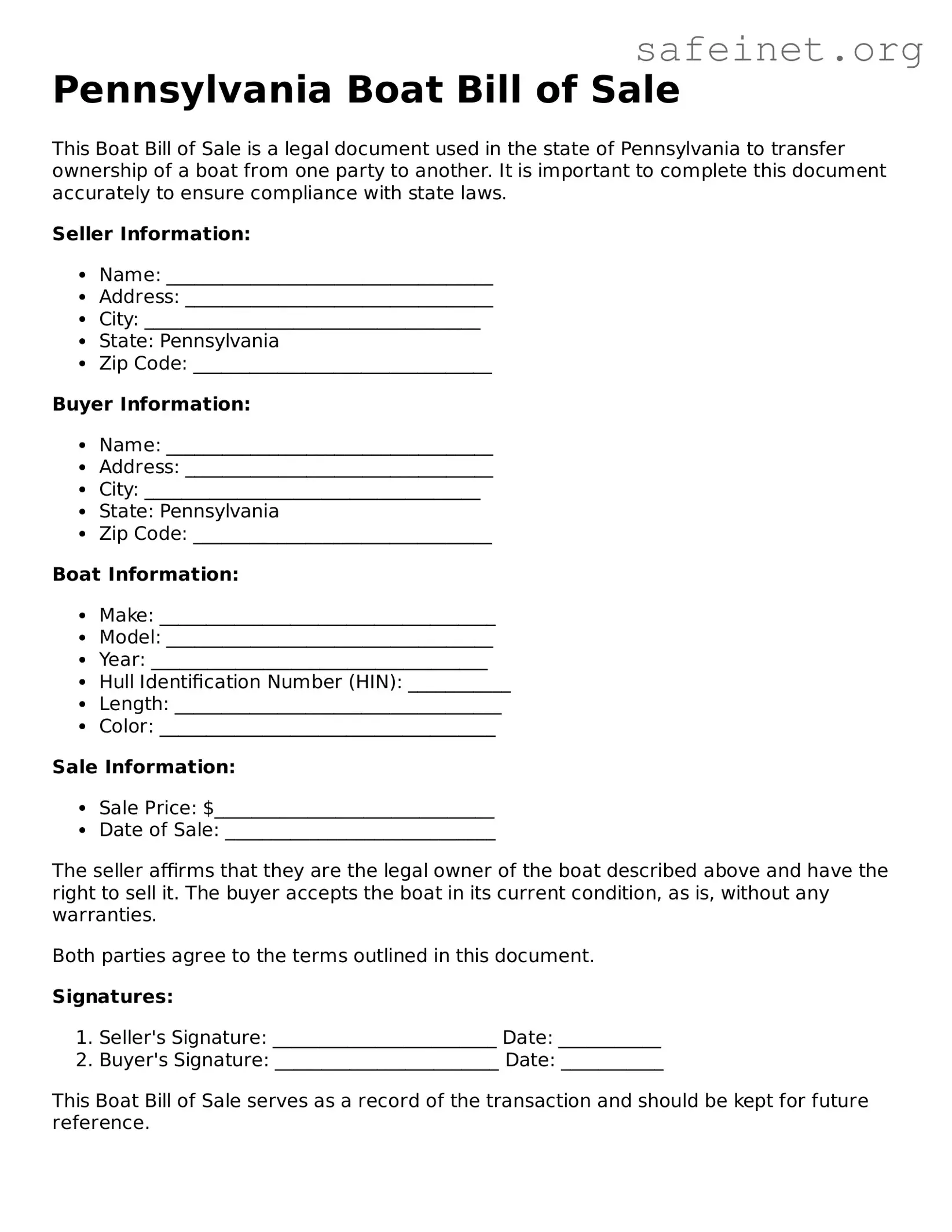
The Pennsylvania Boat Bill of Sale form serves as an essential document for individuals engaged in the buying or selling of a boat within the state. This form provides a clear record of the transaction, outlining key details such as the names and addresses of both the buyer and seller, the boat's description, and the sale price. It also includes information about the boat's hull identification number (HIN), which is crucial for registration purposes. By documenting the transfer of ownership, the Boat Bill of Sale helps protect both parties in the transaction. Additionally, it may serve as proof of ownership for the buyer when registering the boat with the Pennsylvania Fish and Boat Commission. Completing this form accurately is important to ensure compliance with state regulations and to facilitate a smooth transfer process. Overall, the Pennsylvania Boat Bill of Sale is a vital tool for anyone involved in the boating community, ensuring that transactions are conducted fairly and legally.
Pennsylvania Boat Bill of Sale
This Boat Bill of Sale is a legal document used in the state of Pennsylvania to transfer ownership of a boat from one party to another. It is important to complete this document accurately to ensure compliance with state laws.
Seller Information:
Buyer Information:
Boat Information:
Sale Information:
The seller affirms that they are the legal owner of the boat described above and have the right to sell it. The buyer accepts the boat in its current condition, as is, without any warranties.
Both parties agree to the terms outlined in this document.
Signatures:
This Boat Bill of Sale serves as a record of the transaction and should be kept for future reference.
| Fact Name | Description |
|---|---|
| Purpose | The Pennsylvania Boat Bill of Sale form serves as a legal document to transfer ownership of a boat from one party to another. |
| Governing Law | This form is governed by the Pennsylvania Consolidated Statutes Title 30, which pertains to boating and watercraft regulations. |
| Required Information | Essential details include the buyer's and seller's names, addresses, and signatures, as well as the boat's make, model, year, and hull identification number. |
| Notarization | While notarization is not strictly required, having the document notarized can provide additional legal protection and verification. |
| Tax Implications | Sales tax may be applicable based on the sale price of the boat, and it is the buyer's responsibility to pay this tax when registering the boat. |
| Record Keeping | Both the buyer and seller should keep a copy of the Bill of Sale for their records, as it serves as proof of the transaction. |
| Usage | The form is typically used for private sales, but it can also be adapted for sales through dealers or brokers. |
| Transfer of Title | The Bill of Sale is often used in conjunction with the title transfer process, which must be completed at the Pennsylvania Department of Transportation. |
| Online Availability | The Pennsylvania Boat Bill of Sale form can be accessed online, making it convenient for users to obtain and complete the document. |
After obtaining the Pennsylvania Boat Bill of Sale form, you will need to provide specific information to complete it. This form is essential for documenting the sale of a boat in Pennsylvania. Follow the steps below to fill it out correctly.
Once the form is completed, make sure both parties keep a copy for their records. This documentation may be necessary for future reference, such as registration or transfer of ownership.
What is a Pennsylvania Boat Bill of Sale?
A Pennsylvania Boat Bill of Sale is a legal document used to record the sale of a boat from one party to another. This form serves as proof of ownership transfer and includes important details such as the buyer's and seller's names, the boat's make, model, year, and identification number. It is essential for both parties to have a copy of this document for their records.
Is a Boat Bill of Sale required in Pennsylvania?
While a Boat Bill of Sale is not legally required for every transaction, it is highly recommended. Having this document can help protect both the buyer and seller in case of disputes regarding ownership or condition of the boat. Additionally, it may be required when registering the boat with the Pennsylvania Fish and Boat Commission.
What information should be included in the Bill of Sale?
The Bill of Sale should include the following information: the names and addresses of both the buyer and seller, the boat's make, model, year, and hull identification number (HIN), the sale price, and the date of the transaction. Both parties should sign and date the document to validate the sale.
Can I create my own Boat Bill of Sale?
Yes, you can create your own Boat Bill of Sale as long as it includes all the necessary information. However, using a standardized form can ensure that you don’t miss any important details. Many online resources offer templates that comply with Pennsylvania's requirements, making it easier to complete the document correctly.
What should I do after completing the Bill of Sale?
After completing the Bill of Sale, both the buyer and seller should keep a signed copy for their records. If the buyer plans to register the boat, they should present the Bill of Sale to the Pennsylvania Fish and Boat Commission along with any other required documents. This step is crucial for ensuring the boat is legally registered in the new owner's name.
Incomplete Information: Failing to provide all required details can lead to issues. Ensure that the names, addresses, and contact information of both the buyer and seller are fully filled out.
Incorrect Boat Details: Mistakes in the boat's description, such as the make, model, year, or hull identification number, can create confusion. Double-check these details for accuracy.
Omitting Signatures: Both the buyer and seller must sign the document. Neglecting to obtain one or both signatures can invalidate the sale.
Not Including the Sale Price: The bill of sale should clearly state the sale price. Leaving this blank or writing an incorrect amount can lead to disputes later.
Failure to Date the Document: The date of the transaction is crucial. Not dating the bill of sale can lead to complications regarding ownership and registration.
Not Keeping Copies: After completing the bill of sale, both parties should retain a copy. Failing to do so can result in a lack of proof of the transaction in the future.
When buying or selling a boat in Pennsylvania, it's essential to have the right documentation in place to ensure a smooth transaction. Along with the Pennsylvania Boat Bill of Sale form, several other forms and documents can help clarify ownership, registration, and legal responsibilities. Here’s a list of five important documents often used in conjunction with the Boat Bill of Sale:
Having these documents ready can streamline the buying or selling process and ensure compliance with Pennsylvania laws. Proper documentation not only protects both parties but also helps prevent future disputes regarding ownership and responsibilities.
The Pennsylvania Vehicle Bill of Sale serves a similar purpose to the Boat Bill of Sale. Both documents provide a record of the transfer of ownership from one party to another. In the case of a vehicle, this form includes details such as the make, model, year, and Vehicle Identification Number (VIN). Just like the Boat Bill of Sale, it also requires the signatures of both the seller and buyer, ensuring that the transaction is legally binding. Both documents protect the interests of both parties by documenting the sale and the condition of the item at the time of transfer.
The Motorcycle Bill of Sale is another document akin to the Boat Bill of Sale. It facilitates the transfer of ownership for motorcycles, capturing essential details like the motorcycle's make, model, year, and VIN. Similar to the Boat Bill of Sale, it serves as proof of purchase and includes the signatures of both parties involved. This document is crucial for registering the motorcycle with the state and can be used to settle disputes regarding ownership or condition.
The ATV Bill of Sale operates in much the same manner as the Boat Bill of Sale. This document is specifically designed for the sale of all-terrain vehicles. It includes pertinent information such as the ATV's make, model, year, and identification number. The signatures of both the seller and buyer are also required, making it a legally binding agreement. Just as with the Boat Bill of Sale, this document provides protection for both parties by clearly outlining the terms of the sale and the condition of the ATV at the time of transfer.
The Snowmobile Bill of Sale is yet another document that mirrors the Boat Bill of Sale. This form is used when transferring ownership of a snowmobile. It captures essential details, including the make, model, year, and serial number of the snowmobile. Like the Boat Bill of Sale, it requires the signatures of both the seller and buyer, thus formalizing the transaction. This document ensures that both parties have a record of the sale, which is important for registration and potential future disputes.
Finally, the Personal Property Bill of Sale is similar in function to the Boat Bill of Sale but is broader in scope. This document can be used for various types of personal property, including boats, vehicles, and other items. It outlines the details of the item being sold and includes the signatures of both parties. While it may not specify details unique to boats, it serves the same purpose of providing proof of ownership transfer and protecting the interests of both the seller and buyer.
When filling out the Pennsylvania Boat Bill of Sale form, it's essential to follow certain guidelines to ensure the process goes smoothly. Here are four things to do and four things to avoid:
The Pennsylvania Boat Bill of Sale form is an essential document for anyone buying or selling a boat in the state. However, several misconceptions surround this form that can lead to confusion. Here are nine common misconceptions:
Many people believe that a Bill of Sale is only required for larger boats. In reality, any boat sale in Pennsylvania should be documented with a Bill of Sale, regardless of size.
Some assume that only the seller's signature is required. Both the buyer and seller should sign the Bill of Sale to ensure that the transaction is legally binding.
While notarization is not mandatory for all boat sales, having a notary public witness the signing can add an extra layer of authenticity and protection for both parties.
While it is possible to write a Bill of Sale on any paper, using a standard form helps ensure that all necessary information is included and reduces the risk of errors.
Some believe that the Bill of Sale is only relevant for private transactions. However, it is also important for sales through dealers or brokers to document the transfer of ownership.
Omitting essential details about the boat, such as the hull identification number, make, and model, can lead to complications. A comprehensive Bill of Sale should include all relevant information.
While both documents are important, a Bill of Sale is not a title. The title is a separate document that proves ownership and must be transferred as well.
While it’s best to get it right the first time, if mistakes are found after signing, both parties can agree to amend the document. Just be sure to initial any changes made.
Many think that only motorized boats require a Bill of Sale. In fact, non-motorized boats, such as canoes and kayaks, also benefit from having this document for clarity in ownership.
Understanding these misconceptions can help ensure that boat transactions in Pennsylvania go smoothly and legally. Always take the time to complete a Bill of Sale properly to protect both parties involved in the transaction.
When it comes to buying or selling a boat in Pennsylvania, using a Boat Bill of Sale form is essential. Here are some key takeaways to keep in mind:
Understanding these key points can help ensure a smooth transaction when dealing with boats in Pennsylvania.