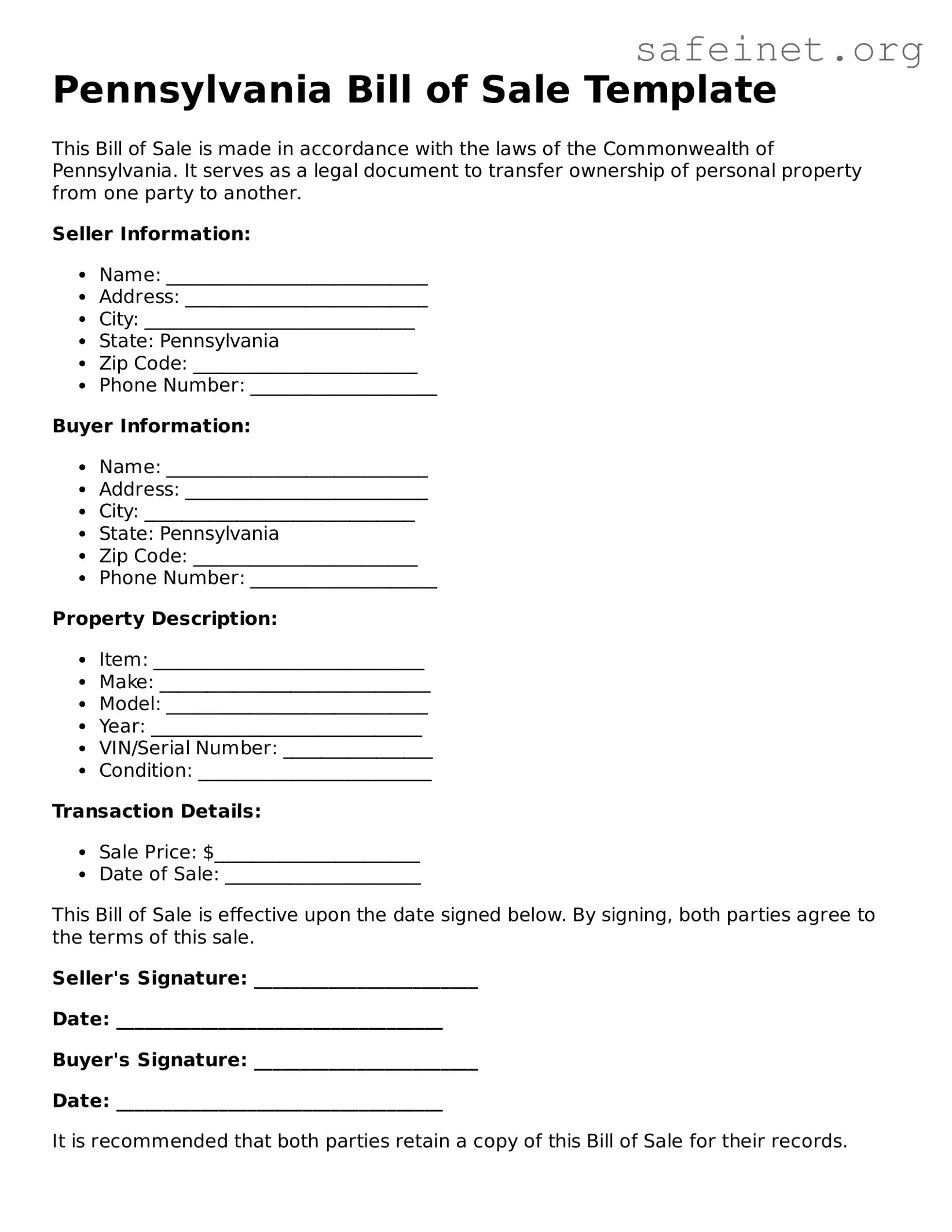
The Pennsylvania Bill of Sale form serves as a crucial document in the transfer of ownership for various types of personal property, including vehicles, boats, and other tangible assets. This form not only provides a clear record of the transaction but also protects the interests of both the seller and the buyer. Key elements typically included in the Bill of Sale are the names and addresses of the parties involved, a detailed description of the item being sold, and the purchase price. Additionally, it often includes information about the condition of the item and any warranties or guarantees offered by the seller. By documenting the sale, the Bill of Sale helps to establish legal ownership and can be instrumental in resolving disputes that may arise after the transaction is completed. Furthermore, in Pennsylvania, certain sales may require notarization, adding an extra layer of authenticity to the document. Understanding the nuances of this form is essential for anyone engaging in a sale, ensuring that all parties are protected and that the transaction proceeds smoothly.
Pennsylvania Bill of Sale Template
This Bill of Sale is made in accordance with the laws of the Commonwealth of Pennsylvania. It serves as a legal document to transfer ownership of personal property from one party to another.
Seller Information:
Buyer Information:
Property Description:
Transaction Details:
This Bill of Sale is effective upon the date signed below. By signing, both parties agree to the terms of this sale.
Seller's Signature: ________________________
Date: ___________________________________
Buyer's Signature: ________________________
Date: ___________________________________
It is recommended that both parties retain a copy of this Bill of Sale for their records.
| Fact Name | Description |
|---|---|
| Purpose | The Pennsylvania Bill of Sale form is used to document the transfer of ownership of personal property from one party to another. |
| Governing Law | This form is governed by the Pennsylvania Uniform Commercial Code (UCC), which outlines the regulations for the sale of goods. |
| Types of Property | The form can be used for various types of personal property, including vehicles, furniture, and equipment. |
| Signatures Required | Both the seller and buyer must sign the Bill of Sale to validate the transaction and confirm the transfer of ownership. |
| Notarization | While notarization is not always required, it is recommended for added legal protection and to ensure authenticity. |
| Record Keeping | It is advisable for both parties to keep a copy of the Bill of Sale for their records in case of future disputes or legal issues. |
After you gather the necessary information, you'll be ready to fill out the Pennsylvania Bill of Sale form. This document is important for transferring ownership of personal property. Make sure to have all relevant details at hand before you start.
What is a Pennsylvania Bill of Sale form?
A Pennsylvania Bill of Sale form is a legal document that serves as proof of the transfer of ownership of personal property from one party to another. This form is particularly important for transactions involving vehicles, boats, and other valuable items. It provides details about the item being sold, the parties involved, and the terms of the sale, ensuring that both the buyer and seller have a clear record of the transaction.
Do I need a Bill of Sale for every transaction in Pennsylvania?
While a Bill of Sale is not required for every transaction in Pennsylvania, it is highly recommended for significant purchases, especially those involving vehicles, trailers, or boats. In these cases, the Bill of Sale can be used to register the item with the Pennsylvania Department of Transportation or to establish proof of ownership. For smaller transactions, such as the sale of household items, a Bill of Sale may not be necessary, but having one can still provide clarity and protection for both parties.
What information should be included in a Pennsylvania Bill of Sale?
A comprehensive Pennsylvania Bill of Sale should include the following information: the names and addresses of both the buyer and seller, a detailed description of the item being sold (including make, model, year, and VIN for vehicles), the purchase price, the date of the transaction, and any warranties or conditions of the sale. Additionally, both parties should sign the document to validate the transaction.
Is a Bill of Sale legally binding in Pennsylvania?
Yes, a Bill of Sale is legally binding in Pennsylvania as long as it contains the necessary elements of a contract, including an offer, acceptance, and consideration (the purchase price). Once signed by both parties, it serves as evidence of the transaction and can be enforced in a court of law if disputes arise. However, it is important to ensure that the form is completed accurately to avoid any potential issues later on.
Can I create my own Bill of Sale, or do I need a specific form?
You can create your own Bill of Sale in Pennsylvania, as there is no official state form required. However, it is advisable to use a template or a form that includes all necessary information to ensure that it meets legal standards. Many online resources provide free or low-cost templates that can be customized to suit your specific transaction, making it easier to create a comprehensive and effective document.
What should I do with the Bill of Sale after the transaction?
After the transaction is completed, both the buyer and seller should keep a copy of the Bill of Sale for their records. The seller may need it for tax purposes, while the buyer may require it for registration or proof of ownership. It is wise to store the document in a safe place, as it can be a crucial piece of evidence in case of any future disputes or issues related to the sale.
Incorrect Information: One common mistake is providing inaccurate details about the buyer or seller. This includes misspelling names, using wrong addresses, or incorrect identification numbers. Always double-check that all information is accurate.
Missing Signatures: Both parties must sign the Bill of Sale for it to be valid. Forgetting to sign or having only one party sign can lead to issues later on. Ensure that both the buyer and seller provide their signatures.
Omitting Important Details: Some people forget to include crucial information such as the date of the sale, the purchase price, or a description of the item being sold. This can create confusion and disputes. Always include all relevant details.
Not Keeping Copies: After filling out the Bill of Sale, it’s important to make copies for both parties. Failing to do this can lead to problems if there are disagreements in the future. Always keep a copy for your records.
A Bill of Sale is an important document used in Pennsylvania for transferring ownership of personal property. However, several other forms and documents may accompany it to ensure a smooth transaction. Here are some commonly used documents that often go hand-in-hand with the Pennsylvania Bill of Sale:
These documents collectively help protect both buyers and sellers during a transaction. Ensuring that all necessary forms are completed accurately can facilitate a smoother transfer of ownership and reduce the potential for disputes in the future.
The Vehicle Bill of Sale is a document used to transfer ownership of a vehicle from one party to another. Like the Pennsylvania Bill of Sale, it includes essential details such as the vehicle's make, model, year, and VIN. Both documents require the signatures of the buyer and seller, ensuring a legal transfer of ownership. This form is particularly important for registering the vehicle in the new owner's name.
The Personal Property Bill of Sale serves a similar purpose for items that are not vehicles. This document outlines the sale of personal property, such as furniture or electronics. It details the item being sold, including its condition and any warranties. Like the Pennsylvania Bill of Sale, it protects both parties by providing proof of the transaction.
A Firearm Bill of Sale is specifically designed for the sale of firearms. This document includes the seller's and buyer's information, as well as details about the firearm, such as its make, model, and serial number. Similar to the Pennsylvania Bill of Sale, it serves as proof of ownership transfer and may be required for legal compliance in certain states.
The Boat Bill of Sale is used for transferring ownership of a boat. It captures key information about the vessel, including its registration number and hull identification number. Like the Pennsylvania Bill of Sale, it requires signatures from both the seller and buyer, ensuring a clear record of the transaction.
An Equipment Bill of Sale is used for the sale of business equipment. This document includes details about the equipment being sold, such as its condition and any warranties. Both the Equipment Bill of Sale and the Pennsylvania Bill of Sale provide legal protection for both parties involved in the transaction.
The Mobile Home Bill of Sale is used to transfer ownership of a mobile home. It includes important information about the home, such as its title number and serial number. Similar to the Pennsylvania Bill of Sale, it requires both parties to sign, ensuring that the sale is legally binding.
A Livestock Bill of Sale is used when buying or selling livestock. This document outlines the type and number of animals being sold, as well as their health status. Like the Pennsylvania Bill of Sale, it provides proof of the transaction and protects both the buyer and seller.
The Business Bill of Sale is designed for transferring ownership of a business or its assets. This document details the assets included in the sale and the terms of the transaction. Similar to the Pennsylvania Bill of Sale, it requires signatures from both parties to validate the transfer.
Finally, the Real Estate Bill of Sale is used in property transactions. It outlines the details of the property being sold, including its address and any included fixtures. Like the Pennsylvania Bill of Sale, it serves as a formal record of the sale and requires signatures from both the buyer and seller, ensuring a clear transfer of ownership.
When filling out the Pennsylvania Bill of Sale form, there are important guidelines to follow. Here are some things you should and shouldn't do:
Understanding the Pennsylvania Bill of Sale form can be tricky. Here are eight common misconceptions that people often have about it:
Many believe that a Bill of Sale is required solely for the sale of vehicles. In reality, this document can be used for a variety of transactions, including the sale of personal property, such as furniture or electronics.
Some think that notarization is mandatory for a Bill of Sale to be valid. However, in Pennsylvania, notarization is not required unless specified by the type of transaction.
While many use it for private sales, businesses can also utilize a Bill of Sale. It serves as a legal record for any sale, regardless of the seller's status.
Not every sale requires a Bill of Sale. For example, transactions involving items of little value may not need this document, though having one can provide protection.
A Bill of Sale does not guarantee the condition of the item sold. It simply documents the transaction and the agreement between the buyer and seller.
While a Bill of Sale can be handwritten, it is often better to use a printed form. This ensures clarity and can help avoid misunderstandings.
People often think that a Bill of Sale is set in stone after signing. In fact, both parties can agree to amendments, but it’s best to document any changes formally.
Some may believe that a Bill of Sale holds no legal weight. In Pennsylvania, it is a legally binding document that can be enforced in court if necessary.
Being informed about these misconceptions can help ensure smoother transactions and protect both buyers and sellers.
When dealing with the Pennsylvania Bill of Sale form, it's essential to understand its purpose and how to complete it accurately. Here are some key takeaways:
Understanding these aspects can help facilitate a smooth transaction and protect the interests of both the buyer and seller.