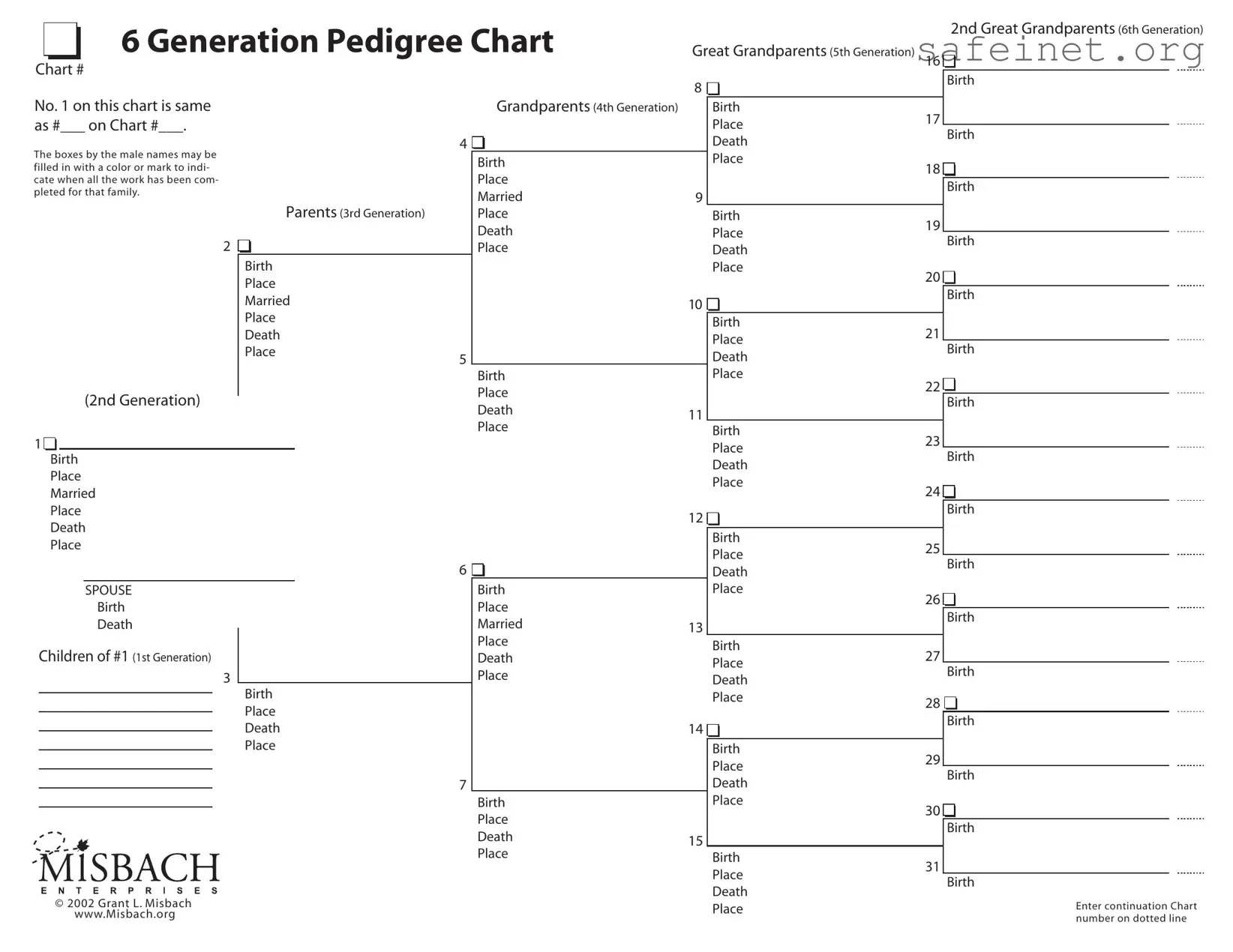
The Pedigree Chart form serves as a vital tool for individuals and families seeking to trace their lineage and understand their genetic heritage. This structured diagram visually represents family relationships across generations, allowing users to map out connections between relatives, including parents, siblings, and ancestors. Each symbol within the chart conveys specific information, such as gender and affected status regarding genetic conditions. By utilizing this form, individuals can identify patterns of inheritance, assess the likelihood of passing on genetic traits, and gain insights into their family's medical history. The simplicity of the design makes it accessible for both professionals and laypersons alike, facilitating discussions about health risks and family planning. Ultimately, the Pedigree Chart form not only aids in genealogical research but also enhances awareness of inherited conditions, fostering informed decisions about health and wellness.
|
|
|
|
|
6 Generation Pedigree Chart |
Great Grandparents (5th Generation) |
|
|
2nd Great Grandparents (6th Generation) |
||||||||||
|
|
|
|
|
|||||||||||||||
|
|
|
|
|
16 □ |
||||||||||||||
Chart # |
|||||||||||||||||||
|
|
|
|
|
|
|
|
|
|
|
|
Birth |
|
||||||
|
|
□ |
|
|
|
|
|
|
|
|
8 |
□ |
|
|
|||||
No. 1 on this chart is same |
|
|
Grandparents (4th Generation) |
|
|
|
|
||||||||||||
|
|
|
Birth |
17 |
|
|
|
||||||||||||
as #___ on Chart #___. |
|
|
|
|
Place |
|
|
|
|||||||||||
|
|
|
|
|
|
Birth |
|||||||||||||
|
|
|
|
|
|
|
|
|
|
4 |
|
□ |
|
Death |
|
|
|||
The boxes by the male names may be |
|
|
|
|
|
|
|||||||||||||
|
|
Place |
|
|
|
|
|||||||||||||
|
|
Birth |
|
18 |
|
|
|
||||||||||||
filled in with a color or mark to indi- |
|
|
|
|
|
□ |
|
||||||||||||
|
|
Place |
|
|
|
|
|||||||||||||
cate when all the work has been com- |
|
|
|
|
|
|
|||||||||||||
|
|
|
|
|
|||||||||||||||
pleted for that family. |
|
|
Married |
9 |
|
|
|
Birth |
|||||||||||
|
|
|
|
|
|
|
|||||||||||||
|
|
|
|
|
|
|
|
Parents (3rd Generation) |
|
|
|
|
|
|
|
||||
|
|
|
|
|
|
|
|
|
|
Place |
|
Birth |
19 |
|
|
|
|||
|
|
|
|
|
|
|
|
|
|
|
|
Death |
|
Place |
|
|
|
||
|
|
|
|
|
|
2 |
|
□ |
|
|
|
|
|
Birth |
|||||
|
|
|
|
|
|
|
|
|
Place |
|
Death |
|
|
||||||
|
|
|
|
|
|
|
|
|
|
|
|
|
|
||||||
|
|
|
|
|
|
|
|
|
|
|
|
|
|
||||||
|
|
|
|
|
|
|
|
Birth |
|
|
|
|
Place |
20 |
|
□ |
|
||
|
|
|
|
|
|
|
|
Place |
|
|
|
|
|
|
|
||||
|
|
|
|
|
|
|
|
Married |
|
|
|
10 |
□ |
|
|
Birth |
|||
|
|
|
|
|
|
|
|
|
|
|
|
|
|
|
|||||
|
|
|
|
|
|
|
|
Place |
|
|
|
|
|
|
|
||||
|
|
|
|
|
|
|
|
|
|
|
|
Birth |
|
|
|
|
|||
|
|
|
|
|
|
|
|
Death |
|
|
|
|
21 |
|
|
|
|||
|
|
|
|
|
|
|
|
|
|
|
|
Place |
|
|
|
||||
|
|
|
|
|
|
|
|
Place |
|
|
|
|
|
|
Birth |
||||
|
|
|
|
|
|
|
|
5 |
|
|
|
Death |
|
|
|||||
|
|
|
|
|
|
|
|
|
|
|
|
|
|
|
|
|
|||
|
|
|
|
|
|
|
|
|
|
|
|
Birth |
|
Place |
22 |
|
□ |
|
|
|
|
|
|
|
|
|
|
|
|
|
|
Place |
|
|
|
|
|||
|
|
|
|
|
(2nd Generation) |
|
|
|
|
|
Birth |
||||||||
|
|
|
|
|
|
|
Death |
11 |
|
|
|
||||||||
|
|
|
|
|
|
|
|
|
|
|
|
|
|
|
|
|
|||
1 |
|
|
|
|
|
|
|
|
|
|
Place |
|
Birth |
23 |
|
|
|
||
|
|
|
|
|
|
|
|
|
|
|
|
|
|
|
|||||
|
|
|
|
|
|
|
|
|
|
|
|
Place |
|
|
|
||||
□Birth |
|
|
|
|
|
|
|
|
|
|
Birth |
||||||||
|
|
|
|
|
|
|
|
|
|
|
Death |
|
|
||||||
|
|
Place |
|
|
|
|
|
|
|
|
|
|
|
|
|
||||
|
|
|
|
|
|
|
|
|
|
|
Place |
24 |
|
|
|
||||
|
|
Married |
|
|
|
|
|
□ |
|
||||||||||
|
|
|
|
|
|
|
|
|
|||||||||||
|
|
Place |
|
|
|
|
|
|
|
|
12 |
□ |
|
|
Birth |
||||
|
|
Death |
|
|
|
|
|
|
|
||||||||||
|
|
|
|
|
|
|
|
|
|
||||||||||
|
|
Place |
|
|
|
|
|
|
|
|
|
Birth |
25 |
|
|
|
|||
|
|
|
|
|
|
|
|
|
|
|
Place |
|
|
|
|||||
|
|
|
|
|
|
|
|
|
|
6 |
|
□ |
|
|
|
Birth |
|||
|
|
|
|
|
|
|
|
|
|
|
|
Death |
|
|
|||||
|
|
|
|
|
|
|
|
|
|
|
|
|
|
|
|
||||
|
|
|
|
|
|
|
|
|
|
|
|
|
|
|
|
|
|||
|
|
|
|
|
SPOUSE |
|
|
Birth |
|
Place |
26 |
|
□ |
|
|||||
|
|
|
|
|
Birth |
|
|
Place |
|
|
|
|
|||||||
|
|
|
|
|
|
|
|
|
|
||||||||||
|
|
|
|
|
Death |
|
|
|
|
|
Married |
13 |
|
|
|
Birth |
|||
|
|
|
|
|
|
|
|
|
|
|
|
|
|
||||||
Children of #1 (1st Generation) |
|
|
|
|
|
Place |
|
Birth |
27 |
|
|
|
|||||||
|
|
|
|
|
Death |
|
|
|
|
||||||||||
|
|
|
|
|
Place |
|
|
|
|||||||||||
|
|
|
|
|
|
|
Birth |
||||||||||||
|
|
|
|
|
3 |
|
|
|
|
|
Place |
|
|
|
|||||
|
|
|
|
|
|
|
|
|
|
|
Death |
|
|
||||||
|
|
|
|
|
|
|
|
|
|
|
|
|
|
|
|||||
|
|
|
|
|
|
Birth |
|
|
|
|
|
|
|
||||||
|
|
|
|
|
|
|
|
|
|
|
|
Place |
28 |
|
□ |
|
|||
|
|
|
|
|
|
|
|
|
|
|
|||||||||
|
|
|
|
|
|
|
|
Place |
|
|
|
|
|
|
|
||||
|
|
|
|
|
|
|
|
|
|
|
|
|
|
Birth |
|||||
|
|
|
|
|
|
|
|
Death |
|
|
|
14 |
□ |
|
|
||||
|
|
|
|
|
|
|
|
|
|
|
|
|
|
|
|||||
|
|
|
|
|
|
|
|
Place |
|
|
|
|
Birth |
29 |
|
|
|
||
|
|
|
|
|
|
|
|
|
|
|
|
||||||||
|
|
|
|
|
|
|
|
|
|
|
|
|
|
Place |
|
|
|
||
|
|
|
|
|
|
|
|
|
|
|
|
|
|
|
|
Birth |
|||
|
|
|
|
|
|
|
|
|
|
|
|
|
|
|
|||||
|
|
|
|
|
|
|
|
|
|
7 |
|
|
|
Death |
|
|
|||
|
|
|
|
|
|
|
|
|
|
|
|
|
|
|
|
|
|||
|
|
|
|
|
|
|
|
|
|
|
|
|
|
|
|
||||
|
|
|
|
|
|
|
|
|
|
|
|
Birth |
|
Place |
30 |
|
□ |
|
|
|
|
|
|
|
|
|
|
|
|
|
|
Place |
|
|
|
|
|||
|
|
|
|
|
|
|
|
|
|
|
|
|
|
|
Birth |
||||
|
|
|
|
|
|
|
|
|
|
|
|
Death |
15 |
|
|
|
|||
|
|
|
|
|
|
|
|
|
|
|
|
|
|
|
|
|
|||
|
|
|
|
|
|
|
|
|
|
|
|
Place |
|
Birth |
31 |
|
|
|
|
|
|
|
|
|
|
|
|
|
|
|
|
|
|
|
|
|
|||
|
|
|
|
|
|
|
|
|
|
|
|
|
|
Place |
|
|
|
||
|
|
|
|
|
|
|
|
|
|
|
|
|
|
|
|
Birth |
|||
|
ENTERPRISES |
|
|
|
|
Death |
|
|
|||||||||||
|
|
|
|
|
|
|
|
|
|||||||||||
|
|
© 2002 Grant L. Misbach |
|
|
|
|
Place |
|
|
Enter continuation Chart |
|||||||||
|
|
|
www.Misbach.org |
|
|
|
|
|
|
||||||||||
|
|
|
|
|
|
|
|
|
|
number on dotted line |
|||||||||
|
|
|
|
|
|
|
|
|
|
|
|
|
|
|
|
|
|||
| Fact Name | Description |
|---|---|
| Definition | A Pedigree Chart is a visual representation of a person's ancestry, showing relationships between family members over generations. |
| Purpose | Used to track genetic traits, health conditions, and family history, particularly in genetic counseling and research. |
| Format | Typically structured as a tree-like diagram, with the individual at the base and ancestors branching upwards. |
| Generations | Each generation is represented by a horizontal line, allowing for easy visualization of familial connections. |
| Symbols | Standard symbols include squares for males and circles for females, with lines connecting parents to their children. |
| State-Specific Forms | Some states may have specific guidelines or templates for creating Pedigree Charts, particularly in legal or medical contexts. |
| Governing Laws | For example, in California, the Family Code governs the use of Pedigree Charts in family law cases. |
| Usage in Legal Contexts | Pedigree Charts can be used in inheritance cases, custody disputes, and other legal matters involving family lineage. |
| Privacy Considerations | When sharing a Pedigree Chart, consider the privacy of individuals included, especially in sensitive situations. |
| Software Tools | Various software programs and online tools exist to assist in creating and storing Pedigree Charts efficiently. |
Filling out the Pedigree Chart form is an important step in documenting your family history. It allows you to trace your lineage and understand your family connections better. Once you have the form ready, you can begin to gather information about your relatives and start filling it out.
What is a Pedigree Chart?
A Pedigree Chart is a visual representation of a family tree that outlines the lineage and relationships among family members. It helps track genetic traits, health issues, and ancestry over generations.
Why would I need a Pedigree Chart?
People often use Pedigree Charts for various reasons, including genealogy research, understanding hereditary health conditions, or simply documenting family history. It can also be beneficial for medical professionals in assessing genetic risks.
How do I fill out a Pedigree Chart?
Start by entering your information at the base of the chart. Then, add your parents, grandparents, and so on, connecting them with lines to show relationships. Be sure to include important details such as birth dates and any relevant health information.
Can I include adopted family members in my Pedigree Chart?
Yes, you can include adopted family members. The chart is flexible and can reflect all types of familial relationships, ensuring that everyone who plays a role in your family history is represented.
What symbols are commonly used in a Pedigree Chart?
Typically, circles represent females and squares represent males. A horizontal line connects partners, while vertical lines show the offspring. Different shading or markings may indicate health conditions or specific traits.
Is there a specific format I should follow?
While there is no strict format, it’s important to maintain clarity. Use a consistent layout, label each individual clearly, and ensure that relationships are easy to understand. Various templates are available online to help guide you.
How can I share my Pedigree Chart with others?
You can share your Pedigree Chart in several ways. Print it out for family gatherings, or save it as a digital file to email or share on social media. Some online genealogy platforms allow you to upload and share your chart with a broader audience.
What if I don’t have all the information needed to complete the chart?
It’s okay if you don’t have every detail. Start with the information you have and fill in the gaps as you gather more data. Family members may be able to help you find missing pieces of your family history.
Are there any software programs that can help create a Pedigree Chart?
Yes, there are many software programs and online tools designed for creating Pedigree Charts. These tools often come with features that make it easy to add information, customize layouts, and share your chart with others.
How do I keep my Pedigree Chart updated?
Regularly review and update your Pedigree Chart as new family members are born or as you discover more information about your ancestors. Set a reminder to check in every few years to ensure your chart remains accurate and comprehensive.
Inaccurate Information: Many individuals provide incorrect names, dates, or relationships. Double-checking details can prevent confusion later.
Omitting Key Individuals: Some people forget to include important family members, such as siblings or grandparents. Ensure all relevant relatives are listed.
Using Inconsistent Naming Conventions: Mixing first names, nicknames, and last names can lead to misunderstandings. Stick to one naming style throughout the chart.
Neglecting to Update Information: Family situations change. Failing to update the chart with new marriages, divorces, or deaths can create inaccuracies.
Ignoring Privacy Concerns: Sharing sensitive information about living relatives can violate their privacy. Be cautious about what you include.
The Pedigree Chart form serves as a vital tool for documenting family lineage and ancestry. When working with this form, several other documents may be beneficial for providing additional context or supporting information. Below is a list of commonly used forms and documents that often accompany the Pedigree Chart.
Utilizing these documents alongside the Pedigree Chart can enhance the understanding of family history and relationships. Each document contributes unique information that can help paint a fuller picture of one's ancestry.
The Pedigree Chart is similar to a Family Tree. Both documents visually represent familial relationships and lineage. A Family Tree typically branches out to show multiple generations of a family, illustrating how individuals are connected through bloodlines. This visual representation helps individuals understand their heritage and can be a valuable tool for genealogical research.
Another document that shares similarities is the Ancestry Chart. Like the Pedigree Chart, the Ancestry Chart focuses on tracing lineage but often includes more detailed information about ancestors. This document may list specific dates of birth, marriage, and death, providing a richer context for each family member's life. Both documents serve to clarify relationships across generations.
The Medical History Form is also akin to the Pedigree Chart. While the Pedigree Chart outlines familial connections, the Medical History Form emphasizes health-related information within a family. It typically records hereditary conditions and diseases, making it crucial for understanding potential health risks. Both documents highlight the importance of family connections, albeit from different perspectives.
A Genetic Family Tree serves a similar purpose to the Pedigree Chart, focusing on genetic relationships. This document is particularly useful for understanding inherited traits and genetic predispositions. It often includes DNA test results and can provide insights into an individual’s ancestry, just like a Pedigree Chart, but with a stronger emphasis on genetic links.
The Adoption Records are comparable to the Pedigree Chart in that they document familial connections, albeit in the context of adopted individuals. These records often provide information about biological and adoptive families, helping to clarify relationships and lineage. Both documents serve as important resources for individuals seeking to understand their family backgrounds.
Birth Certificates share similarities with the Pedigree Chart as they both document vital information about individuals in a family. A Birth Certificate typically includes details such as the child's name, parents’ names, and the date of birth. While not a direct representation of familial relationships, it serves as an official record that supports the connections outlined in a Pedigree Chart.
Death Certificates can also be compared to the Pedigree Chart. They provide essential information about an individual's passing, including date, cause, and familial connections. This document can help fill in gaps in a family’s history, allowing individuals to trace their lineage and understand the impact of certain events on their family tree.
The Marriage Certificate is another document that relates closely to the Pedigree Chart. It officially records the union between two individuals and often includes information about their families. This document highlights the connections created through marriage, adding another layer to the relationships depicted in a Pedigree Chart.
Lastly, the Census Records can be likened to the Pedigree Chart. These records provide snapshots of families at specific points in time, listing members and their relationships to one another. Census data can reveal changes in family structure, migration patterns, and demographic information, enriching the context of a family’s history as shown in a Pedigree Chart.
When filling out a Pedigree Chart form, certain practices can enhance accuracy and clarity. Below is a list of recommended actions and common pitfalls to avoid.
Pedigree charts are valuable tools for understanding family relationships and genetic inheritance. However, several misconceptions can lead to confusion. Here are eight common misconceptions about pedigree charts:
This is not true. While pedigree charts are often used to track genetic conditions, they can also illustrate other family relationships and traits.
Pedigree charts can vary significantly based on the purpose and the information being conveyed. Different symbols and structures may be used depending on the context.
Anyone can create a pedigree chart. With basic information about family relationships, individuals can draw their own charts to visualize ancestry.
While they can indicate potential genetic risks based on family history, pedigree charts cannot definitively predict whether an individual will develop a condition.
Including every family member is not necessary. A pedigree chart can focus on specific individuals or branches of a family to highlight particular traits or conditions.
Pedigree charts can include adopted individuals and step-family members, reflecting a broader view of family relationships.
Different cultures and fields may use different symbols. It is essential to include a key or legend to clarify the meaning of symbols used in a specific chart.
Family histories can change over time. Updating a pedigree chart regularly ensures it remains accurate and useful.
When filling out and utilizing the Pedigree Chart form, it is essential to keep a few key points in mind. Understanding these takeaways will help ensure accuracy and effectiveness in your documentation.
By keeping these takeaways in mind, you can effectively fill out and use the Pedigree Chart form, ensuring it serves its intended purpose efficiently.