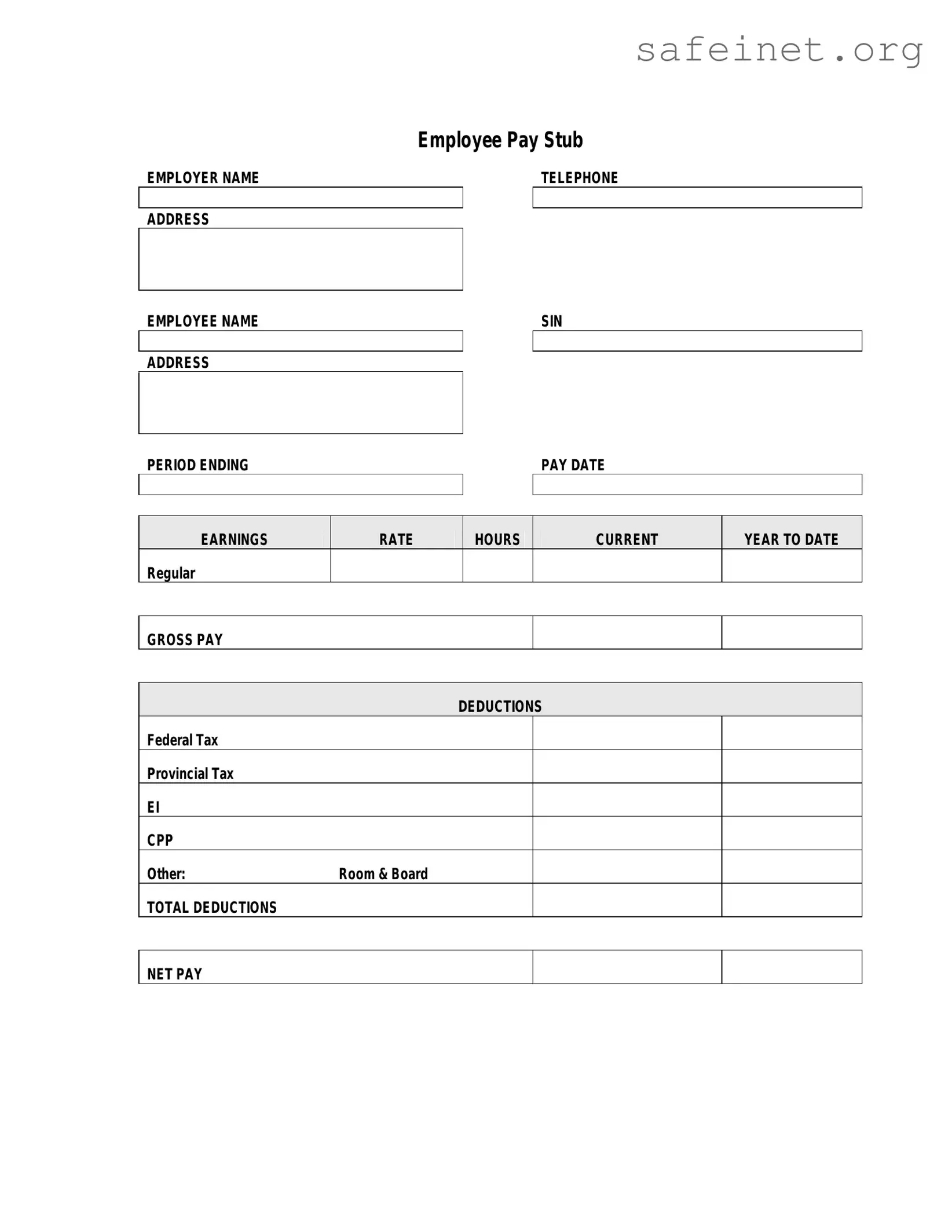
The Pay Stub form serves as a crucial document for both employees and employers, providing a detailed breakdown of an employee's earnings and deductions for a specific pay period. This form typically includes essential information such as the employee's name, identification number, and the pay period dates. It outlines gross wages, which represent the total earnings before any deductions, as well as net pay, the amount the employee takes home after deductions. Common deductions listed on the pay stub may include federal and state taxes, Social Security contributions, health insurance premiums, and retirement plan contributions. Additionally, the Pay Stub form may provide information on accrued benefits such as vacation and sick leave, helping employees track their entitlements. Understanding this document is vital for employees to verify their earnings and for employers to maintain accurate payroll records.

Employee Pay Stub
EMPLOYER NAME |
|
TELEPHONE |
|
|
|
ADDRESS
EMPLOYEE NAME |
|
SIN |
|
|
|
ADDRESS
PERIOD ENDING |
|
|
PAY DATE |
|
|
|
|
|
|
|
|
|
|
|
EARNINGS |
RATE |
HOURS |
CURRENT |
YEAR TO DATE |
Regular |
|
|
|
|
GROSS PAY
DEDUCTIONS
Federal Tax
Provincial Tax
EI
CPP
Other:Room & Board
TOTAL DEDUCTIONS
NET PAY
| Fact Name | Description | Governing Law (State-Specific) |
|---|---|---|
| Definition | A pay stub is a document that outlines an employee's earnings and deductions for a specific pay period. | N/A |
| Contents | Typically includes gross pay, net pay, taxes withheld, and other deductions. | N/A |
| Frequency | Employers must provide pay stubs for each pay period, which can be weekly, bi-weekly, or monthly. | California Labor Code Section 226 |
| Accessibility | Employees have the right to receive a pay stub in a format that is easy to read and understand. | New York Labor Law Section 195 |
| Record Keeping | Employers are required to maintain pay stub records for a specific duration, often three years. | Federal Fair Labor Standards Act (FLSA) |
Filling out the Pay Stub form is an important step in ensuring accurate record-keeping for your earnings. This process requires attention to detail and a clear understanding of the information needed. Follow these steps carefully to complete the form correctly.
What is a Pay Stub?
A pay stub is a document that provides details about an employee's earnings for a specific pay period. It typically includes information such as the employee's gross pay, deductions, and net pay. Pay stubs can also show hours worked, overtime, and any bonuses or commissions earned. They serve as a record for both the employee and employer, helping to track income and deductions over time.
Why is a Pay Stub important?
Pay stubs are important for several reasons. They help employees understand how their pay is calculated, providing transparency about deductions for taxes, insurance, and retirement contributions. Additionally, pay stubs can be used as proof of income when applying for loans, renting an apartment, or verifying employment. Keeping pay stubs organized can assist in budgeting and financial planning.
How can I obtain my Pay Stub?
You can typically obtain your pay stub from your employer’s payroll department or through an online employee portal. Many companies provide electronic pay stubs, which can be accessed anytime. If you have trouble locating your pay stub, reach out to your HR department for assistance. They can guide you on how to access your pay information.
What should I do if I find an error on my Pay Stub?
If you notice an error on your pay stub, it’s important to address it promptly. First, review the details to ensure the mistake is not a misunderstanding. If you confirm there’s an error, contact your employer’s payroll department right away. They can investigate the issue and make any necessary corrections. Keeping a record of your communications can be helpful in resolving the problem.
Not double-checking personal information. It's easy to overlook your name, address, or Social Security number. Any errors here can lead to bigger issues down the line.
Forgetting to include all income sources. If you have multiple jobs or side gigs, make sure to report every source of income. Missing one can affect your tax situation.
Neglecting to account for deductions. Common deductions include health insurance and retirement contributions. If these are not listed correctly, it could impact your take-home pay.
Using outdated tax information. Tax laws change frequently. Ensure that you are using the most current rates and guidelines to avoid mistakes.
Not reviewing the pay period dates. Pay periods can vary. Make sure the dates align with your work schedule to ensure accuracy.
Ignoring state and local taxes. Some people focus only on federal taxes. Remember that state and local taxes can also affect your overall income.
Failing to keep a copy. After filling out the form, it’s crucial to save a copy for your records. This can help if there are questions later.
Overlooking the importance of accuracy. Small mistakes can lead to big problems. Take your time to ensure everything is filled out correctly.
Not asking for help if needed. If you're unsure about something, don't hesitate to ask a colleague or a tax professional for assistance.
The Pay Stub form is a crucial document for employees as it provides a detailed breakdown of earnings and deductions for a specific pay period. Alongside the Pay Stub, several other forms and documents are commonly used to ensure accurate payroll processing and compliance with regulations. Below are four such documents that often accompany the Pay Stub.
Understanding these documents can help employees better manage their finances and ensure that they are receiving the correct compensation. Each of these forms plays a vital role in the payroll process and contributes to the overall clarity and transparency of employee compensation.
The W-2 form is a crucial document for employees and employers alike. It reports an employee's annual wages and the amount of taxes withheld from their paycheck. Similar to a pay stub, the W-2 provides a summary of earnings over a year, but it is typically issued at the end of the tax year. While a pay stub offers detailed information for each pay period, the W-2 consolidates this information into a single annual report, making it essential for tax filing purposes.
The 1099 form serves a different purpose but shares similarities with the pay stub in terms of reporting income. This form is used primarily for independent contractors and freelancers, detailing payments received throughout the year. Like a pay stub, the 1099 outlines the total earnings, but it does not include tax withholdings, as these workers are responsible for paying their own taxes. Both documents provide important financial information, but they cater to different employment situations.
The paycheck itself is perhaps the most direct comparison to a pay stub. A paycheck represents the actual payment made to an employee for their work, while a pay stub accompanies or is included with the paycheck, detailing the breakdown of earnings, deductions, and taxes. Both documents serve the same purpose of informing employees about their compensation, but the pay stub provides a more comprehensive view of the financial details behind the paycheck.
The direct deposit statement is another document that shares similarities with a pay stub. When employees opt for direct deposit, they often receive a statement that outlines the amount deposited into their bank account. This statement functions similarly to a pay stub by detailing earnings and deductions, allowing employees to track their income effectively. However, it may not provide as much information as a traditional pay stub, which includes a full breakdown of earnings for each pay period.
The earnings statement is closely related to the pay stub and is often used interchangeably. This document provides a detailed account of an employee's earnings over a specific period, including hours worked, hourly rates, and any bonuses or commissions. While a pay stub is typically a single document provided per pay period, an earnings statement may encompass a longer time frame, offering a broader view of an employee's financial history.
The payroll summary report is another document that resembles a pay stub in its function. This report is typically generated by the employer's payroll system and provides a comprehensive overview of all employees' earnings and deductions for a specific period. While a pay stub focuses on individual employees, the payroll summary report aggregates data for the entire workforce, making it useful for employers to analyze labor costs and ensure accurate financial reporting.
The tax withholding statement, often found alongside a pay stub, provides details about the amount of federal, state, and local taxes withheld from an employee's earnings. This document is crucial for understanding how much of an employee's gross income is being set aside for taxes. Like a pay stub, it helps employees anticipate their tax liabilities and can be useful for budgeting purposes, but it focuses specifically on tax deductions rather than overall earnings.
When filling out the Pay Stub form, it's important to be thorough and accurate. Here are some key points to keep in mind:
Understanding pay stubs is crucial for both employees and employers. However, several misconceptions can lead to confusion. Here are nine common misconceptions about pay stubs:
This is not true. All employees, whether part-time, full-time, or temporary, should receive pay stubs to ensure transparency regarding their earnings and deductions.
Many believe that pay stubs only reflect gross earnings. In reality, they detail both gross pay and net pay, along with any deductions taken from the gross amount.
While laws vary by state, many require employers to provide pay stubs. It's essential for employees to check local regulations to understand their rights.
Some people confuse pay stubs with W-2 forms. Pay stubs provide a snapshot of earnings for a specific pay period, whereas W-2 forms summarize annual earnings and tax withholdings.
While some deductions, like taxes, are required, others may be optional, such as contributions to retirement accounts or health insurance. Employees should review their pay stubs to understand their choices.
Pay stubs are valuable year-round. They help employees track their earnings, understand deductions, and verify their financial information for loans or other applications.
Discrepancies should never be ignored. Employees should address any inconsistencies with their employer promptly to ensure accurate compensation.
On the contrary, pay stubs can be instrumental in budgeting. They provide clear insights into income and expenses, helping individuals manage their finances effectively.
Digital pay stubs are just as reliable as paper versions, provided they come from a legitimate source. They often offer added convenience and accessibility.
By clearing up these misconceptions, employees can better understand their pay stubs and take control of their financial well-being.
Understanding how to fill out and use the Pay Stub form is crucial for both employees and employers. Here are some key takeaways:
By following these guidelines, you can ensure that you accurately fill out and effectively use the Pay Stub form.