In Oregon, the Transfer-on-Death Deed (TOD) form offers a straightforward way for property owners to pass their real estate to beneficiaries without the need for probate. This legal tool allows individuals to retain full control of their property during their lifetime while designating who will inherit it after their death. The TOD deed must be properly executed and recorded to be effective, ensuring that the transfer occurs automatically upon the owner’s passing. Importantly, this form can be revoked or modified at any time before the owner's death, providing flexibility and peace of mind. With the right information and a clear understanding of the process, property owners can use the Transfer-on-Death Deed to simplify estate planning and help their loved ones avoid potential complications in the future.
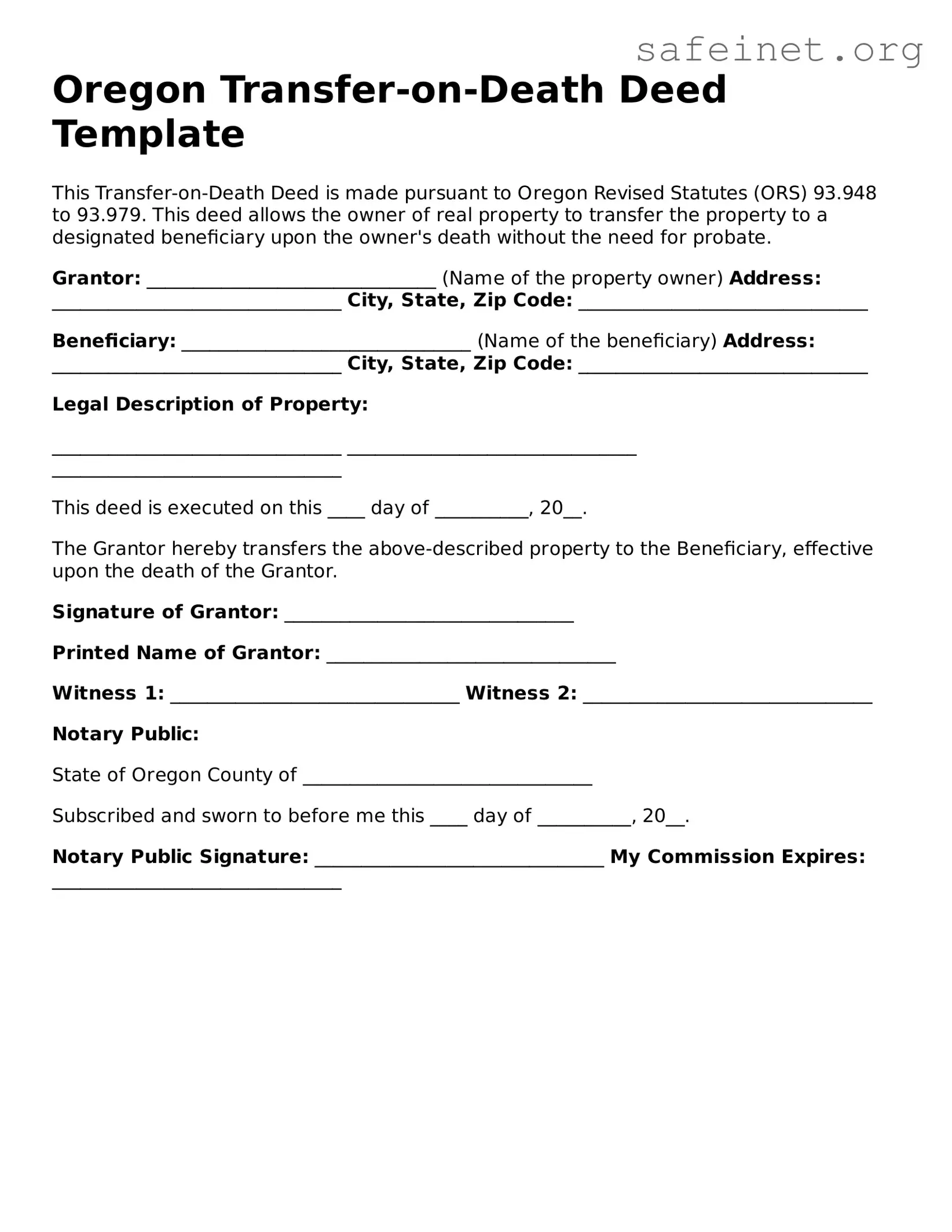
Oregon Transfer-on-Death Deed Template
This Transfer-on-Death Deed is made pursuant to Oregon Revised Statutes (ORS) 93.948 to 93.979. This deed allows the owner of real property to transfer the property to a designated beneficiary upon the owner's death without the need for probate.
Grantor: _______________________________ (Name of the property owner) Address: _______________________________ City, State, Zip Code: _______________________________
Beneficiary: _______________________________ (Name of the beneficiary) Address: _______________________________ City, State, Zip Code: _______________________________
Legal Description of Property:
_______________________________ _______________________________ _______________________________
This deed is executed on this ____ day of __________, 20__.
The Grantor hereby transfers the above-described property to the Beneficiary, effective upon the death of the Grantor.
Signature of Grantor: _______________________________
Printed Name of Grantor: _______________________________
Witness 1: _______________________________ Witness 2: _______________________________
Notary Public:
State of Oregon County of _______________________________
Subscribed and sworn to before me this ____ day of __________, 20__.
Notary Public Signature: _______________________________ My Commission Expires: _______________________________
| Fact Name | Description |
|---|---|
| Definition | An Oregon Transfer-on-Death Deed allows property owners to transfer real estate to a designated beneficiary upon their death without going through probate. |
| Governing Law | This deed is governed by Oregon Revised Statutes, specifically ORS 93.948 to 93.979. |
| Beneficiary Designation | Property owners can name one or more beneficiaries, and they can also specify alternate beneficiaries in case the primary ones are unable to inherit. |
| Revocation | The deed can be revoked at any time during the property owner's lifetime by executing a new deed or a revocation document. |
| Recording Requirement | To be effective, the Transfer-on-Death Deed must be recorded with the county clerk in the county where the property is located. |
| No Immediate Transfer | The transfer of property does not occur until the property owner passes away, allowing the owner to retain full control during their lifetime. |
After obtaining the Oregon Transfer-on-Death Deed form, it's important to carefully complete it to ensure that your wishes regarding property transfer are clearly documented. Follow these steps to fill out the form accurately.
What is a Transfer-on-Death Deed in Oregon?
A Transfer-on-Death Deed (TODD) is a legal document that allows a property owner in Oregon to transfer real estate to a designated beneficiary upon their death. This deed is effective only upon the death of the property owner and does not require the beneficiary to go through probate. It provides a straightforward way to ensure that property passes directly to the intended person without the complications of a will or trust.
Who can use a Transfer-on-Death Deed?
Any individual who owns real estate in Oregon can utilize a Transfer-on-Death Deed. This includes single individuals, married couples, and even partners in domestic relationships. However, it is important to ensure that the property is not subject to any liens or other encumbrances that could complicate the transfer.
How do I create a Transfer-on-Death Deed?
To create a Transfer-on-Death Deed, the property owner must complete the form, which includes details such as the legal description of the property, the name of the beneficiary, and the signature of the property owner. It is crucial to have the deed notarized and recorded with the county clerk's office where the property is located. This ensures that the transfer is legally recognized and enforceable.
Is there a cost associated with recording a Transfer-on-Death Deed?
Yes, there is typically a fee for recording the Transfer-on-Death Deed with the county clerk. The amount may vary by county, so it is advisable to check with the local clerk's office for the exact fee. This cost is generally modest compared to the expenses associated with probate proceedings.
Can I change or revoke a Transfer-on-Death Deed after it has been created?
Yes, a property owner can change or revoke a Transfer-on-Death Deed at any time before their death. This can be done by creating a new deed that explicitly revokes the previous one or by recording a formal revocation document. It is important to ensure that any changes are properly documented and recorded to avoid confusion later on.
What happens if the beneficiary predeceases the property owner?
If the designated beneficiary passes away before the property owner, the Transfer-on-Death Deed will typically become void. In this case, the property owner may want to update the deed to name a new beneficiary. If no new beneficiary is designated, the property will be distributed according to the owner's will or, if there is no will, according to state intestacy laws.
Are there any tax implications associated with a Transfer-on-Death Deed?
Generally, there are no immediate tax implications for the property owner when creating a Transfer-on-Death Deed. However, the beneficiary may be responsible for property taxes after the transfer occurs. Additionally, the beneficiary may also be subject to capital gains taxes if they sell the property after inheriting it. Consulting with a tax professional can provide clarity on specific situations.
Can multiple beneficiaries be named in a Transfer-on-Death Deed?
Yes, a property owner can name multiple beneficiaries in a Transfer-on-Death Deed. It is important to clearly outline how the property will be divided among them. For example, the deed can specify that the property is to be divided equally or in specific proportions. Clear instructions will help prevent disputes among beneficiaries after the property owner’s death.
What types of property can be transferred using a Transfer-on-Death Deed?
In Oregon, a Transfer-on-Death Deed can be used to transfer real estate, such as residential homes, commercial properties, and vacant land. However, it cannot be used for personal property like vehicles or bank accounts. It is also important to note that the deed must be recorded to be effective, and it should comply with all state laws regarding property transfers.
Failing to properly identify the property. It's essential to provide a complete legal description of the property being transferred. This includes the address and any relevant parcel numbers.
Not including all owners. If the property is co-owned, all owners must sign the deed. Omitting a co-owner can lead to legal complications.
Using incorrect names. Ensure that the names of the beneficiaries are spelled correctly and match their legal documents. Any discrepancies can cause issues with the transfer.
Neglecting to sign the deed. All required parties must sign the deed for it to be valid. A missing signature can invalidate the entire document.
Not having the deed notarized. In Oregon, a Transfer-on-Death Deed must be notarized to be legally binding. Failing to do so can render the deed ineffective.
Not recording the deed. After completing the deed, it must be filed with the county recorder's office. If it is not recorded, the transfer may not be recognized.
Overlooking tax implications. Some individuals do not consider the tax consequences of transferring property upon death. Consulting a tax professional can provide clarity.
Ignoring state-specific requirements. Each state has its own rules regarding Transfer-on-Death Deeds. Familiarity with Oregon's specific requirements is crucial for a valid transfer.
When considering the Oregon Transfer-on-Death Deed, it’s essential to understand that other documents often accompany it. These forms help ensure that the transfer of property occurs smoothly and according to the wishes of the property owner. Here are five common documents you might encounter:
Understanding these documents can help in planning for property transfer effectively. Each form plays a role in ensuring that your wishes are respected and that your loved ones are taken care of after your passing.
The Oregon Transfer-on-Death Deed is similar to a Living Trust in that both allow for the transfer of property outside of probate. A Living Trust holds assets during a person's lifetime and specifies how they should be distributed upon death. This means that property can pass directly to beneficiaries without the lengthy and often costly probate process, providing a smoother transition of assets and greater privacy for the family.
Another document that shares similarities is the Last Will and Testament. Like the Transfer-on-Death Deed, a Will outlines how a person's assets should be distributed after their death. However, unlike the Transfer-on-Death Deed, a Will must go through probate, which can be time-consuming and public. The Transfer-on-Death Deed allows for a more straightforward transfer of property directly to heirs without court involvement.
The Quitclaim Deed is also comparable, as it transfers ownership of property from one person to another. However, a Quitclaim Deed does not provide any guarantees about the ownership rights being transferred. In contrast, the Transfer-on-Death Deed allows the owner to retain full control of the property during their lifetime, only transferring ownership upon death, thus ensuring a clear title for the beneficiaries.
A Beneficiary Designation form is another document that serves a similar purpose. This form allows individuals to designate beneficiaries for certain assets, such as life insurance policies or retirement accounts. Like the Transfer-on-Death Deed, it enables the direct transfer of assets upon death, bypassing probate. Both documents simplify the process of asset distribution and ensure that the owner’s wishes are honored.
The General Power of Attorney can be compared to the Transfer-on-Death Deed in terms of managing assets. A Power of Attorney allows someone to make financial decisions on behalf of another person while they are alive. While it does not directly transfer property upon death, it can be part of a larger estate planning strategy that includes a Transfer-on-Death Deed for real estate, ensuring that decisions can be made smoothly until the transfer occurs.
The Life Estate Deed is another document with similarities. It allows a person to retain ownership of property while granting another individual the right to use it during their lifetime. Upon the death of the life tenant, the property automatically transfers to the remainder beneficiary. This is similar to the Transfer-on-Death Deed, where the property ownership shifts upon the owner’s death, but with different rights and responsibilities during the owner's lifetime.
The Affidavit of Heirship is also relevant, as it is used to establish the heirs of a deceased person when no formal probate is initiated. This document can help clarify who inherits property, similar to how a Transfer-on-Death Deed designates beneficiaries for real estate. Both documents aim to simplify the transfer of assets and provide clear evidence of ownership and inheritance rights.
Lastly, the Deed of Gift is comparable, as it involves the transfer of property while the owner is still alive. A Deed of Gift allows a property owner to give their property to someone else without expecting anything in return. While both the Deed of Gift and the Transfer-on-Death Deed facilitate property transfer, the key difference lies in timing and intent. The Transfer-on-Death Deed ensures that the property remains with the owner until their passing, at which point it automatically transfers to the designated beneficiary.
When filling out the Oregon Transfer-on-Death Deed form, it's important to follow certain guidelines to ensure the document is valid and effective. Here are six things you should and shouldn't do:
Understanding the Oregon Transfer-on-Death Deed form is crucial for property owners considering their estate planning options. However, several misconceptions can lead to confusion. Here are eight common misconceptions, along with clarifications.
Many believe that the Transfer-on-Death Deed can only be used for real estate. In reality, it specifically allows for the transfer of real property but does not extend to personal property or financial assets.
Some individuals think that using a Transfer-on-Death Deed necessitates probate. However, property transferred via this deed bypasses the probate process, simplifying the transfer to beneficiaries.
A common misunderstanding is that once the deed is executed, it cannot be changed. In fact, the grantor retains the right to revoke or modify the deed at any time before death.
Some people fear that executing a Transfer-on-Death Deed restricts their ability to sell the property. This is not the case; the grantor can sell or mortgage the property without any limitations.
There is a misconception that beneficiaries gain immediate ownership upon the grantor's death. However, the property only transfers to them after the grantor's death and not before.
Some assume that Transfer-on-Death Deeds are only beneficial for individuals with substantial estates. In reality, they can be advantageous for anyone wishing to simplify the transfer of property, regardless of the estate's size.
Many people confuse a Transfer-on-Death Deed with a will. While both serve to transfer property, a will requires probate, whereas a Transfer-on-Death Deed does not.
Some individuals mistakenly believe that the Transfer-on-Death Deed is available and functions identically in all states. Each state has its own laws and procedures regarding such deeds, making it essential to understand local regulations.
Addressing these misconceptions can help individuals make informed decisions about their estate planning strategies and better understand the benefits of the Oregon Transfer-on-Death Deed.
When considering the Oregon Transfer-on-Death Deed, it’s essential to understand its implications and requirements. Here are some key takeaways to keep in mind:
Understanding these key points can help ensure a smoother transfer of property and peace of mind for both the property owner and their beneficiaries.