In the state of Oregon, managing the affairs of a deceased loved one can often be a challenging process, especially when it comes to settling their estate. One tool that simplifies this process is the Oregon Small Estate Affidavit form. This form is designed for use in situations where the total value of the estate is relatively modest, specifically when it falls below a certain threshold set by state law. By utilizing this affidavit, individuals can bypass the more complex and time-consuming probate process, allowing for a more straightforward transfer of assets. The form requires essential information, such as the names of the deceased and the heirs, as well as a detailed inventory of the estate's assets. Additionally, it serves as a declaration that the person filing the affidavit is entitled to receive the property and that all debts of the deceased have been settled or accounted for. Understanding the requirements and implications of this form can help individuals navigate the often emotional and logistical challenges that come with managing a small estate in Oregon.
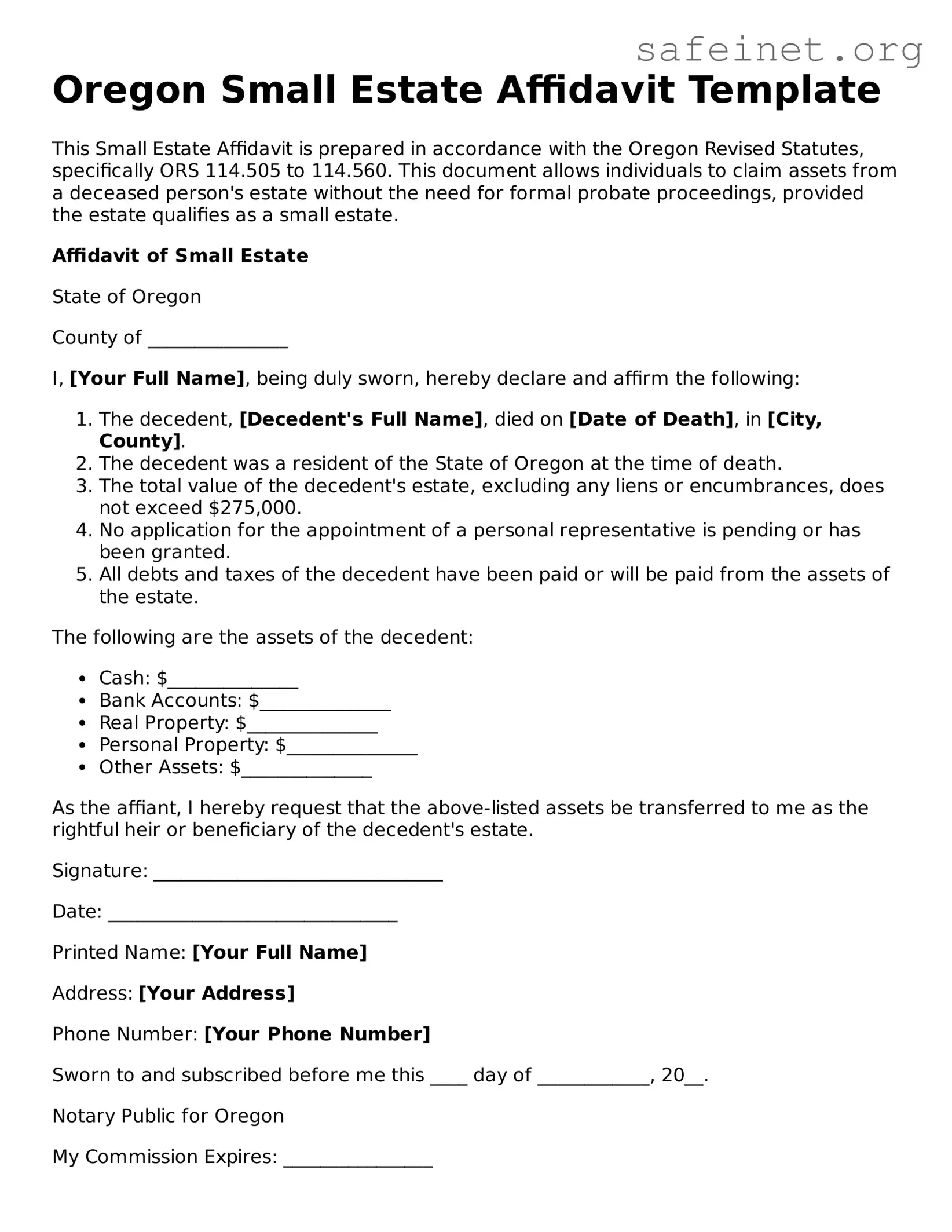
Oregon Small Estate Affidavit Template
This Small Estate Affidavit is prepared in accordance with the Oregon Revised Statutes, specifically ORS 114.505 to 114.560. This document allows individuals to claim assets from a deceased person's estate without the need for formal probate proceedings, provided the estate qualifies as a small estate.
Affidavit of Small Estate
State of Oregon
County of _______________
I, [Your Full Name], being duly sworn, hereby declare and affirm the following:
The following are the assets of the decedent:
As the affiant, I hereby request that the above-listed assets be transferred to me as the rightful heir or beneficiary of the decedent's estate.
Signature: _______________________________
Date: _______________________________
Printed Name: [Your Full Name]
Address: [Your Address]
Phone Number: [Your Phone Number]
Sworn to and subscribed before me this ____ day of ____________, 20__.
Notary Public for Oregon
My Commission Expires: ________________
| Fact Name | Details |
|---|---|
| Purpose | The Oregon Small Estate Affidavit allows individuals to claim assets of a deceased person without going through formal probate. |
| Eligibility | To qualify, the total value of the estate must be $275,000 or less, excluding certain exempt property. |
| Governing Law | The use of the Small Estate Affidavit is governed by Oregon Revised Statutes, specifically ORS 114.505 to 114.560. |
| Filing Process | The affidavit must be completed and signed by the person claiming the assets, and it may need to be notarized. |
| Assets Covered | The affidavit can be used for various types of assets, including bank accounts, vehicles, and personal property. |
| Timeframe | The affidavit can be submitted immediately after the death of the individual, provided all conditions are met. |
| Limitations | Some assets, such as real estate, may not be transferred using the Small Estate Affidavit and may require formal probate. |
| Alternative Options | If the estate exceeds the $275,000 limit, the executor or administrator must initiate formal probate proceedings. |
After obtaining the Oregon Small Estate Affidavit form, you will need to complete it carefully to ensure it is filled out correctly. This form is a legal document that allows for the distribution of a deceased person's assets without going through the full probate process. Once the form is completed, it will need to be filed with the appropriate court and may require additional documentation.
What is the Oregon Small Estate Affidavit?
The Oregon Small Estate Affidavit is a legal document that allows individuals to claim the assets of a deceased person without going through the formal probate process. This affidavit simplifies the transfer of assets when the total value of the estate is below a certain threshold, currently set at $275,000 for personal property and $200,000 for real property.
Who can use the Small Estate Affidavit?
The Small Estate Affidavit can be used by the surviving spouse, domestic partner, or a relative of the deceased. To qualify, the individual must be entitled to inherit under Oregon law. The person using the affidavit must also ensure that the deceased had no outstanding debts or that the debts can be settled using the estate's assets.
What assets can be claimed using the Small Estate Affidavit?
Assets that can be claimed include bank accounts, vehicles, personal property, and real estate. However, the total value of these assets must not exceed the limits set by Oregon law. It’s important to note that certain assets, like those held in a trust or life insurance policies with designated beneficiaries, do not qualify.
How do I complete the Small Estate Affidavit?
To complete the Small Estate Affidavit, you must fill out the form accurately, providing details about the deceased, the assets, and your relationship to them. You will also need to sign the affidavit in front of a notary public. After completing the form, you should file it with the county clerk in the county where the deceased lived at the time of death.
Is there a fee to file the Small Estate Affidavit?
Yes, there is typically a filing fee associated with submitting the Small Estate Affidavit. This fee varies by county, so it is advisable to check with your local county clerk’s office for the exact amount. Additionally, you may incur notary fees when having the document notarized.
How long does it take to process the Small Estate Affidavit?
The processing time for a Small Estate Affidavit can vary by county. Generally, once filed, the affidavit can be processed relatively quickly, often within a few weeks. However, delays may occur if additional documentation is required or if there are any disputes regarding the estate.
What happens if the estate exceeds the Small Estate limit?
If the total value of the estate exceeds the Small Estate limit, the Small Estate Affidavit cannot be used. In such cases, the estate must go through the formal probate process, which can be more time-consuming and complex. It is advisable to consult with a probate attorney to navigate this process effectively.
Can I use the Small Estate Affidavit if there is a will?
Yes, you can use the Small Estate Affidavit even if the deceased left a will. However, the will must be valid and should not contradict the use of the affidavit. If the will names an executor, that individual may need to be involved in the process, and it may be necessary to consult with an attorney to ensure compliance with the will's terms.
Incomplete Information: Many individuals fail to provide all required details on the form. This can include missing the decedent's full name, date of death, or the specific assets being claimed. Ensuring that all sections are filled out completely is crucial for the affidavit to be valid.
Incorrect Asset Valuation: Some people miscalculate the total value of the estate. The Small Estate Affidavit is only applicable if the total value of the estate is below a certain threshold. Providing inaccurate valuations can lead to complications and potential rejection of the affidavit.
Failure to Sign and Date: It is essential to sign and date the affidavit. Neglecting this step can result in the form being considered incomplete. All parties involved should ensure that their signatures are present and that the date reflects when the affidavit was completed.
Not Notarizing the Affidavit: The affidavit must be notarized to be legally binding. Some individuals overlook this requirement, which can render the document ineffective. It is important to find a notary public who can witness the signing and provide the necessary acknowledgment.
When dealing with the Oregon Small Estate Affidavit, it's essential to be aware of other forms and documents that may come into play during the estate settlement process. These documents help streamline the process and ensure that all legal requirements are met. Below is a list of commonly used forms alongside the Small Estate Affidavit.
Understanding these forms and documents is crucial for anyone navigating the small estate process in Oregon. Each plays a role in ensuring that the estate is settled efficiently and in accordance with the law. Being prepared with the right paperwork can significantly ease the burden during a challenging time.
The Oregon Small Estate Affidavit is similar to the Affidavit of Heirship, which is used to establish the heirs of a deceased person when there is no will. This document allows heirs to claim property without going through probate. Like the Small Estate Affidavit, it simplifies the process for heirs, ensuring they can access the deceased's assets efficiently. Both documents aim to reduce the time and cost involved in settling an estate.
Another similar document is the Will. A Will outlines how a person wishes their assets to be distributed after their death. While a Will requires probate, it serves as a legal declaration of intent, much like the Small Estate Affidavit, which provides a streamlined way to claim assets without extensive legal proceedings. Both documents express the wishes of the deceased and guide the distribution of their property.
The Letter of Administration is also comparable. This document is issued by a court when someone dies without a Will, allowing an appointed administrator to manage the estate. While the Small Estate Affidavit is a simpler alternative for smaller estates, both documents serve the purpose of transferring assets and managing the estate's affairs, albeit through different processes.
The Affidavit of Debt is another related document. It is used to assert a claim for debts owed to the deceased. Similar to the Small Estate Affidavit, it can help facilitate the transfer of assets by clarifying financial obligations. Both documents assist in resolving financial matters following a person's death, ensuring that the estate is settled fairly.
The Trust Agreement is akin to the Small Estate Affidavit in that it allows for the management and distribution of assets. A Trust can bypass probate, similar to how a Small Estate Affidavit simplifies the process for small estates. Both documents provide a means to transfer property efficiently, reflecting the wishes of the deceased while minimizing legal complications.
The Power of Attorney is also relevant. This document allows an individual to act on behalf of another in legal and financial matters. While it typically applies during a person's lifetime, it shares similarities with the Small Estate Affidavit in that it empowers individuals to manage assets. Both documents are tools for facilitating the handling of someone else's affairs, whether in life or after death.
The Probate Petition is another document that is similar. This is filed to initiate the probate process for larger estates. While the Small Estate Affidavit is designed for smaller estates to avoid probate, both documents ultimately aim to ensure the proper distribution of assets according to the law. They serve as formal requests to manage the estate's affairs.
The Deed of Distribution is also comparable. This document is used to formally transfer property from an estate to the heirs or beneficiaries. Like the Small Estate Affidavit, it provides a legal means to facilitate the transfer of assets after death. Both documents help ensure that the deceased's wishes are honored and that their property reaches the intended recipients.
Lastly, the Affidavit of Survivorship is similar in that it is used when a joint owner of property passes away. This document allows the surviving owner to claim full ownership without going through probate. Like the Small Estate Affidavit, it simplifies the transfer of assets, making it easier for individuals to manage property after a loved one's death.
When filling out the Oregon Small Estate Affidavit form, it is important to follow certain guidelines to ensure the process goes smoothly. Below is a list of what you should and shouldn't do.
The Oregon Small Estate Affidavit is a useful tool for settling the estates of individuals who have passed away, particularly when their assets are below a certain threshold. However, several misconceptions can lead to confusion and misunderstandings. Here are eight common misconceptions about the Oregon Small Estate Affidavit form:
Understanding these misconceptions can help individuals navigate the process of settling an estate more effectively. The Oregon Small Estate Affidavit is designed to ease the burden during a difficult time, allowing families to focus on healing and remembrance.
Filling out and using the Oregon Small Estate Affidavit form can streamline the process of settling a small estate. Here are key takeaways to consider:
Understanding these points can help ensure a smoother process when dealing with small estates in Oregon.