The Oregon Self-Proving Affidavit form plays a crucial role in the estate planning process, providing a streamlined method for validating a will without the need for witnesses to testify in court. This form allows the testator, or the person who creates the will, to affirm that they executed the will voluntarily and were of sound mind at the time. By incorporating this affidavit, individuals can enhance the efficiency of the probate process, as it serves as evidence that the will was properly executed according to state law. The form must be signed in the presence of a notary public, ensuring that all parties involved are verified and that the document holds legal weight. Additionally, the affidavit includes spaces for the signatures of witnesses, further solidifying its legitimacy. Understanding how to properly complete and utilize the Oregon Self-Proving Affidavit is essential for anyone looking to ensure their final wishes are honored while minimizing potential disputes among heirs.
Oregon Self-Proving Affidavit Template
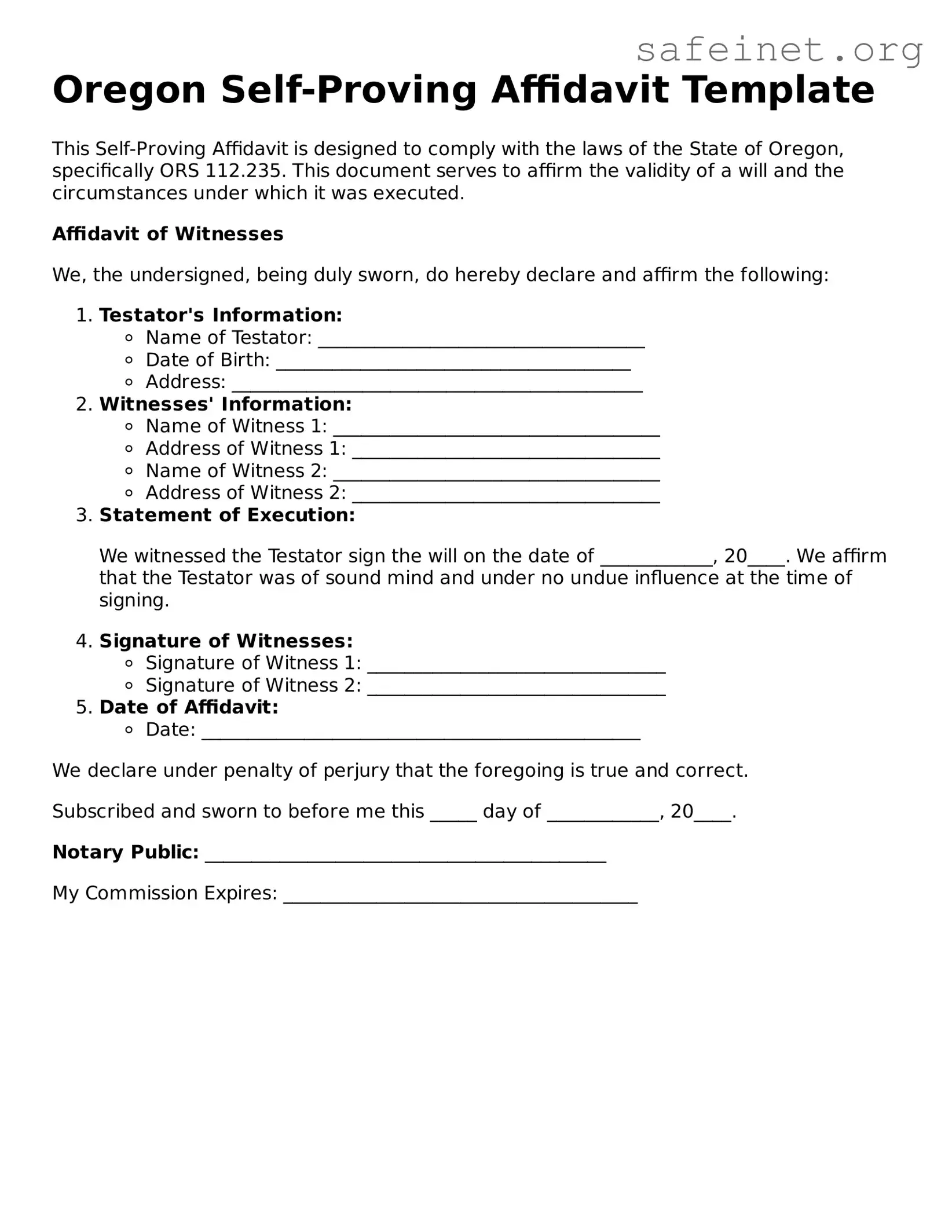
This Self-Proving Affidavit is designed to comply with the laws of the State of Oregon, specifically ORS 112.235. This document serves to affirm the validity of a will and the circumstances under which it was executed.
Affidavit of Witnesses
We, the undersigned, being duly sworn, do hereby declare and affirm the following:
We witnessed the Testator sign the will on the date of ____________, 20____. We affirm that the Testator was of sound mind and under no undue influence at the time of signing.
We declare under penalty of perjury that the foregoing is true and correct.
Subscribed and sworn to before me this _____ day of ____________, 20____.
Notary Public: ___________________________________________
My Commission Expires: ______________________________________
| Fact Name | Details |
|---|---|
| Definition | The Oregon Self-Proving Affidavit is a legal document that allows a will to be accepted without the need for witnesses to testify in court. |
| Governing Law | This form is governed by Oregon Revised Statutes (ORS) 112.235. |
| Purpose | The primary purpose is to simplify the probate process by affirming the validity of a will. |
| Eligibility | Any person who has executed a will in Oregon can use this affidavit, provided it meets specific requirements. |
| Signatures Required | The affidavit must be signed by the testator and at least two witnesses who are present at the same time. |
| Notarization | While notarization is not required, it is recommended to enhance the document's credibility. |
| Effect on Probate | Using a self-proving affidavit can expedite the probate process, as it eliminates the need for witness testimony. |
| Storage | It is advisable to keep the affidavit with the will in a safe place to ensure easy access during probate. |
| Limitations | Not all wills are eligible for this affidavit; it must comply with Oregon's statutory requirements for self-proving documents. |
After gathering all necessary information and documents, you can begin filling out the Oregon Self-Proving Affidavit form. This process will ensure that your will is validated without requiring witnesses to testify in court later on.
What is an Oregon Self-Proving Affidavit?
The Oregon Self-Proving Affidavit is a legal document that allows a will to be validated without requiring witnesses to testify in court. This affidavit is typically signed by the testator (the person who made the will) and witnesses in the presence of a notary public. By including this document with the will, the process of probate can be streamlined, as it eliminates the need for witnesses to appear in court to confirm the will’s authenticity.
Why should I use a Self-Proving Affidavit?
Using a Self-Proving Affidavit can save time and reduce complications during the probate process. When a will is self-proving, the court accepts it as valid without needing to summon witnesses. This can be especially beneficial if witnesses are unavailable or if their memories of the events have faded. Additionally, it provides clarity and assurance that the will reflects the testator's intentions.
How do I create a Self-Proving Affidavit in Oregon?
To create a Self-Proving Affidavit, you need to follow a few steps. First, ensure that your will is properly drafted and signed. Next, during the signing of the will, have at least two witnesses present. After the will is signed, the witnesses and the testator should complete the Self-Proving Affidavit in the presence of a notary public. The notary will then verify the identities of those signing and affix their seal. It’s important to keep this affidavit with the will when it is filed for probate.
Is there a specific format for the Self-Proving Affidavit?
Yes, Oregon law provides a specific format for the Self-Proving Affidavit. While the exact wording can vary, it generally includes statements confirming the identities of the testator and witnesses, as well as their affirmations regarding the signing of the will. It’s advisable to use a template or consult legal resources to ensure that all necessary components are included and that the document complies with state requirements.
Can I revoke a Self-Proving Affidavit?
Yes, a Self-Proving Affidavit can be revoked, but doing so typically requires revoking the will itself. If a testator decides to create a new will, the new document should either replace the old one entirely or explicitly revoke it. It is important to ensure that the new will includes a new Self-Proving Affidavit if the testator wishes to maintain that streamlined process for probate.
What happens if I don’t use a Self-Proving Affidavit?
If you choose not to use a Self-Proving Affidavit, the will can still be valid, but it may complicate the probate process. In such cases, witnesses may need to be called to testify about the circumstances surrounding the will’s signing. This can lead to delays, increased costs, and potential disputes among heirs or beneficiaries. Therefore, while not mandatory, a Self-Proving Affidavit is a helpful tool to simplify matters during probate.
Failing to include the correct title of the document. Many individuals neglect to specify that the affidavit is a self-proving affidavit, which can lead to confusion.
Not signing in the presence of a notary. The affidavit must be signed in front of a notary public to be valid. Some people overlook this requirement.
Incorrectly identifying witnesses. The form requires the names and signatures of witnesses. Errors in spelling or incorrect information can invalidate the affidavit.
Using outdated forms. Legal documents can change over time. Using an old version of the self-proving affidavit can lead to complications.
Neglecting to date the document. A date is essential for establishing when the affidavit was executed. Omitting this can create issues in the future.
Providing incomplete information. Each section of the affidavit must be filled out completely. Incomplete forms may be rejected.
Not understanding the purpose of the affidavit. Some individuals fill out the form without fully grasping its significance in the probate process.
Failing to keep copies. After completing the affidavit, individuals should retain copies for their records. Lack of documentation can lead to disputes.
Ignoring state-specific requirements. Each state may have unique laws regarding self-proving affidavits. Not adhering to Oregon's specific rules can render the document ineffective.
Overlooking the need for clarity in language. Ambiguous or unclear wording can lead to misinterpretation. It is important to use straightforward language.
The Oregon Self-Proving Affidavit is a valuable document that serves to validate a will by confirming that the testator and witnesses signed it. In addition to this affidavit, several other forms and documents may be used in conjunction with the self-proving affidavit to ensure proper estate management and execution of the will. Below is a list of commonly associated documents.
These documents work together to ensure that the wishes of the deceased are honored and that the estate is managed according to the law. Each form plays a critical role in the estate planning process.
The Oregon Self-Proving Affidavit form shares similarities with the Affidavit of Execution. This document serves as proof that a will was properly executed in accordance with state laws. Like the Self-Proving Affidavit, it requires the signatures of witnesses who can affirm that they observed the testator sign the will. Both documents aim to simplify the probate process by providing evidence of the will's validity without needing the witnesses to testify in court.
Another document akin to the Oregon Self-Proving Affidavit is the Will Contest Affidavit. This affidavit is utilized when someone disputes the validity of a will. It often includes statements from witnesses or interested parties regarding the circumstances surrounding the will's creation. Similar to the Self-Proving Affidavit, it can help streamline legal proceedings by providing necessary information upfront, potentially reducing the need for lengthy court battles.
The Durable Power of Attorney is also comparable to the Self-Proving Affidavit in its purpose of facilitating legal processes. This document allows an individual to designate another person to make decisions on their behalf, particularly regarding financial matters. Both documents require signatures and may need notarization to ensure authenticity. They serve to clarify intentions and reduce ambiguity in legal situations.
The Living Will is another document that parallels the Self-Proving Affidavit. This form outlines a person's wishes regarding medical treatment in case they become incapacitated. Like the Self-Proving Affidavit, it is designed to provide clear guidance and minimize confusion during critical times. Both documents reflect an individual's preferences and can ease the decision-making burden on family members.
The Affidavit of Identity is similar in that it serves to verify a person's identity in various legal contexts. This document can be used in situations where proof of identity is required, such as when executing a will or other legal documents. While the Self-Proving Affidavit focuses on the execution of a will, both documents emphasize the importance of confirming identities to uphold the integrity of legal processes.
The Certificate of Trust is another document that shares characteristics with the Self-Proving Affidavit. This certificate provides information about a trust's existence and terms without disclosing the entire trust document. Similar to the Self-Proving Affidavit, it aims to simplify legal proceedings by offering essential details that can help facilitate transactions or legal actions involving the trust.
The Consent to Serve as Personal Representative is also akin to the Self-Proving Affidavit. This document is signed by an individual agreeing to act as the personal representative of an estate. Like the Self-Proving Affidavit, it helps clarify roles and responsibilities in the probate process. Both documents aim to streamline legal proceedings by ensuring that all parties are aware of their obligations and consent to their roles.
Lastly, the Affidavit of Heirship is similar to the Self-Proving Affidavit in its function of establishing the rightful heirs of a deceased person's estate. This document typically includes statements from witnesses who can confirm the relationship between the deceased and the heirs. Both documents serve to clarify legal matters and can simplify the distribution of assets, reducing potential disputes among heirs.
When filling out the Oregon Self-Proving Affidavit form, it's essential to follow specific guidelines to ensure accuracy and compliance. Here’s a helpful list of dos and don’ts:
By following these guidelines, you can help ensure that the Self-Proving Affidavit is completed correctly and is legally valid in Oregon.
The Oregon Self-Proving Affidavit form is often misunderstood. Here are four common misconceptions:
When filling out and using the Oregon Self-Proving Affidavit form, it is essential to keep several key points in mind. This form serves a specific purpose in the estate planning process, ensuring that a will can be validated without requiring witnesses to appear in court.