When renting a room in Oregon, having a clear and comprehensive Room Rental Agreement is essential for both landlords and tenants. This agreement outlines the terms and conditions of the rental arrangement, ensuring that both parties understand their rights and responsibilities. Key aspects of the form include the rental amount, payment due dates, and the duration of the lease. It also addresses security deposits, maintenance responsibilities, and rules regarding the use of common areas. Additionally, the agreement may specify policies on guests, pets, and termination procedures. By clearly detailing these elements, the Room Rental Agreement helps prevent misunderstandings and provides a framework for resolving disputes should they arise.
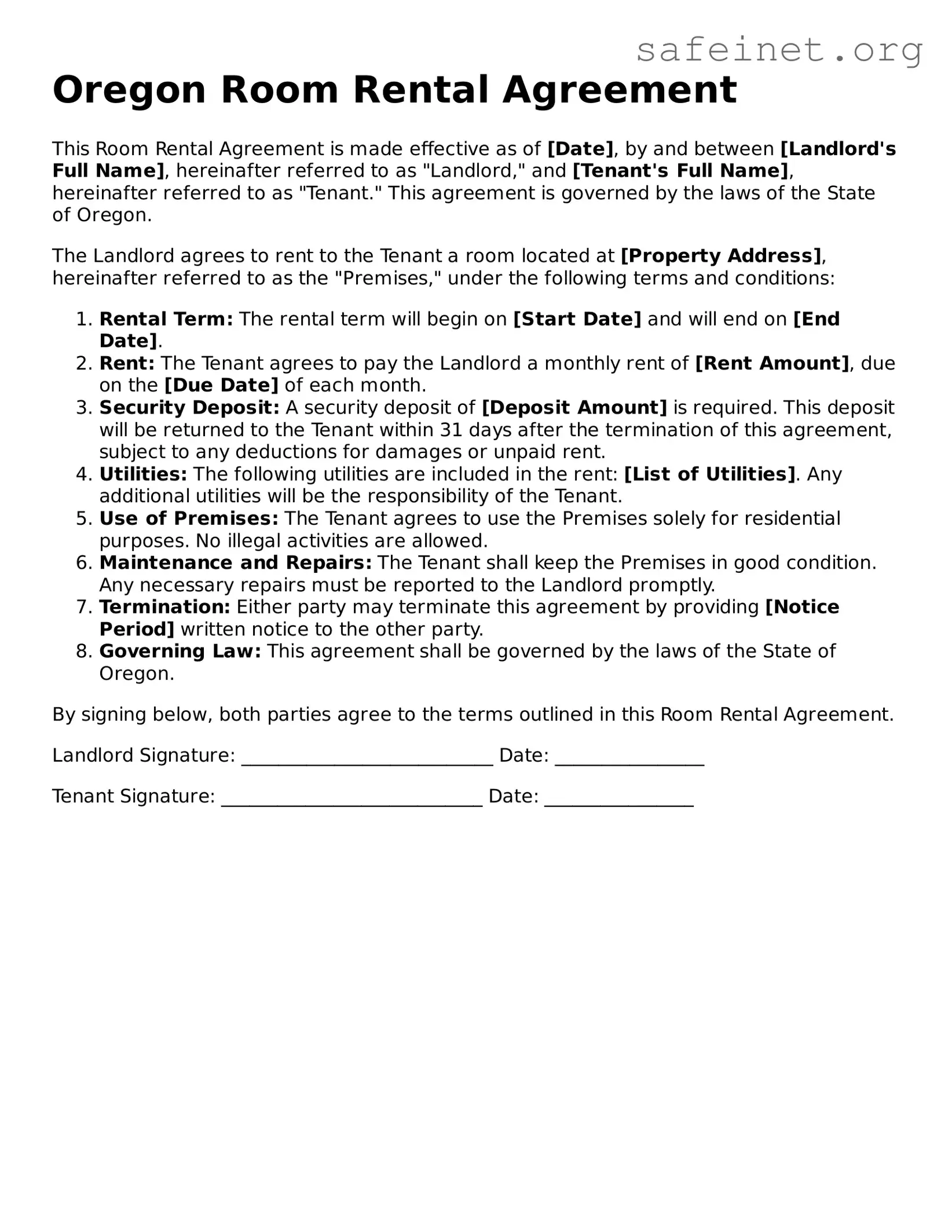
Oregon Room Rental Agreement
This Room Rental Agreement is made effective as of [Date], by and between [Landlord's Full Name], hereinafter referred to as "Landlord," and [Tenant's Full Name], hereinafter referred to as "Tenant." This agreement is governed by the laws of the State of Oregon.
The Landlord agrees to rent to the Tenant a room located at [Property Address], hereinafter referred to as the "Premises," under the following terms and conditions:
By signing below, both parties agree to the terms outlined in this Room Rental Agreement.
Landlord Signature: ___________________________ Date: ________________
Tenant Signature: ____________________________ Date: ________________
| Fact Name | Description |
|---|---|
| Legal Requirement | The Oregon Room Rental Agreement is governed by Oregon state law, specifically the Oregon Residential Landlord and Tenant Act. |
| Purpose | This form is used to outline the terms and conditions of renting a room in a residential property. |
| Essential Elements | It typically includes details such as rent amount, payment due dates, and responsibilities of both the landlord and tenant. |
| Duration | The agreement can specify a fixed term or be month-to-month, depending on the arrangement between the parties. |
| Security Deposit | Oregon law allows landlords to collect a security deposit, which must be clearly stated in the agreement. |
Filling out the Oregon Room Rental Agreement form is a straightforward process that requires attention to detail. Once completed, this document will serve as a binding agreement between the landlord and tenant, outlining the terms of the rental arrangement. Below are the steps to guide you through filling out the form.
What is the Oregon Room Rental Agreement form?
The Oregon Room Rental Agreement form is a legal document that outlines the terms and conditions under which a landlord rents a room to a tenant. This agreement helps protect the rights of both parties by clearly stating the responsibilities, obligations, and expectations involved in the rental arrangement.
Who should use the Oregon Room Rental Agreement form?
This form is suitable for landlords who are renting out individual rooms within a property, as well as tenants seeking to rent a room. Whether it’s a shared house, an apartment, or a single-family home, this agreement is essential for establishing clear communication and understanding between the landlord and tenant.
What key elements are included in the agreement?
The agreement typically includes important details such as the names of the landlord and tenant, the rental property's address, the rental amount, the duration of the rental period, security deposit requirements, and rules regarding shared spaces. It may also cover maintenance responsibilities and procedures for terminating the agreement.
How does the security deposit work in the Oregon Room Rental Agreement?
In Oregon, a landlord can require a security deposit, which is usually equivalent to one month's rent. This deposit serves as a financial safeguard for the landlord against potential damages or unpaid rent. The agreement should specify the amount, how it will be held, and the conditions under which it will be returned to the tenant at the end of the rental period.
Can the terms of the agreement be changed after it is signed?
Once the Oregon Room Rental Agreement is signed, the terms are legally binding. However, if both the landlord and tenant agree to modifications, they can create an addendum to the original agreement. This addendum should be signed by both parties to ensure that any changes are enforceable.
What happens if a tenant wants to terminate the agreement early?
If a tenant wishes to end the rental agreement before the specified term, they must refer to the termination clause within the agreement. This clause outlines the notice period required and any penalties for early termination. Generally, providing written notice is essential to avoid misunderstandings.
Are there any specific state laws that affect the Oregon Room Rental Agreement?
Yes, Oregon has specific laws regarding rental agreements, including regulations on security deposits, notice periods for termination, and tenant rights. Familiarizing oneself with these laws is crucial for both landlords and tenants to ensure compliance and protect their rights.
Where can I obtain a copy of the Oregon Room Rental Agreement form?
Landlords and tenants can typically find the Oregon Room Rental Agreement form online through legal document websites, local government offices, or real estate associations. It is important to use a current version of the form to ensure that it complies with the latest state laws and regulations.
Incomplete Information: Many people forget to fill in all required fields. Missing details like names, addresses, or dates can lead to confusion later.
Incorrect Dates: Double-check the rental period. Entering the wrong start or end date can cause disputes between the landlord and tenant.
Not Reading the Terms: Skimming through the terms and conditions is a common mistake. Understanding the rules is crucial to avoid future conflicts.
Failure to Sign: Forgetting to sign the agreement is a simple yet significant error. Without a signature, the document may not be legally binding.
Leaving Out Payment Details: Clearly stating the rent amount and payment method is essential. Omitting this information can lead to misunderstandings about financial obligations.
Ignoring Contact Information: Providing accurate contact details for both parties is vital. This ensures easy communication during the rental period.
Not Keeping a Copy: After filling out the form, many forget to keep a copy for their records. Having a copy can be helpful in case of disputes.
When renting a room in Oregon, several important documents often accompany the Room Rental Agreement. These documents help clarify the terms of the rental, protect both the landlord's and tenant's rights, and ensure a smooth rental process. Here’s a brief overview of some commonly used forms and documents:
Understanding these documents can greatly enhance the renting experience for both landlords and tenants. By ensuring all necessary paperwork is in order, both parties can foster a positive and transparent relationship throughout the rental period.
The Oregon Room Rental Agreement form shares similarities with the Lease Agreement. Both documents outline the terms and conditions under which a tenant can occupy a property. They typically include details such as the duration of the rental period, payment terms, and responsibilities of both the landlord and tenant. While a Lease Agreement may cover longer-term rentals, the Room Rental Agreement often pertains to shorter stays, making it suitable for various living arrangements.
Another document that resembles the Oregon Room Rental Agreement is the Sublease Agreement. This agreement allows a tenant to rent out their leased property to another party. Like the Room Rental Agreement, it specifies the rental terms, including duration and payment. Both documents ensure that all parties understand their rights and obligations, promoting clear communication and minimizing potential disputes.
The Rental Application form is also comparable to the Oregon Room Rental Agreement. While the Room Rental Agreement formalizes the rental terms, the Rental Application gathers essential information about potential tenants. This document typically includes personal details, rental history, and references. Both documents are crucial in the rental process, helping landlords make informed decisions while ensuring a smooth tenant onboarding experience.
The Property Management Agreement is another related document. This agreement outlines the relationship between a property owner and a property management company. Similar to the Room Rental Agreement, it details responsibilities, fees, and the duration of the management services. Both documents aim to protect the interests of the property owner while ensuring that tenants receive quality service and support.
The Move-In Checklist also bears similarities to the Oregon Room Rental Agreement. This document serves as a record of the property's condition at the start of a rental period. It helps tenants identify any existing issues and ensures that landlords are aware of the property's state. Both documents emphasize the importance of clear communication and documentation, which can help prevent misunderstandings later on.
Finally, the Eviction Notice is another document that aligns with the Oregon Room Rental Agreement. While the Room Rental Agreement sets the terms for occupancy, the Eviction Notice outlines the process for terminating that agreement under specific circumstances. Both documents are essential in the rental relationship, as they establish the framework for tenant rights and responsibilities, ensuring that all parties are aware of the consequences of non-compliance.
When filling out the Oregon Room Rental Agreement form, it is essential to be thorough and accurate. Here are nine important dos and don'ts to keep in mind:
Understanding the Oregon Room Rental Agreement form is essential for both landlords and tenants. However, several misconceptions often arise regarding this important document. Below are nine common misunderstandings, clarified for your benefit.
Many believe this form is applicable only for leases longer than a year. In reality, it can be used for both short-term and long-term rentals, making it versatile for various rental situations.
While the agreement does create obligations for both parties, it must be properly executed and signed to be enforceable. Simply having the form does not automatically make it binding.
While many terms can be negotiated, some are set by state law and cannot be altered. Understanding which terms are flexible and which are not is crucial.
Tenants also have the right to suggest changes to the agreement. Open communication can lead to a mutually beneficial arrangement.
In many cases, a security deposit is required to protect the landlord against potential damages. This is a standard practice, and tenants should be prepared for this possibility.
This form provides a framework but may not address every detail. Additional agreements or documents may be necessary to cover specific issues.
While verbal agreements can be made, they are difficult to enforce. Having a written agreement helps clarify expectations and protects both parties.
Even if you have a good relationship with a tenant, a written agreement is essential. It helps prevent misunderstandings and provides legal protection.
Agreements can be amended if both parties consent to the changes. Keeping an open dialogue can facilitate necessary adjustments.
By addressing these misconceptions, both landlords and tenants can approach the Oregon Room Rental Agreement with a clearer understanding, fostering a more positive rental experience.
Filling out and utilizing the Oregon Room Rental Agreement form is an important step for both landlords and tenants. Here are some key takeaways to keep in mind:
By following these guidelines, both landlords and tenants can foster a clear understanding of their rights and responsibilities, ultimately leading to a smoother rental experience.