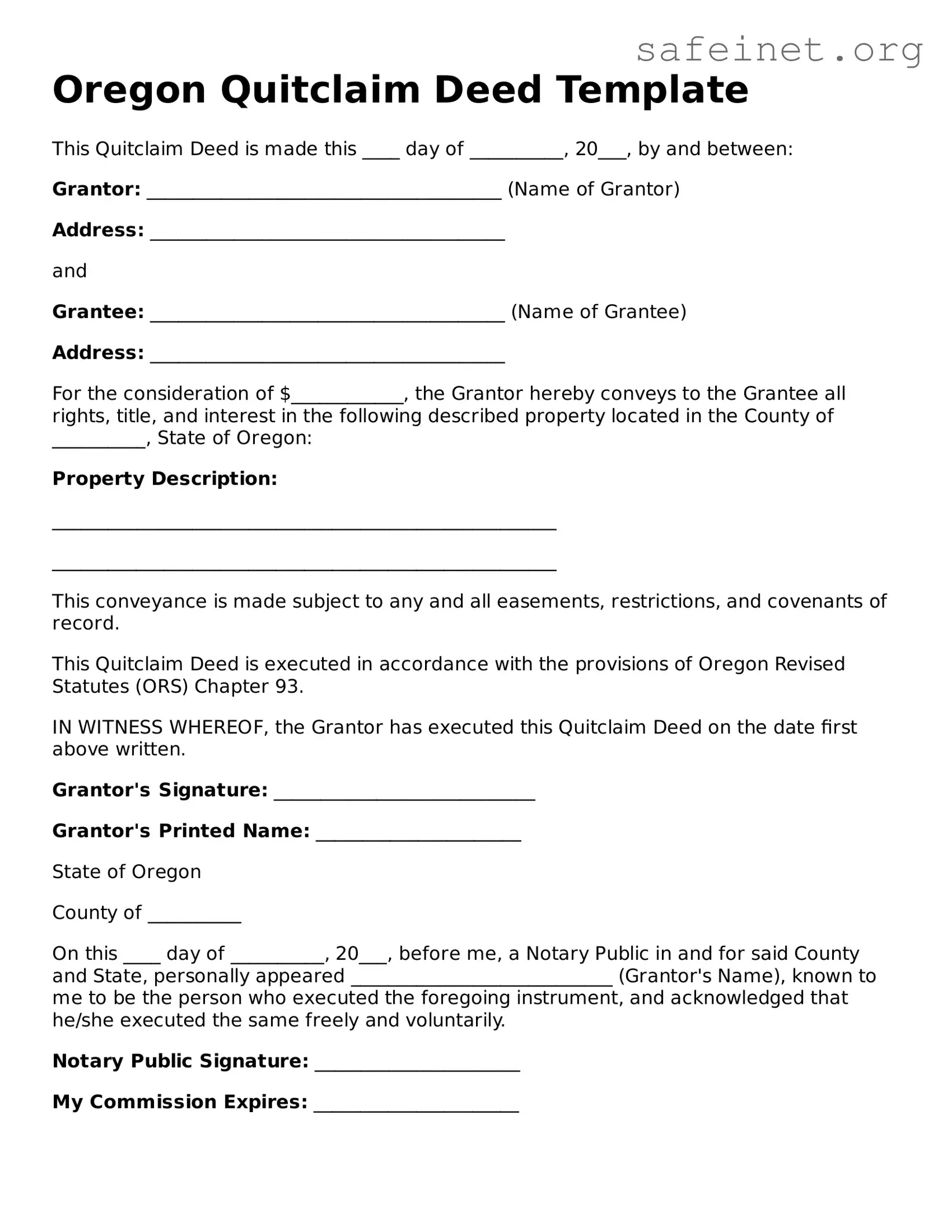
When it comes to transferring property in Oregon, the Quitclaim Deed form plays a crucial role. This simple yet effective document allows one party to transfer their interest in a property to another party without making any guarantees about the title. It’s particularly useful in situations like divorce settlements, where one spouse may need to relinquish their claim to a home. The form is straightforward and requires basic information, such as the names of the parties involved, a description of the property, and the signatures of those transferring their interest. While it does not provide the same level of protection as other types of deeds, such as warranty deeds, it serves its purpose well for those looking to make quick and uncomplicated property transfers. Understanding the Quitclaim Deed form is essential for anyone navigating property transactions in Oregon, whether you’re a homeowner, a buyer, or an attorney assisting clients in real estate matters.
Oregon Quitclaim Deed Template
This Quitclaim Deed is made this ____ day of __________, 20___, by and between:
Grantor: ______________________________________ (Name of Grantor)
Address: ______________________________________
and
Grantee: ______________________________________ (Name of Grantee)
Address: ______________________________________
For the consideration of $____________, the Grantor hereby conveys to the Grantee all rights, title, and interest in the following described property located in the County of __________, State of Oregon:
Property Description:
______________________________________________________
______________________________________________________
This conveyance is made subject to any and all easements, restrictions, and covenants of record.
This Quitclaim Deed is executed in accordance with the provisions of Oregon Revised Statutes (ORS) Chapter 93.
IN WITNESS WHEREOF, the Grantor has executed this Quitclaim Deed on the date first above written.
Grantor's Signature: ____________________________
Grantor's Printed Name: ______________________
State of Oregon
County of __________
On this ____ day of __________, 20___, before me, a Notary Public in and for said County and State, personally appeared ____________________________ (Grantor's Name), known to me to be the person who executed the foregoing instrument, and acknowledged that he/she executed the same freely and voluntarily.
Notary Public Signature: ______________________
My Commission Expires: ______________________
| Fact Name | Description |
|---|---|
| Definition | A quitclaim deed is a legal document that transfers ownership of real property from one party to another without any warranties regarding the property title. |
| Governing Laws | The Oregon Quitclaim Deed is governed by Oregon Revised Statutes (ORS) Chapter 93, which outlines the requirements for property conveyance. |
| Purpose | This form is often used to transfer property between family members, in divorce settlements, or to clear up title issues. |
| Title Transfer | With a quitclaim deed, the grantor (the person transferring the property) relinquishes any claim to the property, but does not guarantee that the title is clear. |
| Filing Requirements | The completed quitclaim deed must be filed with the county clerk in the county where the property is located to be effective. |
| Consideration | While a quitclaim deed can be executed for no consideration, it is common to include a nominal amount to formalize the transfer. |
| Notarization | The signature of the grantor must be notarized for the quitclaim deed to be legally binding and accepted for recording. |
| Limitations | Because quitclaim deeds do not provide any guarantees about the title, they may not be suitable for all property transfers, especially in transactions involving unknown title issues. |
After completing the Oregon Quitclaim Deed form, the next step involves submitting it to the appropriate county office for recording. This process ensures that the transfer of property rights is officially documented and recognized. It is advisable to keep a copy of the recorded deed for personal records.
What is a Quitclaim Deed in Oregon?
A Quitclaim Deed is a legal document used to transfer ownership of real property from one person to another in Oregon. This type of deed does not guarantee that the person transferring the property has clear title to it. Instead, it simply conveys whatever interest the grantor has in the property at the time of transfer.
When should I use a Quitclaim Deed?
Quitclaim Deeds are commonly used in situations where property is transferred between family members, during divorce settlements, or when clearing up title issues. They are ideal when the parties involved trust each other and do not require a title guarantee.
How do I fill out an Oregon Quitclaim Deed?
To fill out a Quitclaim Deed in Oregon, you need to include the names of the grantor (the person transferring the property) and the grantee (the person receiving the property), a legal description of the property, and the signature of the grantor. It is important to ensure that all information is accurate to avoid future disputes.
Do I need a notary for a Quitclaim Deed in Oregon?
Yes, in Oregon, a Quitclaim Deed must be signed in front of a notary public. This notarization helps verify the identity of the grantor and ensures that the deed is legally binding.
Is a Quitclaim Deed the same as a Warranty Deed?
No, a Quitclaim Deed is not the same as a Warranty Deed. A Warranty Deed provides a guarantee that the grantor holds clear title to the property and has the right to transfer it. In contrast, a Quitclaim Deed offers no such guarantees, making it a riskier option for the grantee.
Are there any fees associated with filing a Quitclaim Deed in Oregon?
Yes, there are typically fees associated with filing a Quitclaim Deed in Oregon. These fees can vary by county, so it is advisable to check with your local county clerk's office for specific amounts. Additionally, there may be costs for notarization and any necessary property surveys.
Can I revoke a Quitclaim Deed once it is filed?
Once a Quitclaim Deed is filed, it cannot be revoked unilaterally. If you wish to reverse the transfer, you would need to execute another deed that transfers the property back to the original owner, or you could seek legal advice on how to address the situation.
Do I need an attorney to prepare a Quitclaim Deed?
While it is not legally required to have an attorney prepare a Quitclaim Deed, it can be beneficial, especially if you have questions about the property title or the implications of the transfer. If you feel comfortable with the process, you can prepare the deed yourself using available templates.
Where do I file a Quitclaim Deed in Oregon?
A Quitclaim Deed should be filed with the county clerk's office in the county where the property is located. Once filed, the deed becomes part of the public record, which helps establish ownership and can be referenced in future transactions.
Incorrect Names: One common mistake is not using the full legal names of all parties involved. This includes both the grantor (the person transferring the property) and the grantee (the person receiving the property). Abbreviations or nicknames can lead to confusion and may complicate the transfer process.
Missing Signatures: All required signatures must be present on the form. If even one signature is missing, the deed may be considered invalid. Double-check to ensure that everyone involved has signed where necessary.
Improper Property Description: The property description must be clear and accurate. This includes the address and any legal descriptions that may apply. Failing to provide precise information can result in legal issues down the line.
Not Notarizing the Document: In Oregon, a Quitclaim Deed must be notarized to be legally binding. Skipping this step can render the deed unenforceable. Make sure to find a notary public who can witness the signatures.
When completing a property transfer in Oregon using a Quitclaim Deed, several other documents may be necessary to ensure the process goes smoothly. Each of these documents serves a specific purpose and can help clarify ownership, facilitate the transfer, or fulfill legal requirements. Below is a list of commonly used forms and documents that often accompany a Quitclaim Deed.
Understanding these additional documents can help streamline the property transfer process and protect both buyers and sellers. Each document plays a crucial role in ensuring that the transaction is legally sound and that all parties are adequately informed about their rights and responsibilities.
The Warranty Deed is often compared to the Quitclaim Deed. Both documents transfer property ownership, but they differ significantly in the guarantees they provide. A Warranty Deed assures the buyer that the seller has clear title to the property and has the right to sell it. If any issues arise regarding ownership, the seller is responsible for resolving them. In contrast, a Quitclaim Deed offers no such assurances, making it a riskier option for buyers.
The Bargain and Sale Deed is another document similar to the Quitclaim Deed. This deed transfers ownership of property but does not guarantee that the title is clear. It implies that the seller has an interest in the property and is transferring that interest to the buyer. Like the Quitclaim Deed, it offers limited protection to the buyer, as it does not provide any warranties about the title.
A Special Purpose Deed is also comparable to the Quitclaim Deed. This type of deed is used for specific transactions, such as transferring property between family members or in divorce settlements. While it may serve a particular purpose, it typically does not include warranties about the property title, similar to the Quitclaim Deed.
The Trustee's Deed is another document that shares similarities with the Quitclaim Deed. This deed is used when a property is transferred by a trustee, often during a foreclosure or bankruptcy. While it conveys ownership, it usually does not provide any warranties regarding the title, leaving the buyer with the same level of risk as with a Quitclaim Deed.
A Deed in Lieu of Foreclosure is also akin to a Quitclaim Deed. This document allows a borrower to transfer their property to the lender to avoid foreclosure. While it effectively transfers ownership, it does not guarantee a clear title. Buyers should exercise caution, as they may inherit any existing liens or claims against the property.
The Life Estate Deed is another document that can be likened to the Quitclaim Deed. This deed allows an individual to transfer property while retaining certain rights, such as the right to live on the property for life. While it does convey ownership, it typically does not offer warranties about the title, similar to the Quitclaim Deed.
Lastly, the Gift Deed shares characteristics with the Quitclaim Deed. This document is used when property is transferred as a gift, often between family members. Like the Quitclaim Deed, a Gift Deed does not guarantee that the title is clear, which may expose the recipient to potential claims or issues with the property.
When filling out the Oregon Quitclaim Deed form, it’s essential to approach the task with care. Here’s a list of things to do and avoid to ensure a smooth process.
Understanding the Oregon Quitclaim Deed form can be challenging. Many people hold misconceptions about its purpose and use. Here are ten common misunderstandings:
By clearing up these misconceptions, individuals can better understand the Oregon Quitclaim Deed and its appropriate use in property transactions.
When utilizing the Oregon Quitclaim Deed form, it is essential to understand several key aspects to ensure the process is completed correctly. The following takeaways provide important information regarding this legal document.
Understanding these points can facilitate a smoother property transfer process in Oregon.