When couples in Oregon consider marriage, they often overlook the importance of a prenuptial agreement. This legal document serves as a proactive measure to outline each partner's rights and responsibilities concerning property and finances in the event of a divorce or separation. By addressing issues such as asset division, debt allocation, and spousal support, the Oregon Prenuptial Agreement form provides clarity and security for both parties. It allows couples to customize their agreement based on their unique circumstances, ensuring that their wishes are respected should the relationship end. Additionally, the form typically requires full disclosure of assets and liabilities, promoting transparency and trust between partners. As a tool for financial planning, it can also help mitigate potential conflicts and misunderstandings, fostering a healthier dialogue about money matters before saying "I do." Understanding the nuances of this form is essential for anyone contemplating marriage in Oregon, as it lays the groundwork for a more informed and equitable partnership.
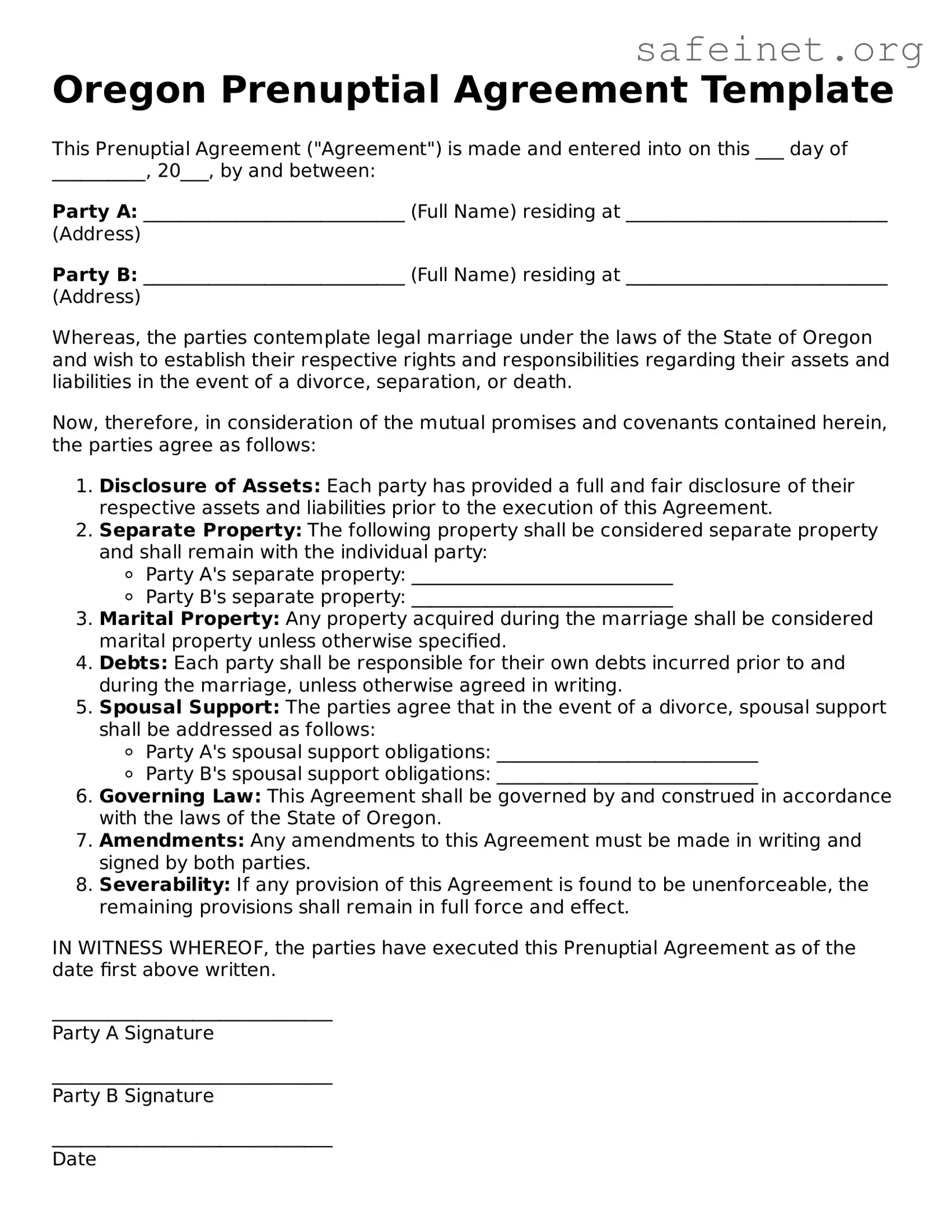
Oregon Prenuptial Agreement Template
This Prenuptial Agreement ("Agreement") is made and entered into on this ___ day of __________, 20___, by and between:
Party A: ____________________________ (Full Name) residing at ____________________________ (Address)
Party B: ____________________________ (Full Name) residing at ____________________________ (Address)
Whereas, the parties contemplate legal marriage under the laws of the State of Oregon and wish to establish their respective rights and responsibilities regarding their assets and liabilities in the event of a divorce, separation, or death.
Now, therefore, in consideration of the mutual promises and covenants contained herein, the parties agree as follows:
IN WITNESS WHEREOF, the parties have executed this Prenuptial Agreement as of the date first above written.
______________________________
Party A Signature
______________________________
Party B Signature
______________________________
Date
| Fact Name | Details |
|---|---|
| Definition | An Oregon Prenuptial Agreement is a legal document that outlines the distribution of assets and responsibilities in the event of a divorce or separation. |
| Governing Laws | The agreement is governed by the Oregon Uniform Premarital Agreement Act, found in Oregon Revised Statutes (ORS) Chapter 108. |
| Eligibility | Both parties must voluntarily enter into the agreement, and it must be signed before the marriage takes place. |
| Disclosure Requirements | Full financial disclosure is required from both parties to ensure that each person is aware of the other's assets and debts. |
| Enforceability | The agreement is enforceable in court, provided it meets certain legal standards, such as being fair and reasonable at the time of signing. |
| Amendments | Any changes to the agreement must be made in writing and signed by both parties to be valid. |
| Legal Advice | While not required, it is highly recommended that both parties seek independent legal advice before signing the agreement to ensure their rights are protected. |
Filling out the Oregon Prenuptial Agreement form is a straightforward process. By following these steps, you can ensure that all necessary information is included and that the document is completed correctly.
After completing the form, it is advisable to consult with a legal professional to ensure that everything is in order. This step can help avoid any misunderstandings in the future.
What is a prenuptial agreement in Oregon?
A prenuptial agreement, often called a prenup, is a legal contract between two people before they get married. In Oregon, this agreement outlines how assets and debts will be divided if the marriage ends in divorce or separation. It can also address issues such as spousal support. Having a prenup can provide clarity and peace of mind for both parties, ensuring that each person's rights and responsibilities are clearly defined from the start.
How do I create a prenuptial agreement in Oregon?
To create a prenuptial agreement in Oregon, both parties must agree on the terms and conditions. It’s advisable to consult with a lawyer who specializes in family law to ensure that the agreement is legally enforceable. Each party should fully disclose their assets and debts. After drafting the agreement, both parties must sign it, preferably in the presence of a notary public. This helps to validate the document and adds an extra layer of protection.
Can a prenuptial agreement be changed or revoked in Oregon?
Yes, a prenuptial agreement can be changed or revoked in Oregon, but both parties must agree to the changes. This typically involves drafting a new agreement that outlines the revised terms. It is important to follow the same legal processes as the original agreement, including full disclosure of assets and signing in front of a notary. Keep in mind that any changes should be made well in advance of any divorce proceedings to avoid complications.
What happens if a prenuptial agreement is not signed?
If a prenuptial agreement is not signed before marriage, the couple will be subject to Oregon’s default divorce laws. This means that, in the event of a divorce, assets and debts will be divided according to state law rather than the couple's preferences. Without a prenup, the court will determine how property is divided and whether spousal support is awarded, which may not align with what either party desires.
Incomplete Information: Many individuals fail to provide all necessary details. This includes not listing all assets, debts, and income sources. Omitting crucial information can lead to disputes later.
Not Seeking Legal Advice: Some people choose to fill out the form without consulting an attorney. Legal advice is essential to ensure that the agreement is fair and enforceable.
Failure to Disclose Assets: Transparency is key. If one party does not fully disclose their assets, it can invalidate the agreement. Full disclosure builds trust and protects both parties.
Rushing the Process: Taking time to carefully consider the terms is important. Many couples rush through the process, leading to misunderstandings or overlooked details.
Not Reviewing the Agreement Periodically: Life changes, and so should your prenuptial agreement. Failing to revisit and update the agreement can leave it outdated and ineffective.
When preparing a prenuptial agreement in Oregon, it is essential to consider several other documents that may complement or enhance the agreement. These documents can provide clarity and ensure that both parties are fully informed about their rights and responsibilities. Below is a list of commonly used forms and documents associated with a prenuptial agreement.
Considering these documents alongside the Oregon Prenuptial Agreement can help ensure that both parties are protected and that their interests are clearly defined. It is advisable to consult with a legal professional to navigate these forms effectively.
The Oregon Prenuptial Agreement form is similar to a Marital Settlement Agreement. Both documents outline the terms of property division and support obligations in the event of a divorce. A Marital Settlement Agreement is typically created after marriage, while a prenuptial agreement is established before marriage. Both serve to clarify financial responsibilities and protect individual assets, ensuring that both parties have a clear understanding of their rights and obligations.
Another document that shares similarities is the Postnuptial Agreement. Like a prenuptial agreement, a postnuptial agreement is a contract between spouses that addresses the division of assets and debts. The key difference is that a postnuptial agreement is executed after the marriage has taken place. Both agreements aim to provide clarity and reduce conflict in the event of separation or divorce.
The Cohabitation Agreement is also comparable to the Oregon Prenuptial Agreement. This document is used by couples who live together but are not married. It outlines how assets and debts will be handled during the relationship and in the event of a breakup. Both agreements help protect individual interests and provide a framework for financial responsibilities.
A Separation Agreement is another similar document. This is used when a couple decides to live apart but is not yet divorced. It addresses issues like property division, child custody, and support. While a prenuptial agreement is proactive, a separation agreement is often reactive, dealing with the realities of a relationship that is ending.
The Property Settlement Agreement is akin to a prenuptial agreement in that it deals specifically with the division of property and assets. This document is typically created during divorce proceedings and outlines how marital property will be divided. Both agreements focus on asset protection and can prevent lengthy disputes during separation.
The Domestic Partnership Agreement is also similar, particularly for couples in domestic partnerships. This agreement outlines the rights and responsibilities of partners, similar to what a prenuptial agreement does for married couples. It covers aspects like property rights and financial responsibilities, ensuring both parties are protected.
A Business Partnership Agreement has similarities in terms of asset protection and financial clarity. While it pertains to business partners, it serves a similar purpose in defining roles, responsibilities, and the division of assets in the event of dissolution. Both agreements are crucial for preventing disputes and ensuring smooth transitions.
The Will, while primarily a document for after death, shares some characteristics with a prenuptial agreement regarding asset distribution. Both documents help clarify how assets will be handled, though a will focuses on distribution after death, while a prenuptial agreement addresses these issues before marriage or during separation.
Lastly, the Trust Agreement can be compared to a prenuptial agreement in terms of asset protection. A trust is often used to manage and protect assets for beneficiaries, similar to how a prenuptial agreement protects individual assets in a marriage. Both documents provide a structured approach to asset management and distribution.
When filling out the Oregon Prenuptial Agreement form, it's important to approach the process thoughtfully. Here are some key dos and don'ts to consider:
Taking these steps can help ensure that your prenuptial agreement serves its intended purpose, providing clarity and protection for both parties.
When considering a prenuptial agreement in Oregon, many individuals hold misconceptions that can lead to confusion. Understanding these misconceptions is essential for making informed decisions. Below are six common misunderstandings about the Oregon Prenuptial Agreement form.
Understanding these misconceptions can help individuals approach the process of creating a prenuptial agreement with clarity and confidence. It is important to consult with legal professionals to ensure that all aspects are properly addressed.
Filling out and using the Oregon Prenuptial Agreement form requires careful attention to detail. Here are key takeaways to consider:
By following these guidelines, both parties can create a fair and effective prenuptial agreement that protects their interests.