The Oregon Power of Attorney form is a vital legal document that allows individuals to appoint someone they trust to make decisions on their behalf, particularly in financial or medical matters. This form empowers the designated agent to act in the best interest of the principal, ensuring that their wishes are respected even when they are unable to communicate or make decisions themselves. Key aspects of this form include the ability to specify the scope of authority granted, whether it be broad or limited, and the option to include specific instructions regarding healthcare decisions. Additionally, the form can be tailored to remain effective even if the principal becomes incapacitated, providing peace of mind for both parties involved. Understanding the nuances of the Oregon Power of Attorney form is essential for anyone looking to safeguard their interests and ensure that their affairs are managed according to their preferences. By carefully considering who to appoint and what powers to grant, individuals can take a proactive step toward securing their future and alleviating potential burdens on their loved ones.
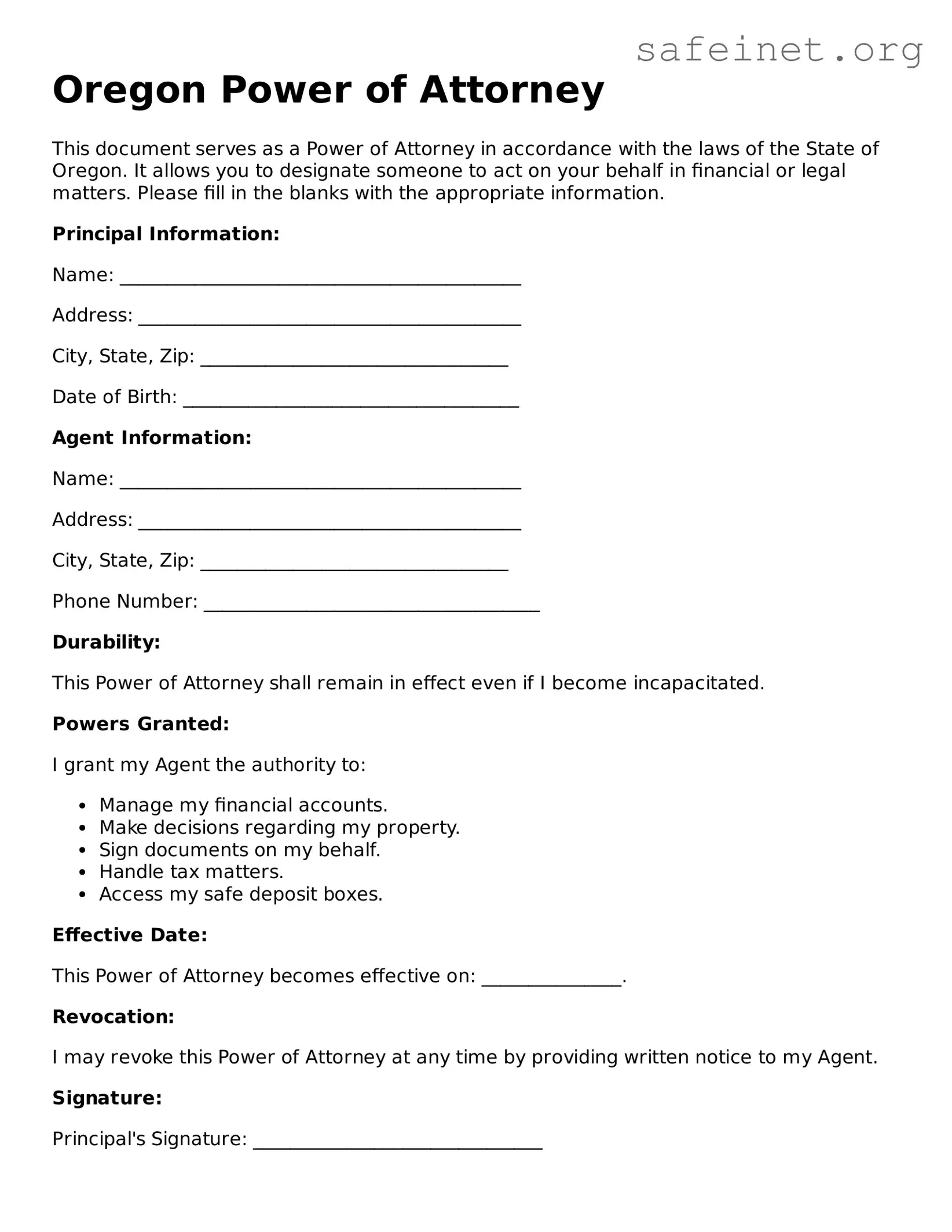
Oregon Power of Attorney
This document serves as a Power of Attorney in accordance with the laws of the State of Oregon. It allows you to designate someone to act on your behalf in financial or legal matters. Please fill in the blanks with the appropriate information.
Principal Information:
Name: ___________________________________________
Address: _________________________________________
City, State, Zip: _________________________________
Date of Birth: ____________________________________
Agent Information:
Name: ___________________________________________
Address: _________________________________________
City, State, Zip: _________________________________
Phone Number: ____________________________________
Durability:
This Power of Attorney shall remain in effect even if I become incapacitated.
Powers Granted:
I grant my Agent the authority to:
Effective Date:
This Power of Attorney becomes effective on: _______________.
Revocation:
I may revoke this Power of Attorney at any time by providing written notice to my Agent.
Signature:
Principal's Signature: _______________________________
Date: _____________________________________________
Witnesses:
Two witnesses are required for this document to be valid.
Notarization:
This document must be notarized to be effective.
Notary Public Signature: ____________________________
Date: _____________________________________________
My commission expires: _____________________________
| Fact Name | Details |
|---|---|
| Definition | The Oregon Power of Attorney form allows a person (the principal) to appoint another individual (the agent) to make decisions on their behalf. |
| Governing Laws | The form is governed by the Oregon Revised Statutes, specifically ORS 94.600 to ORS 94.660. |
| Types of Powers | It can grant general or specific powers, covering financial, legal, and healthcare decisions. |
| Durability | The Oregon Power of Attorney can be durable, meaning it remains effective even if the principal becomes incapacitated. |
| Revocation | The principal can revoke the Power of Attorney at any time, as long as they are mentally competent. |
Filling out the Oregon Power of Attorney form is a straightforward process that allows you to designate someone to act on your behalf in various matters. After completing the form, you will need to ensure that it is properly signed and witnessed, which is crucial for its validity.
What is a Power of Attorney in Oregon?
A Power of Attorney (POA) in Oregon is a legal document that allows one person, known as the principal, to appoint another person, called the agent or attorney-in-fact, to make decisions on their behalf. This can include financial, medical, or legal matters. The principal must be of sound mind when signing the document, and the agent must act in the best interests of the principal.
What types of Power of Attorney are available in Oregon?
Oregon recognizes several types of Power of Attorney. The most common are the general Power of Attorney, which grants broad authority to the agent, and the limited Power of Attorney, which restricts the agent’s authority to specific tasks or time periods. There is also a durable Power of Attorney, which remains effective even if the principal becomes incapacitated, and a medical Power of Attorney, which specifically addresses healthcare decisions.
How do I create a Power of Attorney in Oregon?
To create a Power of Attorney in Oregon, you must complete a written document that clearly states your wishes. The form should include your name, the name of your agent, and the specific powers you wish to grant. It is advisable to have the document signed in the presence of a notary public to ensure its validity. While not required, having witnesses can also strengthen the document's credibility.
Can I revoke a Power of Attorney in Oregon?
Yes, you can revoke a Power of Attorney at any time as long as you are competent. To do so, you should create a written revocation document and notify your agent and any relevant institutions or individuals. It is important to keep a copy of the revocation for your records to avoid any confusion in the future.
What happens if my agent does not act in my best interest?
If an agent fails to act in the best interest of the principal, the principal or their family members may take legal action against the agent. This could involve seeking to revoke the Power of Attorney, holding the agent accountable for any financial losses, or even pursuing criminal charges if the agent has committed fraud or theft.
Do I need an attorney to create a Power of Attorney in Oregon?
While it is not legally required to have an attorney to create a Power of Attorney in Oregon, consulting with one can be beneficial. An attorney can help ensure that the document meets all legal requirements and accurately reflects your wishes. They can also provide guidance on selecting an appropriate agent and discuss the implications of the powers you are granting.
Is a Power of Attorney valid in other states?
A Power of Attorney created in Oregon may be recognized in other states, but this is not guaranteed. Each state has its own laws regarding POAs. It is advisable to check the specific requirements of the state where the Power of Attorney will be used. If you plan to move or travel frequently, consider creating a new Power of Attorney that complies with the laws of your new state of residence.
Not specifying the type of Power of Attorney. People often forget to indicate whether they are creating a general or limited Power of Attorney. This can lead to confusion about the authority granted.
Failing to name an agent. Some individuals leave the agent section blank. This omission means there is no one designated to act on their behalf, which defeats the purpose of the document.
Inadequate description of powers. When filling out the form, people sometimes provide vague descriptions of the powers they wish to grant. Clear and specific language is crucial to avoid misunderstandings.
Not including alternate agents. Many forget to name an alternate agent. If the primary agent is unable or unwilling to act, having a backup can ensure that the individual's wishes are still honored.
Ignoring the signature requirements. Some individuals overlook the need for their signature and the date. Without these, the document may not be valid, rendering it useless.
Not having the form notarized or witnessed. Depending on the situation, failing to have the Power of Attorney notarized or witnessed can lead to complications. This step is often necessary for the document to be recognized legally.
When considering a Power of Attorney (POA) in Oregon, it’s important to understand that this document often works in conjunction with several other forms. Each of these documents serves a unique purpose and can help ensure that your wishes are respected and your affairs are managed effectively. Below is a list of commonly used forms alongside the Oregon Power of Attorney.
Understanding these documents can empower individuals to make informed decisions about their health care, finances, and estate planning. Each form plays a vital role in ensuring that your preferences are honored and that your loved ones are supported in times of need.
The Oregon Power of Attorney form shares similarities with the Durable Power of Attorney. Both documents grant an individual the authority to make decisions on behalf of another person. The key distinction lies in the durability of the authority. A Durable Power of Attorney remains effective even if the principal becomes incapacitated, ensuring that the appointed agent can continue to act in the principal's best interests during times of vulnerability.
Another document akin to the Oregon Power of Attorney is the Medical Power of Attorney. This specific form allows an individual to designate someone to make healthcare decisions on their behalf. While the general Power of Attorney can cover a broad range of decisions, the Medical Power of Attorney is focused solely on medical care and treatment, particularly in situations where the individual is unable to communicate their wishes.
The Living Will is also comparable to the Oregon Power of Attorney, particularly in its focus on healthcare decisions. However, while a Living Will outlines an individual's preferences regarding medical treatment in end-of-life situations, it does not appoint an agent to make those decisions. Instead, it serves as a directive for healthcare providers, guiding them on the individual's wishes when they are unable to express them.
A Revocable Trust shares some characteristics with the Oregon Power of Attorney, especially regarding the management of assets. In a Revocable Trust, an individual places their assets into a trust for management during their lifetime and distribution after death. While a Power of Attorney allows an agent to manage assets on behalf of the principal, a Revocable Trust provides a structured way to handle those assets, often avoiding probate and ensuring a smoother transition to beneficiaries.
The Health Care Proxy is another document that resembles the Oregon Power of Attorney. This form specifically allows an individual to appoint someone to make healthcare decisions when they cannot do so themselves. Like the Medical Power of Attorney, it focuses on health-related matters, but it may have different legal implications depending on state laws. The Health Care Proxy is essential for ensuring that a person's medical wishes are honored when they are unable to advocate for themselves.
Similar to the Oregon Power of Attorney is the Financial Power of Attorney. This document specifically grants authority to an agent to handle financial matters on behalf of the principal. While the general Power of Attorney can encompass both financial and healthcare decisions, the Financial Power of Attorney is dedicated solely to financial transactions, such as managing bank accounts, paying bills, and handling investments.
The Advance Directive is another document that parallels the Oregon Power of Attorney, as it combines elements of both a Living Will and a Medical Power of Attorney. An Advance Directive allows individuals to specify their medical treatment preferences and appoint a healthcare agent. This dual function makes it a comprehensive tool for ensuring that one’s healthcare wishes are respected while also designating someone to make decisions when necessary.
The Guardianship document also bears similarities to the Oregon Power of Attorney. Guardianship is a legal arrangement where a court appoints an individual to make decisions for someone who is unable to do so due to incapacity. While a Power of Attorney allows individuals to choose their agents, Guardianship requires court involvement, making it a more formal and often more restrictive process for managing another person's affairs.
The Special Power of Attorney is yet another related document. It grants an agent limited authority to act on behalf of the principal in specific situations, such as selling property or managing a particular transaction. Unlike the broader Oregon Power of Attorney, which can cover a wide range of decisions, the Special Power of Attorney is tailored to particular needs, providing a focused approach to delegation of authority.
Lastly, the Joint Power of Attorney is similar in that it allows two or more individuals to act as agents for the principal. This document can be structured to require joint action, meaning both agents must agree on decisions, or it can allow for independent action by either agent. This arrangement can be beneficial in ensuring checks and balances in decision-making, particularly in complex situations where multiple perspectives are valuable.
When filling out the Oregon Power of Attorney form, it's important to follow certain guidelines to ensure the document is valid and effective. Here are five things to do and five things to avoid:
Understanding the Oregon Power of Attorney form is essential for effective legal planning. However, several misconceptions can lead to confusion. Here are four common misconceptions:
Many people believe that a Power of Attorney in Oregon is solely for financial decisions. In reality, it can also cover healthcare decisions, allowing an agent to make medical choices on behalf of the principal if they are unable to do so.
Some individuals think that once a Power of Attorney is signed, it cannot be changed or revoked. This is incorrect. The principal has the right to revoke the Power of Attorney at any time, as long as they are mentally competent.
There is a misconception that only attorneys can draft a Power of Attorney. While legal advice can be helpful, individuals can create a valid Power of Attorney using templates or forms available online, provided they meet the state’s requirements.
Many assume that a Power of Attorney only takes effect when the principal is incapacitated. However, a Power of Attorney can be set up to be effective immediately upon signing, or it can be made to activate only under specific conditions, as specified by the principal.
Filling out and using the Oregon Power of Attorney form is an important step in managing your financial and legal affairs. Here are key takeaways to consider:
By following these guidelines, you can ensure that your Oregon Power of Attorney is effective and aligns with your needs.