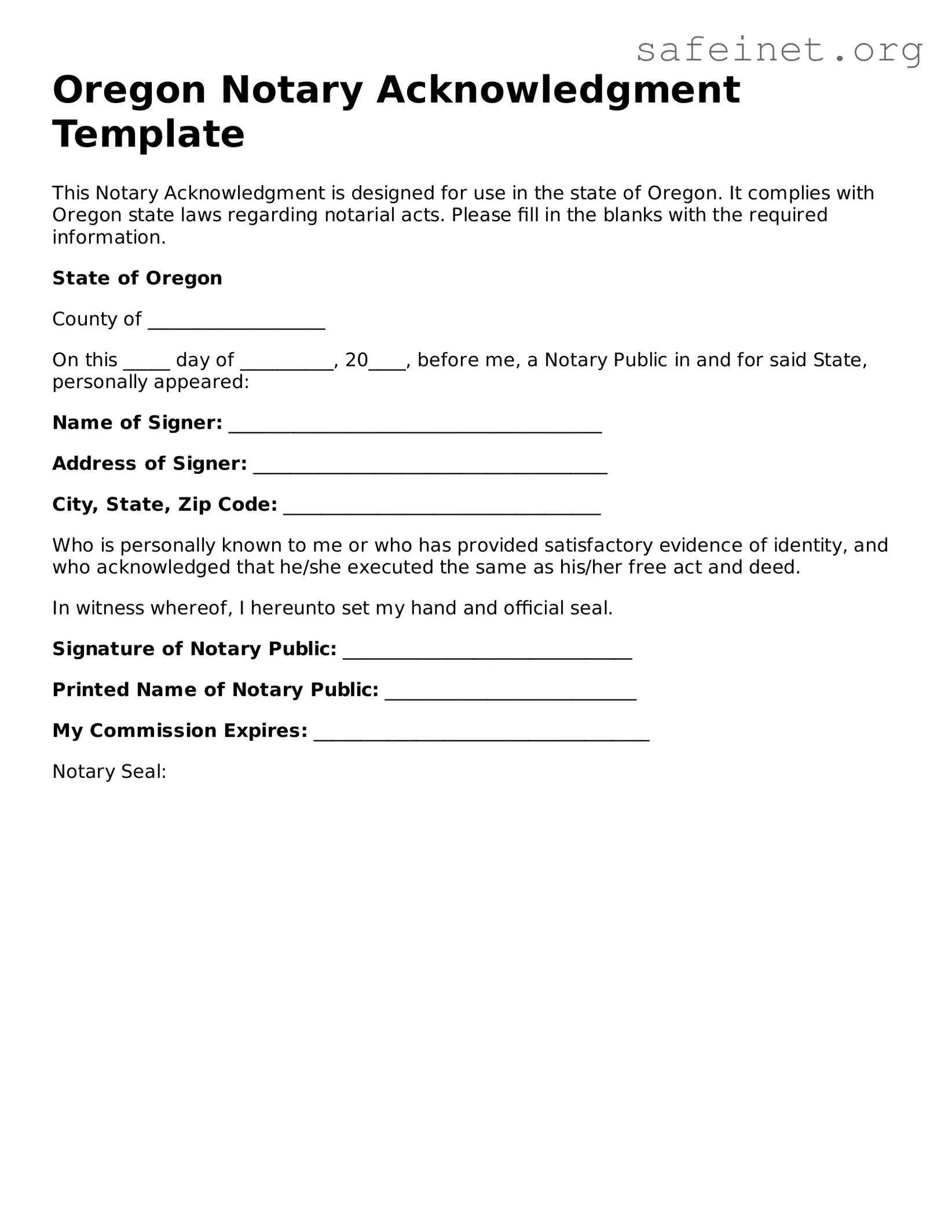
The Oregon Notary Acknowledgement form plays a crucial role in the notarization process, ensuring that documents are properly verified and authenticated. This form is primarily used to confirm that a signer has willingly signed a document in the presence of a notary public. It includes essential details such as the name of the signer, the date of the acknowledgment, and the notary's signature and seal. By completing this form, individuals can enhance the credibility of their documents, making them more likely to be accepted by courts and other institutions. The form also serves as a safeguard against fraud, as it requires the notary to verify the identity of the signer. Understanding the key components and purpose of the Oregon Notary Acknowledgement form is important for anyone involved in legal or official documentation in the state.
Oregon Notary Acknowledgment Template
This Notary Acknowledgment is designed for use in the state of Oregon. It complies with Oregon state laws regarding notarial acts. Please fill in the blanks with the required information.
State of Oregon
County of ___________________
On this _____ day of __________, 20____, before me, a Notary Public in and for said State, personally appeared:
Name of Signer: ________________________________________
Address of Signer: ______________________________________
City, State, Zip Code: __________________________________
Who is personally known to me or who has provided satisfactory evidence of identity, and who acknowledged that he/she executed the same as his/her free act and deed.
In witness whereof, I hereunto set my hand and official seal.
Signature of Notary Public: _______________________________
Printed Name of Notary Public: ___________________________
My Commission Expires: ____________________________________
Notary Seal:
| Fact Name | Details |
|---|---|
| Purpose | The Oregon Notary Acknowledgment form is used to verify the identity of a signer and confirm their willingness to sign a document. |
| Governing Law | This form is governed by Oregon Revised Statutes (ORS) Chapter 194, which outlines notary public practices in the state. |
| Signature Requirement | The signer must be present at the time of notarization and must sign the document in front of the notary. |
| Form Availability | The Oregon Notary Acknowledgment form can be obtained from various sources, including state government websites and notary public associations. |
Filling out the Oregon Notary Acknowledgement form is a straightforward process that requires careful attention to detail. Once the form is completed, it will need to be submitted as part of a legal document or transaction. Below are the steps to ensure the form is filled out correctly.
What is an Oregon Notary Acknowledgement form?
The Oregon Notary Acknowledgement form is a legal document used to verify that a signature on a document was made willingly and that the signer is who they claim to be. This form is essential for various legal processes, ensuring that documents are executed with integrity and authenticity. It provides a layer of protection against fraud, as it requires the notary to confirm the identity of the signer before notarizing the document.
Who can serve as a notary in Oregon?
In Oregon, a notary public must be at least 18 years old, a resident of the state, and able to read and write in English. Individuals must also complete a notary training course and pass an exam. After meeting these requirements, they can apply for a notary commission through the Secretary of State’s office. Once commissioned, notaries can perform notarizations throughout the state.
What information is required on the Notary Acknowledgement form?
The Notary Acknowledgement form typically requires the name of the signer, the date of the acknowledgment, and the notary’s information, including their name, signature, and seal. Additionally, it may include a statement confirming that the signer appeared before the notary and acknowledged that they signed the document willingly. Accurate and complete information is crucial for the document's validity.
Is a Notary Acknowledgement form necessary for all documents?
No, not all documents require a Notary Acknowledgement. However, it is often necessary for legal documents such as deeds, contracts, and powers of attorney. The requirement for notarization can vary based on the type of document and the jurisdiction. It’s always a good idea to check the specific requirements for the document you are working with to ensure compliance.
How does one obtain a Notary Acknowledgement?
To obtain a Notary Acknowledgement, you must first sign the document in the presence of a notary public. The notary will then complete the acknowledgment section of the document, which includes their signature and seal. It’s important to bring valid identification, such as a driver’s license or passport, to verify your identity. Without proper identification, the notary cannot proceed with the acknowledgment.
What happens if a Notary Acknowledgement is not properly completed?
If a Notary Acknowledgement is not properly completed, the document may be considered invalid. This can lead to complications, especially if the document is needed for legal purposes. In some cases, it might require re-execution of the document with proper notarization. To avoid such issues, it’s crucial to ensure that all information is accurately filled out and that the notary follows the correct procedures during the acknowledgment process.
Failing to include the signer's name correctly. It's essential to write the name exactly as it appears on the identification. Any discrepancies can lead to issues with the notarization.
Not specifying the date of the notarization. The date is crucial for legal purposes. Without it, the document may not be valid.
Leaving out the notary's signature. The notary must sign the form to confirm that they witnessed the signing of the document. Without this signature, the acknowledgment is incomplete.
Using an incorrect notary seal. The seal must be clear and legible. If it is faded or unclear, it may not be accepted by courts or other entities.
Not providing the correct venue. The venue should include the county and state where the notarization takes place. Omitting this information can invalidate the acknowledgment.
When engaging in legal transactions, especially those requiring notarization, several documents may accompany the Oregon Notary Acknowledgement form. Each of these forms serves a specific purpose and ensures that the process is conducted smoothly and legally. Below is a list of commonly used documents that often accompany the notary acknowledgment.
Understanding these documents and their purposes can help individuals navigate the complexities of legal transactions. Each form plays a vital role in ensuring that the rights and responsibilities of all parties involved are clearly defined and legally binding.
The Oregon Notary Acknowledgment form is similar to the Affidavit form, which is used to verify the truthfulness of a statement made under oath. Both documents require a notary public to witness the signing, ensuring that the individual is affirming the information presented is accurate. This process adds a layer of credibility and legal weight to the statements made within the affidavit, much like how the acknowledgment form confirms the identity of the signer and their intent to execute the document.
Another document akin to the Oregon Notary Acknowledgment form is the Power of Attorney (POA). A POA grants someone the authority to act on behalf of another person in legal matters. Just like the acknowledgment form, a notary public typically verifies the identity of the person granting the power and ensures they are doing so willingly. This helps prevent fraud and ensures that the individual understands the implications of the authority they are granting.
The Deed form also shares similarities with the Oregon Notary Acknowledgment form. When transferring property ownership, a deed must be signed and often notarized to validate the transaction. Both documents require the notary to confirm the identity of the signers and their understanding of the document's purpose. This not only protects the parties involved but also helps maintain accurate public records regarding property ownership.
A Certificate of Acknowledgment is another document that aligns with the Oregon Notary Acknowledgment form. This certificate is often attached to various legal documents to confirm that the signer appeared before a notary and acknowledged their signature. The purpose is similar: to provide assurance that the signer is who they claim to be and that they are signing willingly. This adds an extra layer of authenticity to the legal process.
The Jurat is yet another document that resembles the Oregon Notary Acknowledgment form. A jurat is used when an individual swears to the truth of the contents of a document, often in the context of affidavits or sworn statements. Like the acknowledgment form, it requires a notary public to witness the signing, ensuring that the individual is affirming the truthfulness of the document under oath. This helps to establish the document's credibility in legal matters.
The Loan Document is similar as well. When securing a loan, borrowers often need to sign various documents, which may require notarization. The notary's role is to confirm the identity of the borrower and ensure they understand the terms of the loan. This process mirrors the Oregon Notary Acknowledgment form, which serves to validate the intent and identity of the signer in a legal context.
Another related document is the Will. While not all wills require notarization, having a notary acknowledge the signature can add an extra layer of validity. The notary verifies the identity of the testator, ensuring that they are signing the will willingly and understand its implications. This parallels the function of the Oregon Notary Acknowledgment form in confirming the signer's intent and identity.
The Bill of Sale is also comparable to the Oregon Notary Acknowledgment form. This document is used to transfer ownership of personal property, and having it notarized can provide additional assurance to both parties involved in the transaction. The notary's role is to confirm that the seller is indeed transferring ownership and that the buyer is aware of the transaction. This helps to prevent disputes and protects the interests of both parties.
Lastly, the Contract form shares similarities with the Oregon Notary Acknowledgment form. Contracts often require signatures from all parties involved, and having a notary acknowledge these signatures can enhance the document's enforceability. The notary verifies the identities of the signers and ensures they are entering into the agreement willingly. This process is crucial for upholding the integrity of the contractual relationship.
When filling out the Oregon Notary Acknowledgment form, it is important to follow certain guidelines to ensure accuracy and compliance. Below is a list of things you should and shouldn't do.
Many people have misunderstandings about the Oregon Notary Acknowledgement form. Here are five common misconceptions:
This is not true. In Oregon, a notary's role is to witness signatures and verify identities. They do not certify the content of the documents.
Not every document requires a notary acknowledgment. Only certain legal documents, like deeds or contracts, may need this form to be valid.
Each state has its own rules and forms for notary acknowledgments. What works in Oregon may not be acceptable in another state.
This is a misconception. A notarized document can be amended, but any changes must be properly documented and re-notarized if necessary.
Notaries are not allowed to give legal advice. They can only perform notarial acts and should not interpret the law or documents.
When filling out and using the Oregon Notary Acknowledgement form, it’s important to keep several key points in mind. Here are some essential takeaways: