In the dynamic landscape of employment law, non-compete agreements play a significant role in shaping the relationship between employers and employees. In Oregon, the Non-compete Agreement form serves as a crucial tool for businesses looking to protect their trade secrets and competitive advantages while also respecting the rights of their workforce. This form outlines specific terms, including the duration and geographic scope of the non-compete clause, ensuring that employees understand the limitations placed on their ability to seek employment in similar industries after leaving a job. Additionally, the form must comply with Oregon's legal requirements, which stipulate that non-compete agreements are only enforceable under certain conditions, such as when the employee earns a minimum salary. By clearly defining these parameters, the Non-compete Agreement form helps foster transparency and fairness in the employer-employee relationship, while also providing a framework for resolving disputes that may arise in the future.
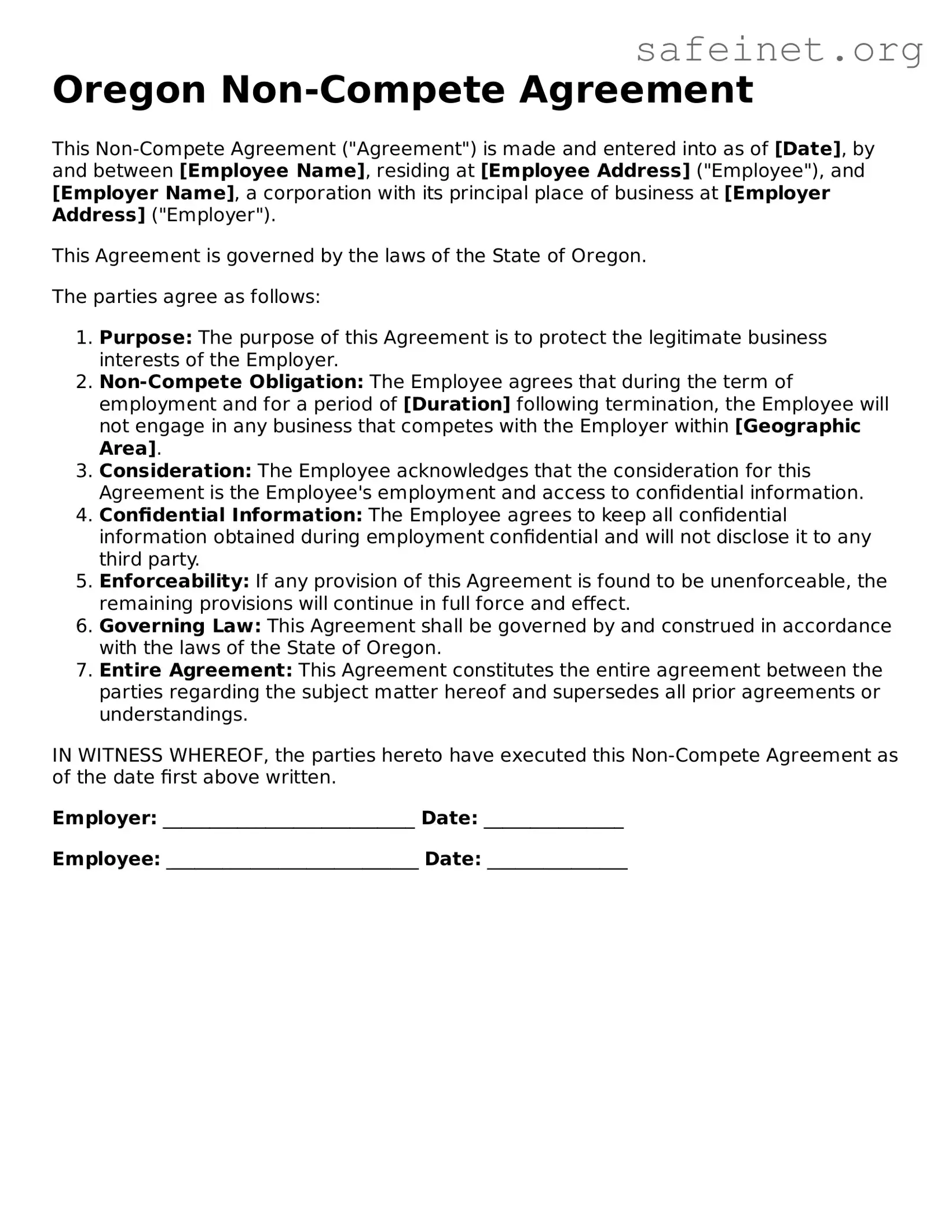
Oregon Non-Compete Agreement
This Non-Compete Agreement ("Agreement") is made and entered into as of [Date], by and between [Employee Name], residing at [Employee Address] ("Employee"), and [Employer Name], a corporation with its principal place of business at [Employer Address] ("Employer").
This Agreement is governed by the laws of the State of Oregon.
The parties agree as follows:
IN WITNESS WHEREOF, the parties hereto have executed this Non-Compete Agreement as of the date first above written.
Employer: ___________________________ Date: _______________
Employee: ___________________________ Date: _______________
| Fact Name | Description |
|---|---|
| Governing Law | The Oregon Non-compete Agreement is governed by Oregon Revised Statutes (ORS) 653.295. |
| Enforceability | Non-compete agreements in Oregon are enforceable only if they meet specific criteria outlined by state law. |
| Duration Limit | The maximum duration for a non-compete agreement in Oregon is 18 months. |
| Geographic Scope | The agreement must specify a reasonable geographic area where the restrictions apply. |
| Employee Eligibility | Only employees who earn a salary above a certain threshold can be bound by non-compete agreements. |
| Written Agreement | The non-compete agreement must be in writing and signed by both the employer and employee. |
| Consideration Requirement | There must be valid consideration, such as a job offer or promotion, for the agreement to be enforceable. |
| Right to Review | Employees must be given at least 14 days to review the agreement before signing. |
| Legal Remedies | Employees can seek legal remedies if they believe a non-compete agreement is being enforced unfairly. |
Filling out the Oregon Non-compete Agreement form requires careful attention to detail. Once completed, the form will need to be signed and dated by all parties involved. Be prepared to provide necessary information accurately to ensure compliance with Oregon law.
What is a Non-compete Agreement in Oregon?
A Non-compete Agreement is a legal document that restricts an employee from working for a competitor or starting a competing business for a certain period after leaving their current employer. In Oregon, these agreements must adhere to specific laws to be enforceable, ensuring that they are reasonable in scope and duration.
Are Non-compete Agreements enforceable in Oregon?
Yes, Non-compete Agreements can be enforceable in Oregon, but they must meet certain criteria. For example, they should be limited in time and geographic area. Additionally, they typically need to be signed by the employee at the time of employment or within a reasonable time frame before the employee begins their job.
How long can a Non-compete Agreement last in Oregon?
In Oregon, the duration of a Non-compete Agreement cannot exceed 18 months from the date of termination of employment. This time frame is designed to balance the employer's interests with the employee's right to seek new employment opportunities.
What happens if a Non-compete Agreement is violated?
If an employee violates a Non-compete Agreement, the employer may seek legal action. This could involve requesting an injunction to prevent the employee from continuing to work for a competitor or pursuing damages for any losses incurred due to the breach. Legal outcomes can vary based on the specifics of the case and the enforceability of the agreement.
Can an employee negotiate a Non-compete Agreement?
Absolutely! Employees have the right to negotiate the terms of a Non-compete Agreement before signing it. This could include discussing the duration, geographic limitations, and specific job roles affected by the agreement. Open communication can lead to a more balanced and fair agreement for both parties.
Are there any exceptions to Non-compete Agreements in Oregon?
Yes, certain exceptions exist. For instance, Non-compete Agreements cannot be enforced against employees who earn less than a specified annual salary, which is set by Oregon law. Additionally, employees who are laid off or terminated without cause may also have protections against these agreements.
What should I do if I’m asked to sign a Non-compete Agreement?
Take the time to read the document carefully. Consider seeking legal advice to understand your rights and obligations fully. If you have concerns about the terms, discuss them with your employer before signing. It’s essential to ensure that you are comfortable with the agreement and its implications for your future employment opportunities.
Can I work for a competitor after my Non-compete Agreement expires?
Yes, once the Non-compete Agreement period has expired, you are free to seek employment with a competitor or start your own competing business. It’s important to keep track of the duration specified in the agreement to avoid any potential legal issues.
What is the difference between a Non-compete Agreement and a Non-solicitation Agreement?
A Non-compete Agreement restricts an employee from working for competitors or starting a competing business, while a Non-solicitation Agreement prevents an employee from soliciting clients or employees from their former employer. Both serve to protect business interests but focus on different aspects of employee behavior after leaving a job.
Inadequate Definition of Restricted Activities: Many individuals fail to clearly outline what activities are considered competitive. A vague definition can lead to confusion and potential legal disputes.
Overly Broad Geographic Scope: Some people mistakenly set a geographic area that is too expansive. Courts often strike down non-compete agreements that restrict individuals from working in an unreasonably large area.
Lack of Time Limit: Not specifying a reasonable duration for the non-compete period is a common error. A time limit is essential; otherwise, the agreement may be deemed unenforceable.
Ignoring State-Specific Laws: Each state has different rules regarding non-compete agreements. Failing to comply with Oregon's specific requirements can render the agreement invalid.
Neglecting to Include Consideration: Individuals often forget to mention what the employee receives in exchange for signing the agreement. Without this, the contract may lack enforceability.
A Non-compete Agreement is often accompanied by several other forms and documents that help clarify the terms of employment and protect the interests of both the employer and employee. Below is a list of related documents that may be used in conjunction with the Oregon Non-compete Agreement.
These documents work together to create a clear understanding of the expectations and obligations of both parties. It is important to review and understand each document before signing to ensure compliance and protection of rights.
The Oregon Non-Disclosure Agreement (NDA) is a legal document that protects confidential information shared between parties. Like the Non-compete Agreement, it restricts the sharing of sensitive information. Both agreements are designed to safeguard a business's interests and prevent unfair competition. They require the parties involved to maintain confidentiality and can include specific terms about what information is considered confidential.
The Oregon Non-Solicitation Agreement serves a similar purpose by preventing one party from soliciting clients or employees from another party. This agreement is often used in conjunction with non-compete clauses to provide additional protection for businesses. Both documents aim to minimize the risk of losing valuable relationships and resources to competitors. They establish clear boundaries on what actions are permissible after employment or partnership ends.
The Employment Agreement is another document that often contains non-compete or non-solicitation clauses. This agreement outlines the terms of employment, including job responsibilities, compensation, and termination conditions. Like the Non-compete Agreement, it can protect a company’s proprietary information and trade secrets. It ensures that employees understand their obligations both during and after their employment.
The Independent Contractor Agreement is similar in that it can include non-compete and non-solicitation provisions. This document outlines the relationship between a contractor and a business, detailing the scope of work and payment terms. By including non-compete clauses, businesses can protect themselves from contractors who might take their knowledge or client relationships to competitors after the contract ends.
The Partnership Agreement also shares similarities with the Non-compete Agreement. This document governs the relationship between business partners and outlines each partner's rights and responsibilities. Non-compete clauses can be included to prevent partners from starting competing businesses or soliciting clients after leaving the partnership. This helps to maintain the integrity and value of the partnership.
Finally, the Confidentiality Agreement (or Confidentiality Clause) is closely related to the Non-compete Agreement. It focuses on protecting sensitive information shared between parties. While the Non-compete Agreement restricts competitive behavior, the Confidentiality Agreement ensures that proprietary information remains private. Both documents are essential for businesses that want to protect their interests and maintain a competitive edge in the market.
When filling out the Oregon Non-compete Agreement form, it is essential to approach the process thoughtfully. Here are some important dos and don’ts to consider:
Being diligent in this process can help protect your rights and clarify your obligations. Remember, a well-informed decision is always the best path forward.
Non-compete agreements can be confusing. Here are five common misconceptions about the Oregon Non-compete Agreement form that you should know:
This is not true. In Oregon, non-compete agreements must meet specific criteria to be enforceable. They must be in writing, signed by both parties, and the employee must be informed about the agreement at least two weeks before their employment ends.
Not all employees are covered. In Oregon, non-compete agreements can only be enforced against employees who earn a salary above a certain threshold. If an employee earns less than this amount, the agreement may not apply.
This is a misconception. In Oregon, a non-compete agreement cannot last longer than 18 months after the employee leaves the company. After this period, the agreement becomes void.
This is misleading. While a non-compete may restrict you from working for a direct competitor, it does not prevent you from working in your field entirely. You may still find opportunities that do not violate the agreement.
This is incorrect. Each state has its own laws regarding non-compete agreements. Oregon has specific rules that differ from those in other states, making it essential to understand the local regulations.
When dealing with the Oregon Non-compete Agreement form, it’s essential to understand its implications and requirements. Here are some key takeaways to consider: