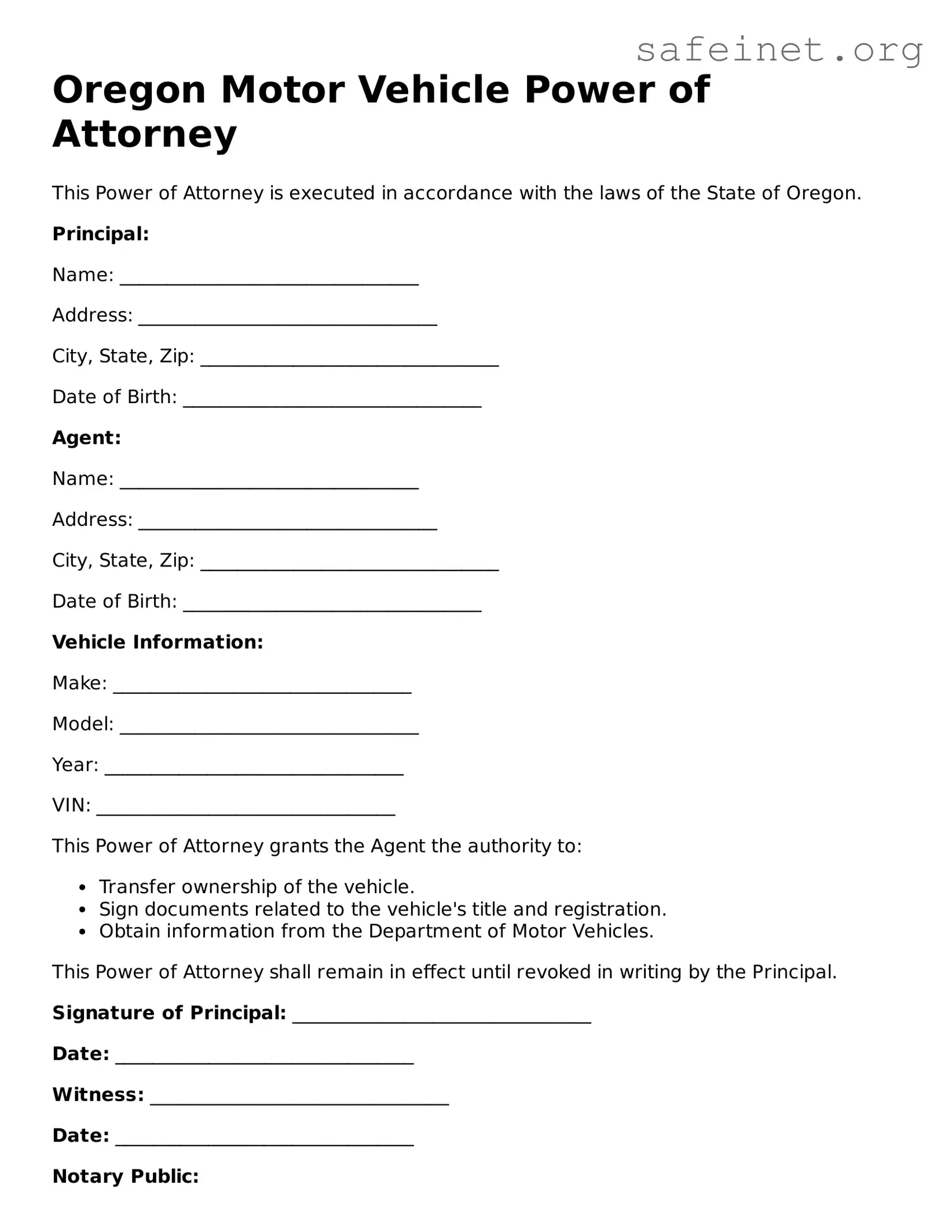
The Oregon Motor Vehicle Power of Attorney form is a crucial document that allows individuals to designate another person to handle specific vehicle-related transactions on their behalf. This form is particularly useful when the vehicle owner cannot be present to sign necessary paperwork, such as during the sale of a vehicle or when transferring title. By granting this authority, the vehicle owner can ensure that their interests are represented without needing to be physically present. The form requires clear identification of both the principal— the person granting authority— and the agent— the individual receiving that authority. It also outlines the specific powers granted, which can include signing documents, transferring titles, and managing registration matters. Understanding the implications of this form is essential for anyone looking to simplify their vehicle transactions while ensuring compliance with Oregon law.
Oregon Motor Vehicle Power of Attorney
This Power of Attorney is executed in accordance with the laws of the State of Oregon.
Principal:
Name: ________________________________
Address: ________________________________
City, State, Zip: ________________________________
Date of Birth: ________________________________
Agent:
Name: ________________________________
Address: ________________________________
City, State, Zip: ________________________________
Date of Birth: ________________________________
Vehicle Information:
Make: ________________________________
Model: ________________________________
Year: ________________________________
VIN: ________________________________
This Power of Attorney grants the Agent the authority to:
This Power of Attorney shall remain in effect until revoked in writing by the Principal.
Signature of Principal: ________________________________
Date: ________________________________
Witness: ________________________________
Date: ________________________________
Notary Public:
State of Oregon
County of ________________________________
Subscribed and sworn to before me this _____ day of ____________, 20__.
Notary Signature: ________________________________
My Commission Expires: ________________________________
| Fact Name | Details |
|---|---|
| Purpose | The Oregon Motor Vehicle Power of Attorney form allows an individual to authorize another person to act on their behalf regarding motor vehicle transactions. |
| Governing Law | This form is governed by the Oregon Revised Statutes, specifically ORS 87.040, which outlines the legal framework for powers of attorney in the state. |
| Usage | It can be used for various tasks, including signing documents for vehicle registration, title transfers, and other related matters. |
| Validity | The form remains valid until revoked by the principal or upon the principal's death, ensuring that the designated agent can act as needed. |
Filling out the Oregon Motor Vehicle Power of Attorney form is a straightforward process. Once you have completed the form, you can submit it to allow someone else to act on your behalf regarding motor vehicle matters.
Once you have followed these steps, your form is ready to be submitted to the appropriate DMV office or used as needed. Ensure that your agent understands the powers granted to them.
What is the Oregon Motor Vehicle Power of Attorney form?
The Oregon Motor Vehicle Power of Attorney form allows an individual to appoint another person to act on their behalf regarding motor vehicle transactions. This can include tasks such as registering a vehicle, transferring ownership, or obtaining a title. It is a legal document that ensures the appointed agent has the authority to handle specific motor vehicle-related matters without needing the principal present.
Who can be appointed as an agent in the Power of Attorney?
Any adult can be appointed as an agent in the Oregon Motor Vehicle Power of Attorney form. This includes friends, family members, or professionals such as attorneys or auto dealers. It is essential that the person chosen is trustworthy and capable of handling the responsibilities assigned to them.
How do I complete the Oregon Motor Vehicle Power of Attorney form?
To complete the form, you need to provide your personal information, including your name and address, as well as the details of the vehicle in question, such as the make, model, and VIN. You must also specify the powers you are granting to your agent. After filling out the form, both you and your agent must sign it, and it is advisable to have it notarized to enhance its validity.
Is the Oregon Motor Vehicle Power of Attorney form valid if it is not notarized?
Can I revoke a Power of Attorney once it has been issued?
Yes, you can revoke a Power of Attorney at any time as long as you are mentally competent. To do so, you should create a written revocation notice and provide a copy to your agent. It is also advisable to inform any institutions or agencies that may have relied on the original Power of Attorney to ensure they are aware of the change.
What should I do if my agent is unable to fulfill their duties?
If your appointed agent is unable to fulfill their duties, you have the option to appoint a new agent by completing a new Power of Attorney form. It is crucial to ensure that the new agent is notified and that the previous agent is informed of their removal to avoid any confusion regarding authority.
Failing to provide the correct name of the principal. Ensure that the full legal name matches the name on the identification.
Omitting the date of signing. The form must include the date to validate the authority granted.
Not specifying the powers granted. Clearly outline what the attorney-in-fact is authorized to do regarding the vehicle.
Using an incorrect or outdated form. Always use the most current version of the Oregon Motor Vehicle Power of Attorney form.
Neglecting to sign the form. The principal's signature is necessary for the document to be effective.
Forgetting to include the attorney-in-fact's information. Provide the full name and address of the person receiving the authority.
Not having the form notarized when required. Some situations may require notarization for the document to be accepted.
Leaving blank spaces. Ensure all relevant sections are filled out completely to avoid confusion.
Failing to keep a copy of the completed form. Retaining a copy is important for future reference and verification.
The Oregon Motor Vehicle Power of Attorney form is an important document that allows one person to authorize another to act on their behalf regarding motor vehicle transactions. When completing this process, there are several other forms and documents that may be needed to facilitate various vehicle-related matters. Below is a list of these documents, along with brief descriptions of each.
Having these documents ready can streamline the process of managing vehicle transactions in Oregon. Each form plays a crucial role in ensuring compliance with state regulations and protecting the rights of vehicle owners.
The Oregon Motor Vehicle Power of Attorney form shares similarities with the general Power of Attorney (POA) document. Both forms allow an individual, known as the principal, to designate another person, called the agent, to act on their behalf. This can include making decisions and signing documents. However, while a general POA can cover a wide range of matters, the Oregon Motor Vehicle POA is specifically tailored for vehicle-related transactions, such as title transfers and registration issues.
Another document akin to the Oregon Motor Vehicle Power of Attorney is the Durable Power of Attorney. Like the Motor Vehicle POA, this document permits someone to make decisions for another person. The key difference lies in the durability aspect; a Durable Power of Attorney remains effective even if the principal becomes incapacitated. This feature is crucial for long-term planning, especially when considering vehicle management in the event of unforeseen circumstances.
The Healthcare Power of Attorney is also similar in that it allows an individual to appoint someone to make healthcare decisions on their behalf. While the focus of this document is on medical choices, both types of Power of Attorney empower an agent to act in the principal's best interest. This highlights the importance of trust in the relationship between the principal and the agent, whether dealing with health or vehicle matters.
The Limited Power of Attorney is another relevant document. This type of POA restricts the agent's authority to specific tasks or timeframes, much like the Oregon Motor Vehicle Power of Attorney, which is limited to vehicle-related matters. Individuals often use a Limited Power of Attorney when they need someone to handle a particular transaction without granting full authority over their affairs.
The Vehicle Title Transfer form bears resemblance to the Oregon Motor Vehicle Power of Attorney, as both are used in the context of vehicle ownership. The Vehicle Title Transfer form facilitates the official change of ownership when a vehicle is sold or gifted. However, the Motor Vehicle POA allows someone to handle this process on behalf of the owner, making it easier for those unable to attend the DMV in person.
The Bill of Sale is another document that aligns with the Motor Vehicle Power of Attorney. When buying or selling a vehicle, a Bill of Sale serves as proof of the transaction. In conjunction with the Motor Vehicle POA, it allows the agent to finalize the sale on behalf of the principal, ensuring that all necessary paperwork is completed correctly.
The Release of Liability form is also relevant. This document protects the seller from future liabilities related to a vehicle after it has been sold. The Oregon Motor Vehicle Power of Attorney can empower an agent to sign this form on behalf of the seller, ensuring that the transfer of ownership is legally recognized and that the seller is no longer responsible for the vehicle.
The DMV Application for Title is similar in that it is a necessary document when dealing with vehicle registration and ownership. The Oregon Motor Vehicle Power of Attorney allows an agent to complete this application on behalf of the vehicle owner, streamlining the process for those who may not be able to visit the DMV themselves.
Lastly, the Consent to Transfer form is comparable to the Oregon Motor Vehicle Power of Attorney. This document is often required when a vehicle is being transferred to a new owner, especially if the vehicle is jointly owned. The Motor Vehicle POA can authorize an agent to sign this consent, making the transfer process smoother and more efficient.
When filling out the Oregon Motor Vehicle Power of Attorney form, it's essential to approach the task with care. Here are some important dos and don'ts to keep in mind:
The Oregon Motor Vehicle Power of Attorney form is a valuable document that allows individuals to appoint someone to act on their behalf regarding motor vehicle transactions. However, several misconceptions surround this form. Here are six common misunderstandings:
This is not true. Any individual can complete and use the Oregon Motor Vehicle Power of Attorney form. It is designed for anyone who needs assistance with vehicle-related matters.
While notarization can add an extra layer of authenticity, it is not a requirement for the Oregon Motor Vehicle Power of Attorney form to be valid. Signatures from both the principal and the agent are sufficient.
Many believe that the power of attorney is limited to a single transaction. In reality, the form can grant authority for multiple transactions, as specified by the principal.
This misconception is false. The principal has the right to revoke the power of attorney at any time, as long as they are mentally competent to do so.
While many choose family members as their agents, it is not a requirement. Any trustworthy individual can be appointed to act on behalf of the principal.
This is incorrect. Minors can also use the form if a parent or legal guardian signs it on their behalf, allowing for flexibility in vehicle transactions.
Understanding these misconceptions can help individuals make informed decisions when using the Oregon Motor Vehicle Power of Attorney form.
When filling out and using the Oregon Motor Vehicle Power of Attorney form, keep these key takeaways in mind:
By following these guidelines, you can navigate the process smoothly and ensure that your motor vehicle matters are handled as you intend.