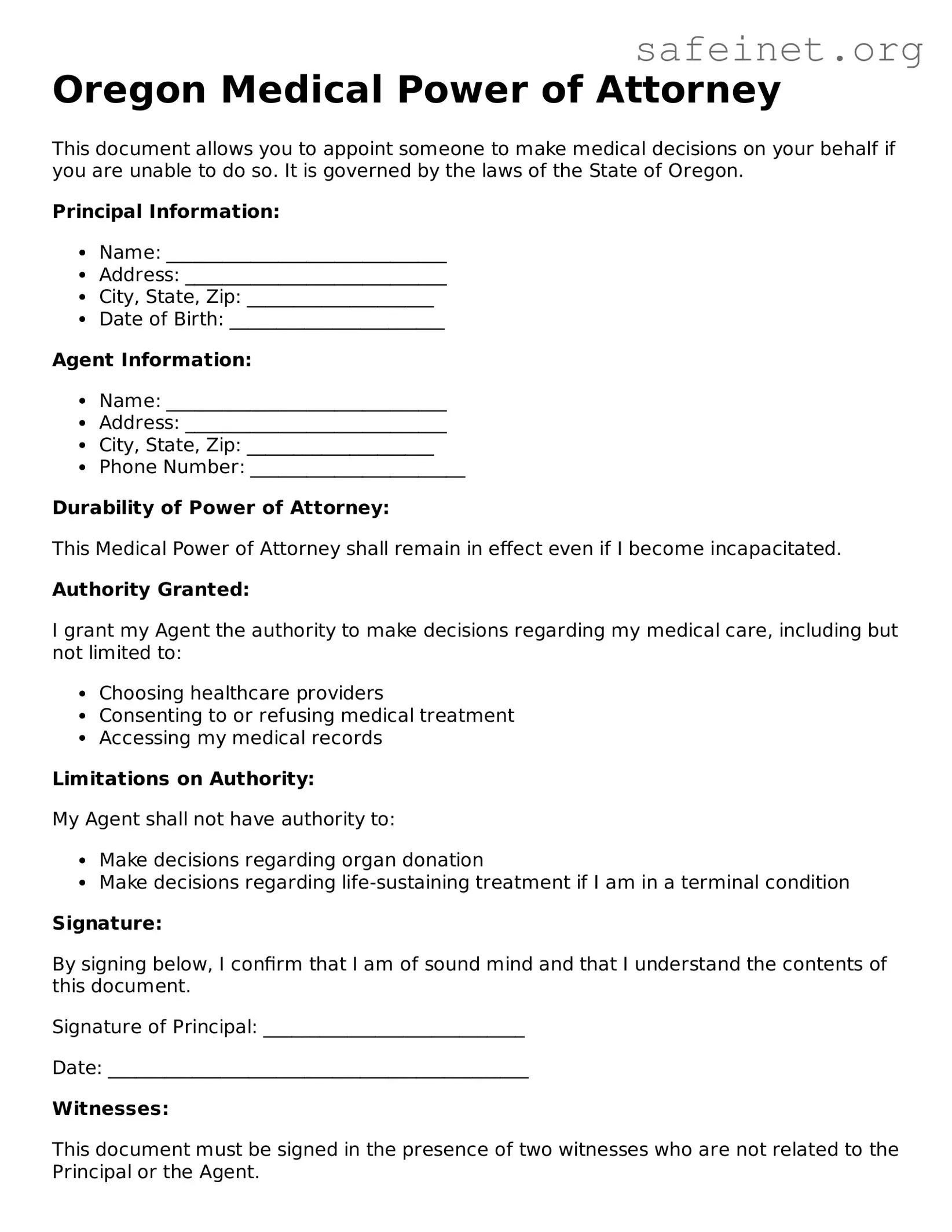
The Oregon Medical Power of Attorney form is a vital legal document that allows individuals to designate someone they trust to make medical decisions on their behalf in the event they become unable to do so. This form empowers a chosen agent to act in accordance with the individual’s wishes regarding healthcare, ensuring that their values and preferences are respected. It covers a range of medical decisions, from routine care to life-sustaining treatments, providing clarity during challenging times. Additionally, the form includes sections for specifying preferences about end-of-life care and other critical health-related choices. By completing this document, individuals can alleviate the burden on family members and healthcare providers, guiding them to make informed decisions that align with the individual’s desires. Understanding the nuances of the Oregon Medical Power of Attorney form is essential for anyone looking to secure their medical future and ensure their voice is heard, even when they cannot speak for themselves.
Oregon Medical Power of Attorney
This document allows you to appoint someone to make medical decisions on your behalf if you are unable to do so. It is governed by the laws of the State of Oregon.
Principal Information:
Agent Information:
Durability of Power of Attorney:
This Medical Power of Attorney shall remain in effect even if I become incapacitated.
Authority Granted:
I grant my Agent the authority to make decisions regarding my medical care, including but not limited to:
Limitations on Authority:
My Agent shall not have authority to:
Signature:
By signing below, I confirm that I am of sound mind and that I understand the contents of this document.
Signature of Principal: ____________________________
Date: _____________________________________________
Witnesses:
This document must be signed in the presence of two witnesses who are not related to the Principal or the Agent.
Notary Public:
State of Oregon
County of ______________________
Subscribed and sworn before me on this ____ day of __________, 20__.
Notary Public Signature: ______________________
My Commission Expires: ______________________
| Fact Name | Details |
|---|---|
| Definition | The Oregon Medical Power of Attorney form allows an individual to designate someone to make healthcare decisions on their behalf if they become unable to do so. |
| Governing Law | This form is governed by Oregon Revised Statutes, specifically ORS 127.505 to 127.660. |
| Eligibility | Any adult resident of Oregon can complete and sign the Medical Power of Attorney form. |
| Revocation | The principal can revoke the Medical Power of Attorney at any time, as long as they are of sound mind. |
| Witness Requirements | The form must be signed in the presence of two witnesses or a notary public to be valid. |
Filling out the Oregon Medical Power of Attorney form is an important step in ensuring that your healthcare wishes are respected. This document allows you to appoint someone you trust to make medical decisions on your behalf if you are unable to do so. Below are the steps to guide you through the process of completing this form.
What is a Medical Power of Attorney in Oregon?
A Medical Power of Attorney (MPOA) in Oregon is a legal document that allows you to appoint someone to make healthcare decisions on your behalf if you become unable to do so. This person, known as your agent or proxy, will have the authority to make medical decisions based on your wishes and best interests. It is crucial to select someone you trust to handle these important decisions when you cannot communicate your preferences.
How do I create a Medical Power of Attorney in Oregon?
To create a Medical Power of Attorney in Oregon, you need to fill out the official form provided by the state. This form requires you to identify your chosen agent and specify any limitations on their authority. Once completed, you must sign the document in the presence of a notary public or two witnesses who are not related to you or beneficiaries of your estate. It is advisable to keep copies of the signed document in accessible locations and provide copies to your healthcare providers and the appointed agent.
Can I revoke my Medical Power of Attorney in Oregon?
Yes, you can revoke your Medical Power of Attorney at any time as long as you are mentally competent. To do this, you must create a written revocation document or simply destroy the original MPOA form. Inform your appointed agent and healthcare providers about the revocation to ensure they are aware of your current wishes. It's important to note that if you create a new MPOA, it will automatically revoke any previous versions.
What happens if I do not have a Medical Power of Attorney?
If you do not have a Medical Power of Attorney in place and become unable to make your own healthcare decisions, Oregon law will determine who can make those decisions for you. This may lead to delays and potential disagreements among family members. Having an MPOA ensures that your preferences are respected and that someone you trust is making decisions on your behalf, avoiding confusion and conflict during a difficult time.
Not clearly identifying the principal and the agent. Ensure that both parties' names and contact information are accurate and complete.
Failing to specify the powers granted. Be explicit about what medical decisions the agent can make on your behalf.
Neglecting to date the form. A signature without a date can lead to confusion about when the document was executed.
Not signing in the presence of a witness or notary. Oregon law requires proper witnessing for the document to be valid.
Using outdated forms. Always check for the most current version of the Oregon Medical Power of Attorney form.
Overlooking the need for alternate agents. Designate a backup agent in case your primary choice is unable or unwilling to serve.
Ignoring state-specific requirements. Familiarize yourself with Oregon's specific rules regarding medical powers of attorney.
Failing to discuss your wishes with your agent. Communication is key. Ensure your agent understands your healthcare preferences.
Not reviewing or updating the document regularly. Life changes, and so should your medical power of attorney.
Assuming the form is only necessary for the elderly. Anyone can face medical emergencies, so it’s wise to have this document in place.
The Oregon Medical Power of Attorney form allows individuals to designate someone to make healthcare decisions on their behalf if they become unable to do so. Along with this form, several other documents may be used to ensure comprehensive planning for medical and financial decisions. Below is a list of common forms and documents that complement the Oregon Medical Power of Attorney.
These documents work together to provide a comprehensive approach to healthcare and financial decision-making. It is essential for individuals to consider their options and ensure that their wishes are clearly documented and communicated to their loved ones and healthcare providers.
The Oregon Medical Power of Attorney (MPOA) is similar to the Durable Power of Attorney (DPOA). Both documents allow individuals to designate someone to make decisions on their behalf. The key difference is that the DPOA can cover a wider range of decisions, including financial matters, while the MPOA is specifically focused on healthcare decisions. This means that if you become unable to communicate your wishes regarding medical treatment, the person you appointed can step in and make those choices for you.
Another document that shares similarities with the MPOA is the Living Will. A Living Will outlines your preferences for medical treatment in situations where you cannot express your wishes. While the MPOA appoints someone to make decisions, the Living Will provides specific instructions about what you want or do not want in terms of life-sustaining treatments. Both documents work together to ensure your healthcare wishes are respected.
The Advance Healthcare Directive (AHD) also resembles the MPOA. An AHD combines the powers of a Medical Power of Attorney and a Living Will into one document. It allows you to appoint a healthcare agent and specify your medical treatment preferences. This comprehensive approach ensures that your healthcare decisions are clear and that your appointed agent has the authority to act according to your wishes.
The Healthcare Proxy is another document that functions similarly to the MPOA. This form allows you to appoint someone to make medical decisions on your behalf if you become incapacitated. Like the MPOA, the Healthcare Proxy emphasizes the importance of having someone you trust to advocate for your healthcare needs, ensuring that your values and preferences guide the treatment you receive.
The Do Not Resuscitate (DNR) order is related to the MPOA in that it addresses specific medical decisions. A DNR order instructs healthcare providers not to perform CPR if your heart stops beating or if you stop breathing. While the MPOA allows for broader decision-making authority, a DNR focuses on a particular aspect of medical care, emphasizing your wishes regarding resuscitation efforts.
The Physician Orders for Life-Sustaining Treatment (POLST) form is also similar to the MPOA. A POLST form translates your healthcare wishes into actionable medical orders. It is intended for individuals with serious health conditions and ensures that your preferences for treatments like resuscitation and hospitalization are honored by medical professionals. Both the POLST and MPOA prioritize your choices in critical healthcare situations.
The Mental Health Advance Directive (MHAD) is another document akin to the MPOA. An MHAD allows individuals to express their preferences for mental health treatment in case they become unable to communicate those wishes. While the MPOA focuses on general medical decisions, the MHAD specifically addresses mental health care, ensuring that your preferences in this area are respected as well.
Similarly, the End-of-Life Care Plan is related to the MPOA. This document outlines your wishes for care during the final stages of life. It can include preferences for pain management, hospice care, and other aspects of end-of-life treatment. While the MPOA grants authority to someone to make decisions, the End-of-Life Care Plan provides detailed guidance on what you want during this critical time.
Lastly, the Declaration for Mental Health Treatment shares similarities with the MPOA. This declaration allows individuals to appoint a representative to make mental health treatment decisions if they become unable to do so. Like the MPOA, it emphasizes the importance of having someone you trust to advocate for your healthcare, particularly in the realm of mental health.
When filling out the Oregon Medical Power of Attorney form, it’s important to be thorough and careful. Here are some essential do's and don'ts to guide you through the process.
Taking these steps can help ensure that your medical wishes are respected and that your agent is prepared to act on your behalf when needed.
Understanding the Oregon Medical Power of Attorney form can be tricky. Here are nine common misconceptions that people often have about this important document.
It’s the same as a regular Power of Attorney. Many believe a Medical Power of Attorney is the same as a general Power of Attorney. In reality, the medical version specifically focuses on healthcare decisions, while the general one covers a broader range of financial and legal matters.
Anyone can be appointed as an agent. Some think they can appoint anyone as their agent. However, Oregon law requires that the agent be an adult and of sound mind. Certain individuals, like healthcare providers involved in your care, cannot serve as your agent.
It only takes effect when I’m incapacitated. A common belief is that the Medical Power of Attorney only kicks in when you are unable to make decisions. In Oregon, you can choose for it to take effect immediately or only when you are incapacitated.
I can’t change my agent once I’ve signed. Many people think that once they designate an agent, they’re stuck with that choice. In fact, you can revoke or change your Medical Power of Attorney at any time, as long as you are competent.
It’s only for end-of-life situations. Some assume this document is only necessary for end-of-life care. However, it’s useful for any situation where you might be unable to make your own healthcare decisions, not just terminal illnesses.
My family can make decisions for me if I don’t have a form. People often think that family members can automatically make decisions on their behalf. Without a Medical Power of Attorney, healthcare providers may not know who to consult, which can lead to confusion and delays.
It’s a one-time document. Some believe that once they fill out the form, it’s set in stone. In truth, you should review and update it regularly, especially after major life changes like marriage, divorce, or the birth of a child.
It can only be created with a lawyer’s help. Many think that a lawyer must draft this document. While legal advice can be beneficial, you can create a Medical Power of Attorney on your own using state-approved forms.
Once signed, it can’t be revoked. Some people mistakenly believe that signing the document means they can never change their mind. In reality, you can revoke your Medical Power of Attorney at any time, as long as you are mentally competent.
Clearing up these misconceptions can help you make informed decisions about your healthcare planning. Always ensure your choices reflect your wishes and values.
Filling out and using the Oregon Medical Power of Attorney form is an important step in ensuring your healthcare wishes are respected. Here are some key takeaways to keep in mind:
Taking these steps can help ensure that your healthcare choices are honored and that your loved ones are prepared to make decisions in accordance with your wishes.