Creating a Last Will and Testament is an essential step in ensuring your wishes are honored after your passing. In Oregon, this legal document serves as a crucial tool for individuals looking to outline the distribution of their assets, appoint guardians for minor children, and designate an executor to manage their estate. The Oregon Last Will and Testament form is straightforward and user-friendly, making it accessible for anyone wanting to take control of their legacy. Key elements of this form include specifying beneficiaries, detailing asset distribution, and including necessary witness signatures to validate the document. Understanding these components can empower you to make informed decisions about your estate, providing peace of mind for you and your loved ones. By taking the time to complete this form, you can ensure that your final wishes are clearly communicated and legally recognized, allowing your family to navigate the future with clarity and confidence.
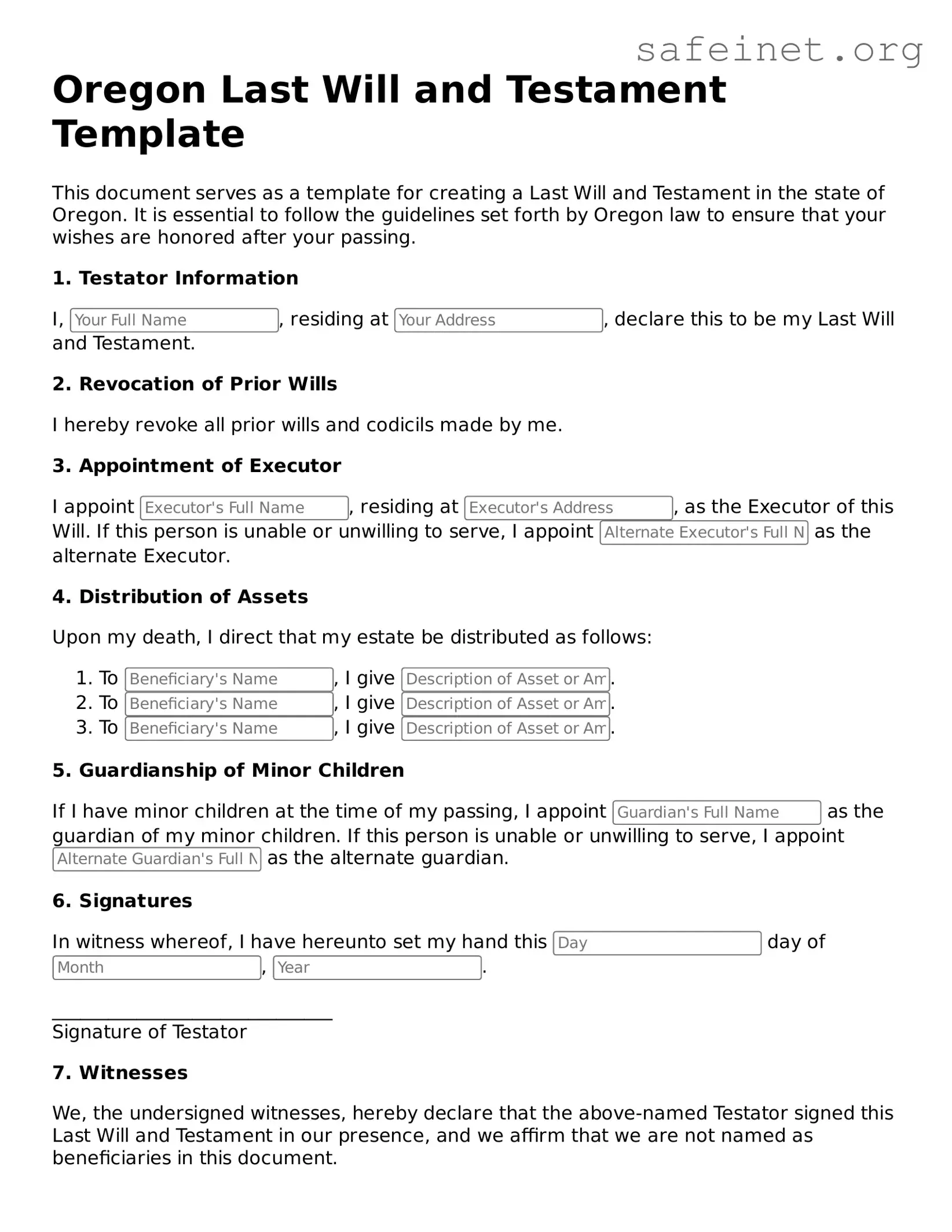
Oregon Last Will and Testament Template
This document serves as a template for creating a Last Will and Testament in the state of Oregon. It is essential to follow the guidelines set forth by Oregon law to ensure that your wishes are honored after your passing.
1. Testator Information
I, , residing at , declare this to be my Last Will and Testament.
2. Revocation of Prior Wills
I hereby revoke all prior wills and codicils made by me.
3. Appointment of Executor
I appoint , residing at , as the Executor of this Will. If this person is unable or unwilling to serve, I appoint as the alternate Executor.
4. Distribution of Assets
Upon my death, I direct that my estate be distributed as follows:
5. Guardianship of Minor Children
If I have minor children at the time of my passing, I appoint as the guardian of my minor children. If this person is unable or unwilling to serve, I appoint as the alternate guardian.
6. Signatures
In witness whereof, I have hereunto set my hand this day of , .
______________________________
Signature of Testator
7. Witnesses
We, the undersigned witnesses, hereby declare that the above-named Testator signed this Last Will and Testament in our presence, and we affirm that we are not named as beneficiaries in this document.
______________________________
Signature of Witness 1
Printed Name:
Address:
______________________________
Signature of Witness 2
Printed Name:
Address:
| Fact Name | Description |
|---|---|
| Legal Requirement | In Oregon, a Last Will and Testament must be in writing and signed by the testator to be valid. |
| Witnesses | The will must be signed in the presence of at least two witnesses who are not beneficiaries of the will. |
| Governing Law | The Oregon Revised Statutes, specifically ORS 112.235 to 112.265, govern the creation and execution of wills. |
| Revocation | A will can be revoked by a subsequent will or by physically destroying the original document with the intent to revoke. |
Filling out the Oregon Last Will and Testament form is an important step in ensuring your wishes are honored after you pass away. Once you have completed the form, it will need to be signed and witnessed according to Oregon law. This will help to make your will legally binding.
What is a Last Will and Testament in Oregon?
A Last Will and Testament is a legal document that outlines how you want your assets distributed after your death. It allows you to specify who will inherit your property and appoint guardians for any minor children. In Oregon, this document must meet certain requirements to be valid, including being signed by you and witnessed by at least two individuals who are not beneficiaries.
Who can create a Last Will and Testament in Oregon?
Any adult who is at least 18 years old and of sound mind can create a Last Will and Testament in Oregon. This means you should understand the nature of your decisions and the consequences of your will. If you are a minor or deemed incapacitated, you may not have the legal capacity to create a will.
Do I need a lawyer to make a will in Oregon?
No, you do not necessarily need a lawyer to create a will in Oregon. You can use a template or form to draft your will. However, consulting with a lawyer can help ensure that your will meets all legal requirements and accurately reflects your wishes, especially if your estate is complex.
What should I include in my Oregon Last Will and Testament?
In your will, you should include your personal information, a statement revoking any prior wills, details about how you want your assets distributed, and the names of your chosen executors. If you have minor children, you should also name guardians for them. Clear instructions can help prevent confusion and disputes among your loved ones.
Can I change my will after it is created?
Yes, you can change your will at any time while you are still alive. To make changes, you can either create a new will that revokes the old one or add a codicil, which is an amendment to your existing will. Make sure any changes are properly signed and witnessed to maintain their validity.
What happens if I die without a will in Oregon?
If you die without a will, your estate will be distributed according to Oregon's intestacy laws. This means the state will determine how your assets are divided, which may not align with your wishes. Your property could go to relatives you might not have chosen, and the court may appoint an administrator to manage your estate.
How do I ensure my will is valid in Oregon?
To ensure your will is valid, you must sign it in the presence of at least two witnesses who are not beneficiaries. These witnesses must also sign the will. Additionally, it is a good idea to date the document and keep it in a safe place. Consider discussing your will with your witnesses to confirm they understand your intentions.
Can I write my will by hand in Oregon?
Yes, you can write a handwritten will, known as a holographic will, in Oregon. However, it must be entirely in your handwriting and signed by you. While handwritten wills are legal, they can be more challenging to prove in court. It is often safer to use a typed will that meets all the formal requirements.
What should I do with my completed will?
Once you have completed your will, store it in a safe but accessible location. You may choose to keep it in a safe deposit box, with your attorney, or in a fireproof safe at home. Inform your executor and close family members where the will is located, so they can find it when needed.
Not signing the will in front of witnesses: In Oregon, a will must be signed in the presence of at least two witnesses. Failing to do so can lead to the will being deemed invalid.
Choosing witnesses who are beneficiaries: Selecting individuals who stand to gain from the will as witnesses can create conflicts of interest. This may result in legal challenges or the disqualification of those beneficiaries from receiving their inheritance.
Failing to date the will: A will should always be dated. Without a date, it may be difficult to determine which version of the will is the most recent, potentially leading to disputes among heirs.
Not being clear about the distribution of assets: Ambiguities in asset distribution can cause confusion and conflict among heirs. It is crucial to be specific about who receives what to avoid misunderstandings.
Neglecting to update the will: Life changes, such as marriage, divorce, or the birth of children, can affect one’s estate plan. Failing to update the will after significant life events may lead to unintended consequences.
Overlooking the need for a self-proving affidavit: While not required, including a self-proving affidavit can simplify the probate process. This document verifies the authenticity of the will and can expedite its acceptance in court.
When creating a Last Will and Testament in Oregon, several additional documents can complement this important legal instrument. Each of these documents serves a unique purpose, ensuring that your wishes are clearly communicated and legally binding. Below is a list of common forms and documents that are often used alongside a will.
Using these documents in conjunction with your Oregon Last Will and Testament can help provide clarity and peace of mind for you and your loved ones. Each document plays a vital role in ensuring your wishes are respected and that your affairs are handled according to your preferences.
The Oregon Last Will and Testament is similar to a Living Will. A Living Will outlines your wishes regarding medical treatment in case you become unable to communicate. While a Last Will deals with the distribution of your assets after death, a Living Will focuses on your healthcare preferences while you are still alive. Both documents serve to express your wishes and protect your rights, but they do so in different contexts.
Another document that shares similarities is a Durable Power of Attorney. This document allows you to appoint someone to make financial or legal decisions on your behalf if you become incapacitated. Like a Last Will, it is about planning for the future, ensuring that your wishes are honored even when you cannot speak for yourself. Both documents require careful consideration of whom you trust to act on your behalf.
The Oregon Advance Directive is also comparable. This document combines elements of a Living Will and a Durable Power of Attorney for healthcare. It allows you to specify your medical preferences and appoint someone to make healthcare decisions for you. Similar to a Last Will, it emphasizes your personal choices and provides guidance to your loved ones during challenging times.
A Trust, particularly a Revocable Living Trust, is another related document. A Trust allows you to manage your assets during your lifetime and specify how they should be distributed after your death. While a Last Will only takes effect after death, a Trust can help avoid probate and provide more immediate access to your assets. Both documents serve to protect your estate and ensure your wishes are followed.
The Codicil is a document that modifies an existing Last Will. If you want to make changes to your will without creating an entirely new document, a Codicil is the way to go. It allows you to add or remove provisions while keeping the original will intact. Both documents are essential for ensuring that your estate plan reflects your current wishes.
A Declaration of Guardian is another important document. This form allows you to name a guardian for your minor children in case something happens to you. Similar to a Last Will, it addresses your wishes for your loved ones and ensures they are cared for according to your preferences. Both documents are crucial for family planning and peace of mind.
Lastly, a Beneficiary Designation form is similar in that it determines who will receive specific assets, like life insurance or retirement accounts, upon your death. While a Last Will covers your entire estate, beneficiary designations take precedence for those particular assets. Both documents are vital for ensuring that your property goes to the right people, but they operate in slightly different ways.
When filling out the Oregon Last Will and Testament form, it's important to approach the process with care. Here’s a helpful list of things you should and shouldn’t do:
By following these guidelines, you can help ensure that your wishes are honored and that the process goes smoothly for your loved ones.
Understanding the Oregon Last Will and Testament form can be challenging due to several misconceptions. Here are five common misunderstandings:
Filling out the Oregon Last Will and Testament form is a significant step in ensuring that your wishes are honored after your passing. Here are some key takeaways to keep in mind:
By keeping these points in mind, you can navigate the process of creating an effective will that reflects your wishes and provides peace of mind for you and your loved ones.